Skip to content
DevMeme
5255 of 7435
Seniority is Not a Dress Code
Career HR Post #5763, on Dec 20, 2023 in TG

Seniority is Not a Dress Code

Why is this Career HR meme funny?

Level 1: Looks Can Be Deceiving

Imagine you see someone dressed up in a super fancy, frilly costume, and you assume they’re just a kid playing around. Then that person turns around and says they’ve been doing a very hard job for longer than you’ve been alive! 😲 It’s funny because it teaches the same lesson as “don’t judge a book by its cover.” Just because someone looks young or is wearing unusual clothes doesn’t mean they aren’t an expert. It’s like seeing your teacher show up to class in a silly outfit — at first you might think, “Who is this? They look too playful to be a teacher!” But then they start teaching and you realize, “Oh wow, they really know their stuff.” In short, the way someone dresses or looks can fool you, and the joke here is that the person everyone thought was just a goofy kid is actually the big boss of the tech team!

Level 2: Dress Code Irony

At first glance, this meme might seem confusing if you’re new to the tech scene. Let’s break down what’s happening and why it’s funny to people who work in software:

  • Tech Lead: In a development team, a Tech Lead is a senior engineer who guides the team’s technical direction. Think of this person as the captain of a coding team – they decide on which technologies to use, help solve the hardest problems, and mentor other developers. They’ve usually been coding for a long time and have earned a lot of respect. In the meme, when the character says “I am tech lead,” it means “I’m the senior technical boss here.” If someone has 23 years of experience in software development, it’s safe to say they’ve seen and done a lot – possibly coding since the late 1990s! That’s longer than some junior developers have been alive. So this is not just any engineer; it’s a very seasoned one who likely has deep knowledge of many systems.

  • 23 years of experience: To put “23 years” in perspective, imagine starting a job and doing it every year since before the year 2000 up to now. That’s what 23 years in tech means – this person possibly started programming back when people were fixing the Y2K bug, and has kept up all the way into today’s world of cloud computing and mobile apps. They probably wrote code before Google even existed and have adapted through generations of programming languages. For a newer developer, meeting someone with that much experience can be a bit awe-inspiring – they often become the go-to person for tricky questions. In our meme, it’s intentionally a big number to emphasize how wrong the onlooker’s assumption is.

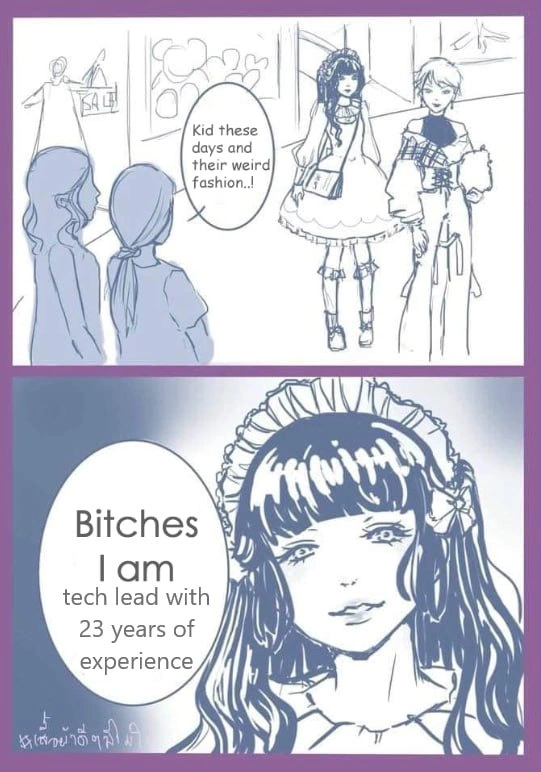
  • Appearance Bias: This is a term for when we judge people’s abilities or roles based on how they look. In regular life, it’s like assuming someone in a doctor’s coat is the doctor (often true) or someone with messy clothes isn’t responsible (often false!). In tech, appearance bias can show up when, say, a developer wearing a quirky T-shirt and jeans is not taken as seriously as someone in a blazer – even though the dress style tells you nothing about how well they code. The meme exaggerates this: the onlooker sees a person in a frilly, Gothic-style dress and immediately labels them a “kid” into “weird fashion,” assuming they can’t be a highly experienced professional. It’s highlighting a bias that sometimes happens unconsciously in workplaces: people might assume the young-looking, casually dressed person is a junior employee, not the boss. Here that bias is proven very wrong.

  • Dress Code in Tech vs. Corporate: A dress code is a set of rules about what you can or can’t wear in a workplace. In many traditional companies (banks, law firms), there’s an expectation to wear formal clothes like suits, or at least business casual attire. However, tech companies (especially startups and modern software firms) are famous for relaxed dress codes. It’s not uncommon for developers to come to work in T-shirts, hoodies, sneakers – basically whatever they feel comfortable in. Some companies explicitly say, “Wear whatever you want, we care about your work, not your outfit.” This meme takes that idea to an extreme case: the tech lead is wearing something very unconventional – a style you’d usually see maybe at a fashion show or an anime convention, not an office. The irony is that even though she’s dressed like a character out of a Gothic anime, she holds a serious leadership position in tech. It’s funny because it’s an unexpected mix of WorkplaceCulture elements: strict role vs. free-form clothing. It’s also a subtle nod that in tech, someone’s dress often doesn’t tell you how important or skilled they are. The “weird fashion” the onlooker comments on is actually gothic lolita fashion, which is indeed a real fashion subculture.

  • Gothic Lolita Fashion (and why it stands out): Gothic lolita is a style that started in Japan, where people (often young women, but not exclusively) dress in elaborate outfits inspired by Victorian-era dresses and rococo fashion, usually with a dark or “gothic” twist (think lots of black lace, ruffles, and elegant hats or bows). It’s the kind of look you might see at a cosplay event, a specialized fashion meetup, or on certain city streets known for alternative fashion (like Harajuku in Tokyo). It’s not at all typical office wear. Seeing someone in that attire walking around a mall (as drawn in the top panel) would definitely draw stares, especially from folks who aren’t familiar with it. In the comic, that’s why the onlookers say “kids these days and their weird fashion” – they assume it's just a trendy teenager making a bold fashion statement. They do not think, “Oh, that must be a senior engineer on her lunch break.” The humor comes when that assumption is overturned. For a new developer or anyone really, the lesson is that someone’s style (even an extreme style) doesn’t tell you their job or how good they are at it. Tech, especially, is full of people with eclectic tastes. Your teammate might show up in anything from a superhero hoodie to a full business suit -- it doesn’t correlate with their skill.

  • Ageism in Tech: This term refers to the prejudice or discrimination against someone based on their age, and tech has a bit of a reputation for favoring the young. You might hear about companies preferring “fresh grads” or that in Silicon Valley, being over 35 is considered “old” by some startup folks. Ageism_in_tech usually is talked about in the context of older developers having trouble getting hired or being assumed to be out of touch with new technology. In this meme, we see a twist on that theme: the tech lead likely is older (because 23 years of experience doesn’t usually come before your 40s), but because of her youthful fashion, people mistake her for a much younger, inexperienced person. It’s a form of age-related bias, but in this case the assumption of youth is what leads to underestimation. Essentially, people are thinking, “She dresses like a teenager, so she must be a newbie,” which is a wrong link between age appearance and competence. This is a good reminder in any workplace: sometimes the most seasoned expert might not look the way you expect. They might even seem younger in spirit or style than their peers – it doesn’t change the fact that they have a ton of knowledge.

  • Anime-Style Comic & Developer Meme Culture: The image itself is drawn like a scene from a manga (Japanese comic) or anime, with dramatic expressions and stylized characters. Many developers enjoy anime, gaming, and comics; these hobbies are common enough that references to them often appear in developer memes. By using this art style, the meme is playing on something familiar and fun for the tech community. It almost feels like a scene out of an anime where a character reveals their secret identity or power level. The bottom panel especially, with the close-up on the character’s face as she rebukes the onlookers, feels like a classic anime “big reveal” moment. This artistic choice makes the meme more engaging to a tech audience who might share those interests (it’s a bit of geek culture crossover). Plus, it adds to the humor because it exaggerates the moment of revelation – in realistic art it might not be as amusing, but in manga style it’s dramatic and cool.

For a junior developer just starting out, the takeaway of this meme is twofold. First, don’t judge your teammates or colleagues solely by how they look or dress. The quiet person in the corner in a cartoon hoodie might be the database wizard who can solve in seconds something that would take you days. The friendly woman in the gothic dress might be the one who architected the entire software platform you’re working on. In tech, expertise isn’t always obvious – you discover it by working with people, seeing their code, and hearing their insights, not by their fashion choices. Second, it highlights how tech industry culture is generally more relaxed about appearance than other fields. Many programmers express themselves freely through their clothes or style. As long as the work gets done, most teams don’t mind if you have pink hair, wear flip-flops, or, yes, even dress in Victorian-era goth attire. In fact, some companies celebrate this kind of diversity and personal expression as part of a creative, open work environment. It can actually be pretty fun – you might find “dress-up Fridays” or cosplay days at some tech companies! So the meme is also welcoming in a way: it says you can be yourself in this field, and being yourself might pleasantly surprise those who underestimate you.

Level 3: Lace & Legacy Code

In the tech world, appearances can be deceiving – and that’s exactly the punchline of this meme. We have a senior software engineer, a tech lead with 23 years of experience, striding through a public space in elaborate gothic lolita fashion. Two onlookers scoff from the sidelines:

Onlooker: “Kid these days and their weird fashion..!”

They see lace, ribbons, and frills and assume this must be some eccentric youngster with no real chops. This setup taps into a classic appearance bias – judging someone’s professional ability by their outward look. It’s a scenario many seasoned devs know too well: the battle-scarred veteran gets mistaken for an intern just because they don’t fit the stuffy corporate mold.

Then comes the plot twist, delivered in true dramatic manga style. The second panel zooms in on our fashionable engineer’s face as they drop a one-liner mic drop:

Tech Lead: “Bitches I am tech lead with 23 years of experience.”

That blunt retort shatters the stereotype in one go. It’s DeveloperHumor gold – the absurd mismatch between WorkplaceCulture assumptions and reality. The humor lands because it flips a common tech industry experience on its head. Usually, it’s the older suit-and-tie manager underestimating the hoodie-wearing coder; here it’s onlookers writing off a senior engineer as some “weird kid,” only to find out this “kid” probably architected the systems they use. The dress_code_irony is delicious: decades of SeniorEngineerLife hidden under layers of velvet and lace.

This meme resonates especially with experienced devs because it compresses a bunch of insider truths into one scene:

  • Authority isn’t always obvious: In many dev teams, the person with the most power or knowledge might be the one dressed most casually (or quirkiest). Ever seen a principal engineer in a Star Wars tee and sandals? Or a database guru with neon hair and tattoos? The Senior vs Junior Developers dynamic often defies traditional CorporateCulture expectations. Here the tech lead’s extravagant style hides the fact that they probably reviewed the code for half the company’s core libraries.
  • Age and experience aren’t on the sleeve: With 23 years in tech, this engineer likely started coding when dial-up internet was king. They’ve survived everything from the Y2K scare to the rise and fall of countless frameworks. They’ve wrangled legacy COBOL, refactored monoliths, deployed to the cloud, and debugged 3 AM outages. That kind of experience doesn’t always manifest as grey hair and business suits – sometimes it’s a confident attitude and zero concern for conforming. As a wry inside joke, “I have t-shirts older than you” is almost literally true for them (except in this case it might be a frilly blouse from a 2000 anime con).
  • Rebellion in tech culture: The tech_lead in the meme is a walking contrast to the buttoned-up manager stereotype. This is a nod to real DeveloperCulture, where many developers pride themselves on comfortable or unconventional attire. The tech industry largely doesn’t do dress codes – some of the most brilliant engineers come to work in hoodies, cosplay outfits, or goth attire and nobody bats an eye if they deliver results. In fact, thumbing one’s nose at strict dress norms is practically a badge of honor in some startup circles. Here the dress code irony is cranked up to eleven – a gothic_lolita ensemble that would turn heads anywhere, yet the wearer has the gravitas of a senior technical leader. It’s like saying: “I’m so good at my job, I can lead your sprint planning in a Victorian ball gown and still crush it.”
  • Shared trauma and satisfaction: There’s a bit of catharsis here for anyone who’s been underestimated. It’s not uncommon for a senior dev who looks young (or just doesn’t look like the clichéd idea of an “engineer”) to be talked down to by recruiters or newer colleagues. That feeling when you get to correct their mistake? Priceless. The meme’s spicy comeback (“Bitches, I’m the tech lead…”) is the fantasy of every undersung senior who’s had to quietly prove themselves. It’s a relatable humor moment: we’ve either been that dev or seen it happen. The bold choice of words adds a DeveloperMemes flair – it’s exaggerated for comic effect, much like an over-the-top anime dialogue, reflecting the frustration and sass in one go. (The explicit language, while playful here, conveys the character’s confidence and exasperation: they’re seasoned enough not to care about a polite corporate response.)

Under the hood, this scene also challenges some deeper industry issues like ageism_in_tech and superficial judgments. In tech, ageism often means folks assume older engineers can’t keep up with trends. But flip it around and you see another bias: assuming someone in youthful clothes must be a newbie. It’s a reminder that skill in software isn’t skin-deep. The best coder in the meeting might be the one in ripped jeans, or a kawaii dress – and they might also be the only one who knows how to recover the production database when things go south. As the saying goes, “On the internet, nobody knows you’re a dog” – and in the office, nobody knows your expertise just from looks. You have to actually talk to them (or read their code) to find out. This meme humorously compresses that lesson into one visual gag.

Finally, the choice of an anime_style_comic format is no accident. A lot of developers grew up on anime, gaming, and alternative subcultures – it’s a common thread in many DeveloperCulture circles. By using a blue-tinted manga style with dramatic zoom, the meme speaks in a visual language the target audience finds nostalgic and funny. The dramatic close-up of the lolita-dressed character’s determined face is straight out of a shounen anime reveal scene (“Ultimate power unlocked!”). It amplifies the shock value: the onlookers (and the reader) realize in that moment this character isn’t who they assumed. For a seasoned developer reader, it’s both hilarious and a bit triumphant – a celebration of the fact that engineering chops aren’t visible on the surface. The “goth tech lead” is essentially saying: “Judge me by my code and experience, not by my wardrobe.” And in a field that often values meritocracy (at least idealistically), that message hits home with a grin.

Description

A two-panel comic meme drawn in a sketchy, blue-and-purple-toned anime/manga style. The top panel depicts two conventionally dressed individuals from behind, looking at two others with elaborate, alternative fashion. A speech bubble from one of the onlookers reads, 'Kid these days and their weird fashion..!'. In the bottom panel, the perspective shifts to a close-up of one of the uniquely dressed individuals, who has long, dark hair and is wearing a frilly, gothic-lolita style outfit. They look directly at the viewer with a confident expression, and a large speech bubble next to them declares, 'Bitches I am tech lead with 23 years of experience'. The humor subverts the initial judgment, directly challenging the stereotype that technical seniority correlates with a specific, conventional appearance. It highlights the flawed assumption that alternative fashion is exclusively for the young or inexperienced, asserting that deep expertise and personal style are entirely unrelated

Comments

15
Anonymous ★ Top Pick After 23 years of experience, you've earned the right to compile your code and your outfit with whatever flags you want
  1. Anonymous ★ Top Pick

    After 23 years of experience, you've earned the right to compile your code and your outfit with whatever flags you want

  2. Anonymous

    Laugh at the lace if you like - the real gothic masterpiece is the pre-Y2K monolith I still shepherd through every quarterly “lift-and-shift” pitch

  3. Anonymous

    After 23 years in tech, you've earned the right to conduct architecture reviews dressed as your favorite anime character - the real power move is making junior devs explain their O(n²) algorithms while you're wearing cat ears and maintaining perfect deadpan authority

  4. Anonymous

    When you've been debugging production incidents since before React was invented, you've earned the right to wear whatever the hell you want to standup. That tech lead has probably migrated more legacy systems than those observers have had hot deployments - and did it all while maintaining impeccable frills-per-line-of-code ratio

  5. Anonymous

    23 YOE: wardrobe with more backward compatibility than your legacy monolith

  6. Anonymous

    Judge the lace all you want - git blame and PagerDuty history show they shipped your core service before your cloud account existed

  7. Anonymous

    Say “kids these days” all you want - git blame says they’ve owned your PagerDuty weekends since CVS

  8. @callofvoid0 2y

    only if you add up your mom's experience

    1. @paul_thunder 2y

      he/she can be 40 years old.

      1. @callofvoid0 2y

        or less doesn't matter

    2. @SamsonovAnton 2y

      * all the JS frameworks lifetime

    3. @Araalith 2y

      One year of Lisp, Ruby, Lua and other BS languages counts as two.

  9. @gonzoops 2y

    Literally me. But 35 yo and 17 years of exp. Dressed like a man, but totally crazy.

  10. @callofvoid0 2y

    17 ?

  11. @bodiany4 2y

    Literally me(except 23 years experience team lead)

Use J and K for navigation