Court instructs Apple and Google to block X app with anti-VPN tricks
Why is this Apple meme funny?
Level 1: No Secret Passages
Imagine a teacher decides a certain comic book is bad and tells the school librarian to take it off the shelves so kids can’t read it. That’s like Apple or Google removing an app from their store – nobody can easily get it anymore. Now imagine the teacher also says: “And if any kid already has that comic or finds it somewhere else, let’s also lock all the secret doors and tunnels so they absolutely can’t sneak in to read it!” That second part is like the anti-VPN measure – blocking any sneaky way of accessing the app. It’s an extra lock on the system. In our story, it’s as if the school was going to not just ban the book, but also seal off every hidden reading spot. In the end, the teacher changes their mind about the secret doors, saying “okay, we won’t lock those, that’s too much.” The whole situation is a bit wild: it’s both serious and a little like a cartoon villain plan. It’s funny in a “wow, they really tried that?!” way and also scary because it shows how far someone in charge was willing to go. The core idea is about blocking something completely – first the normal way, and then even the secret way – and that’s why people in tech found this story amazing and troubling at the same time.
Level 2: Gatekeepers Under Orders
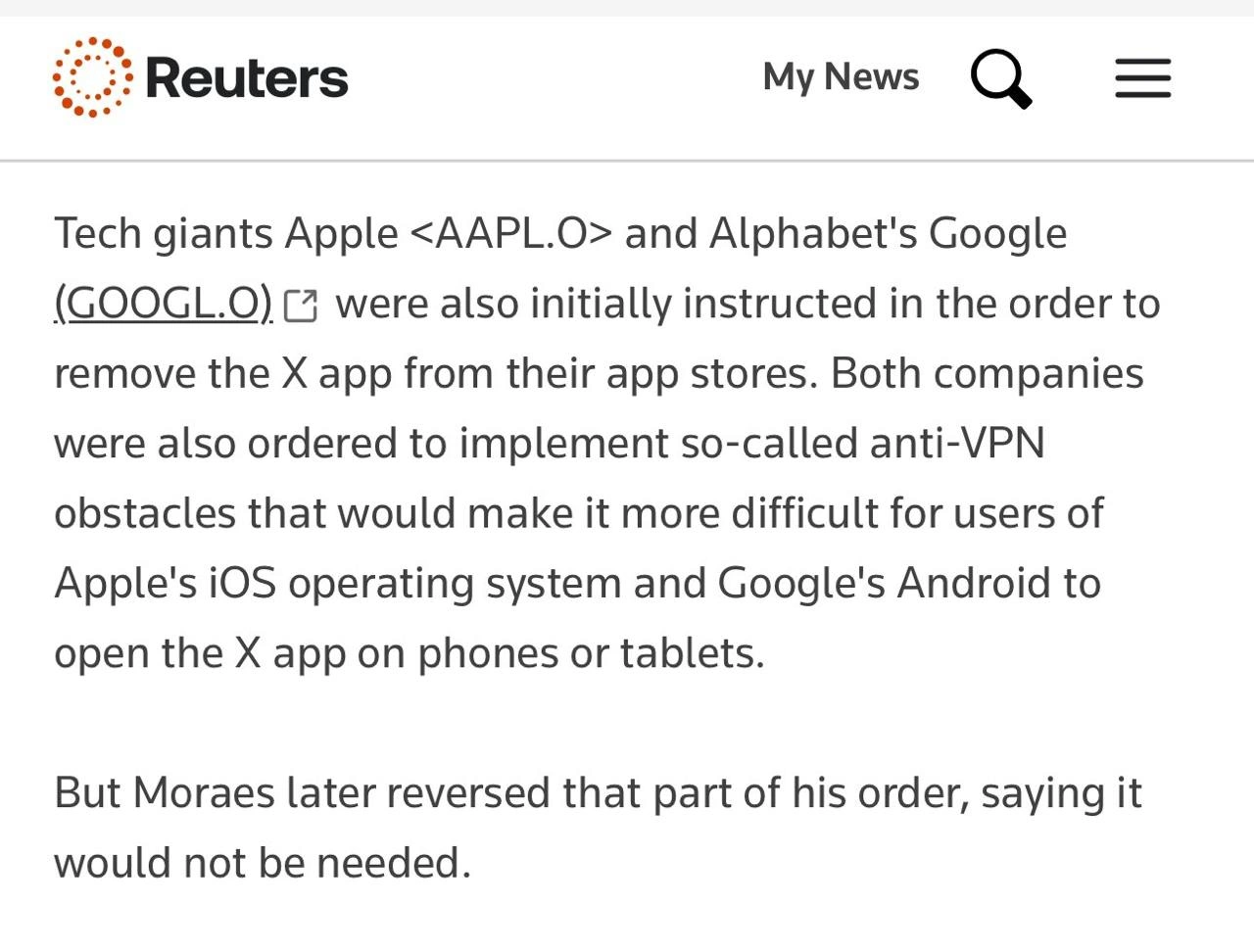
Let’s break down what’s happening in that screenshot for those newer to MobileDevelopment and tech policy. Apple and Google operate the two major mobile app stores (the Apple App Store for iOS devices like iPhones, and Google Play Store for Android phones/tablets). They are often called gatekeepers because they control which apps are available for download on their platforms. If an app is "removed from the app store," it means new users can’t install it and it’s harder for existing users to get updates (on iPhones, it’s essentially gone unless you already have it). The “X app” refers to the social network app formerly known as Twitter (rebranded as X by Elon Musk). Now, a court order instructed Apple and Google to remove this X app from their stores – basically a legal mandate to deplatform the app, likely because authorities felt the app was violating laws or spreading something harmful. That alone is a big deal: it’s an example of government_censorship_orders or regulatory action forcing private companies to block content. But the order went even further: it told Apple and Google to implement “anti-VPN obstacles” to make it harder for users to open X on their devices.
What’s a VPN? It stands for Virtual Private Network – essentially a secure encrypted tunnel for your internet traffic. People use VPNs for privacy or to bypass regional restrictions. For example, if a certain app or website is blocked in your country, connecting through a VPN might let you appear as if you’re browsing from another country where it’s not blocked. It’s a common trick to get around censorship or content blocks. So when the order talks about anti-VPN obstacles, it means the court didn’t just want the app gone from the store; they also wanted to stop people who already had the app (or found another way to install it) from using clever network tricks like VPNs to make it work. In practical terms, that is very unusual – neither iOS nor Android is designed to randomly block a specific app from working based on network conditions. Both operating systems generally treat VPN connections as just another network interface. There’s no simple switch like “if user is on a VPN, prevent app X from opening.” This would require deeper intervention in the phone’s operating system or settings. For instance, Apple might have to push an update or policy to iPhones saying “don’t let the X app connect to the internet if a VPN is active” – something completely off-menu for normal operations. Google on Android could theoretically do something similar via Play Services or an OS update, but again, this is cross_platform_policy engineering – coordinating a block across two very different OS architectures. It’s MobileDev meets high-stakes policy: mobile developers usually worry about their apps following App Store guidelines or Play Store policies (so they don’t get removed), but here we have an external legal order adding a new rule out of thin air.
To put it simply, the court wanted to deplatform X at the store level and cut off any loopholes. Think of Apple and Google being asked to be not just gatekeepers, but also bouncers and wall-builders: toss X out of the front door, and brick up any back door (like VPN tunnels) that users might use to get X back in. That’s why tech folks found this notable. It’s also why the judge, Moraes, later reversed that part about VPN obstacles – it was kind of extreme and apparently “not needed” in the end (maybe the situation changed or cooler heads prevailed). For someone early in tech, it’s a lesson in how corporate policy and government demands can collide. Companies like Apple and Google design operating systems with certain freedoms (like letting you use a VPN for security and freedom online), but they also must follow laws where they operate. Usually, removing an app is as far as it goes. This time they nearly went a step beyond, highlighting the power and precarious position of those gatekeepers.
Level 3: The Great App Firewall
This meme spotlights a senior engineer’s nightmare: being voluntold to turn your platform into a censorship tool overnight. The Reuters screenshot describes how a court initially ordered Apple and Google to not only yank the "X app" (formerly Twitter) from their app stores, but also to somehow prevent users from accessing it via VPNs on iOS and Android. In other words, “Please convert your carefully maintained walled gardens into armed fortresses – block the main gate and fill in any secret tunnels people might use.” This combo of app store deplatforming + network-level lockdown is jaw-dropping. It’s like an app_store_deplatforming on steroids. We’ve seen apps removed from stores before (remember when Parler got booted by both stores for content moderation failures?), but instructing OS makers to also cripple a generic networking feature (VPN) crosses into unprecedented territory. VPNs are a lifeline for users under any kind of network restriction – developers and power-users alike know that firing up a VPN is the classic workaround for region locks or censorship. The humor (tinged with dread) comes from the absurdity of the demand: imagine being an Apple engineer reading that court order. Implementing anti_vpn_compliance measures likely caused some “you’ve gotta be kidding me” eye-rolls in Cupertino and Mountain View. It implies altering fundamental OS behavior – effectively creating a device-level Great App Firewall. The shared industry trauma here is the tension between government_censorship_orders and platform policies. Tech giants are used to being gatekeepers (deciding which apps get on the store), but being ordered to police how users network on a device is next-level. It reminds senior devs of other times politics and tech clashed: Google pulling out of China in 2010 over censorship demands, or Apple reluctantly removing VPN apps from the Chinese App Store in 2017 to comply with local laws. Those were painful choices, but at least they were implemented at the store/service level. This? It’s asking devs to booby-trap their own OS just to stop one pesky social media app. One can almost hear a sarcastic senior voice: “Sure, Your Honor, we’ll just re-engineer our entire TCP/IP stack by Friday to sniff out and block the X app traffic. Maybe throw in a free unicorn while we’re at it.” The fact that Judge Moraes later walked back the anti-VPN part suggests someone realized the overreach. Perhaps Apple and Google’s legal teams pushed back hard, or the immediate crisis (likely involving X_app spreading something the court didn’t like) was averted by simpler means. Still, the meme’s not exactly a knee-slapper; it’s more of a dark chuckle of recognition among devs and tech policy folks. It highlights how those pristine corporate policy documents and platform rules can be bent under political pressure, and how engineers often find themselves in the crossfire of cross_platform_policy battles. For seasoned developers, it’s a sobering “Not lol anymore” moment – a real-life example of how far a system might be twisted, and why broad technical knowledge (from mobile OS internals to network protocols) suddenly matters outside the lab, in courts and headlines.
Level 4: Tunneling Under Siege
At the deepest technical layer, this scenario hints at a battle between encrypted tunnels and platform control. A VPN (Virtual Private Network) creates an encrypted tunnel for internet traffic, essentially wrapping data packets in a secure envelope. Normally, neither your ISP nor your operating system can see what you're accessing inside that tunnel; they just see gibberish going to some server. To comply with an anti-VPN directive, Apple’s iOS or Google’s Android would have to perform deep packet inspection (DPI) or implement OS-level filtering rules to detect and block these encrypted tunnels. This is non-trivial: detecting a VPN often means identifying telltale patterns or handshakes (for example, the TLS signature of an OpenVPN or the packet timing of an IPsec tunnel). It’s an arms race reminiscent of the Great Firewall of China, which famously employs advanced DPI to block VPNs and Tor traffic. For a court to ask OS vendors to bake in similar censorship at the packet level is basically asking every phone to become a miniature Great Firewall. From a systems perspective, this raises fundamental questions: Where do you implement the block? In the kernel’s networking stack via a quick iptables rule or a patched networking extension? At the DNS resolver level by poisoning domain lookups for the X app’s servers? Or perhaps by revoking the app’s cryptographic signatures so it fails to launch? Each approach intersects with low-level OS design. For example, iOS could theoretically push a silent config update revoking the code signature or blocking specific network calls for the X app; Android, more openly, could use its VPN API knowledge (since Android knows when a VPN service is active via VpnService). But all these methods have pitfalls: the OS might accidentally overreach and block legitimate traffic (since a VPN’s encrypted stream might look like your bank’s encrypted app traffic). There’s a whiff of formal verification-like difficulty here – how to precisely target “X app via VPN” traffic without false positives? In theoretical terms, it’s akin to solving a specialized classification problem on encrypted data, which veers into research territory of distinguishing encrypted flows without decrypting them. It’s a daunting technical demand to make of Apple and Google, especially on short notice. Little wonder Judge Moraes later reversed this part; perhaps someone explained that implementing “so-called anti-VPN obstacles” might involve breaking or weakening encryption itself – a can of worms touching everything from user privacy to the mathematics of cryptography. In short, this request went deep into the weeds of networking and OS internals, practically undermining decades of security principles for a quick censorship fix.
// Hypothetical pseudo-code for iOS kernel handling anti-VPN (satirical)
if process.name == "XApp" && network.isUsingVPN {
// Brutally terminate connection
dropAllPackets(to: XApp.servers)
print("VPN connection for X app blocked by court order.")
}
// (Because obviously, detecting any and all VPN usage reliably is super easy... *sarcasm*)
Description
The image is a Reuters article screenshot. A white header bar shows the orange dotted Reuters logo on the left, with "My News" text, a magnifying-glass search icon, and a hamburger menu on the right. Below, the article text reads: "Tech giants Apple <AAPL.O> and Alphabet's Google (GOOGL.O) were also initially instructed in the order to remove the X app from their app stores. Both companies were also ordered to implement so-called anti-VPN obstacles that would make it more difficult for users of Apple's iOS operating system and Google's Android to open the X app on phones or tablets. But Moraes later reversed that part of his order, saying it would not be needed." Visually, it’s plain black text on a white background, typical of Reuters’ mobile site. Technically, it highlights platform-level gatekeeping, app-store governance, and the tension between operating-system APIs (iOS and Android) and network-layer workarounds like VPN tunnels
Comments
9Comment deleted
No problem - just ask Apple and Google to drop every packet that originates from a tun0 interface. What could possibly break besides half the remote-debugging setups on the planet?
When you've spent years building sophisticated VPN detection algorithms only to have the judge hit Ctrl+Z on the requirement - that's what we call 'eventual consistency' in regulatory compliance
When your deployment rollback happens faster than your CI/CD pipeline can say 'production incident' - even Supreme Court justices understand the value of a quick revert. Though I'm sure the engineering teams at Apple and Google appreciated not having to implement DPI-based VPN detection across billions of devices just to play whack-a-mole with determined users armed with Wireguard configs
Regulators bypassing CI/CD to deploy compliance straight to app store prod - no tests, instant rollback
Nothing like a court-ordered 'anti‑VPN obstacle' to convert your network stack into a compliance feature flag - aka intentional packet loss as a service
Feature request: 'Block X by breaking VPN on iOS/Android'; tradeoff: 'Also break every enterprise’s remote access and App Store guidelines'; resolution: 'Won’t fix after court reversal'
I mean, after Elona bought Twitter (X), it became a home of bots (especially, Russian) and far-right and far-left freaks, like Jackson Hinkle, for example. So, adequate people is not going to miss this parody of a social network :) Comment deleted
Reddit's better, right ;) Comment deleted
It's time to install Linage OS on your androids, folks Comment deleted