Corporate Doublespeak: Our Features vs. Their Sins
Why is this CorporateCulture meme funny?
Level 1: Same Stuff, Different Labels
Imagine two kids at the beach who each built a sandcastle. One kid proudly says, “My sandcastle is a magnificent palace!” but points at the other’s and sneers, “That sandcastle is just a ugly pile of dirt.” Now here’s the funny thing: both sandcastles are made of the same wet sand, about the same size, and decorated with the same shells. To any onlooker, they actually look pretty similar. But each kid only has nice words for their own castle and mean words for their friend’s castle.
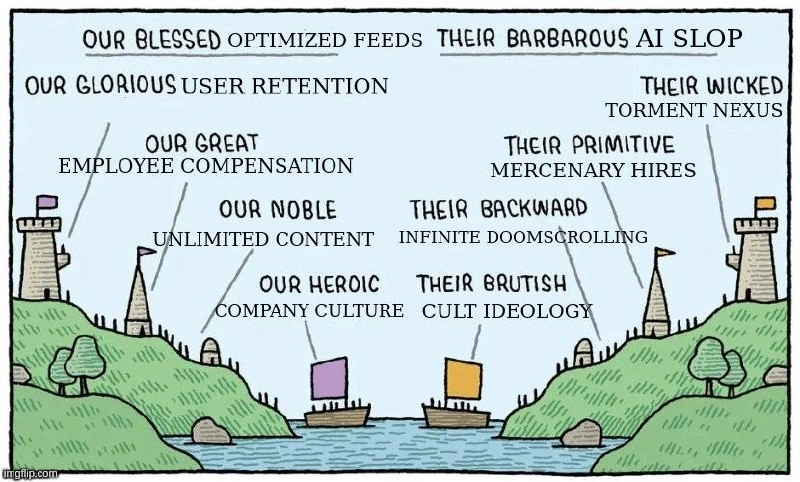
This meme is like that. It’s showing two groups (two tech companies) doing basically the same thing – like giving people an endless stack of videos or posts to look at, and bragging about how great their workplace is – but each group acts like they’re heroes and the other group is awful. It’s a joke about hypocrisy: when you praise yourself for something and criticize someone else for that very same thing. We find it funny (and a bit silly) because the two sides are separated by just a tiny river in the cartoon, meaning there’s not much difference between them. It’s as if those kids’ sandcastles are right next to each other at the edge of the same small stream. They’re practically in the same spot, yet each kid is acting like, “Mine is awesome and yours stinks!”
So, in simple terms, the meme is poking fun at how people or companies sometimes call the same bowl of food “yummy soup” when it’s theirs, and “gross slop” when it’s someone else’s. It reminds us of the childish side of big companies: even grown-ups in charge of huge tech firms can behave like kids saying “I’m good, you’re bad,” even when they’re both doing the same thing. That’s why it’s humorous – we recognize that the two sides are mirror images, but they refuse to admit it.
Level 2: Bait and Scroll: Engagement Tricks
Let’s break down what’s going on in this meme in plain terms. It’s contrasting how a company describes its own product features versus how it describes a rival’s similar features. Both sides actually have the same kinds of features, especially around their feeds and how they keep users hooked, but they use very different words depending on who they’re talking about. Here are the key phrases and concepts:
Optimized Feeds: This refers to the content feed you see in an app (like a social media news feed or video feed) that is curated by an algorithm. “Optimized” means the company’s AI/ML algorithms are deciding what posts or videos to show you, supposedly to give you a better, more personalized experience. In reality, these algorithms are tuned to boost engagement – they learn what keeps you scrolling and show you more of that. When the left castle brags about “our blessed optimized feeds,” they’re using a positive spin, suggesting their feed is a high-tech blessing that gives users exactly what they want.
AI Slop: Now, this is the insulting term the right castle uses for essentially the same thing – the algorithmic feed. Calling it “slop” implies the content is junk, like pig slop, just mindlessly shoveled at users by some AI. It’s a derogatory way to say the competitor’s feed is low-quality or manipulative. Both “optimized feed” and “AI slop” likely refer to the same type of algorithmic content recommendation system. The difference is purely branding: one company’s proud feature is another company’s crappy gimmick.
User Retention: This is a big one in tech. User retention means keeping users on your platform for longer and getting them to come back often. It’s measured in metrics like daily active users, session length, or return rate. Companies love high retention because it usually means people find the product engaging (and it often leads to more ad views or revenue). The left side calls their ability to retain users “our glorious user retention,” like it’s a grand achievement. They frame it as we’re so good at serving users that they stick around (gloriously).
Torment Nexus: This bizarre phrase on the right side is used to mock the left’s user retention tactics. A “torment nexus” sounds like an evil machine or trap – it implies that the app is trapping users in a cycle of torment (like they can’t escape the feed, even if it’s bad for them). This term actually originates from an internet joke about a fictional technology that should never be built, but it’s used here to label the competitor’s high user retention as something basically sinister. In essence, the rival is saying: They’re not retaining users because of quality, they’re capturing users in a torment nexus. It’s an extreme way to accuse the other company of using dark patterns (deceptive design tricks) to keep people hooked.
Employee Compensation vs Mercenary Hires: “Employee compensation” means how much a company pays its employees (salary, benefits, etc.). The left castle proudly says “our great employee compensation,” implying we pay our people well and take care of them. Companies often boast about this to attract talent and show they value employees. The right castle twists this by saying the competitor just has “mercenary hires.” A mercenary is literally a soldier for hire – someone who will join any side for the right price. Calling employees “mercenary hires” implies they’re only there for the money and have no loyalty or passion. So when the rival uses that term, they’re suggesting: Sure, they pay a lot, but their employees don’t really care; they’re just in it for cash. Meanwhile, that rival would say their own high salaries are justified and their employees are talented and dedicated. It’s two ways of looking at the same practice of offering big paychecks: one positive (great compensation attracting the best people) and one negative (money mercenaries with no true team spirit).
Unlimited Content vs Infinite Doomscrolling: Both of these refer to the never-ending stream of posts or videos on modern platforms. “Unlimited content” is how a company would positively frame the fact that you can scroll endlessly and always find something new. It sounds great – you’ll never be bored, there’s limitless stuff to enjoy! This often involves features like infinite scroll, where new content loads continuously as you scroll down, instead of stopping after a page. Now, “infinite doomscrolling” is the critical way to describe that exact situation. Doomscrolling is a term coined to describe the act of endlessly scrolling through news or social media, even if it makes you feel anxious, depressed, or just bleary-eyed. Adding “infinite” just stresses that it never stops. So the right castle is saying: Their “unlimited content” isn’t a feature, it’s a bug – it leads people to endlessly scroll to their own detriment. It implies the design is a dark pattern intentionally making it hard to stop, so users get sucked into a time sink. In short: one side calls it giving users endless choice, the other calls it hooking users like an addiction.
Company Culture vs Cult Ideology: “Company culture” is the term for a company’s values, norms, and environment. Companies love to talk about their culture – for example, “Our company culture is innovative, inclusive, and mission-driven!” It’s generally seen as a positive thing, the personality of the company that makes employees proud and motivated. The left castle’s banner “our heroic company culture” suggests they view their culture as something epic and admirable – heroic, even. Now, the right castle spits that back as “their brutish cult ideology.” Calling a company a cult is a harsh critique: it means you think their culture is more like brainwashing or a fanatical religion than a healthy workplace. Cult ideology implies the employees drank the Kool-Aid, i.e., they follow the company mission blindly, maybe tolerating crazy hours or odd rules because they’re so indoctrinated. So what one side calls strong, positive culture, the other side dismisses as creepy cult-like behavior. This mimics how, in tech rivalries, each company might claim we have the true great culture while hinting that competitors are run like cults or have toxic groupthink.
All these contrasting terms highlight a phenomenon often seen in marketing vs reality spin. It’s basically two sides describing the same practices with opposite words. The left side’s terms are glowing and positive (blessed, glorious, great, noble, heroic), whereas the right side’s terms are negative and insulting (barbarous, wicked, primitive, backward, brutish). The meme is showing that in the tech industry (and really any industry), companies often rebrand identical features or outcomes depending on whether it’s theirs or someone else’s. Our use of AI is cutting-edge and customer-centric; their use of AI is crude and dangerous. Our endless feed empowers users; their endless feed exploits users. The thin strip of water between the castles in the cartoon symbolizes how little actually separates these two camps.
For a junior developer or someone new to tech, the message here is an introduction to tech cynicism: Be aware that terms like “optimized feed” are buzzwords that might obscure the reality of infinite scroll dark patterns and engagement hacking. When you hear a company tout their user metrics or culture, remember that competitors likely have the same things and might frame it very differently. Essentially, it’s a lesson in reading through the PR language. The meme uses humor to show that one person’s AI breakthrough can be another person’s AI hype or even AI horror (“slop”/“torment nexus”), depending on perspective.
And yes – the castle meme format here is a known comic style to depict two sides yelling at each other with banners. It visually sets up a confrontational ours vs theirs scenario. Each castle even has a little boat with its flag (purple on the left, yellow on the right) as if they occasionally send envoys or attacks across the water. The absurdity is that the water is so small – they’re practically standing across a creek – meaning they are very close in reality. This drives home the joke: these companies are super alike, but you’d never know it from how they talk about each other.
In summary, this meme is explaining in a funny way how tech companies engage in “tech double-speak.” They have the same engagement-focused features (born from similar social_media_engagement strategies and perhaps even the same AI/ML tools), but each company’s marketing will glorify their own and vilify the rival’s. It’s a cautionary chuckle: things aren’t always as they’re branded. As a newcomer in tech, it’s good to recognize these patterns – it will help you understand the context behind corporate claims and maybe even design choices you’ll encounter (like why every app seemingly wants you scrolling forever).
Level 3: Double-Speak at Scale
For the seasoned developer or tech insider, this meme reeks of pot calling the kettle black on an industrial scale. It’s a satire of CorporateCulture where every tech company markets its own engagement tactics as if they were noble innovations, while slamming the exact same tactics from competitors as immoral or lowbrow. The two castles with their banners are basically mirror images – a marketing vs reality face-off where both sides are guilty of the same behavior. The left castle trumpets things like “OUR glorious user retention” and “OUR noble unlimited content” – these are the rosy terms companies use in press releases and all-hands meetings. It’s the familiar corporate double-speak: we’re not addicting users, we’re just providing unlimited content for their enjoyment! Meanwhile, the right castle’s banners flip the script, calling those same features “infinite doomscrolling” and a “wicked torment nexus.” That’s exactly how rivals and critics describe those engagement mechanics: they trapped users in an endless, mind-numbing scroll for profit! The humor is that both castles engage in the same behavior but each pretends to wear a white hat while painting the other as a villain.
Anyone who’s sat through a few quarterly reports or all-hands meetings will chuckle at the IndustryIrony here. One quarter, your company might boast about boosting user retention with a new AI-powered feed. The next, you’re casually implying that a competitor’s AI-curated feed is “low-quality slop” degrading society. It’s classic tech marketing glass-house behavior – throwing stones while living in a fragile glass castle. Senior engineers have seen this with features like algorithmic timelines: Remember when one social platform swore that chronological feeds were morally superior, until they quietly rolled out their own algorithmic feed once growth stalled? 😏 Or how every social app adopted infinite scroll; internally it’s hailed as a UX improvement and engagement win, but externally they’ll claim “We give users endless possibilities,” while competitors “hook users in endless doomscroll.” This meme nails that hypocrisy.
Each pair of banners is dripping with satire that a tech insider can appreciate:
- “Our Blessed Optimized Feeds” vs “Their Barbarous AI Slop”: Both refer to essentially the same AI-driven recommendation engine. Inside the company, it’s our secret sauce personalization engine blessed by data science. Talking about the other company, suddenly it’s that garbage algorithm churning out clickbait. This evokes the recent AI hype vs reality dynamic: companies praise their AI as revolutionary, but call others’ AI output derivative slop.
- “Our Glorious User Retention” vs “Their Wicked Torment Nexus”: User retention is the golden metric of every ad-driven platform – something growth teams celebrate (glorious revenue graphs!). But phrase it differently and it sounds downright evil: a torment nexus trapping users. The term Torment Nexus comes from a satirical sci-fi reference, basically a nightmare machine that no one should build… except tech companies actually do in pursuit of engagement. It’s a dark joke: one company’s growth hack is another’s moral failing.
- “Our Great Employee Compensation” vs “Their Primitive Mercenary Hires”: This hits on culture wars in tech recruiting. Company A will brag they pay top-of-market salaries (great compensation!). Company B snidely remarks that A’s employees are just mercenaries with no loyalty, only in it for the money. Meanwhile B will say their generous pay is to reward talent while A’s high pay is just throwing money at “hired guns.” It’s a hilarious double standard that those of us who’ve switched jobs recognize – every company claims we have a superior mission, others just poach with cash.
- “Our Noble Unlimited Content” vs “Their Backward Infinite Doomscrolling”: Internally, unlimited content is spun as a noble offering – look at all the information and entertainment at your fingertips! Externally, the same infinite feed is blasted as backward, exploitative doomscrolling – a dark pattern that glues users to the screen consuming an endless, often depressing feed. This pair especially hits home for developers who have built these features knowing they create addictive UX loops. Both castles have the same infinite scroll mechanism, but the PR framing flips depending on whose product it is.
- “Our Heroic Company Culture” vs “Their Brutish Cult Ideology”: Internally, every big tech firm loves to mythologize its company culture – we have a heroic mission, a bold culture of innovation, rah rah! But competitors or ex-employees may deride that as cult-like behavior. We’ve all heard the jokes comparing fanatical startup environments or trillion-dollar company loyalty to a cult ideology. When it’s your company, it’s team spirit; when it’s the other guys, they’ve drunk the Kool-Aid. The meme’s castle banners capture that perfectly.
What makes this funny (and a bit painfully true) is the thin divide between “us” and “them.” The cartoon shows just a small channel of water between the two fortresses – they’re practically neighbors, just painted different colors (note the purple boat vs the yellow boat). It emphasizes that tech firms are more alike than they’d ever admit. They all sail the same waters of social_media_engagement tactics and user_retention_metrics, yet each pretends to be on a righteous island while the others are pirates. This is TechSatire 101: highlighting how competitors engage in tech double-speak to appear morally superior, even as they copy each other’s dark patterns.
A senior dev reading this might recall late-night deployment discussions or on-call rotations where these very issues come up. (“Are we really improving user experience, or just increasing ad impressions?” 😬). The meme is essentially calling out the collective cognitive dissonance. Sure, each team pats themselves on the back for engagement numbers and AI/ML breakthroughs in their feed algorithm. But when looking at the competition, suddenly those same breakthroughs are framed as creepy manipulation. It’s a glass-house moment: hey tech leaders, maybe don’t brag about your “noble” engagement tactics while denouncing others’, because we can all see it’s the same game.
In short, the meme’s humor lands with anyone who’s witnessed the MarketingVsReality gulf in big tech. It’s a satirical mirror held up to the industry, and the reflection shows two castles shouting, “Our way is enlightened, their way is evil,” when in fact both are just frantically rowing the same boat across the engagement moat.
// Pseudocode for the corporate PR playbook:
function describeFeature(feature, origin) {
if (origin === "ours") {
return `our blessed ${feature}`;
} else {
return `their barbarous ${feature}`;
}
}
// Example:
describeFeature("AI-powered feed", "ours"); // "our blessed AI-powered feed"
describeFeature("AI-powered feed", "theirs"); // "their barbarous AI-powered feed"
Level 4: One Metric to Rule Them All
At the highest level, this meme spotlights a perverse convergence of AI-driven engagement algorithms. Both fortresses (companies) are waging what amounts to an algorithmic arms race. Each side’s “optimized feed” is likely powered by complex machine learning models (think collaborative filtering, deep neural nets for recommendations, reinforcement learning optimizing for scroll time). The goal? Maximize user retention metrics – the very KPI both sides worship as glorious internally but deride as nefarious when the other guy does it. This is essentially Goodhart’s Law in action: when you optimize exclusively for a proxy like time on site, you inadvertently create a “Torment Nexus” – an emergent dystopia where users are algorithmically trapped in infinite engagement loops. The meme exaggerates this with labels like “Torment Nexus,” a tongue-in-cheek reference to a fictional tech horror, to suggest that overzealous engagement optimization turns a feed into a digital torture chamber.
Under the hood, both sides use the same math and data. They instrument every click, dwell time, and scroll depth, feeding it into AI/ML models that continuously adjust the feed ranking. It’s essentially a giant multi-armed bandit experiment: countless A/B tests tweaked by AI to push whichever content keeps your eyeballs longer. Each castle’s banners (“Optimized Feeds” vs “AI Slop”) belie the monoculture of algorithms beneath the surface. The machine learning models don’t care about branding – they ruthlessly pursue the reward function given to them. And if that reward is user retention, the outcome is eerily similar across platforms: infinite scroll interfaces, addictive notification loops, and ever more provocative content.
It’s a classic AI hype vs reality scenario. Both companies hype that their AI is delivering personalized value (blessed feeds!), while in reality it’s fine-tuned to exploit human psychology (the competitor’s AI slop). The cynical truth that senior engineers see: optimizing for engagement is a race to the bottom. Call it retention, call it torment – the underlying algorithm doesn’t know the difference. Each side has effectively created the same “maximize KPI at all costs” engine and unleashed it on their users. This is the alignment problem scaled to millions: the AI optimizes for a narrow corporate metric rather than any broader notion of user well-being. In such a scenario, any pretense of ethical superiority is almost laughable – it’s marketing double-think layered on top of identical technical architectures. The meme’s humor hits hard here: it’s pointing out that for all the fancy AI branding, both fortresses are built on the same shaky ethical ground, separated only by a narrow moat of corporate self-righteousness.
Description
A satirical cartoon depicting two opposing castles on separate shores, illustrating the hypocrisy of corporate competition in the tech industry. The left castle represents 'Us' and has labels with positive, self-aggrandizing descriptions of its practices. The right castle represents 'Them' and labels the exact same practices with negative, derogatory terms. The paired labels are: 'OUR BLESSED OPTIMIZED FEEDS' vs. 'THEIR BARBAROUS AI SLOP'; 'OUR GLORIOUS USER RETENTION' vs. 'THEIR WICKED TORMENT NEXUS'; 'OUR GREAT EMPLOYEE COMPENSATION' vs. 'THEIR PRIMITIVE MERCENARY HIRES'; 'OUR NOBLE UNLIMITED CONTENT' vs. 'THEIR BACKWARD INFINITE DOOMSCROLLING'; and 'OUR HEROIC COMPANY CULTURE' vs. 'THEIR BRUTISH CULT IDEOLOGY'. The meme is a sharp critique of how tech companies use marketing and internal propaganda to frame their own ethically questionable practices as virtuous while demonizing competitors for doing the identical things. It perfectly captures the tribalism and moral relativism common in competitive tech environments
Comments
13Comment deleted
Our A/B testing is ethical user experience research; theirs is a psychological manipulation engine. The only difference is whose name is on the stock options
Internally it’s a “hyper-personalized engagement loop”; when the competitor ships the same thing it’s an “algorithmic doom-machine” - turns out the real abstraction layer is PR
After 20 years in tech, I've learned that 'our revolutionary ML-driven engagement optimization' and 'their manipulative dark pattern doomscroll engine' are literally the same codebase, just with different Jira ticket descriptions and marketing decks
Every tech company's internal slide deck explaining why their engagement-maximizing algorithmic feed is 'blessed optimization' while their competitor's identical implementation is 'barbarous AI slop' - because apparently the difference between heroic company culture and cult ideology is just which side of the castle you're standing on when the quarterly earnings call happens
Optimize NDCG@20 for “personalization” and OKRs for “minutes watched,” and you’ve basically shipped the Torment Nexus with a nicer dashboard
Their torment nexus: infinite doomscrolling via AI slop, the ultimate CAP theorem violation - max consistency in addiction, zero availability for engineer sanity
Rename doomscrolling to 'north-star retention' and the recommender still converges to a Torment Nexus; gradient descent doesn't optimize ethics
Newsflash: Comment deleted
It was my idea Comment deleted
I still don't get why they call it a PNG; There is nothing related to a PNG file format in this video Comment deleted
THE FUCKV Comment deleted
https://x.com/sterlingcrispin/status/1949541268872446377 Comment deleted
Using birds as an information channel is kinda old-fashioned. People do it for like... a lot of centuries? Comment deleted