Skip to content
DevMeme
6367 of 7435
The Legacy of Ea-nasir: Why Infamy Lasts Longer Than Integrity
TechHistory Post #6981, on Aug 1, 2025 in TG

The Legacy of Ea-nasir: Why Infamy Lasts Longer Than Integrity

Why is this TechHistory meme funny?

Level 1: Famous for the Wrong Reasons

Think about two kids at school. One kid is always good: they do all their homework, share their toys, and never break the rules. The other kid usually behaves, but one day he does something really bad – let’s say he cheats on a big test or pulls a huge prank that gets him into a lot of trouble. Now, which kid do you think everyone in school will still be talking about next year? Probably the one who did the really bad thing, not the one who was good every single day. People tend to remember the big wow story (even if it’s a negative one) more than the everyday good behavior.

This meme is joking about that same idea with a story from ancient times. It’s talking about a merchant named Ea-Nasir who lived thousands of years ago. Ea-Nasir did something naughty in business: he gave his customer really low-quality copper instead of the good copper that the customer paid for. That’s like if a shopkeeper promised you a great toy but sold you a broken one. The customer was so angry that he wrote down a complaint on a clay tablet (kind of like writing a very angry review). Because of that, we still know Ea-Nasir’s name 3,700 years later! If Ea-Nasir had been honest and never cheated anyone, we probably would’ve never heard of him – he’d just be another forgettable nice guy.

So the funny message of the meme is: doing something terribly wrong can make you famous (but for a bad reason), while doing everything right might not get you noticed at all. It flips our usual expectation. We normally think people become famous for great deeds or heroism. But here, someone achieved a form of “immortality” by being a cheat and getting called out for it. We laugh at this because it’s ironic and a bit absurd – it’s saying, in a mock-serious way, “Hey, if you want to be remembered forever, just do something so notoriously bad that people literally carve your name in stone!” Of course, it’s not actually advising anyone to do bad things; it’s just a playful reminder that history (and people) often remember the big failures and bad examples even more than the quiet good examples. And that twist makes it both funny and relatable, even for something that happened ages ago.

Level 2: First Bad Review

Imagine an ancient business deal gone wrong: Ea-Nasir was a real merchant in Mesopotamia (around 1750 BC) who promised to sell high-quality copper but delivered low-grade copper instead (basically, crappy material). His customer was so angry about getting scammed that he wrote the oldest known complaint letter about it – on a clay tablet! This tablet is like the world’s first recorded customer support ticket or bad product review. In it, the client complains that the copper ingots were subpar and demands a refund or better product. Fast forward to today, and Ea-Nasir has become a bit of a legend in nerdy circles for being the guy behind history’s first documented customer complaint. It’s proof that stakeholder expectations (like a customer expecting quality goods) have been a big deal for literally thousands of years.

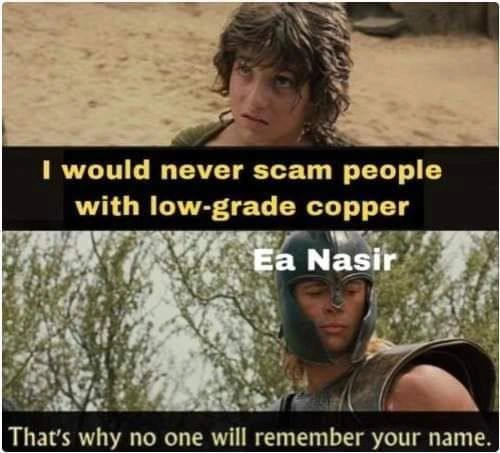
Now, the meme takes that ancient tale and gives it a fun movie twist. It uses a famous scene from the film Troy. In the original scene, the Greek hero Achilles is talking to a boy who’s scared of a big opponent. The boy says, “I wouldn’t want to fight him,” and Achilles responds with the burn, “That’s why no one will remember your name.” The idea is that if you don’t take risks or do great deeds, you won’t be remembered in history. In this meme, the dialogue is changed to fit Ea-Nasir’s story:

  • In Panel 1, a young soldier (from the movie scene) is captioned with “I would never scam people with low-grade copper.” It’s like a modern person saying, “I’d never rip off my customers with bad quality!”
  • In Panel 2, Achilles (a confident warrior in armor) is labeled “Ea Nasir” and replies, “That’s why no one will remember your name.” Now Achilles is speaking as if he’s Ea-Nasir, basically telling the honest person: “Exactly – by being good and never scamming, you won’t become famous like I did.”

The humor here is a bit cheeky: Ea-Nasir did something bad (cheated a client) and ironically that’s why his name survived for millennia (we remember him because of the complaint carved in clay). Someone who never cheats anyone might not get any attention or remembrance at all, because there’s no juicy story to tell. It’s the idea of “no news, no notoriety.” The meme isn’t actually encouraging bad behavior; it’s winking at the fact that stories of failure or wrongdoing often spread more widely and stick in people’s minds longer than stories of everything going fine.

To see the parallel, compare the ancient scenario to a modern tech one:

Ancient Mesopotamia (Bronze Age) Today’s Tech Industry
Merchant sells low-grade copper (promised quality, delivered junk). Company ships buggy software or a defective product (promised feature, delivered with bugs).
Disgruntled customer carves a complaint on a clay tablet (in cuneiform writing). Upset user writes a support ticket or a scathing 1-star review on the internet.
The complaint is literally set in stone and preserved for millennia. The incident report lives online forever (in forums, blogs, or as office lore).
Ea-Nasir becomes infamous as a bad supplier, remembered thousands of years later. The dev or vendor earns a bad reputation and becomes a cautionary tale (even a meme) that colleagues talk about for years.

For a newcomer in tech, the takeaway is understanding that people tend to remember the big mistakes more than the everyday successes. Clients and users expect good quality as the norm, so if you deliver exactly what was promised, it might feel unremarkable – it’s “nothing new.” But if something goes wrong in a big way, that’s when everyone notices. Think about deployments: nobody hears about the hundreds of deploys that go smoothly, but everyone hears about the one that crashes a site for an hour. In the same way, no one in ancient times bothered writing, “Ea-Nasir delivered fine copper, I’m very pleased.” That wasn’t noteworthy. But screw-ups? Those got written down (on clay, no less!).

The meme is funny to developers because it playfully exaggerates this reality. It’s saying with a smirk: “If you never do anything scandalous (like selling dodgy copper), you’ll just be another good guy lost to history. But pull an Ea-Nasir – do something so wrong that a customer goes ballistic – and congrats, you’ve secured a chapter in the history books (or at least a footnote in a museum and a meme on the internet).” Of course, in real life we try not to be that person! It’s a reminder of how human nature and storytelling work: we remember the outliers, especially the bad apples, much more than the quiet everyday heroes. The lesson for a junior dev is both humorous and cautionary: don’t chase fame via failure, but do realize that one big mistake can define your reputation if you’re not careful. And also – hey – it’s oddly comforting to know even ancient traders had to deal with “support tickets” and angry clients complaining about quality. Plus, who would’ve thought a 3,700-year-old customer complaint would turn into a modern office joke? Pretty cool, right?

Level 3: Bronze Age Burn

Ea-Nasir is infamous among tech historians and developers alike because of what might be the world’s oldest recorded customer complaint. Around 1750 BC in ancient Mesopotamia, this merchant delivered low-grade copper ingots to a customer (meaning the metal was poorer quality than promised). The unhappy client, a man named Nanni, literally wrote a complaint on a clay tablet about it. That tablet – a 3,700-year-old letter written in wedge-shaped cuneiform – is basically the first support ticket in history, a Bronze Age bug report saying “you sold me bad product!” In modern terms, it’s the first known RMA (Return Merchandise Authorization) request: an ancient customer demanding a refund or better goods because the stakeholder expectations were not met. The whole situation shows that disgruntled clients and quality issues are nothing new in our industry – they’re as old as writing itself.

Now enter meme culture. The image uses a scene from the 2004 movie Troy where the hero Achilles (played by Brad Pitt) delivers a legendary one-liner. In the film, a young soldier nervously says he wouldn’t want to fight a giant, and Achilles quips, “That’s why no one will remember your name.” The meme repurposes this moment brilliantly. Panel 1 shows a dusty-haired youth on a battlefield with the caption, “I would never scam people with low-grade copper.” (Translation: I’m an honest trader; I’d never cheat my customers.) Panel 2 cuts to Achilles – now labeled Ea Nasir – and the subtitle, “That’s why no one will remember your name.” By putting Ea-Nasir in Achilles’ place, the meme implies he’s proud of the shady deal that earned him eternal notoriety. It’s a historical inside-joke: immortality through infamy. Ea-Nasir’s bad behavior made his name survive (on a clay tablet and now in digital meme form), whereas someone who never pulls such stunts remains just a face in the crowd of history.

For seasoned engineers, this juxtaposition lands with a smirk of recognition. It highlights the darkly funny truth that in tech (as in ancient Mesopotamia) big failures and product quality shortcuts tend to be remembered far longer than everyday best practices. It’s common in our industry lore: nobody writes articles about the thousands of honest merchants or the countless developers who consistently write clean, bug-free code – that’s expected, so it flies under the radar. But one spectacular screw-up or act of corner-cutting, and your name might end up immortalized as a cautionary tale. The meme’s caption about not scamming being forgettable is sardonic: it pokes fun at “virtue is its own reward” by suggesting virtue alone won’t put you in the history books. In other words, quietly doing the right thing won’t get you fame, but one notorious mistake might!

Consider how we talk about famous tech blunders. We all remember the story of the left-pad fiasco – one developer yanking a tiny NPM package that unexpectedly broke half the JavaScript ecosystem – but we don’t remember all the packages that were updated smoothly that same year. Developers still swap stories about the engineer who deleted a production database on a Friday or the time a single misconfigured server took down a huge site; those events become legendary. Meanwhile, the unsung heroes who prevent disasters or always deliver quality code get, at best, a pat on the back and then anonymity. Ea-Nasir is basically the ancient prototype of this phenomenon. His name is literally preserved in stone for delivering subpar goods and enraging a client. Thousands of other merchants who did play by the rules? Lost to time.

So this meme cleverly wraps that insight in humor. By channeling Achilles, it humorously frames a stakeholder/client drama as a path to glory: “Take a shortcut, skip quality – and you, too, can be forever remembered… as a joke.” Seasoned devs chuckle (and cringe) because they’ve seen it happen – one sloppy deployment or shady business move can overshadow an entire career of clean code. It’s a tongue-in-cheek reminder that fame in tech isn’t always about great accomplishments; sometimes it’s about great failures. And in a final ironic twist, we’re all here remembering good old Ea-Nasir – not for any heroic deed, but because he ticked off a customer 37 centuries ago and got his name immortalized in a complaint. Now that’s an epic industry satire carved in clay and reborn as a meme.

Description

A two-panel meme that references an ancient historical inside joke. The top panel shows a young boy from the movie 'Troy' with the caption, 'I would never scam people with low-grade copper.' The bottom panel shows the character Achilles from the same movie, but with the name 'Ea Nasir' superimposed. The caption below reads, 'That's why no one will remember your name.' The humor is rooted in the story of Ea-nasir, an ancient Mesopotamian merchant from ~1750 BCE who is known from a cuneiform tablet that contains the world's oldest customer complaint about the poor quality of his copper ingots. The meme ironically suggests that Ea-nasir's notoriety for bad business has made him historically famous, while an honest merchant would have been forgotten. It's a niche joke popular in history and tech circles that appreciate the absurdity of someone being remembered for millennia for a customer service failure
Comments

11
Anonymous ★ Top Pick Ea-nasir's customer complaint was the world's first Jira ticket. It's been in the 'Won't Fix' column for 3,800 years
  1. Anonymous ★ Top Pick

    Ea-nasir's customer complaint was the world's first Jira ticket. It's been in the 'Won't Fix' column for 3,800 years

  2. Anonymous

    Proof that closing a ticket with “won’t fix” can leave your SLA in cuneiform for millennia

  3. Anonymous

    Just like Ea-Nasir's copper tablets live on 4000 years later, that one npm package with 47 critical vulnerabilities you vendored in 2016 will haunt your codebase forever - except instead of clay tablets, it's immortalized in your package-lock.json

  4. Anonymous

    Just like Ea-Nasir's complaint tablets survived 4000 years in cuneiform, EA's microtransaction strategies are being permanently archived in GitHub issues, Reddit threads, and regulatory filings. The difference? Ea-Nasir's customers only had to write one complaint tablet per bad copper shipment - EA's players have to file a new one with every game release. At least ancient Mesopotamians didn't have to deal with 'surprise mechanics' or day-one patches for their substandard copper

  5. Anonymous

    The real hero move is speccing solid copper; CCA “Cat6” is microservices over UDP - fine in the demo, packet loss and PoE brownouts in prod

  6. Anonymous

    In engineering, ten years of boring reliability gets you anonymity; one tin‑grade release that burns the error budget and you’re immortalized like Ea‑Nasir in every RCA and Slack emoji pack

  7. Anonymous

    Architects ship pristine microservices and fade; Ea-Nasir's crap copper endures 3,800 years - like that unkillable COBOL monolith

  8. @Maxinator_Great 11mo

    Why is this mene here?🤔

    1. @f0cu53d 11mo

      Copper wires, computers, etc

      1. @Sun_Serega 11mo

        that's quite a stretch

  9. @f0cu53d 11mo

    Horror

Use J and K for navigation