Skip to content
DevMeme
7070 of 7435
Swearing at Work: 13 HR-Approved 'Try Saying' Translations
CorporateCulture Post #7751, on Feb 23, 2026 in TG

Swearing at Work: 13 HR-Approved 'Try Saying' Translations

Why is this CorporateCulture meme funny?

Level 1: The Polite Words Costume

Imagine a school where kids aren't allowed to yell "That's so unfair!" anymore — so the teachers hand out a cheat sheet: instead of yelling, say "How interesting!" Instead of "No way!", say "I'm not sure that will fit in my schedule." Everyone still feels exactly as angry as before; they've just dressed their angry words in a tiny suit and tie. The funny part is that everyone knows the costume is a costume. When someone at the office smiles and says "That's interesting," every grown-up in the room hears the real sentence underneath — the same way your mom saying your name very slowly doesn't need any bad words to tell you you're in trouble.

Level 2: Reading the Translation Table

Corporate euphemism is indirect language that softens a blunt message — "not feasible" instead of "no," "needs more training" instead of "incompetent." The memo parodies an HR memo, the formal company-wide notice format, complete with the standard structure: problem statement ("complaints received"), policy ("will no longer be tolerated"), and remedy (the "13 New and Innovative 'TRY SAYING' phrases"). The joke format — "try saying X instead of Y" — works because each polite phrase is one you will genuinely hear weekly in standups, retros, and stakeholder calls, and the right column tells you what the speaker actually felt. For someone early in their career, this table is honestly useful onboarding material: when a senior engineer says "I'm certain that isn't feasible" in a meeting about cramming three features into one sprint, the words are calm but the meaning is row 4. Learning to produce the left column while feeling the right column is, unofficially, the core competency called "communication skills" on every job listing. Passive-aggressive translation memes endure because they teach that skill faster than any training course.

Level 3: A Rosetta Stone for Corporate Diplomacy

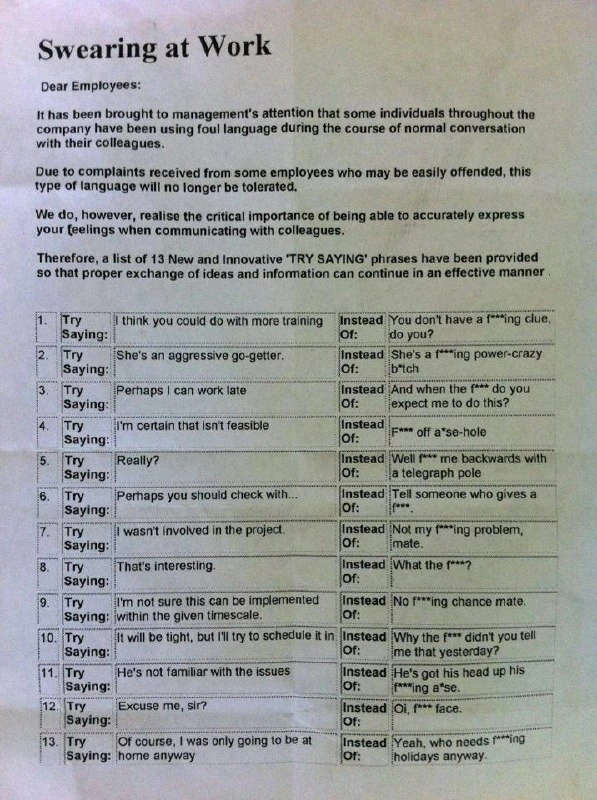
This photographed memo — "Swearing at Work," opening with the immortal "Dear Employees" — is a pre-social-media artifact of office samizdat: the kind of thing photocopied, faxed, and pinned to break-room corkboards for decades before it was ever a JPEG. Its comedy engine is precision. The framing paragraphs are pitch-perfect HR-memo pastiche, right down to the legalistic concession that management "realise the critical importance of being able to accurately express your feelings" — and then the document delivers a 13-row, two-column lookup table mapping sanctioned phrases to the profanity they encode. It's not satire of swearing; it's satire of the translation layer itself.

What makes it eternal for anyone in software is that the table is real. These aren't invented jokes — they're the actual production mappings of workplace communication. Row 9, "I'm not sure this can be implemented within the given timescale""No f***ing chance mate," is every sprint-planning meeting where an arbitrary deadline arrives pre-committed by someone who will never touch the code. Row 10, "It will be tight, but I'll try to schedule it in""Why the f*** didn't you tell me that yesterday?", is the canonical response to Friday-afternoon scope discoveries. Row 8 is the most load-bearing entry in the entire corpus: "That's interesting""What the f***?" — which any code reviewer recognizes as the exact semantics of "interesting approach" left as a PR comment. And row 13, "Of course, I was only going to be at home anyway""Yeah, who needs f***ing holidays anyway," documents on-call martyrdom with archival accuracy.

The sharper observation underneath: the memo accidentally proves that corporate language is a protocol with lossless decoding. Professionalism doesn't eliminate the hostility; it encodes it at a layer everyone can pretend not to parse. Seniors fluent in this protocol read "perhaps you should check with..." (row 6: "Tell someone who gives a f***") and route accordingly; juniors take the surface text literally and walk into ambushes. The memo's fictional premise — management issuing the decoder ring — is the utopian twist: an organization honest enough to publish its own euphemism table would, paradoxically, be the healthiest workplace imaginable. Real organizations maintain the table too; they just keep it undocumented, transmitted orally, like all the most critical legacy systems. The distinctly British register ("a*se-hole," "mate," "Oi, f*** face") is part of the charm — a culture that has elevated polite hostility to a national art form, writing down its own compiler.

Description

A photo of a printed office memo titled 'Swearing at Work,' addressed 'Dear Employees,' stating that foul language will no longer be tolerated due to complaints, but management 'realise the critical importance of being able to accurately express your feelings,' so 13 'New and Innovative TRY SAYING phrases' are provided. A numbered two-column table maps corporate-polite phrases to their censored profane originals, e.g.: 'I think you could do with more training' instead of 'You don't have a f***ing clue, do you?'; 'I'm certain that isn't feasible' instead of 'F*** off a*se-hole'; 'That's interesting' instead of 'What the f***?'; 'I'm not sure this can be implemented within the given timescale' instead of 'No f***ing chance mate'; and 'Of course, I was only going to be at home anyway' instead of 'Yeah, who needs f***ing holidays anyway.' A classic corporate-satire artifact decoding what workplace diplomacy actually means - instantly recognizable to anyone who has translated sprint-planning pushback into polite estimate language
Comments

5
Anonymous ★ Top Pick This memo is just a lookup table for code review comments: 'That's interesting' has meant 'what the f***' in every approval-with-comments since the dawn of pull requests
  1. Anonymous ★ Top Pick

    This memo is just a lookup table for code review comments: 'That's interesting' has meant 'what the f***' in every approval-with-comments since the dawn of pull requests

  2. @hoodiepaws 4mo

    lmfao

  3. @blue_bonsai 4mo

    "the Party knows best" ahh paper

  4. @BEST8OY 4mo

    Oi, fuck face🤣

  5. @AbolhasanAshori 4mo

    Bro these are stress management techniques.

Use J and K for navigation