Skip to content
DevMeme
755 of 7435
Sun Microsystems' Literal Take on Containerization
TechHistory Post #854, on Nov 25, 2019 in TG

Sun Microsystems' Literal Take on Containerization

Why is this TechHistory meme funny?

Level 1: Big Box Surprise

Imagine you told your friend that the best way to organize things for the future is to put everything in special containers. You meant small, neat boxes for each group of items. But the next day, a huge truck pulls up, and your friend says, “Ta-da! I got a container,” and points to a giant shipping box sitting on your lawn. Your friend took your idea very literally – instead of using little boxes to sort stuff, they brought one enormous box that could fit your entire room! It’s funny because you didn’t expect them to interpret your words that way. That’s what’s happening in this meme: the engineer talked about a smart new idea (like organizing computer work into separate parts called “containers”), and the marketing team misunderstood and brought a massive actual container full of computers. It’s like a goofy mix-up where someone follows your words exactly, but not in the way you intended, leading to a big and hilarious surprise.

Level 2: Data Center in a Box

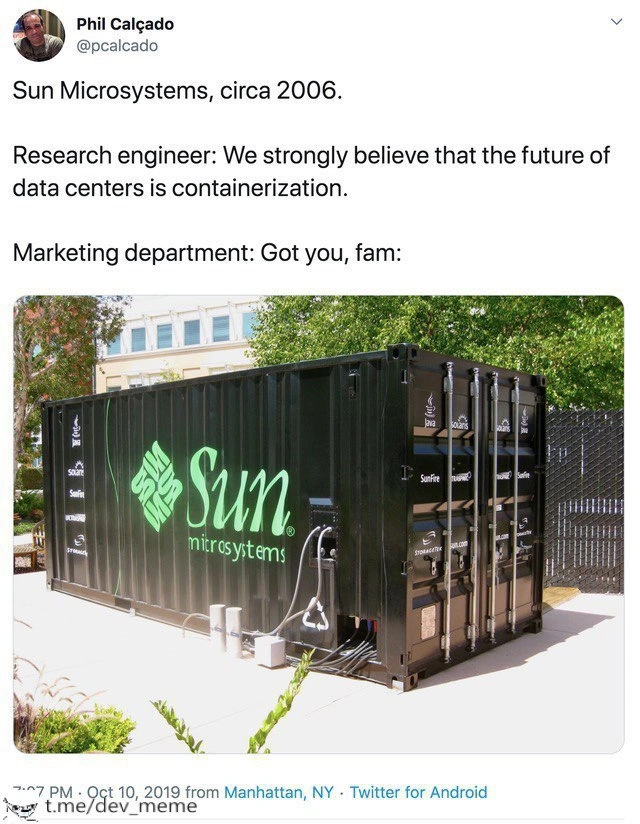
Let’s break down the joke for newer folks. First, Sun Microsystems was a large tech company (acquired by Oracle in 2010) known for making powerful servers, the Solaris operating system (similar to Linux/Unix), and developing the Java programming language. In 2006, Sun created something called Project Blackbox: a full data center built inside a standard shipping container. Yes, an actual 20-foot long metal shipping container (the kind you see on cargo ships and trucks) outfitted with racks of computers, storage drives, cooling equipment, and all the power hookups needed. The idea was you could literally deploy a data center by delivering this container to wherever it was needed, hook it up to utilities, and voilà – instant computing power. It was marketed as a “data center in a box.” The photo in the meme shows one of these Sun Blackbox containers, painted black with a big green Sun logo and a list of Sun’s products (Java, Solaris, SunFire, StorageTek) on the door. Those labels basically advertise that inside this box are servers (SunFire), storage systems (StorageTek), running Sun’s software (Solaris OS and supporting Java). It was a pretty cool piece of Infrastructure engineering for its time, showing off Sun’s hardware and thinking inside an actual box.

Now, the funny part comes with the word “containerization.” Today, in software, containerization usually refers to packaging an application and its environment into a software container (like a Docker container). For example, using Docker you can bundle your app’s code, libraries, and dependencies into an image that runs reliably on any machine that has Docker installed. This concept is huge in modern DevOps and cloud computing – tools like Docker and orchestration systems like Kubernetes (which manages lots of containers across servers) are foundational to how we deploy apps at scale. Containerization in this context means isolating processes in their little sandbox so they don’t conflict with each other, but they share the host machine’s operating system kernel to be efficient. It’s a bit like having many separate rooms inside one house, rather than each person needing their own house – more lightweight than full virtual machines.

Back in 2006, however, the term container wasn’t yet a mainstream way to talk about software isolation (Docker didn’t exist, although some technologies like Solaris Zones and Linux Containers were around in niche use). So when the meme quotes a research engineer saying, “We strongly believe that the future of data centers is containerization,” it sets up a double meaning. The engineer likely means software containerization – a vision where applications are deployed in modular units for flexibility and efficiency. But the marketing department in the joke responds with, “Got you, fam,” and produces an actual shipping container data center. The phrase “Got you, fam” is internet slang for “I’ve got your back” or “I understand what you need.” Here it’s used humorously: marketing is saying “We understood your request and delivered on it, friend” – except they interpreted “containerization” in the most literal way possible. They did containerize the data center… by physically putting it in a giant metal container!

So the humor comes from this miscommunication and literal interpretation. It’s as if the engineer spoke about a high-tech concept, and the marketing team nodded, then went and built something tangible that uses the same word in a totally different sense. This is a play on literal_vs_figurative meaning. In tech (and any specialized field), engineers often use jargon or forward-looking terms that can sound odd to others. A marketing team might latch onto a buzzword like “container” without fully grasping the nuance, and turn it into a flashy project or campaign. In this case, Sun’s marketing actually did create a product around the word “container” – the Sun Blackbox – which was pre-Docker containerization in a purely physical sense.

To a newcomer, it’s also interesting to note how far ahead some ideas were. Sun’s container data center was a precursor to today’s modular cloud infrastructure. And Sun’s Solaris had its own version of containers (Solaris Zones) that were like earlier Docker-style environments, though those were largely used in enterprise settings and not widely popularized. The meme is essentially pointing out: years before Docker and Kubernetes made “containerization” a software buzzword, Sun was literally hauling around containers full of servers. It’s a mix of TechHistory and EngineeringHumor: we laugh because nowadays everyone talks about containerization as a software thing, yet here was Sun doing a giant pun in 2006. It also lightly pokes fun at the dynamic between engineering and marketing in tech companies. The engineering team proposes a forward-thinking idea (like a new architecture or concept), and the marketing team, tasked with promoting the company’s innovation, might interpret that idea in an unexpected way. Sometimes the result is brilliant, sometimes it’s off-target, and if you’re lucky, it’s both – which makes for a great story (or in this case, a meme).

In summary, the meme uses the image of Sun’s shipping container data center to joke that Sun’s marketing department “delivered containerization” literally, long before the Docker era. It’s funny to tech folks because it plays on both the historical reality (Sun really did that project) and the terminology twist. Now when someone says “containerization,” we think of app containers in the cloud – but Sun’s big black shipping container is a reminder that words can take on a life of their own across different contexts!

Level 3: Think Inside the Box

This meme brilliantly captures a bit of TechHistory and the classic marketing_vs_engineering miscommunication. Back in 2006, a Sun engineer’s forward-looking statement that “the future of data centers is containerization” was likely about software – isolating applications for easier deployment and management. But Sun’s marketing team answered with Project Blackbox, which is literally a shipping container full of high-end Sun hardware. It’s a perfect dad-joke brought to life: they thought inside the box instead of outside it. The tweet humorously plays out the dialogue:

Research engineer: We strongly believe that the future of data centers is containerization.
Marketing department: Got you, fam. 🤝

Cue the image of an actual big black shipping container parked in an office courtyard, emblazoned with a giant green Sun logo and a stack of product names (Java, Solaris, SunFire, StorageTek) on the door. It’s as if marketing said, “Oh, you meant containers? Sure, we’ll put our entire data center in a container and slap our greatest hits on the side for branding!” The joke lands because of this literal_containerization: a physical container vs. the virtual containers the engineer likely intended. It’s EngineeringHumor 101 – using a bit of wordplay to highlight how differently the two groups (engineering and marketing) think.

For those of us who remember Sun Microsystems (or have dealt with corporate IT in the 2000s), this is a nod to a real product and era. Sun Microsystems was a big deal in enterprise computing: they made robust SPARC servers (the SunFire line), owned the Java programming language, developed the Solaris operating system, and had acquired StorageTek for data storage solutions. In 2006, Sun was trying to stay relevant against emerging x86 servers and the nascent cloud concept. Project Blackbox was an innovative marketing idea to showcase Sun’s hardware might: “Why build a server room when we can ship you one?” It was literally data_center_in_a_box. They drove a demo unit around on a truck to universities and tech expos, showing off how you could plug in water, power, and network, and have a working data center in minutes. For infrastructure geeks, it was actually pretty cool – a self-contained room with cooling systems, fire suppression, and shock absorbers for the equipment, all inside a rugged shipping container.

Now fast-forward a few years: when we talk about Containerization today, we’re usually referring to Docker, Kubernetes, and the whole cloud-native paradigm of packaging software into lightweight containers. So the meme’s tweet, written in 2019, winks at the audience: Sun’s marketing literally delivered “containerization” before Docker was even a thing. It’s a playful historical irony. The pre_docker_containerization reference isn’t just about the physical box; Sun also had Solaris Zones (essentially early containers in software) – but of course, marketing can’t take a Code Isolation feature to a trade show as easily as they can take a big black shipping crate on wheels.

This meme also touches on a broader CorporateHumor theme. In tech companies, engineering ideas can get distorted as they travel to the marketing and executive levels. Engineers speak in abstractions and future possibilities (“we need to containerize workloads for efficiency”), whereas marketing wants something concrete to sell or a story to tell (“look, we put it in a container, how catchy!”). The result can be equal parts impressive and absurd. Every senior developer or architect has likely seen a well-intentioned technical concept turned into something flashy – or occasionally misconstrued – by the time it’s a press release. The humor is in that perennial gap: the engineer imagines elegant software infrastructure improvements, and the company ends up painting logos on a giant metal box because hey, that photographs well. Sun’s Project Blackbox is a legendary example of marketing taking something and running with it (literally, running with it on a semi-truck).

In retrospect, Sun wasn’t wrong to experiment here. Modular, portable data centers did become a trend – even modern cloud providers toy with the idea of dropping container data centers in remote regions or edge locations. But the meme is a cheeky reminder that sometimes marketing and engineering operate on different wavelengths. It’s DevOps humor with a historical twist: before you laugh at today’s buzzwords, remember that a decade ago someone might have taken those buzzwords far more literally! Containerization meant two very different things depending on who you asked, and Sun’s team delivered on both interpretations with enthusiasm. As tech veterans, we chuckle because we’ve all seen a “Got you, fam” moment where a simple suggestion leads to an over-the-top solution. Sun’s literal shipping container data center is the perfect, punny embodiment of thinking inside the box.

Level 4: Containers All the Way Down

In the mid-2000s, Sun Microsystems was experimenting with both literal and virtual containers, exemplifying a layered irony of containerization. On one level, Sun’s engineers were advancing OS-level virtualization: Solaris Zones (also marketed as Solaris Containers) allowed multiple isolated user-space instances on a single Solaris kernel – an early form of what we now call containerization. This was a technically elegant solution: by leveraging kernel-level isolation (similar to modern Linux cgroups and namespaces), Sun could containerize applications with minimal overhead compared to full virtual machines. In essence, Solaris was doing Docker-like things circa 2005, providing a sandbox for processes long before Docker’s 2013 debut. It was a forward-thinking approach to Infrastructure and resource management, aligning with the idea that the future of data centers is containerization – albeit referring to software containers.

Simultaneously, another Sun team took “containerization” in a very concrete direction. Project Blackbox (launched 2006) was Sun’s radical prototype of a shipping-container datacenter. Picture a standard 20-foot ISO intermodal container outfitted with racks of Sun Fire servers, StorageTek disk arrays, hefty cooling systems, and its own power distribution – essentially a plug-and-play data center in a big metal box. This wasn’t just a marketing stunt; it addressed real Infrastructure challenges. Moving entire data centers is non-trivial: power density, cooling, and network connectivity all have to be self-contained. By standardizing on a shipping container, Sun could deliver a fully functional data center to any location reachable by truck or ship. It was modular deployment taken to an extreme physical form – drop in a crate and get 5000 CPU cores running on arrival. Interestingly, the inspiration drew from the very etymology of “containerization”: just as the shipping industry’s adoption of uniform containers in the 1960s revolutionized cargo logistics, Sun aimed to revolutionize how companies deploy computing power by using the same physical concept. They quite literally borrowed the shipping container metaphor and turned it into tangible technology.

This dual-pronged exploration of containerization – virtual Solaris Containers for software and shipping containers for hardware – highlights an almost matryoshka doll situation of containers within containers. In fact, it’s entirely plausible that inside that Sun shipping container sat servers running Solaris OS instances, each with several isolated Zones (containers) handling different applications. So you’d have containers inside a container – an Inception-like scenario that would delight any systems theorist. It’s containers all the way down! This deep harmony between software abstraction and physical design was ahead of its time.

From a TechHistory perspective, the meme’s punchline lands because we know what happened next: the industry’s notion of "data center containerization" shifted entirely to the logical realm. By the 2010s, Docker and Kubernetes made software containers ubiquitous, emphasizing deployment consistency and scalability across clusters of machines. Sun’s Project Blackbox, while conceptually brilliant, remained a niche (and was arguably a bit too literal in execution). The fundamental constraints of physics – latency, bandwidth, cooling – mean you can’t just ship a critical data center overnight without challenges (for instance, a “fedexed” server farm still needs fiber connectivity and an on-site fire suppression plan!). Meanwhile, software containers faced their own theoretical limits (from the CAP theorem in distributed systems to kernel security isolation issues), but solved a different set of problems around software portability. The humor here is that Sun’s marketing and engineering were, in a way, both right about containerization, but they were operating on entirely different layers of the computing stack. The research engineer’s vision of encapsulating workloads was prophetic, and Sun’s marketing department did deliver on the term – just in the form of a massive black shipping container humming with servers.

Description

A screenshot of a tweet from user Phil Calcado (@pcalcado). The tweet reads: 'Sun Microsystems, circa 2006. Research engineer: We strongly believe that the future of data centers is containerization. Marketing department: Got you, fam:'. Below the text is an image of a large, black industrial shipping container with the green 'Sun Microsystems' logo prominently displayed on its side. Various cables and cooling units are visible on the exterior. The meme plays on the double meaning of 'containerization.' While the research engineers were referring to OS-level virtualization (like Sun's own Solaris Zones, a precursor to modern Docker containers), the marketing department is humorously depicted as having interpreted the request literally, producing a data center inside a physical shipping container. This product, known as Project Blackbox or the Sun Modular Datacenter, was actually real, adding a layer of historical irony that resonates with senior developers familiar with pre-cloud data center innovations
Comments

7
Anonymous ★ Top Pick Sun was so ahead of its time. They shipped the first container, but the orchestrator was a forklift
  1. Anonymous ★ Top Pick

    Sun was so ahead of its time. They shipped the first container, but the orchestrator was a forklift

  2. Anonymous

    Sun’s end-to-end container story: Solaris Zones in the kernel, Project Blackbox on a forklift - Kubernetes just replaced the forklift driver with 3,000 lines of YAML

  3. Anonymous

    Sun's engineers were so ahead of their time with Solaris Zones that marketing needed a shipping container to hold all the namespace isolation features Docker would eventually reinvent as revolutionary

  4. Anonymous

    Sun Microsystems was 15 years ahead of the curve on containerization - they just needed to wait for Docker to explain they meant *virtual* containers, not the kind you ship servers in. Though to be fair, their marketing team's interpretation did solve the 'infrastructure as code' problem by making infrastructure literally shippable. One could argue they achieved true 'portable' computing before Kubernetes made it cool

  5. Anonymous

    Engineers dreamed of immutable images and pod orchestration; marketing delivered forklift-proof steel that outlasted the company

  6. Anonymous

    Project Blackbox: the only time 'container orchestration' meant forklifts instead of kubelets

  7. Anonymous

    Sun had containerization in 2006: Project Blackbox - forklift as the orchestrator, and autoscaling meant calling logistics for another 40ft node

Use J and K for navigation