Stories Invade The Code Editor
Why is this IDEs Editors meme funny?
Level 1: The Noisy Desk
Imagine trying to do homework at a clean desk, but someone tapes a row of tiny TV screens above your notebook showing what your friends are doing. The screens might be interesting, but now your homework desk is also a playground. The joke is that the programmer opened a tool for writing code, and it started acting like a social app asking for attention.
Level 2: Sidebar Meets Social Feed
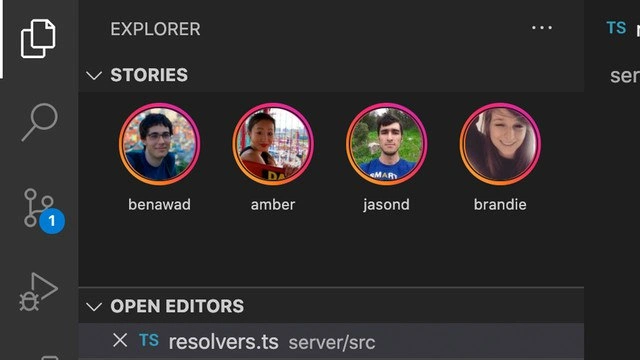
In a normal project, the Explorer panel shows folders and files. The Open Editors section shows files currently open, like the visible resolvers.ts, which is probably a TypeScript source file used for server-side logic. A developer uses this panel to move around the codebase quickly.
The fake Stories section borrows a visual pattern from social media apps: circular profile pictures, colorful rings, and short usernames. On platforms like Instagram, that design tells users there is fresh personal content to view. In a code editor, the same design would mean another reason to stop coding, click around, and lose context.
That is why the meme fits categories like IDEs and editors, developer tooling, developer workflow, and context switching. Early in a programming career, it is easy to underestimate how expensive interruptions are. You might be holding several details in your head at once: which file calls which function, why the resolver is failing, what the test expects, and whether the server needs restarting. One shiny distraction can make all of that fall out of working memory.
The funny part is not just "social media bad." It is that developer tools often claim to improve productivity while quietly adding more things to monitor. A harmless-looking sidebar feature can become another tab, another badge, another unread count, and another small tax on concentration.
Level 3: Engagement-Driven Explorer
The screenshot works because it violates a very specific social contract: VS Code's Explorer sidebar is supposed to be boring. It is where files live, where resolvers.ts waits in server/src, and where a developer goes when they are trying to keep a fragile thread of concentration intact. Dropping an Instagram-style Stories rail into that space turns the editor into another attention marketplace.
The visible text sells the whole joke:
STORIES
and under it:
benawad amber jasond brandie
Those gradient-ring avatars are familiar enough that the brain instantly recognizes the pattern: unseen updates, social presence, maybe something expiring soon, maybe something you should click before you get back to work. That is exactly the opposite of what a code editor is meant to optimize. The Explorer is a navigation surface; stories are an engagement surface. Combining them is funny because it feels like a product manager looked at the last remaining quiet tool in the stack and asked, "but where is the retention loop?"
There is a sharper developer-experience joke under the obvious one. Modern IDEs already compete for attention with extension recommendations, inline hints, Git decorations, test status, remote workspace badges, AI suggestions, terminal problems, telemetry prompts, and notification toasts. Most of those features are defensible in isolation. Together, they can turn the editor from a thinking environment into a dashboard that keeps asking to be fed. The meme exaggerates that trend by adding the one feature no one needs while debugging a TypeScript resolver: a feed of people with glowing rings around their faces.
It also pokes at the VSCode extension ecosystem. VS Code became popular partly because it is lightweight enough to customize and extensible enough to become almost anything. The cursed bargain is that "anything" includes turning source control into a social network, a text editor into a streaming platform, or a sidebar into a dopamine vending machine. Somewhere, an extension manifest is already clearing its throat.
Description
The image is a cropped Visual Studio Code window in dark theme, focused on the Explorer sidebar. Under a section labeled "STORIES," four Instagram-like circular profile avatars appear with gradient rings and the names "benawad," "amber," "jasond," and "brandie." Below that, the "OPEN EDITORS" section shows a TypeScript file, "resolvers.ts," in "server/src." The meme imagines social-media story UI embedded into a serious coding environment, turning the editor itself into a productivity distraction.
Comments
6Comment deleted
Because apparently `resolvers.ts` needed an engagement funnel before it needed tests.
VSCode stories? 🤣🤣🤣 why microsoft always butcher its softwares??? Comment deleted
because they can Comment deleted
Microsoft fan 101? 😁 Comment deleted
That's not official feature, but a plugin Comment deleted
I have been waking up to this and feeling very confused as it's supposedly November, not April Comment deleted