Stack Overflow Powered by Wrong Answers
Why is this DevCommunities meme funny?
Level 1: Class Correction
Imagine a classroom where asking "can someone help me?" gets silence, but loudly saying "two plus two equals five" makes everyone shout the right answer at once. The meme is funny because it says programmers can be the same way: they may ignore confusion, but they cannot resist correcting confident nonsense.
Level 2: The Wrong Answer Trap
Stack Overflow is a question-and-answer site where developers post coding problems and other developers answer them. A good answer explains the cause, shows a fix, and ideally teaches the principle behind it. Reputation points, accepted answers, comments, and votes make the whole system feel a little like peer review mixed with a leaderboard.
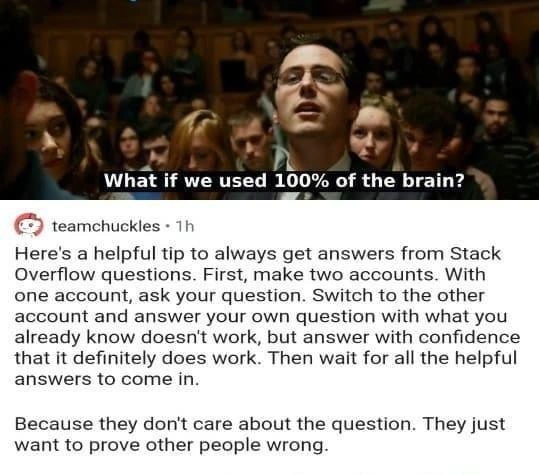
The meme uses a familiar movie still of someone having a brilliant realization. Under that, the fake social post describes a trick: create two accounts, ask a question from one, then post a bad answer from the other "with confidence." The joke depends on overconfidence bias and the Dunning-Kruger effect: people who sound certain can attract attention even when they are wrong, and people who know the topic well often feel compelled to correct them.
For a junior developer, this maps to a common early lesson: asking for help is a skill. If you post "my code does not work," people need logs, error messages, versions, expected behavior, and what you already tried. But if someone posts "the answer is obviously to store passwords in plain text," experienced developers immediately know what is wrong and why. The wrong answer creates a clear path for correction, even if it is a terrible way to behave in an actual community.
Level 3: Cunningham's Law Engine
The visible setup says, What if we used 100% of the brain?, then proposes a two-account Stack Overflow maneuver: ask the question honestly with one account, answer it confidently and incorrectly with the other, and wait for corrections. The punchline lands because it describes a real developer community dynamic with uncomfortable precision: a vague question may be ignored, but a wrong answer delivered with swagger activates every expert's need to prevent misinformation from becoming canon.
This is not really about Stack Overflow being mean; it is about incentive design. Technical forums reward precision, correction, reputation, and visible expertise. A well-asked question requires readers to do diagnostic labor, infer missing context, and risk giving an answer that might not fit. A confidently wrong answer, by contrast, gives everyone a target. It reduces the problem from "please solve my ambiguous issue" to "someone is wrong about async, SQL indexes, CORS, or the Python import system, and now the room has work to do."
The darkly funny part is that the scheme weaponizes knowledge sharing against itself. Communities built for community support often develop a correction-first culture because correction is measurable, fast, and socially satisfying. The meme's final line, They just want to prove other people wrong, turns that into a brutally efficient debugging strategy. It is adversarial UX for humans: file a bad patch to the public brain and let reviewers arrive with torches, benchmarks, and three duplicate links from 2014.
Description
The image combines a lecture-hall movie still with the caption "What if we used 100% of the brain?" above a social-media screenshot from "teamchuckles · 1h". The post says: "Here's a helpful tip to always get answers from Stack Overflow questions. First, make two accounts. With one account, ask your question. Switch to the other account and answer your own question with what you already know doesn't work, but answer with confidence that it definitely does work. Then wait for all the helpful answers to come in. Because they don't care about the question. They just want to prove other people wrong." The meme is about exploiting correction-driven behavior in technical communities, where a confidently wrong answer may attract faster and better responses than a sincere unanswered question. For developers, it captures both the usefulness and adversarial social texture of Stack Overflow culture.
Comments
1Comment deleted
The fastest path to a correct answer is sometimes shipping a wrong one with enough confidence to trigger every senior engineer's interrupt handler.