Stack Overflow Frankenstein Compiles
Why is this DevCommunities meme funny?
Level 1: A Working Puzzle Monster
This is like building a toy by taping together pieces from 27 different instruction books, then being amazed that it stands up. It is funny because standing up does not mean it was built well. Programmers laugh because code can “compile” while still being confusing, fragile, and only partly understood.
Level 2: Paste, Pray, Build
Stack Overflow is a developer Q&A community where people ask technical questions and share answers. Developers often use it to understand errors, learn APIs, and find examples. That is normal and useful when the answer is read, understood, and adapted carefully.
Copy-paste coding means taking code from somewhere else and inserting it into your program. That can be fine for small examples, but it becomes risky when the developer does not understand the copied code. If several snippets solve different problems in different ways, combining them can create hidden conflicts.
The phrase “it actually compiles” means the compiler or build tool accepts the program. For a beginner, that can feel like a huge milestone because the first errors are often syntax problems, missing imports, or type mismatches. But compiling is only the first gate. The code still needs to run correctly, handle real inputs, pass tests, and be readable by the next person who has to change it.
Level 3: Compiler Acquittal
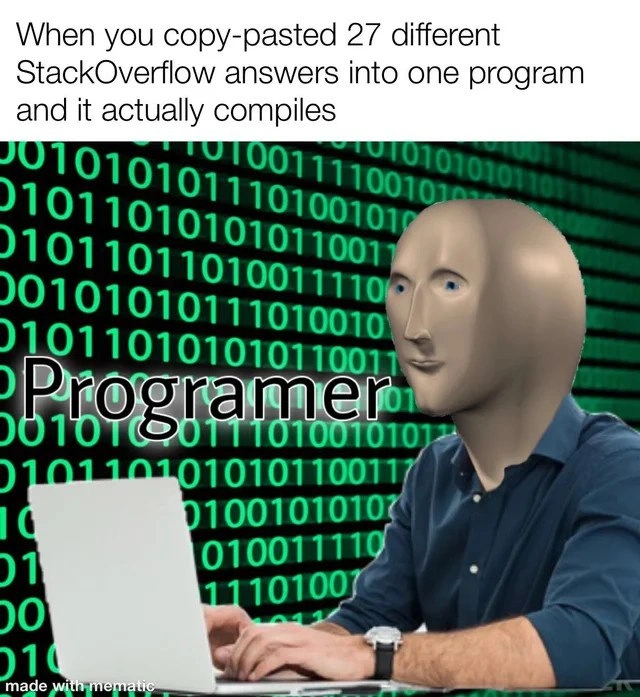
When you copy-pasted 27 different StackOverflow answers into one program and it actually compiles
The meme shows a masked “Programmer” sitting at a laptop against a dramatic wall of binary digits, as if some grand act of software engineering has occurred. The top text reveals the real achievement: 27 unrelated StackOverflow answers have been stitched into one program, and the compiler did not immediately reject the creature. That is not victory. That is the compiler saying, “I have no further syntactic objections,” which is a much narrower statement than management would prefer to believe.
The senior-level humor is that compilation checks only a slice of correctness. Depending on the language, it may verify syntax, names, type compatibility, imports, and some structural rules. It does not prove the business logic is right, the snippets share the same assumptions, the error handling is compatible, the security model is sane, the performance is acceptable, or the license and maintenance story are clean. A program can compile beautifully while doing the exact wrong thing with tremendous confidence.
Stack Overflow dependence is not inherently shameful. Good developers search, compare, adapt, and learn from community answers constantly. The problem begins when copy-paste programming replaces understanding. Snippets are usually written for someone else’s context: a different framework version, data shape, operating system, threading model, or threat model. Paste enough of them together and you may get something that passes the compiler while quietly accumulating contradiction like a codebase with a scrapbook habit.
The masked face makes the image sharper. The “Programmer” looks anonymous and uncanny, which fits the feeling of assembling code whose authorship is scattered across strangers, old answers, and desperate edits. The developer is present at the keyboard, but the resulting program may not have a single coherent design mind behind it. The real post-compile question is not “does it build?” It is “can anyone explain why this works, what it assumes, and what breaks when the next dependency update arrives?”
Description
The meme text at the top says "When you copy-pasted 27 different StackOverflow answers into one program and it actually compiles." Below it, a person with a smooth mannequin-like mask sits at a laptop in front of a green binary-code background, with the large label "Programmer" across the image and a small "made with mematic" watermark at the bottom. The joke is the uneasy triumph of assembling unrelated snippets from Stack Overflow into a program that at least passes compilation, even if no one fully understands the resulting behavior.
Comments
1Comment deleted
Compilation is not proof of design; it is just the compiler politely declining to testify about provenance.