Skip to content
DevMeme
2630 of 7435
Software Engineers vs. The Physical World
Hardware Post #2909, on Apr 8, 2021 in TG

Software Engineers vs. The Physical World

Why is this Hardware meme funny?

Level 1: It Runs on Electricity

Imagine you ask your very smart computer-programmer friend to help fix your broken remote-controlled toy car. He opens it up, looks at all the wires and little parts inside, and after a long pause he says, “Well, it looks like this thing uses batteries to work.” 😅 Not exactly a brilliant fix, right? Everyone knows the toy car needs batteries! He basically just stated the obvious because he didn’t know what else to do.

That’s what’s happening in this meme. A software engineer (a person who is great at writing computer code) is asked to repair a household electrical device (like a kitchen appliance or gadget). After poking around, all they can say is, “It runs on some form of electricity.” In super simple terms, that’s like saying, “This thing needs power to work.” Of course it does! We all know that. It’s a Captain Obvious moment. The joke is funny because the engineer is so out of their comfort zone that they end up giving an answer that even a little kid could’ve told you. It’s like watching an expert from one field feel totally lost in another — a bit embarrassing for them, but amusing to everyone else.

In everyday life, it’s similar to asking a chef to fix your broken lamp and they just announce, “This lamp needs electricity to shine.” True, but not helpful! We laugh because we expected a smart, complex answer, and instead we got a simple duh-obvious answer. It reminds us that even really smart people can sound silly when they’re dealing with something they know nothing about. In the end, the meme is playfully saying: “Hey, I might be a tech expert, but when it comes to fixing actual gadgets, I’ve got nothing beyond ‘did you plug it in?’” And that touch of humility and absurdity is what makes it so relatable and funny.

Level 2: Grounding the Basics

Let’s break down why this meme is funny in simpler terms. It’s all about the difference between software and hardware, and a bit of role reversal. A software engineer is someone who writes code – the instructions that tell computers and devices what to do. Think of software like the apps and programs on your phone or laptop. Hardware, on the other hand, is the physical stuff you can touch: the circuits, wires, chips, and devices themselves. So when we say household electric items, we mean everyday gadgets that you plug into the wall or put batteries in, like a lamp, a toaster, or a Wi-Fi router. These things all need electricity (flowing electric power) to run. If they have an issue, you’re dealing with a hardware problem (something in the physical device or its power supply), not a coding or software problem.

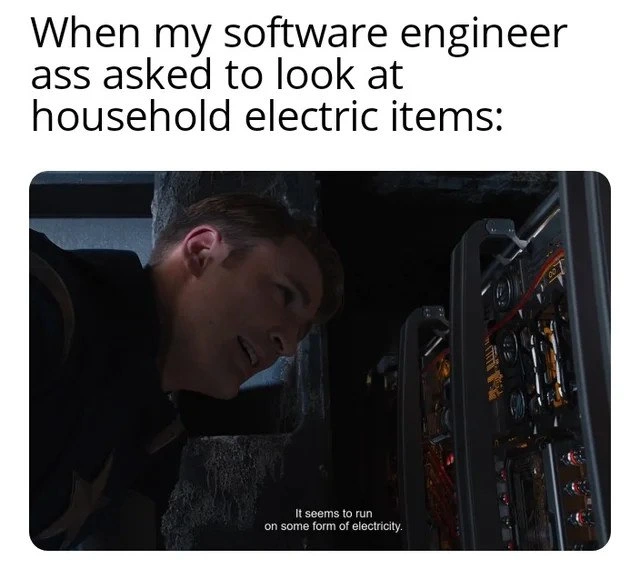
Now, the meme text starts with a caption: “When my software engineer ass is asked to look at household electric items:” – excuse the cheeky language, it’s a playful, self-mocking tone. It implies, “When I as a software engineer am asked to examine a broken appliance… (I’m out of my element).” Below that, on the image, there’s a subtitle quote: “It seems to run on some form of electricity.” This quote is the crux of the joke. Why? Because saying an appliance “runs on electricity” is about as basic and obvious as it gets! It’s like observing that a car needs gasoline or that a flashlight needs batteries. Everyone already knows that. So it’s a goofy thing to announce when you’re supposedly the “expert” checking the device.

The picture (a still from a superhero sci-fi movie) shows a guy in a costume crouching next to a high-tech panel full of wires and blinking lights. He looks a bit puzzled, and then he delivers that line. In the movie, it was funny because the character comes from the 1940s and isn’t familiar with advanced technology, so he basically states the obvious. In the meme, we (the software engineers) are put in the same shoes — we might be coding wizards, but when faced with a bunch of mysterious wires inside a appliance, we end up like, “Uh… well, it has electricity in it, I guess.” It’s self-deprecating because the person is making fun of themselves for not knowing more about hardware.

Let’s think of troubleshooting (another word for debugging or figuring out a problem) in both worlds. In software troubleshooting, if a program isn’t working, a developer will check the code for errors, read error messages, or run the program step by step to see where it breaks. This might involve terms like stack trace (which is basically an error report) or using a debugger tool to pause and inspect the program’s state. It’s all very abstract — it happens in text editors, terminals, or on the screen. Now, take hardware troubleshooting: say your household appliance (maybe a coffee machine) isn’t working. What do you do? First, you check simple things: Is it plugged in? Is the power outlet working? Maybe you check if an internal fuse is blown or if a wire came loose. You might use a tool like a multimeter (a device that measures electrical current and voltage) to see if electricity is flowing through a part of the circuit. These are tangible, physical steps. There’s no error message telling you what went wrong — you have to look, test, and infer. For someone who hasn’t learned about circuits, it can feel pretty confusing.

So in the meme, the software engineer has been asked to do hardware troubleshooting on a household gadget. Since writing code didn’t prepare them to diagnose an electrical failure, they fall back on the one thing they can confidently identify: the fact that the device uses electric power. The phrase “some form of electricity” adds humor because it sounds overly grandiose and unsure — as if the engineer wonders if maybe it’s powered by some exotic energy. But of course, it’s just regular electricity from the wall. It’s a bit like a doctor looking at a patient and saying, “I’ve determined you need some form of air to breathe.” True, but not exactly helpful!

This is a relatable humor in the tech community. A lot of developers have stories of being asked by family or roommates to fix electronic appliances since we’re “good with technology.” And yes, many of us can handle basic things like setting up a Wi-Fi router or restarting a frozen laptop. But ask us to repair a broken oven or rewire a lamp, and we might just scratch our heads. The meme captures that feeling perfectly. The engineer in the scenario isn’t actually stupid; they just lack experience in this other field. It’s a gentle reminder that being an expert in one area (like coding) doesn’t automatically make you an expert in all things tech. And that’s okay — it’s why we have electricians and hardware specialists. But it sure can lead to funny moments when assumptions are made.

So, boiled down: the meme shows a software engineer examining an electrical gizmo and basically saying “Yep, there’s electricity involved.” The humor comes from that being such an obvious, unhelpful statement — indicating that the poor software geek really has no idea how the thing works beyond knowing it plugs in. We find it funny because it’s a mix of self-deprecation (“Haha, look how little I know outside my coding bubble”) and everyday truth (electricity does run everything, but saying that alone isn’t a real solution). It’s a scenario many can chuckle at, whether you’re a coding newbie or a seasoned developer who’s been in that exact awkward spot.

Level 3: Code Confident, Circuit Clueless

When a software engineer is asked to troubleshoot a dead toaster or flickering router, the result can be a hilariously underwhelming analysis. In this meme’s caption, our coding hero proudly declares:

“It seems to run on some form of electricity.”

If that ultra-obvious statement made you facepalm, that’s the whole joke. It’s referencing a famous sci-fi movie quote (from a certain WWII-era superhero coping with modern tech) to poke fun at developers out of their depth with hardware. The top text frames it perfectly: “When my software engineer ass is asked to look at household electric items:” – in other words, “I might be a whiz with Python, but I have zero clue how a blender’s wiring works.” The meme image shows a costumed character crouched by a complex panel of wires, circuit boards, and blinking LEDs, looking baffled. That’s basically the internal face of a programmer drafted into fixing a household appliance. We software folks live in a world of abstract code; confronting a mess of circuits and electronics can feel like landing on an alien planet.

For seasoned developers, this meme hits a nerve in the funniest way. We’ve spent years mastering intricate software systems, from debugging race conditions in a multi-threaded app to fine-tuning cloud deployments. Yet, present us with a simple hardware problem – say a coffee maker that won’t turn on – and we’re stumped. Our big “insight” will be something painfully obvious, like “hmm, is it plugged in?” or this meme’s punchline about electricity. It’s self-deprecating humor at its finest: the meme is basically saying, “I write complex algorithms for a living, but I turn into Captain Obvious when faced with a circuit board.”

This disconnect comes from how specialized technology fields have become. Hardware vs. software is almost like biology vs. geology – related by science, but worlds apart in practice. Modern software engineering abstracts away the physical layer. We write code in high-level languages and let the computer’s hardware (with all its transistors and currents) remain a black box. Many of us haven’t touched a breadboard or a soldering iron since a college class (if ever). So while we know, in theory, that every computer program ultimately runs on electrons moving through silicon, we don’t actively think about it. As a result, our debugging skills are tuned for code, not capacitors.

To illustrate the chasm, consider how a veteran dev approaches a glitch in code versus a glitch in an appliance:

Software Bug 💻 Hardware Issue 🔧
Symptoms: error message or app crash (e.g., NullReferenceException) Symptoms: no power, odd burning smell, device won’t turn on
Tools: debugger, log files, Stack Overflow posts, unit tests Tools: screwdriver, user manual, multimeter (measures volts/ohms), maybe a soldering iron
Method: read stack traces, add print statements, isolate code modules Method: check the plug and power supply, test fuses/wires for continuity, inspect circuit board for fried components
Fixes: update the code, patch a bug, redeploy the app Fixes: replace a burnt-out part, tighten a loose connection, perform actual wiring repair

As you can see, the skill sets barely overlap. A programmer is used to logical reasoning in an IDE, not tracing electrical signals on a board. There’s no GitHub for schematics in our usual workflow. So when a household appliance troubleshooting situation arises, the software engineer often falls back to the one thing they do understand: power flows in and makes the thing go. It’s equivalent to a car mechanic describing a computer problem as “probably something to do with those computer bytes.” It sounds clueless — because it is, a little! — and that’s why it’s funny.

The meme’s humor also taps into a classic relatable developer experience: being the “IT person” for family and friends. If you’re the tech-savvy one in your circle, you’ve likely been handed phones, TVs, or microwaves to fix, usually with zero context. They figure “you work with computers, you can handle this, right?” And often, we do try — reset the device, check for an obvious issue — but beyond that, we’re scratching our heads. The line “It runs on some form of electricity” perfectly encapsulates that semi-embarrassed shrug we give when we’re supposed to be the expert but have no real solution. It’s a senior engineer’s tongue-in-cheek way of saying, “All my sophisticated knowledge, and all I can tell is that the darn thing needs power.”

In essence, this meme gets a laugh by highlighting the gap between software prowess and hardware cluelessness. It’s sending up the idea that even a tech professional can be a total newbie outside their domain. And by using that dramatic movie subtitle, it adds an extra wink: even a superhero (or super-programmer) can end up stating the obvious when in unfamiliar territory. We laugh because we’ve been there — confidently competent in our digital realm, and hilariously helpless with the household gadget in our hands.

Description

A two-part meme. The top section has white background with black text that reads, 'When my software engineer ass asked to look at household electric items:'. The bottom section is a screenshot from a movie, showing a character in a dark, technical environment, looking intently at a complex panel of wires and components. A subtitle at the bottom of the screenshot says, 'It seems to run on some form of electricity.' The character is identifiable as Captain America. The joke hinges on the common misconception that software engineers are experts on all things electronic or computer-related, including hardware. The punchline, a comically unhelpful observation, perfectly captures the feeling of a software specialist trying to diagnose a hardware problem, hilariously highlighting the vast difference between manipulating code and understanding physical circuitry

Comments

7
Anonymous ★ Top Pick My family thinks my job is to fix their printer. I tell them I work with abstractions, and the most physical thing I'm qualified to do is turn it off and on again
  1. Anonymous ★ Top Pick

    My family thinks my job is to fix their printer. I tell them I work with abstractions, and the most physical thing I'm qualified to do is turn it off and on again

  2. Anonymous

    “Happy to debug the dishwasher - just point me to its Prometheus endpoint; if the electrons don’t expose metrics, my RCA is: runs on an undocumented 120 V monolith.”

  3. Anonymous

    After 20 years of arguing about tabs vs spaces and optimizing O(n) algorithms, I still call an electrician when my smart home setup needs a new switch installed - because unlike production deployments, household electrical work has actual fire as a failure mode, not just metaphorical ones

  4. Anonymous

    Ah yes, the classic software engineer's approach to hardware debugging: abstract away all the complexity until you're left with 'it runs on electricity' - which is technically correct, the best kind of correct. It's like explaining a distributed system failure with 'the packets didn't arrive' or a database performance issue with 'the queries are slow.' We've spent years optimizing algorithms and architecting microservices, but hand us a multimeter and suddenly we're back to first principles. At least we can confidently say it's not a DNS issue this time

  5. Anonymous

    Family incident triage: confirmed dependency on electrons (Layer 1); escalating to Facilities - our microservice boundary ends at the wall outlet

  6. Anonymous

    Monolithic power supply with tight coupling to the neutral - desperately needs Kubernetes-orchestrated smart plugs

  7. Anonymous

    Every home repair request ends with my senior diagnosis: electrons confirmed at the power layer; anything past the plug violates our abstraction boundary

Use J and K for navigation