Skip to content
DevMeme
2631 of 7435
Internet Explorer Finally Catches Up to 2012
TechHistory Post #2910, on Apr 8, 2021 in TG

Internet Explorer Finally Catches Up to 2012

Why is this TechHistory meme funny?

Level 1: Missed the Party

Imagine you had a big school party nine years ago, and it was the coolest thing back then. Now picture one friend who is always super slow and late to everything. That friend finally shows up today, all excited, saying “I’m here for the party – awesome!” But everyone else had the party long ago and moved on. It’s funny because he’s so late that the party is already over and people are into new things now. In this meme, Internet Explorer is like that tardy friend. It’s the slowpoke browser arriving years after all the fun (the new memes and new tech) happened. Everyone laughs because the friend (IE) doesn’t realize he missed the joke by a mile – he’s happy about something that’s old news to everyone else. It’s basically teasing Internet Explorer for being so slow that by the time it catches up, what it found “awesome” is something we all laughed at ages ago.

Level 2: Outdated Browser Blues

At its core, this meme is poking fun at Internet Explorer, Microsoft’s old web browser that has a reputation for being really slow and outdated. Internet Explorer (often just called “IE”) was the default browser on Windows computers for many years. If you’re a newer web developer, you might know Microsoft Edge – which is the newer browser that replaced IE – but you’ve probably still heard jokes about IE. This image plays on exactly that: the idea that Internet Explorer is so slow, it arrives years late. The top text says “Heard you guys were posting 2012 memes today” and the bottom says “Awesome.” Why 2012? Because posting memes from 2012 in 2021 is way behind the times – just like IE always felt behind the times in web technology. The meme’s format itself (Impact font caption at top and bottom of an image) was a popular 2012 style, so the whole thing screams “stuck in the past,” in a tongue-in-cheek way.

For a junior developer, here’s the background: web development isn’t just about making a site look good on your machine – it has to work on all sorts of browsers (Chrome, Firefox, Safari, etc., and back then, Internet Explorer too). Browser compatibility is the term for making sure your HTML, CSS, and JavaScript work the same (or at least acceptably) across different browsers. The problem with IE was that it often didn’t follow the modern standards that other browsers agreed on. This meant you could write perfectly good code that worked everywhere else, but IE would act differently or outright break. Developers would then add special fixes (called hacks or shims) specifically for IE. A CSS hack might be a tiny CSS snippet targeting only IE’s unique behavior, and a shim or polyfill is usually a bit of JavaScript that adds a missing feature for an older browser.

Think of features like new CSS layouts or fancy JavaScript functions – today, most browsers auto-update and support them quickly. But Internet Explorer would go years without a major update. For example, other browsers added support for things like HTML5 video and CSS Flexbox (modern ways to build layouts) early on, while IE lagged behind. If you used an HTML5 <video> tag or a flexbox layout, you might see a blank space or a messed-up page in IE unless you added a fallback. Another example: modern JavaScript ES6 features (like arrow functions () => { } or Promises) don’t exist in IE11 – a developer would have to transpile their code (basically convert new JS syntax to old syntax) or include a polyfill library so IE could run it. These extra steps were done just to support IE users who hadn’t switched to a modern browser. That extra work is what we call the legacy browser burden.

Now, why is this funny? Imagine you’re part of an online community and everyone is sharing new memes or using new web features – except one guy who shows up years late still on the old stuff. In web dev, Internet Explorer was exactly that guy. It became a running gag. Posting a 2012 meme in 2021 is something only someone hopelessly behind the curve would do. In tech terms, IE was known for delayed_updates_humor – it got updates so slowly that by the time it learned about a new trend, that trend was no longer new. Developers often personify browsers in jokes, and IE’s personality is the bumbling, slow one.

If you’ve never had to support IE, consider yourself lucky! Many of us in the field had to constantly test our sites on IE to ensure nothing broke. It was common to hear a senior dev say, “Ugh, does it work in IE?” with a worried face. Entire meetings might revolve around, “Can we drop InternetExplorerSupport yet, or do enough users still use it?” Even Microsoft acknowledged IE’s issues – eventually they reinvented their browser with Edge (which uses the Chromium engine, like Google Chrome does) because keeping IE’s old engine (called Trident) up to date was too difficult. By the time of this meme’s posting, Internet Explorer was already on its way out, and most modern websites officially stopped supporting it. This meme evokes a bit of tech nostalgia (hey, remember the days of IE?) but mostly it’s just a playful jab at how painfully slow IE was to catch up. It’s the kind of joke a junior dev might hear from a senior after asking “Why do we include this weird code for IE in our project?” – The answer often is: because IE would break without it, and that’s funny in a “laugh so you don’t cry” way.

Level 3: Late to the Party

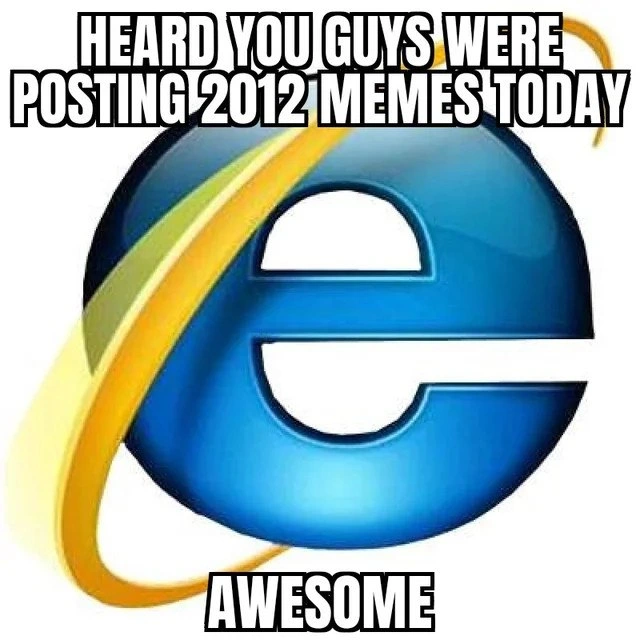
Beneath the humor, this meme exposes a raw truth for veteran front-end developers: Internet Explorer is always late to the party. The image shows the iconic glossy blue Internet Explorer logo (the blue “e” with a golden orbital swoosh) proudly declaring:

HEARD YOU GUYS WERE POSTING 2012 MEMES TODAY
AWESOME.

Translation: IE has just now showed up, excited for memes from 2012, while everyone else moved on years ago. In other words, the browser notorious for being slow and outdated is 9 years behind on the joke. By 2021 (when this meme was posted), 2012-era memes are ancient history – and that’s exactly the point. The humor lands because Internet Explorer was infamous for lagging behind: by the time it implemented a modern web feature or standard, the rest of the web dev world had already moved on to something new (just like posting a 2012 meme in 2021). It’s a classic slow_browser_meme gag, portraying IE as the clueless friend arriving way too late. Seasoned devs smirk at this because it rings so true.

This meme instantly floods experienced devs with memories of legacy_browser_pain. For over a decade, Internet Explorer (especially older versions like IE6, IE7, IE8) was the bane of web development. Why? It had tons of browser quirks and lagged in supporting modern standards. BrowserCompatibility became a full-time job: you’d build a website that worked perfectly in Chrome or Firefox, then open IE and chaos ensued – layout glitches, script errors, features just not working. Developers often had to maintain separate code paths and compatibility shims just for IE. Remember the BrowserWars? IE’s slow progress and non-standard behavior were a huge part of those battles. By the time IE finally delivered support for something (say CSS3 or decent JavaScript standards), other browsers had had it for years. The meme’s joke – IE arriving years late saying “Awesome!” – perfectly satirizes that snail’s pace.

To cope, devs invented all sorts of browser-specific CSS hacks. We wrote extra CSS files or JavaScript just to handle IE’s oddities. You might see code like:

<!-- HTML conditional comment to include IE-specific fixes -->
<!--[if IE]>
<link rel="stylesheet" href="ie-fixes.css">
<![endif]-->

In practice, that snippet meant: “Hey, Internet Explorer, load this special stylesheet with fixes just for you.” We’d use conditional comments or hacky CSS tricks (like the * or _ prefixes that only IE understood) to target IE without affecting other browsers. Every front-end dev from the 2000s recalls the pain of testing in IE: you’d get everything working in modern browsers, then spend hours tweaking for IE. BrowserQuirks mode (IE’s way of handling old-school sites) could be accidentally triggered and break modern layouts. We had to include polyfills (JavaScript patches to mimic new features) because IE didn’t support things like HTML5 video, Flexbox, or modern JavaScript functions for the longest time. It’s no exaggeration to say that a feature that took a day to code might require another day (or more) just to make it work on IE. The meme’s punchline hits home – by the time IE catches up, the fun parts of the project (or the meme trend) are long over.

There’s a healthy dose of TechNostalgia here too. The meme itself uses the classic bold white Impact font – a style of 2012 internet memes – which makes it feel like a time capsule. And that blue IE logo is a sight every developer from the Windows XP era recognizes instantly. It evokes an era of dial-up tones and early CSS, but also of frustration. Many devs have tongue-in-cheek PTSD from wrestling with that Microsoft browser. Mention “Internet Explorer” in a room of senior devs, and you’ll get groans or dark chuckles. It’s the browser that would randomly misinterpret your perfectly good code. There were even running jokes like “Internet Explorer is the best browser… to download a better browser.” In other words, IE’s most useful feature was to download Chrome or Firefox.

So when Internet Explorer in the meme says “Awesome” as it finally arrives (years late) to a 2012 meme party, the irony is delicious. The rest of the web has long since adopted evergreen browsers (ones that auto-update frequently) and left IE behind. Yet here comes IE, oblivious and enthusiastic, acting as if it’s right on time. InternetExplorerSupport was a thankless job, and this joke gives a cathartic laugh about that shared struggle. It’s funny because it’s true: we spent years of our lives catering to a browser that was perennially out-of-date. Seeing IE personified as a happy-go-lucky latecomer perfectly captures both the absurdity and the relief that those days are finally ending. In true sarcastic fashion, the meme says “Awesome.” – the unspoken subtext being “Awesome, IE... only nine years late. Thanks for showing up.

Description

The image features the iconic blue 'e' logo of Internet Explorer, with its golden swirl, set against a plain white background. Overlaying the top of the logo is the text in a bold, white, sans-serif font with a black outline: 'HEARD YOU GUYS WERE POSTING 2012 MEMES TODAY'. At the bottom, in the same font, is the single word 'AWESOME'. This is a classic example of the 'Slowpoke' meme, where a character or entity is comically late to a trend or event. The humor comes from the well-known and long-standing reputation of Internet Explorer as being an extremely slow and outdated web browser. For experienced developers, this meme is a nostalgic jab at the countless hours spent debugging compatibility issues for IE, a browser that consistently lagged behind web standards and performance, making it a punchline in the tech community long after its peak

Comments

17
Anonymous ★ Top Pick Internet Explorer's JavaScript engine just sent a callback, confirming it has successfully parsed the jQuery 1.0 release notes
  1. Anonymous ★ Top Pick

    Internet Explorer's JavaScript engine just sent a callback, confirming it has successfully parsed the jQuery 1.0 release notes

  2. Anonymous

    Internet Explorer sliding into a 2012 meme thread is the same vibe as Legal asking if our WebAssembly pipeline can “gracefully degrade” to IE9 - apparently temporal paradoxes are now feature requests

  3. Anonymous

    Internet Explorer finally loading that meme from 2012 is still faster than convincing management to drop IE11 support in 2024 - at least the meme eventually renders without a polyfill

  4. Anonymous

    Internet Explorer walks into a bar. The bartender says, 'Sorry, we stopped serving you in 2016.' IE replies, 'That's okay, I just got the message.' This perfectly encapsulates every senior engineer's experience maintaining legacy enterprise applications where IE11 support was a contractual obligation, complete with separate CSS files, conditional comments, and the existential dread of seeing 'User-Agent: MSIE' in production logs well into 2020

  5. Anonymous

    IE: The browser that made conditional comments our daily rosary and Quirks Mode eternal

  6. Anonymous

    Internet Explorer implements eventual consistency for web standards - given enough reloads, everything converges to Quirks Mode circa 2012

  7. Anonymous

    IE arriving for “2012 memes today” is why our support matrix still lists IE11, our build emits a nomodule bundle, and the app boots behind an X‑UA‑Compatible incantation

  8. @Roman_Millen 5y

    Heard you guys were posting IE memes today. Awesome.

  9. @Roman_Millen 5y

    Jokes aside, this browser is a fucking joke (no pun intended). I tried watching Twitch streams in it and it was terrible — not only IE had tremendous lags itself, but it also managed to make my Win10 lag with it. And that's considering the fact I have Ryzen 7 and 32 gigs of RAM. I mean, seriously???

    1. dev_meme 5y

      Twitch?

    2. Deleted Account 5y

      i mean, why winholes in the first place

    3. @doodguy1991 5y

      Twitch in itself is awful. If you try to run an adblocker it will try to cuck you. It has a lot of hidden scripts and extra crap that has nothing to do with streaming content in order to farm data or shove ads in your face. Besides, IE is meant for legacy applications and websites, not for running modern crap

      1. @Roman_Millen 5y

        I fully agree on the fact that Twitch is a piece of shit. But gotta disagree on some other points. First, I dunno what ad-blockers are you mentioning, but I'm using uBlock Origin and AdGuard, and never had any problems with them on Twitch whatsoever. Second, I don't say anything about IE being not suited for modern sites, but the fact that its own lags and freezes manage to hang all OS with it just doesn't fit in my head.

        1. @doodguy1991 5y

          IE causing the whole OS to hang I think has to do with the browser and the OS being part of each other rather than an application you can just install and uninstall freely.

          1. @Roman_Millen 5y

            Naturally. MS wouldn't still keep IE in Win10 for nothing — obviously it's a vital dependency not so easily replaced. I just don't get how fucked up can this OS be to lag and freeze on such a (relatively) tiny thing even having the powerful hardware.

            1. @RiedleroD 5y

              "we've tried removing it, but it just keeps crashing without it"

  10. @Roman_Millen 5y

    Yeah, Twitch. Is it a forbidden word?

Use J and K for navigation