A Software Engineer's Darkly Humorous Job Description
Why is this OperatingSystems meme funny?
Level 1: Opposite Day
Imagine opposite day at school – when you say something that sounds terrible but you really mean something good. That’s what’s happening here. The meme says “a person that is happy when children die before their parents do.” Yikes, that sounds awful in normal life! But in computer talk, it’s actually a good thing. Think of a parent and child working on chores: the parent (big job) asks the child (little helper job) to clean their room. The parent is happy if the child finishes their chore (is “done,” like a process that ended) before the parent is done with the whole house. That way, the parent knows everything was finished in the right order and nothing is left unfinished. In real life, parents don’t want their kids to die! – the meme only uses that dramatic language because in programming we jokingly use words like “kill” and “die” for ending tasks. It’s taking a normally sad idea and flipping it upside down. So the joke is funny because it sounds like a horrible statement about families at first, but it’s really about computer programs where that “horrible” situation is actually the goal. It’s a silly Opposite Day kind of humor: something that would be tragic in reality is a reason to smile in the programming world.
Level 2: Good Process Parenting
Let’s break down the technical terms and imagery here. In computing, a process is basically a running program. When one process starts another, we call the original a parent process and the new one a child process. Think of it like a main program launching a helper program. For example, when you use Python’s subprocess module or run a shell command from your code, your program becomes a parent spawning a child process to do that work. In an operating system, every process has a parent (except the very first process that the OS starts). This forms a sort of family tree of processes.
When a process finishes its job and stops running, we say it terminates or “dies.” (No actual living things are harmed – it’s just computer talk for ending a task.) Now, a well-behaved parent process will notice that its child has finished and then officially clean it up. Cleaning up means the parent process asks the OS for the child’s exit information and allows the system to free the resources that child was using. In many programming languages or systems, this is done by calling a function like wait() which literally waits for the child to finish. If the parent does this, the child process is completely gone from the system once it’s done.
If the parent doesn’t clean up – maybe the programmer forgot to add that part – the child process ends but leaves behind a little record in the system. That record says “hey, I finished” but it sticks around until the parent acknowledges it. That leftover record is what we ominously call a zombie process (the process is dead, but it hasn’t been properly buried by its parent!). On Unix/Linux, you might see these in the output of ps or top as processes with status “Z” or labeled <defunct>. They’re essentially ghosts taking up a slot in the operating system’s process table. One or two zombies aren’t usually a big deal – the OS will reclaim their resources once the parent deals with them or exits – but if a program creates many child processes and never waits for them, you could pile up hundreds of zombies and eventually hit system limits. That’s why zombie process prevention is important, especially in LowLevelProgramming and server applications. It basically means writing your code so that every child that finishes is accounted for.
So, why is a software engineer happy to see children die before their parents? In this context, it means the engineer is happy that each child process finished execution before the main parent process is done. It indicates things happened in the right order: all the little helper tasks completed and didn’t get left hanging. If the parent (main program) were to exit while children are still running, those children become orphans – the OS will reassign them to that special top-level parent process (often PID 1, the init process). Orphans will still get cleaned up by the system eventually, but it’s usually a sign that something unexpected happened (the original parent died too soon or intentionally detached them). More commonly problematic is when children die but the parent forgets to notice – that’s when zombies appear. Engineers definitely prefer to avoid both orphans and zombies in their systems.
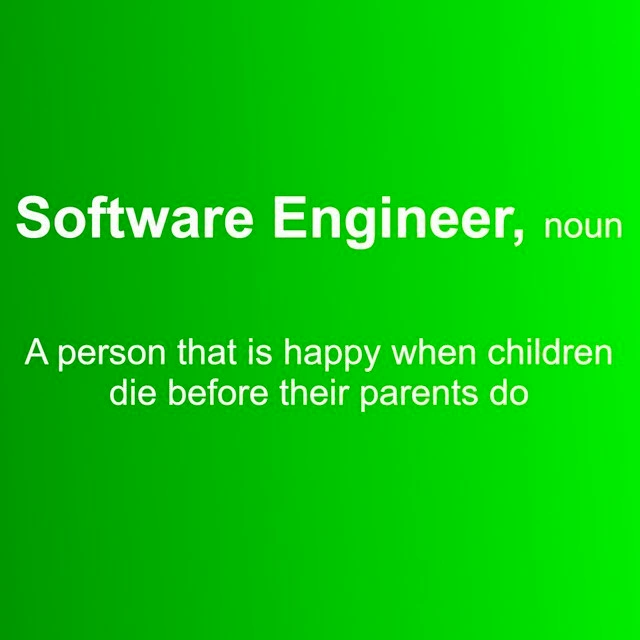
Now, about the meme format: it’s styled like a dictionary definition on a bright green background, with “Software Engineer, noun” as if we’re about to get a formal explanation. This format is a popular tech humor device. The punchline definition given – “A person that is happy when children die before their parents do” – is funny because it sounds shocking and absurd until you realize it’s talking about processes in a computer. In plainer terms, it humorously defines a software engineer as someone who celebrates when a sub-task finishes before the main task. It’s a nerdy joke that plays on the double meaning of “child” and “parent.” Anyone who’s dealt with process management or read about OS concepts will get the reference to child processes dying. For newcomers, once you learn these terms, the joke clicks: it’s not about real kids at all, it’s about being a good parent process in code and cleaning up your children. It’s a bit of DarkHumor programmers use to spice up the dry world of code. After all, talking about “child processes” and “killing tasks” is everyday stuff for us – the meme just pushes it to an extreme sounding statement for comedic effect.
Level 3: Reap What You Fork
To seasoned engineers, this meme lands as classic developer humor with a dark twist. It defines “Software Engineer” like a dictionary entry and delivers a one-liner only a techie would applaud: being happy when children die before their parents. In non-tech life, that statement is horrific. But veterans of OperatingSystems know it’s referencing the joy of proper process management. When you spawn child processes (using forks, thread pools, or job workers), you want those tasks to finish (die) cleanly before the main program (parent) exits. Otherwise, you get nightmare scenarios like zombie processes clogging up the system. Many of us have logged into a server and seen a horde of <defunct> processes – the telltale sign that some parent process forgot to clean up its kids. It’s the programmer’s equivalent of a horror movie: zombie processes everywhere, each one a “dead” child that wasn’t reaped.
The meme hits a nerve because it’s too real. Every senior dev remembers the first time they wrote a script that launched subprocesses and neglected to wait() for them. Everything worked at first, but hours or days later, the system started misbehaving. Check the process list and… surprise! A swarm of zombie children basically saying “Thanks for nothing, Dad!” 😒. Cleaning those up at 3 AM on an on-call night – that’s a rite of passage in SystemsProgramming. So yes, after you’ve been bitten by that issue, you become happy to see children die before their parents – it means you did it right and won’t have undead processes haunting your CPU. It’s dark GeekHumor, but it’s humor born from experience and relief.
There’s also comedic finesse in presenting it deadpan, like a dictionary definition on a bright-green background. The formal setup “Software Engineer, noun:” lulls you into expecting a serious definition, only to smack you with that morbid punchline. This dictionary-style meme format is popular in tech circles because it delivers absurdity with an academic tone. And the content is a tongue-in-cheek nod to what software engineers actually deal with. We celebrate weird victories: freeing memory, avoiding deadlocks, and yes, child processes dying on cue. To an outsider, it’s baffling – DarkHumor at its finest – but to us, it satirizes the mundane parts of our job. It’s funny because it’s a shared secret: only in this profession do we pop champagne (figuratively) when “child” processes drop dead in the right order.
On a deeper level, the meme highlights a quiet truth: good software engineers are basically paranoid parents to their processes. We keep track of our little ones (threads, subprocesses) and make sure none are left wandering or undead. If a child process outlives its parent unexpectedly (say the parent crashes or exits too soon), that’s usually a bug or bad design. Properly written programs either wait for their children or have plans for orphaned tasks (handing them off or shutting them down gracefully). The joke exaggerates this responsibility with macabre wording. But any senior dev who’s debugged a hanging app due to zombie children will tell you – you genuinely are happy (or at least relieved) when those child processes finish and vanish as they should. No one wants a zombie apocalypse in their process list again, thank you very much.
Level 4: Orphans & Zombies
Deep in the Operating Systems underbelly, processes live and die by strict rules. When a program (process) creates another, we call the new one a child process and the original the parent process. In Unix-like systems, this is done with the fork() system call, literally cloning the parent. Eventually these child processes exit() (die) and ideally the parent is still around to reap them (collect their exit status) using a call like wait() or waitpid(). If the parent doesn’t properly wait, the terminated child stays in a limbo state known as a zombie process – it’s dead, but not gone, haunting the process table (<defunct> in ps output) until the parent acknowledges its death. Too many zombies and you’ve got a process table apocalypse on your hands, consuming system resources.
In Operating Systems theory, letting children die before the parent means the parent can clean up after them immediately, preventing resource leaks. It’s a fundamental design for process management: each parent is responsible for its offspring’s cleanup. Orphaned children (when a parent dies first) get adopted by the system’s init process (PID 1, the ultimate foster parent of all orphans) which then reaps them to avoid everlasting zombies. This parent-child hierarchy dates back to early UNIX in the 1970s – a simple but powerful model that treats processes like a family tree. The terminology is unabashedly morbid: we kill processes, we reap or terminate them, and zombies are literally the official name for leftover child processes. (Who says kernel developers don’t have a dark sense of humor?)
The meme’s punchline riffs on these OS internals. A software engineer working in SystemsProgramming or LowLevelProgramming actually smiles at the sight of “children” dying at the right time. Why? Because it means the code is doing the proper thing: child processes finished their work and exited normally, and the parent process is still alive to clean up (preventing zombies). It’s an inside joke rooted in OS lifecycle management – a healthy system prevents zombie processes by ensuring each child dies before (or at least is reaped before) its parent. In essence, “child dies before parent” is just another day in the life of a well-behaved Unix process tree. The meme takes this dry concept and presents it with a morbidly literal phrasing, the kind that makes kernel engineers smirk and newcomers do a double-take.
Description
The image displays white text on a bright, lime-green background, formatted like a dictionary entry. The top line reads "Software Engineer, noun" in a bold font. Below it, the definition is given: "A person that is happy when children die before their parents do". This is a classic piece of dark, technical humor that relies on a metaphor from operating systems and process management. In this context, 'parent' refers to a parent process, and 'children' are the child processes it spawns. For stable system behavior, child processes should terminate and be reaped by their parent before the parent process itself terminates. If a parent dies first, its children become 'orphan processes', which can lead to 'zombie processes' - terminated processes that still occupy space in the process table. Therefore, a software engineer is 'happy' when they see the orderly shutdown of child processes before the parent, preventing resource leaks and system instability

Comments
7Comment deleted
This is my go-to interview question. If the candidate laughs, they get a job in systems programming. If they call HR, they're a great fit for management
Unix parenting tip: call waitpid() on your kids before you exit, or PID 1 becomes foster care and you’re blamed for raising zombies
After 20 years in this industry, I've learned that explaining process management to non-technical stakeholders requires careful word choice - learned that one the hard way during a board presentation about zombie processes
The real horror isn't the legacy COBOL system still running payroll - it's realizing the original developer retired in 2003, the documentation is a single README that says 'Good luck,' and the business just signed a 10-year contract extension because 'it works fine.' At least if the system had died first, you could've advocated for a rewrite in something from this millennium
Only in Unix do you cheer when the kids exit before the parent - forget to wait() and you’re running a zombie farm until PID 1 adopts them
Child process exits first? Pure joy - no zombies crashing the family server
Only in our industry does good parenting mean trap SIGCHLD and call waitpid() fast - otherwise the family tree fills with zombies