Skip to content
DevMeme
919 of 7435
Software Architecture and Other Reasons to Cry
TechDebt Post #1037, on Feb 21, 2020 in TG

Software Architecture and Other Reasons to Cry

Why is this TechDebt meme funny?

Level 1: Why Onions Make You Cry

Imagine you have a huge onion and you want to get to its center. You peel off one layer at a time. But with each layer you peel, your eyes start to water more and more. By the time you reach the middle, you’re crying because of the onion’s effect. Now imagine a toy that is wrapped in lots of nested boxes, one inside another. You open the first box, then realize there’s another box inside, then another… you might start to feel frustrated or even a bit upset because it’s taking so long to get the toy. This meme is saying software can be like that – lots of layers to go through. Each layer is like another box to open or another onion skin to peel. Developers sometimes joke that looking into a very complicated program makes them want to cry, kind of like peeling an onion does. It’s funny because it’s a silly comparison: code doesn’t literally make your eyes water, but it can make you feel overwhelmed. So, the joke is basically: “The deeper you dig into this complicated software, the more it makes you want to cry.” Even someone who isn’t a programmer can relate – it’s like when a simple task turns out to have many hidden steps, and you end up exasperated. The poor programmer is peeling back the layers of a tricky code onion, and yep – they’re crying over code in the end, both from frustration and from the onion’s “fumes.”

Level 2: Peeling Back Abstractions

For a less experienced developer or someone newer to large codebases, let’s break down the joke. Modern software is often built in layers. A layer is just a part of the program separated by its role. For example, a typical web application has a presentation layer (the UI or front-end), a logic layer (the back-end or service that applies rules and coordinates things), and a data layer (talking to the database). In theory, these layers help with CodeQuality by organizing code into neat sections – kind of like how a multi-layer cake has clearly defined tiers. This separation is a common DesignPatterns_Architecture approach, intended to make code easier to manage.

However, the meme jokes that “most software is written like an onion.” An onion has many thin layers, and you have to peel them back one after another to get to the center. In a code context, peeling back layers means digging through multiple levels of code or configurations to find what you’re looking for. HiddenComplexity refers to complexity that isn’t obvious at first glance – it’s hidden inside those layers. Each time you peel one layer in the code (open a function, jump into a class, follow a function call to another service), you find another layer beneath. It’s like those Russian Matryoshka dolls: you open one doll, there’s a smaller one inside, then another inside that, and so on.

Why would that make you want to cry? Two reasons. First, peeling a real onion releases chemicals that irritate your eyes – hence the tears. In code, the irritant is frustration. Imagine you’re debugging a problem: you check one module to find the cause, but it just calls another module. So you open that one, but it in turn calls yet another module or uses a configuration file. Each hop is another layer to investigate. What you hoped would be a quick fix now becomes a lengthy treasure hunt through the codebase. This is extremely frustrating, especially when you’re under pressure to fix a bug. Those are the debugging_tears.

Second, each layer might introduce its own quirks or TechnicalDebt. Technical debt is a term for the consequences of quick-and-dirty design decisions. For instance, if the team rushed to add a feature, they might not have integrated it cleanly; instead they just slapped the new code on top of the old code. Over time, those quick fixes pile up as debt – you “borrowed” time by not cleaning up, but you pay for it later with extra difficulty. RefactoringNeeded is a hint that you should go back and improve the code structure. But if that refactoring never happens, you end up with lots of unnecessary or poorly-thought-out layers. It’s like painting over rust – eventually the rust pokes through again, and by then you have multiple coats of paint to scrape off as well.

This layered onion code is also related to what we call SpaghettiCode. Spaghetti code originally describes code with a tangle of unstructured paths (like a bowl of tangled spaghetti). Onion-style code has a structure (layers on layers), but it can still feel tangled in a different way – you have to move linearly through layers to follow the program’s flow, rather than through one straightforward path. Another term you might hear is lasagna code (lots of layers, like a lasagna). In both cases, it’s considered a CodeSmell when there are too many layers doing trivial things. A code smell is basically an indicator of a potential problem in the code – something isn’t outright broken, but “smells off” and likely should be improved.

So, the meme uses the onion analogy to convey that digging into a complex, multi-layered codebase can be a tearful experience. It resonates with developers because many of us have felt that pain: peel_back_layers of an application trying to find the root cause of a bug, and with each step inward, the design makes less sense or the code gets older and scarier. It’s funny in a bittersweet way – we laugh because it’s true. It’s a form of DeveloperHumor that also gently criticizes poor CodeQuality and excessive TechnicalDebt. The message to a junior dev: if you ever find yourself going through one file, then into another function, then into another module just to understand one thing… congratulations, you’ve experienced the onion-like nature of bad software design! Keep some tissues handy 😉.

Level 3: Tiers of Tears

At the deepest technical level, this meme highlights a pernicious architecture anti-pattern: layered complexity piled so high that it becomes comical and tragic. Seasoned engineers know that every additional abstraction layer (each new micro-service, wrapper class, facade, configuration file, etc.) is supposed to solve a problem – but too often it just shifts the problem one layer down. There’s a classic saying in software design: “All problems in computer science can be solved by another level of indirection… except for the problem of too many layers of indirection.” This onion analogy nails that paradox. CodeQuality suffers when we keep band-aiding a system with extra levels of indirection. Instead of refactoring the core logic, teams add another API on top of an API, or a framework around a framework. Over time, the codebase becomes an onion of abstractions: dozens of interconnected layers you must peel through to trace a single feature. Each layer promises to simplify or decouple, but in practice they often become hiding spots for complexity.

Think of a simple task like retrieving a user’s name in a large enterprise app. On paper, there might be a well-designed onion architecture with clear DesignPatterns_Architecture separation (UI → Service → Repository → Database). But in a messy real-world codebase laden with TechnicalDebt, it looks more like this:

  1. The UI calls a UserServiceProxy – a thin wrapper around the real service.
  2. The UserService then calls a general DataFetcher utility (why? No one remembers).
  3. DataFetcher delegates to a UserDAO in the data access layer.
  4. The UserDAO calls a lower-level ORM API to fetch from the database.
  5. The ORM finally executes an SQL query on the DB.

At each step, the code is just handing off to the next layer with minimal real logic. By the time you reach the actual data, you’ve journeyed through five or six files/modules, each one adding little more than indirection. This is layered_software taken to absurdity – a prime example of HiddenComplexity. No wonder debugging such a scenario can make a developer want to cry. You fix a bug in one layer, only to discover it was actually caused by an assumption in another layer two steps deeper. Peel_back_layers, find another surprise, feel debugging_tears forming – repeat.

From a senior dev’s perspective, the humor of this meme comes from painful familiarity. We’ve all seen SpaghettiCode that was refactored into “lasagna code” – neatly layered slices of pasta that still collectively form a messy blob. 😅 What’s worse is when each generation of programmer simply slaps yet another layer on top because they’re too afraid to touch the rotten core. The result? A Big Ball of Mud architecture wearing a layered disguise. The code might have dozens of classes and interfaces (nice in theory), but under the hood it’s the same tangled logic, just spread thinner. It’s a CodeSmell when you have to open 10 files to understand a simple feature. That smell is the pungent aroma of TechnicalDebt – old quick-fixes and patchwork solutions accumulated over years. And like a real onion, this accumulation can literally bring tears to a veteran developer’s eyes: either from laughing at how convoluted it’s become, or from the despair of having to fix it. In short, the meme pokes fun at how CodeComplexity grows layer by layer until even the most battle-hardened coder is left sobbing into their keyboard. It’s a slice of DeveloperHumor wrapped around a bitter truth: the deeper you dive into a poorly maintained system, the more painful secrets you uncover.

Description

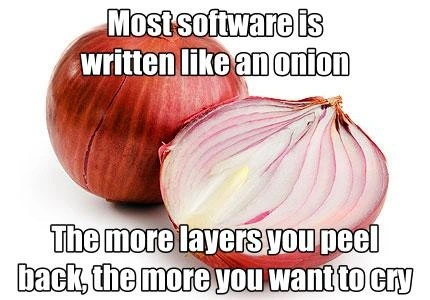
An image macro meme featuring a whole red onion and another one cut in half, revealing its concentric layers, set against a plain white background. The text, in a bold, white 'Impact' font with a black outline, is placed at the top and bottom of the image. The top text reads, 'Most software is written like an onion'. The bottom text completes the thought: 'The more layers you peel back, the more you want to cry'. This meme uses a simple but effective metaphor to describe the experience of working with complex, poorly documented, or legacy codebases. The 'layers' represent levels of abstraction, modules, or historical additions to the software. As a developer 'peels' them back to debug an issue, add a feature, or simply understand the system, they often uncover increasing levels of complexity, technical debt, and questionable design decisions, leading to frustration and despair, much like the eye-stinging effect of cutting an actual onion


Comments

7
Anonymous ★ Top Pick The first layer is a clean DI framework. The second is a mess of circular dependencies. By the core, you're just staring at a global variable that controls everything and weeping
  1. Anonymous ★ Top Pick

    The first layer is a clean DI framework. The second is a mess of circular dependencies. By the core, you're just staring at a global variable that controls everything and weeping

  2. Anonymous

    Our ‘onion architecture’ means a single HTTP call tunnels through a Python gateway, a gRPC sidecar, two feature-flag decorators, and a legacy SOAP adapter before the COBOL core finally responds - pair-programming with a raw Vidalia would sting less

  3. Anonymous

    After 15 years in the industry, I've learned that every 'clean architecture' diagram looks beautiful until you're 8 layers deep trying to add a simple field to the database, navigating through DTOs, mappers, repositories, use cases, and domain models, only to discover the original developer left because they couldn't debug their own creation

  4. Anonymous

    This perfectly captures the experience of inheriting a 'well-architected' enterprise system where each layer of abstraction was added by a different architect who never met the others. You start with a simple bug fix, peel back the repository layer, find three different ORM abstractions, discover a custom event bus wrapping another event bus, encounter a service layer that's actually seven micro-services in a trench coat, and by the time you reach the actual business logic buried six layers deep, you're questioning every life choice that led you to this moment. The real kicker? The original developer left a comment saying 'TODO: simplify this' dated five years ago

  5. Anonymous

    Onion architecture: we kept adding layers to reduce coupling - now a null pointer tours adapters, mappers, proxies, and the service mesh before it reaches my eyes; at least the crying is load-balanced

  6. Anonymous

    Onions have natural layers; software's are 'strategic' wrappers from every architect since Y2K, each leaking their own brand of tears

  7. Anonymous

    Our ‘onion architecture’ turned out to be 14 layers of DTOs around one 300-line SQL query - great separation of concerns, zero separation of tears

Use J and K for navigation