Skip to content
DevMeme
4940 of 7435
A Supabase Tweet on a JPG-less Utopia
DataFormats Post #5407, on Sep 7, 2023 in TG

A Supabase Tweet on a JPG-less Utopia

Why is this DataFormats meme funny?

Level 1: The Blurry Picture Joke

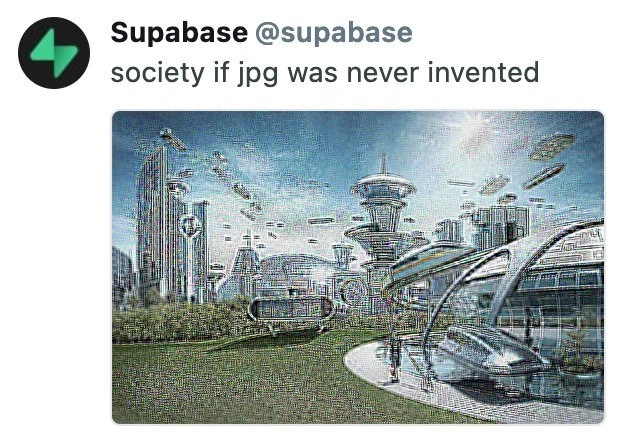
Imagine you have a beautiful painting full of details and vibrant colors. Now imagine someone takes that painting and makes a photocopy of a photocopy of a photocopy, each time using less ink to save money. Eventually, the picture that comes out is all blurry, blocky, and messed up, right? Now here’s the joke: someone said “Wouldn’t the world be perfect if nobody ever used that cheap photocopy method?” — and to show this perfect world, they hold up a picture that itself looks like it was ruined by the cheap photocopying! It’s a silly irony. In the meme, JPEG is like that cheap photocopy method for images: it makes images smaller to store or send, but if you overdo it, the image quality gets really bad (blurry squares everywhere). So the meme shows a “perfect future city” (like a utopia with flying cars) and jokes that we’d have this amazing future if the JPEG format was never invented. But the funny part is the picture of that city looks terrible and blocky because of JPEG’s bad effect. It’s like saying “Imagine how clean my room would be if mud didn’t exist” while you’re standing in a room where everything is covered in mud. 😅 The humor comes from that contradictory visual: the caption says life would be perfect without JPEG, but the picture is clearly suffering from JPEG problems. You don’t need to know the tech details to laugh at it — basically, it’s a joke about a blurry picture ruining a gorgeous scene, right when someone is claiming a life without blurriness would be paradise. It’s a fun, nerdy way to tease a commonly used image format. Even if you didn’t know what JPEG is, you can see that the picture is messed up and guess, “Oh, whatever JPEG is, it must be what made this picture look so bad!” The meme is just exaggerating and being goofy: no one actually thinks a file type is the cause of society’s problems. It’s a playful way for computer folks to bond over something trivial (blurry pictures) and make it absurdly big. In short, it’s funny because it’s like a cartoon – saying one thing, but showing the exact opposite in an exaggerated way so we all get the joke.

Level 2: When Formats Collide

Let’s break down the key ideas for a newer developer or anyone not deeply familiar with image formats. JPEG (pronounced "jay-peg") is a very common image file format (with the extension .jpg or .jpeg) that uses lossy compression. Lossy means it intentionally throws away some image detail to make the file size much smaller. The more you compress (smaller file), the more detail you lose. At normal settings, JPEG is great for photographs: it can reduce an image to like 1/10th of its original size and still look almost as good as the original to our eyes. But if you crank up the compression (very high compression = very low quality setting), you start to see ugly compression artifacts – basically visual glitches and loss of clarity introduced by the compression process. That’s exactly what’s plastered all over the meme’s image. The picture of the futuristic city has big blocky patches, weird fuzzy halos, and color blotches because it’s heavily compressed as a JPEG. Those blocky patches come from JPEG’s method of dividing the image into little 8x8 pixel blocks – at high compression, each block ends up one flat color or a simple pattern, so you literally start seeing the squares. The weird halos and fuzzy edges (we call that ringing) show up around sharp lines or text when JPEG has removed too much high-frequency detail. And color banding is when a smooth gradient (like a blue sky) turns into visible stripes of solid color because the compression reduced the number of color shades. All these are tell-tale jpeg_artifacts. You’ve probably seen similar artifacting in low-quality JPEGs or in memes that have been saved and reposted a million times (each save adding more compression).

Now, why would someone joke “society if jpg was never invented”? This refers to a meme format where people imagine a utopian future (hence the shining city with flying cars) if a certain thing never existed or a certain change happened. It’s usually used humorously or sarcastically. For example, “society if everyone wrote clean code” might show a futuristic paradise, joking that bad code is the only thing holding us back from utopia. Here, the target is the JPEG image format. It’s a playful way of saying “imagine how perfect everything (society) would be if we didn’t have to deal with JPEG’s lousy compression.” Of course, this is an exaggeration — nobody actually believes a file format is holding back society. It’s tongue-in-cheek. The irony (and the humor) is amplified by the fact that the image itself is ruined by JPEG compression. In other words, to depict a world with no JPEG, they used a super low-quality JPEG image, thereby demonstrating exactly what’s so bad about JPEG. It’s a very literal visual joke.

For context, developers often have to choose between image formats based on needs. The image_format_wars go like this:

  • JPEGLossy compression, meaning some data is lost. Great for photographs and complex images because it achieves small file sizes. Bad for images that need to stay razor-sharp or have text/graphics, because you’ll notice blurring and artifacts. (Example: a photo on a website is usually JPEG, since you get a nice balance of quality and size. But if you zoom in a lot or save it repeatedly, it gets ugly fast.)
  • PNGLossless compression, meaning no data lost; the image stays pixel-perfect. Great for logos, icons, or anyplace you need crisp lines or transparency. Downside: files are much larger than JPEG for photos. (Example: a company logo will often be a PNG to keep it super crisp, but a full photograph as PNG would be huge in file size.)
  • WebP – A more modern format (from Google) that can do both lossy and lossless. Often produces smaller files for the same quality compared to JPEG. Not supported everywhere initially, but it’s becoming common. Many websites now serve WebP images to modern browsers because you get good quality with even tinier files than JPEG.
  • GIF – An older format, only allows 256 colors, often used for simple animations. Not relevant for high-quality photos, but historically part of format debates.

In the lossy_vs_lossless debate, it’s about a trade-off: do you want a smaller file or perfect quality? JPEG chose smaller files at the cost of quality (but tried to do it in a smart way that people mostly wouldn’t notice unless you go too far). Supabase, the account shown here, is a tech company, and their Twitter account posting this means they’re engaging in a little inside joke with the developer community. It’s presented as a tweet (with the Supabase logo and handle), which is a common way memes spread on tech Twitter — a funny thought packaged as a tweet screenshot so it looks official or shareable.

The phrase “society if jpg was never invented” with the gleaming city image is actually a two-layer joke. First layer: using the popular “society if…” meme template (the futuristic city represents society achieving perfection). Second layer: the reason society is perfect here is “no JPEG was invented,” which is a pretty absurd reason when you think about it — that’s what makes it funny. It’s poking fun at how programmers sometimes overemphasize the importance of niche tech grievances. To non-devs, arguing over image formats might seem trivial, but among devs, it can be a heated topic (just search debates on “JPEG vs PNG vs WebP” and you’ll see!). By showing the picture full of compression_irony (the image is clearly a JPEG gone wrong), it’s as if the meme is winking and saying, “See? Look how awful JPEG is. We’d be flying around in hover cars by now if we didn’t have to deal with this!” Of course, this is all in jest.

If you look closely, the city image was probably intentionally saved with very low quality to produce those artifacts. This isn’t an accident — it’s the joke. Someone presumably took a nice futuristic city rendering (which normally would look super crisp), and then exported it as a .jpg with something like 10% quality (in Photoshop or using a script) to get that pixelated, artifact-ridden result. In programming or using image libraries, you might see a parameter for JPEG quality (0-100 scale). Setting a low number creates exactly what you see: tiny file, terrible image. For instance, using an image processing library:

from PIL import Image
img = Image.open("utopia_highres.png")           # open a high quality image
img.save("utopia_compressed.jpg", quality=5)    # save with very low quality to create artifacts

This would result in an image similar to the meme’s — a dramatically degraded version, full of blocks and bands. Developers share a laugh here because we’ve all seen someone accidentally do this or push compression too far in the name of optimization. It’s both horrifying and funny to see a beautiful image reduced to “potato quality” (as internet slang would say). And using that as the punchline shows a bit of self-awareness: the meme maker knows it’s ridiculous to blame “.jpg the file format” for society’s problems, so they ham it up by literally demonstrating JPEG’s worst-case scenario.

Finally, the connection to Graphics and DataFormats is straightforward: this meme is about an image file format and its visual effect. It’s an inside joke for folks who deal with images, graphics, and data encoding. If you’re a junior dev, the takeaway is: JPEG is a lossy image format that leaves artifacts when overused, PNG is lossless and stays perfect but larger, and people love to banter about which format is best. The meme exaggerates this into a comedic “what-if” scenario. And if you’ve never seen the “society if…” meme template before, just know it’s always a hyperbole — attributing world peace or utopia to the absence of some mundane annoyance (in this case, a file format). It’s funny because it’s so over-the-top and specifically targeted. Now you’ll recognize those blocky, crusty artifacts as the hallmark of an over-compressed JPEG — basically the visual equivalent of a highly watered-down drink. Once you’ve seen it, you can’t unsee it! And the next time you hear devs joking about image formats or see a meme that looks deliberately low-quality, you’ll be in on the joke.

Level 3: Compression Irony in Paradise

For seasoned developers and graphics geeks, this meme hits on a very specific brand of tech humor. The tweet-style meme text says “society if jpg was never invented,” paired with that gleaming futuristic skyline. This format is a well-known meme culture trope: people imagine a utopian future “society” if some annoying technology or problem never existed. Here, the butt of the joke is the JPEG image format. It’s a bit of ironic hyperbole — implying that if only we never had to deal with .jpg files and their shortcomings, the world (or at least our digital imagery) would be perfect. The humor is cranked up by the glaring contradiction between the message and the medium: to depict a world free of JPEG, they’ve attached an image that is absolutely wrecked by JPEG compression artifacts. Heavy compression artifacts. The pristine sci-fi city of the future looks like it’s being viewed through a grimy, pixelated lens. It’s as if the meme itself fell victim to the very thing it’s criticizing. This is deliberate, deadpan irony that developers find hilarious — a sort of self-referential joke. It’s like complaining about how awful pop music is by performing a song that’s intentionally, comically bad. Here we’re complaining about JPEG by showcasing an exaggerated example of a JPEG-ruined image.

Why is this so funny (and relatable) to people in tech? For one, image format wars and endless debates about lossy vs lossless compression are a real thing in developer circles. Web developers, graphic designers, and software engineers have all at some point argued over using JPEG vs PNG vs WebP for certain images. JPEG is the old guard: it’s ubiquitous and great for photos due to high compression, but it’s lossy, meaning it can introduce fuzziness and blocks. On the other hand, PNG is a lossless format (perfect quality, no artifacts) but produces much larger files, making websites load slowly if used indiscriminately. For years, anytime someone noticed an image looking fuzzy or full of artifacts, a common salty remark was “ugh, JPEG strikes again!” Many of us have experienced the scenario where a beautiful high-res image (say a company logo or a screenshot) gets uploaded to a system that automatically compresses it into a grainy JPEG to save bandwidth. It’s painful to see crisp graphics turn into a blocky mess. This meme taps directly into that shared annoyance. It imagines a world where that annoyance never existed — no more blurry compression, no more image quality trade-offs. Society thrives! The soaring glass towers and flying cars symbolize perfection. And yet, the image itself is absurdly blemished, basically screaming, “Nope, we can’t have nice things.” 😂

The involvement of Supabase @supabase (a real tech company known in developer communities) adds another layer for the insiders. The meme is styled as if Supabase’s official Twitter account posted the joke, complete with a verification badge. It’s likely the real Supabase did tweet this, or someone mimicked their social media style, which gives the meme a bit of tech community cred. Supabase is a company providing a backend platform (essentially an open-source Firebase alternative), which on the surface has nothing to do with image formats. That disconnect makes it even funnier — it’s like even database folks couldn’t resist dunking on JPEG. Tech companies on Twitter often share lighthearted tech memes to engage developers, and this is a prime example. The format also mimics those “society if…” viral posts where people jokingly blame one thing for holding back all of civilization. Every dev immediately recognizes the hyperbole: we’re playfully blaming JPEG for all our woes.

But beneath the humor lies some truth that experienced devs nod at. The lossy compression of JPEG introduced a generation of compromises. Yes, it enabled the early web to actually have images (back in the 90s, when you had to download a single image over dial-up, smaller files were a godsend). JPEG’s efficiency made digital photography and web design viable in an era of limited storage and bandwidth. However, it also normalized a lower standard of image fidelity. How many times have you opened a picture expecting clarity, only to find it murky and full of compression scars? Or tried to zoom in on a detail only to see a mosaic of squares? Those blocky squares and muddy colors are almost a defining aesthetic of “old internet” and poorly saved images. There’s even a whole sub-genre of memes called “deep-fried memes” where images are deliberately re-saved and over-compressed repeatedly to amplify the noise and artifacts — exactly like the city image in this meme — to the point of absurdity. It’s meme culture’s way of being ironically cringey. Here, that deep-fried look is used as satire: “Look, JPEG ruined our perfect future. Thanks a lot, Joint Photographic Experts Group!”

The compression irony is also a geeky inside joke about how no one actually hates JPEG enough to think society’s fate hinges on it. It’s an exaggeration for laughs. In reality, if JPEG wasn’t invented, we’d probably have something similar, or we’d use other formats like BMP or TIFF (which would make the internet painfully slow), so maybe society would actually be worse off! 😂 Many senior devs remember when alternatives like JPEG2000 (using fancy wavelet compression to avoid block artifacts) came out around year 2000, promising to replace JPEG, or when WebP (Google’s more efficient format) arrived in the 2010s. Technically superior or not, none fully dethroned JPEG. Why? Because the ecosystem momentum and compatibility often matter more than perfection. So here we are in 2023, still living with .jpg as a default image format, and still occasionally griping about its flaws. This meme winks at that reality. The utopian city is “ruined” by compression artifacts as a tongue-in-cheek way of saying, “Imagine how much prettier everything could be if we didn’t have to sacrifice quality for smaller files—oh well, too bad we do!” It’s a shared joke about data formats shaping our digital experience: even in our wildest ideal scenario, we can’t escape the fact that heavy compression makes things ugly. In a way, it’s also riffing on the trend of the “society if” meme itself, which always features that same style of ultra-refined future city. Usually those memes aren’t literally corrupted; they just show the perfect city sincerely. By intentionally ruining the perfect city picture with JPEG artifacts, the meme-maker is doubling down on the nerdiness. They’re saying, “I’m not just going to tell a joke about a world without JPEG, I’m going to visually demonstrate why JPEG is ‘bad’ by using a painfully compressed image.” It’s a layered joke that developers and graphic artists can appreciate on multiple levels — aesthetic, technical, and cultural.

In workplaces and online forums, this kind of humor resonates especially with front-end developers or anyone who’s had to optimize images. They remember the bug reports or complaints: “Why is our hero image blurry on the homepage?” “We need smaller images for mobile, but it looks terrible now.” It’s always a balancing act between image quality and performance. This meme exaggerates that into a black-and-white scenario (JPEG existing = dystopia, JPEG gone = utopia) purely for comedic effect. The TechHumor here comes from recognizing that absurd simplification and the dramatic imagery used to sell it. In short, it’s hilariously dramatic irony for the tech crowd: an ideal world promised by the caption, immediately undercut by the picture being evidently harmed by the very thing that wasn’t supposed to exist in that ideal world. It’s the perfect compression irony punchline: we’d live in a gleaming paradise… if not for those darn blurry JPEGs! And yes, we’re chuckling because we’ve all seen exactly this kind of compression fail, just maybe not usually overlaying a utopian society.

Level 4: DCT Dystopia

At the deepest technical level, this meme is poking fun at the fundamentals of JPEG image compression — specifically the lossy techniques that make images blocky and blurry when over-compressed. JPEG’s algorithm works by breaking an image into small blocks (typically 8×8 pixels) and converting each block from the spatial domain (actual pixel colors) into the frequency domain using the Discrete Cosine Transform (DCT). Essentially, the DCT represents the block as a combination of cosine wave patterns at various frequencies. The next step is quantization, where the encoder aggressively rounds off or discards a lot of the high-frequency information (the tiny details and sharp edges) to save space. This is where the trouble begins: heavy quantization means many of those DCT coefficients drop to zero, so each 8×8 block loses detail and can’t perfectly reconstruct the original. The result? The infamous JPEG artifacts we see splattered all over this meme’s image.

In the meme’s futuristic cityscape, the blocky artifacts (those chunky square tiles of uniform color) are a direct consequence of the 8×8 DCT blocks being compressed so hard that each block is almost a single average color. The neat boundaries between blocks become visible, turning what should be a smooth sky or a glass-smooth building into a patchwork quilt of pixels. Then there’s the color banding – notice how what should be gentle gradients of blue in the sky or subtle shadows on the towers instead appear as abrupt stripes or “bands” of color. This happens because JPEG’s compression reduces the number of distinct color shades it can represent in those areas; smooth transitions get quantized into fewer levels. JPEG also often down-samples color information (for example, using 4:2:0 chroma subsampling), essentially tossing out some color detail to save bytes (the human eye is less sensitive to color nuance than brightness). Combine that with heavy quantization and you get bands of color where there used to be a smooth gradient. Lastly, ringing artifacts (those halo-like echoes around sharp edges and text) appear because the high-frequency components that cleanly delineate edges have been stripped away. In the frequency domain, cutting off high frequencies causes a ringing oscillation around edges when you transform back — kind of like an overshoot. In our utopian image, edges of futuristic buildings and flying cars have faint ghost outlines or noisy halos, evidence of the DCT’s limited frequency basis struggling to represent a sharp boundary with too few coefficients. It’s the lossy vs lossless trade-off in action: by throwing away detail to massively shrink file size, JPEG introduces noise and distortions that weren’t in the original image.

From an information theory perspective, this is a classic case of pushing compression beyond the entropy limits of the image’s content. Every image has a certain amount of information (randomness/complexity), and lossy compression like JPEG intentionally removes the “less important” information (according to a model of human perception) to reduce data size. If you crank the compression to an extreme (as was likely done here on purpose), you’re removing so much information that the reconstructed image becomes a garbled, blocky approximation. The society if jpg was never invented image has probably been saved with an absurdly low JPEG quality setting (think quality level 5 or 1 on a 0–100 scale). At such low quality, the standard JPEG quantization tables shred detail mercilessly: most high-frequency DCT coefficients are zeroed out and even some lower-frequency ones are heavily rounded, so you see big flat squares and weird texture instead of fine detail. The encoder might also use aggressive Huffman coding on those run-length encoded zeroes, but by that point almost everything is zeros — it’s a compression quagmire where the file size is tiny but the picture looks like a bad videogame texture from 1996. Ironically, advanced engineers have developed better image formats (like JPEG2000 with wavelet transforms, or newer codecs like WebP and AVIF that use more modern techniques) specifically to avoid these kinds of artifacts, but plain old JPEG remains everywhere due to its simplicity and universal support. In an alternate timeline where JPEG was never invented, maybe we’d have standardized on a purely lossless format (imagine everything as PNG/bitmap — crystal clear but huge files) or a more modern lossy codec from the start. But in our reality, the 30-year-old JPEG standard still underpins a huge chunk of images on the internet, carrying along its 8×8 DCT baggage. This meme humorously embodies that baggage: a vision of a perfect future marred by the very compression artifacts JPEG introduced. The utopia has been literally quantized and compressed into a dystopia of noisy blocks and bands, all thanks to the algorithm that’s supposed to make our image files smaller. It’s a nerdy, tongue-in-cheek reminder that technical decisions (like a particular data format) can have aesthetic and quality consequences — even decades later we recognize a “JPEG’d” image instantly by its scars.

Description

This meme is a screenshot of a tweet from the company Supabase. The text of the tweet reads, 'society if jpg was never invented'. Below the text is an image depicting a gleaming, futuristic, utopian city with sleek, modern architecture, flying vehicles, and green park spaces. The visual humor and irony come from the fact that the image itself is heavily stylized to look like ASCII art or as if it has been passed through a strong edge-detection filter. This creates a highly artifacted, low-fidelity rendering of the supposed high-tech utopia. The joke is multi-layered: it plays on the common developer complaint about the lossy compression artifacts of the JPG format, while ironically presenting the 'better' world in a format that is itself visually degraded and inefficient, mocking the idea that a single technology is the root of all problems
Comments

7
Anonymous ★ Top Pick Society without JPGs would be a utopia, not because of higher image fidelity, but because we'd finally have enough storage and bandwidth from not saving petabytes of JPEGs to run our ASCII-art-rendered cities
  1. Anonymous ★ Top Pick

    Society without JPGs would be a utopia, not because of higher image fidelity, but because we'd finally have enough storage and bandwidth from not saving petabytes of JPEGs to run our ASCII-art-rendered cities

  2. Anonymous

    Proof that if you ban JPEG but keep the 100 KB perf budget, someone will just reinvent lossy compression and we’ll all end up living inside 8×8 DCT blocks anyway

  3. Anonymous

    Without JPEG we'd still be arguing whether BMP or TIFF should be the web standard while our CDN bills approach the GDP of small nations

  4. Anonymous

    Ah yes, the classic paradox: complaining about JPG compression artifacts using an image so heavily compressed it looks like it was saved at quality level 5 through a chain of seventeen Discord uploads. It's the visual equivalent of writing 'TODO: refactor this' in production code that's been running for five years - we all know what should happen, but here we are, living with the consequences of choosing file size over fidelity since 1992

  5. Anonymous

    Without JPEG’s DCT and 4:2:0, every homepage hero becomes a 12MB PNG and the postmortem reads: egress budget exhausted, contributing factor - marketing uploaded a bitmap

  6. Anonymous

    If JPEG hadn’t normalized DCT and 4:2:0, marketing would ship 8K lossless PNG hero banners - the CDN bill would dwarf the database, and our performance OKR would be “raise Series B.”

  7. Anonymous

    JPEG: where you pick quality=90 to halve file size, but inherit eternal block artifacts haunting your A/B tests

Use J and K for navigation