The Pixelated Utopia of a World Without JPEGs
Why is this DataFormats meme funny?
Level 1: Blurry on Purpose
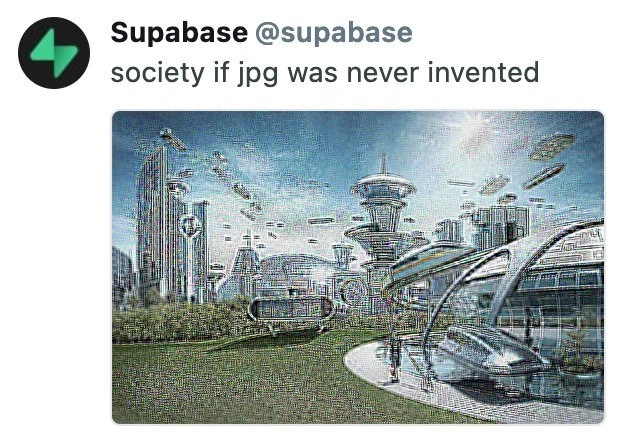
Imagine someone said, “If video games were never invented, we’d all be living in a super futuristic city with flying cars and everything.” It’s a pretty silly claim, right? One little thing like video games isn’t actually going to decide if we have a utopia or not. Now, to make it even sillier, picture that they show you an image of this supposed perfect future world – but the picture looks like an old pixelated video game! The city is all blocky and blurry. You’d probably laugh because the person is kind of contradicting themselves: they’re blaming video games for holding us back, yet they illustrate the “better world” using a video game-style image.
That’s exactly how this meme’s joke works. It says life would be amazing if the JPEG image format never existed (JPEG is just a type of file for pictures, like your phone uses to save photos). But the picture of this amazing future is made to look low-quality and blurry on purpose – the same kind of bad picture quality that JPEG can cause when overused. It’s funny because it doesn’t make sense in a deliberately goofy way. It’s like blaming one tool for all of society’s problems and then using that tool’s biggest flaw as the proof. Of course, in real life, not having JPEG around wouldn’t give us gleaming sci-fi cities overnight. The meme is just playing around, making a big exaggeration for a laugh. The blurry, blocky city is there to remind us of those times we’ve seen a badly saved image. So the whole thing ends up being a joke about how we sometimes love to hate a piece of technology, blaming it for everything – even while we’re still using it in the joke itself. It’s a bit contradictory and totally ridiculous, and that’s why it’s amusing even at a basic level: the picture says “better world” but looks “worse,” and our brain finds that mismatch kind of funny.
Level 2: Quality vs. Size
Let’s break down what’s going on in this meme in simpler terms. First, JPEG is an image format – basically a standardized way to store a picture in a computer file. There are others you might have heard of, like PNG or GIF or BMP. Each format has its own way of packing up the visual data. JPEG is famous for being really good at making image files small (so they take up less disk space or download faster) by using something called lossy compression.
Now, data compression means squeezing data so it uses fewer bytes. There are two main kinds:
- Lossless compression: Nothing is lost; every bit of information can be recovered. Formats like PNG use this. It’s like zipping up a file – you make it smaller, and when you unzip, you get the exact original back. The downside is you can only compress so much; you might reduce an image’s file size by half or so, but not to a tiny fraction without some clever tricks.
- Lossy compression: Some data is thrown away to save more space. The idea is to remove details that hopefully people won’t notice much. JPEG uses this approach. It’s like summarizing a long story: the summary is shorter and gives the gist, but it doesn’t contain every exact detail of the original story. Once lost, those details can’t be recovered from the summary.
JPEG’s lossy compression was designed for photographs and complex images. It was a game-changer because you could take a large image and make the file maybe 10 times smaller, and it would still look pretty good to most people. This was crucial in the early internet days (and even now on slow connections or limited storage), because smaller images mean faster loading websites and more images fitting on your camera’s memory card. The trade-off is that a JPEG image is not an exact 1:1 copy of the original image – it has approximations. If you compress lightly, you probably won’t notice a difference. If you compress a lot (to get a really small file), the image starts to look bad.
What do we mean by “look bad”? This is where compression artifacts come in. Artifacts are visual quirks or errors introduced by the compression process. In a heavily compressed JPEG, you might see:
- Blockiness: The image can break into small square blocks (often 8×8 pixels each) where each block is kind of one color or pattern. Instead of a smooth transition, you see a patchwork.
- Blurriness: Fine details (like text or thin lines) get blurred or smeared out. It’s like the image got a bit muddy.
- Color banding: Gradients (like a clear blue sky going from bright to darker blue) lose their smoothness and turn into noticeable bands or rings of color.
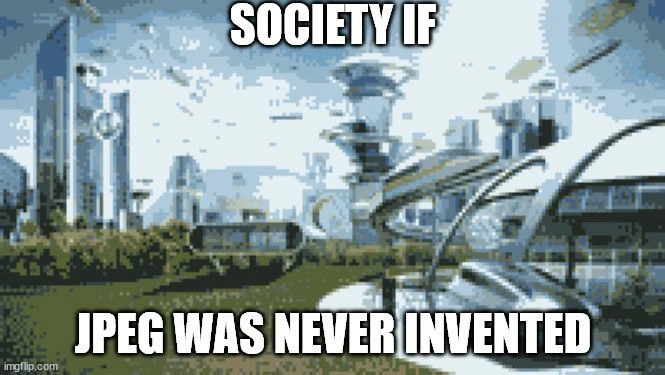
In the meme’s picture, you can clearly see these effects: the whole futuristic city scene is very pixelated (blocky) and blurred. The quality is intentionally bad. If you’ve ever opened a low-quality JPEG or a meme that’s been copied and reposted too many times, you’ve probably seen something similar. It’s the kind of image where you joke, “wow, what did they save this with, 5% quality?”
Now, the text of the meme says: “SOCIETY IF JPEG WAS NEVER INVENTED.” In simpler terms, “imagine the world if we never had JPEG.” And the picture is a super high-tech city of the future – like something out of The Jetsons or a sci-fi movie – but, humorously, shown in really low resolution. This meme belongs to a meme genre where people say “society if X never happened” or “society if X did happen,” with a picture of a utopia (perfect society). It’s a way to jokingly credit or blame a single thing for the state of the world. It’s never serious; it’s always an exaggerated joke. For example, someone might quip “society if everyone used version control properly” with a picture of flying cars and paradise, implying that one little developer habit would magically solve all of humanity’s problems. It’s sarcasm and hyperbole for comedic effect.
So here, they’re joking that if the JPEG format hadn’t been created, we’d be living in a way more advanced world (hence the futuristic city). Obviously, that’s a pretty silly notion – image file formats aren’t really the deciding factor in societal advancement! This is what makes it funny: it’s an outrageous exaggeration.
The irony is turned up to eleven by the fact that the image of that advanced world looks awful. It’s full of the problems that JPEG causes. It’s like saying “wouldn’t life be beautiful without JPEG’s ugly compression?” while showing something ugly from compression. The meme is essentially making fun of itself. It’s as if it’s demonstrating exactly why JPEG was invented (to avoid ugliness) while claiming we’d be better off without it. That contradiction is intentional and is the source of the humor.
To a newer developer or someone not deeply familiar with image formats, here’s the context:
- JPEG – A very common image format, particularly good for photographs. Uses lossy compression, meaning smaller files but potential quality loss. Great for saving space/loading via limited bandwidth. Not great for text, sharp graphics, or if you need absolutely perfect reproduction.
- PNG – Another common format. Uses lossless compression. Keeps image quality perfect, but files are larger compared to JPEG for photographic images. Often used for images that have transparency or that need to stay sharp (like logos or interface screenshots).
- BMP – A raw Bitmap image. Basically no compression (every pixel’s data is stored). These files are huge. Almost nobody uses BMPs on the web because they take too long to transfer.
- GIF – An older format, lossless but limited to 256 colors, mainly famous for simple animations nowadays. Not suitable for detailed photographs either (color limitation).
- WebP/AVIF – Newer generation formats that also use lossy compression (or can do lossless) but more efficiently than JPEG. They’re trying to supersede JPEG in the web world, but adoption is gradual.
If JPEG was “never invented,” realistically we would have just used something else to compress images (because we needed to compress images somehow). Perhaps we’d use wavelet compression (like in JPEG2000 or later formats) or rely more on improving network speeds to send bigger PNG files. The meme isn’t really a serious alternate history though – it’s just picking JPEG as a funny scapegoat.
So the bottom line for level 2: This meme is jokingly blaming an image format for preventing a utopian future. It uses a well-known meme setup (“society if [X]”) and then breaks its own premise by illustrating that future in a very low-quality way (the kind of low quality that having JPEG typically causes!). It’s a playful jab at JPEG’s weaknesses. People who see a lot of internet images or have dealt with too-compressed pictures will recognize the joke immediately. They know what those blocky artifacts mean, and they know it’s over-the-top to claim an entire society is held back by an image data format. The humor lives in that overstatement and the visual contradiction between the idea of a perfect future and the reality of a messed-up picture. In short: JPEG makes images look worse if overused, so here we imagine no JPEG = everything looks amazing... yet we deliberately made the image look terrible as a gag. It’s tech humor wrapped in a meme.
Meme Text:
SOCIETY IF
JPEG WAS NEVER INVENTED
(The meme’s captions are formatted as big white uppercase text at the top and bottom of the image, as is classic in many memes.) This text is just reiterating the joke setup: think of how society could have been, if not for JPEG!
Level 3: Lossy Legacy
Now let’s step back and look at the meme through the eyes of an experienced developer or a seasoned tech observer. The caption declares a grandiose alternate reality: “Society if JPEG was never invented.” And behind those words we see a glittering cityscape with flying monorails and glass skyscrapers – the stereotypical utopia. But there’s a twist: that wondrous city is depicted in comically low fidelity, full of chunky pixels and murky details. It looks like someone zoomed in 800% on a tiny thumbnail or saved it 10 times over in MSPaint. In other words, it’s ruined by the very thing it’s decrying: JPEG compression artifacts. This juxtaposition is the core of the humor. The meme is essentially saying “imagine how advanced everything would be if we didn’t have this pesky old image format” while blatantly showcasing the lossy ugliness that format can produce.
For those of us in tech, especially anyone who’s worked with images or web development, there’s a lot of inside wink-wink here. JPEG is one of those ubiquitous technologies that we simultaneously appreciate and curse. It’s been around forever (over 30 years now!), and virtually every photo you take or see online owes something to it. Yet, we all know the downsides: that moment when a client hands you a company logo that’s a JPEG and you see fuzzy edges on what should be sharp lines, or when you screenshot some code and Discord or WhatsApp compresses it into an unreadable soup of pixels. We’ve learned through mild trauma that if you re-save a JPEG image too many times, or crank the compression quality down too low, you get a blocky mess. Those are the compression artifacts we instantly recognize: tiled squares, blurring, strange halos around text – the hallmarks of aggressive JPEG compression. It’s practically a running joke among developers and designers: “Thanks, JPEG,” we sigh sarcastically when an image looks bad or when a meme gets over-compressed into oblivion.
This meme riffs on a popular format in meme culture: the “Society if...” meme. The format usually goes: “Society if [some trivial or humorous condition]” as the top text, with an image of a hyper-modern, idealized city of the future beneath it. The bottom text often repeats the condition or completes it, like here where it says “JPEG was never invented.” The absurd implication is that this one thing is the linchpin holding back civilization’s greatness. It’s classic internet hyperbole. Tech folks love this because we often jokingly pinpoint a single tech pet peeve as the root of all evil — for example, “society if everyone wrote comments in their code” or “society if Internet Explorer had never existed”. We don’t literally believe those things would bring about world peace and flying cars, but exaggerating that idea is funny. It satirizes both our frustration with that tech and the human tendency to oversimplify complex progress into one silver bullet.
In this case, JPEG is cast as the comic villain. It’s tongue-in-cheek because, honestly, JPEG has been more of a hero historically (enabling digital photos and web images to be shared easily) than a villain. But every hero has flaws, and in JPEG’s case it’s the loss of quality. The meme pretends that flaw was actually a shackle on humanity’s advancement. This is tech satire at work – flipping the narrative for comedic effect. We all get that not having a lossy image format wouldn’t actually gift us hover-cars and utopian cities, but we run with the joke that maybe, just maybe, all those ugly compressed images have been holding us back spiritually or something. It’s absurd, and we’re in on the absurdity.
What really sells the joke to a developer audience is the self-awareness. The meme is deliberately exhibiting compression_artifact_humor: using the problem (blocky, low-res imagery) as the medium of the joke. It’s meta. It’s like a chef complaining about junk food while handing you a greasy burger – the critique is delivered through the thing being critiqued. Here, the statement “if JPEG never existed things would be great” is delivered through an image that looks terrible because of JPEG. The futuristic city looks more like a screenshot from a 1990s video game or a poorly streamed video, and that’s entirely intentional. It’s a visual punchline. If the meme maker had shown a crystal-clear, high-definition render of a future city, the joke wouldn’t land the same way. By using a low_res futuristic city full of artifacts, they’re basically shouting with irony: “Behold the glorious future without compression – brought to you by over-compression!”
There’s also a bit of a historical nod here that seasoned techies might appreciate. Image codec history shows us that JPEG’s reign came with trade-offs. In the 90s and 2000s, we accepted some blur and blocks because the alternative was no image or a several-megabyte BMP that few could download over slow connections. Over time, better formats were proposed. JPEG2000 promised fewer artifacts with wavelet compression; WebP and AVIF (based on modern video codecs) promise even better size-to-quality ratios. Yet, the world didn’t ditch old JPEG wholesale — too much infrastructure and hardware is optimized for it, and for many uses it was “good enough.” So we carry on with this lossy legacy. It’s the reason you still see options to save as .jpg everywhere, and why a meme like this resonates: everyone has seen how that legacy can make images look worse if misused. It’s like the tech equivalent of an old cartoon sidekick that’s both helpful and a little bit of a screw-up at times.
So, experienced devs find this meme funny on several levels. It references a known meme template (we’ve seen the “society if X” gag applied to many in-jokes). It exaggerates a common gripe – “Ugh, JPEG ruins image quality” – by joking that it ruined human progress. And by executing the meme with an deliberately over-compressed image, it creates a layered inside joke. It’s not just saying “bad image quality is bad,” it’s actually showing bad image quality to make fun of the idea of a perfect image world. It’s a perfect example of tech humor and tech satire blending: you need a bit of domain knowledge (knowing what JPEG is known for) to fully appreciate why it’s funny, and when you have that context, you can’t help but smirk at how dramatically it’s portrayed. The world isn’t actually going to become a sci-fi paradise just because we use PNGs or RAW images instead of JPEG – we all know that. But imagining it and visually parodying it? That’s the fun. It bonds us over the shared experience of dealing with compressed images and the unspoken agreement that this is a ridiculously over-the-top way to blame JPEG for our not-yet-utopian society.
Level 4: Utopia at 8x8 Resolution
At the deepest technical level, this meme is poking fun at the very foundations of image compression. The ironically low-quality picture of a futuristic city is drenched in classic JPEG lossy compression artifacts – those chunky 8×8 pixel blocks and smeared colors. Why 8×8 blocks? Because the original JPEG algorithm (standardized back in 1992 by the Joint Photographic Experts Group) divides images into 8×8 pixel squares as part of its compression process. Inside each block, JPEG applies a Discrete Cosine Transform (DCT), effectively turning the block’s pixel values into a combination of frequencies. Think of it as breaking a mini-picture into a sum of waves: some low-frequency waves for broad smooth areas, and high-frequency waves for fine details and sharp edges.
After the DCT, JPEG then performs quantization – a fancy term for "rounding off" or discarding small frequency components that our eyes aren’t too sensitive to. By throwing away a lot of the high-frequency information (like subtle textures or film grain), it drastically reduces the amount of data needed to represent the image. The remaining information (mostly those low-frequency components that define the general shapes and tones) is then compressed further using entropy coding (Huffman tables, run-length encoding of zeroes, etc.). This data format is effectively a serialized stream of compressed coefficients and metadata – a far smaller package than the raw image. The result is a much tinier file at the cost of perfect fidelity.
However, when the compression is cranked up (to get a really small file), the quantization becomes brutal. Those 8×8 blocks start to show their boundaries because each block was compressed independently with not enough bits to smooth it seamlessly with its neighbors. The sky in the meme’s image, which should be a smooth gradient of blue, instead breaks into bands and square regions – a textbook example of compression artifacts. The hovering platforms and sleek monorails in the scene lose their crisp edges; fine details have been quantized away. This blocky, blotchy look is exactly what happens if you push JPEG too far or save an image over and over (each save recompresses and loses more detail). The meme creator has deliberately introduced these artifacts to an extreme degree. In other words, the “utopian” city is literally rendered at what feels like 8×8 resolution per little chunk, a tongue-in-cheek showcase of JPEG’s not-so-pretty side.
From an image processing algorithm perspective, the humor also touches on a bit of a paradox. We know from information theory (thank you, Claude Shannon) that there’s a hard limit to how much you can losslessly compress data – images, especially rich photographs, carry tons of entropy (information). Formats like PNG use lossless compression, which is great for preserving exact image data (every pixel is kept the same), but they often can only shrink file sizes so far for photographic content. Lossy compression like JPEG steps in when we need higher compression ratios by accepting some permanent loss of data. It leverages the imperfections of human vision: we won’t miss some of the high-frequency details or slight color differences if they’re removed cleverly. This gave us a huge advantage in the early days of the web and digital photography – suddenly we could store and transmit images at a fraction of their original size. If not for this breakthrough, loading a single high-resolution image over a 1990s dial-up 56k modem could feel like an eternity. In a very real sense, JPEG’s compression helped make the visual internet (and by extension, meme culture) possible by accommodating the harsh constraints of limited bandwidth and storage.
Now, the meme imagines “society if JPEG was never invented” – implying some alternate history where perhaps images stayed uncompressed or used a superior method. On a technical level, if JPEG hadn’t become the ubiquitous image codec standard, something else would have. Maybe we’d have leaned more on other formats: perhaps GIF (with its lossless LZW compression but only 256 colors, not great for photos), or waited for JPEG 2000 (which uses wavelet transforms instead of 8×8 DCT blocks to avoid those exact block artifacts, but came later and with more computational demands). In some sci-fi timeline without JPEG, perhaps engineers would have pursued wavelet-based or even exotic fractal compression earlier. But no matter what, the underlying physics and math don’t change: any high-compression solution must sacrifice some information unless storage and network speeds miraculously were far beyond what we had. The meme’s futuristic city, ironically rendered in blocky low-res, winks at this truth: to imagine a world with flawless, high-definition imagery everywhere and yet no efficient compression is a contradiction. It’s a cheeky nod to the codec conundrum – you can’t have ultra-tiny image files and perfect quality at the same time, not with the technology constraints of our actual history.
So at this level, the meme is a playful paradox for the tech-savvy. It showcases the very artifacts that the JPEG format introduces, in order to dream of a world without them. It’s practically saying: “Behold, the glorious future without JPEG – brought to you in glorious JPEG artifacts!” The joke lands because those who know the graphics pipeline and image codec history recognize that the world wouldn’t look like a pristine Blade Runner city without JPEG; if anything, without widespread lossy compression, we might not have had such a vibrant visual culture or we would’ve needed absurd bandwidth (maybe our progress would be slower, not faster!). The tech satire comes full circle: the format that helped build the online world of images is cast as the villain holding us back, and the evidence against it is presented using its own signature flaw. It’s a self-referential, deeply nerdy joke hiding in what looks to a layperson like just a blurry picture of Tomorrowland.
Description
This meme uses the 'Society If...' or 'Utopia' meme format. It features an image of a futuristic, utopian city with sleek buildings and flying vehicles. However, the image itself is heavily pixelated and suffers from severe compression artifacts, making it look like a low-quality image from the early days of the internet. The text, in a bold white font, is split between the top and bottom of the image, reading 'SOCIETY IF' and 'JPEG WAS NEVER INVENTED'. The humor is deeply ironic: it proposes a perfect world that has eliminated the often-criticized, lossy JPEG image format, yet the visual representation of this utopia is itself an example of extremely poor image quality, far worse than a typical JPEG. This resonates with experienced developers who understand the nuances and necessary trade-offs of image compression and who appreciate the self-referential joke about technical purism
Comments
7Comment deleted
A world without JPEGs would be a utopia, mainly because every website would take ten minutes to load, forcing us all to go outside and finally touch grass
Sure, ditch JPEG and the future looks sleek - until the first-page load ships a 300 MB lossless PNG, the TCP congestion window stalls, and the CFO discovers our CDN bill requires its own funding round
Without JPEG, we'd still be waiting for that 50MB uncompressed hero image to load while explaining to stakeholders why their "simple" photo gallery needs a CDN budget larger than the engineering team's salaries
The real irony here is that this meme has been recompressed so many times through social media pipelines that it's achieved what we call 'archaeological JPEG' status - each share adding another layer of DCT artifacts like sedimentary rock. If JPEG was never invented, we'd probably be complaining about PNG file sizes breaking our CI/CD pipelines and arguing whether 24-bit or 32-bit alpha channels are worth the storage costs in our S3 buckets. But hey, at least we wouldn't have that one PM who keeps uploading 10MB uncompressed screenshots to Jira tickets
Without JPEG, marketing would upload 48MB PNG heroes - your CDN bill would become ‘progressive’ and LCP would be measured in fiscal quarters
8x8 DCT blocks and 4:2:0 subsampling saved more startups than seed funding; remove JPEG and every hero image becomes a P0 CDN-cost incident
Without JPEG, SREs' on-call would explode from S3 bills on uncompressed hero images, not outages