Skip to content
DevMeme
3621 of 7435
Onboarding New Hires into the Cult of Burnout
CorporateCulture Post #3959, on Nov 23, 2021 in TG

Onboarding New Hires into the Cult of Burnout

Why is this CorporateCulture meme funny?

Level 1: One Babysitter, Too Many Kids

Imagine a daycare where there’s just one adult in the room and a whole bunch of little kids running around. On day one, all the kids are happy, excited, and a bit nervous, and the adult is trying their best to take care of them. But if there are too many kids, things get out of hand quickly. The kids keep asking questions all at once – “Can you help me with this?” “I need this!” “I’m bored, what do I do?” – and the lone adult can’t keep up. The adult gets tired and cranky because it’s just too much for one person. Maybe they start yelling, or they just stop paying attention because they’re overwhelmed. Now the kids, who were excited at first, start to feel upset. They’re not getting the help they need, and they see the adult in a bad mood. Soon, the kids themselves become grumpy. Instead of happily playing and learning, they’re throwing tantrums or sulking because nothing is fun anymore. By the end of the day, that one overworked babysitter has unintentionally turned a room of cheerful kids into a bunch of upset, exhausted little ones.

That’s exactly what this meme is showing, but in a software company with developers. The senior developer is like that babysitter – the only experienced person left to guide all the new employees (the “kids”). The new hires are like the excited kids on their first day, looking to learn and do well. But since there’s just one person to help all of them, it becomes overwhelming. The senior dev (like the tired babysitter) can’t give each new person enough attention. He starts to get frustrated and might even act a bit mean or dismissive (not because he’s truly mean, but because he’s exhausted). The new employees notice this and start feeling bad themselves. They get tired, confused, and upset because they’re not getting the support they need and they see their mentor looking burnt out. In the meme’s funny twist, the senior dev is shown as Skeletor – a cartoon bad guy – and the new hires turn into mini Skeletors. It’s a goofy way to say: if you leave one person in charge of too many newcomers without help, everyone’s going to end up unhappy and burned out, just like a babysitter and kids in a chaotic daycare. The picture makes us laugh, but the feeling behind it – being overwhelmed and turning enthusiastic people into frustrated ones – is something a lot of people understand.

Level 2: Trial by Fire

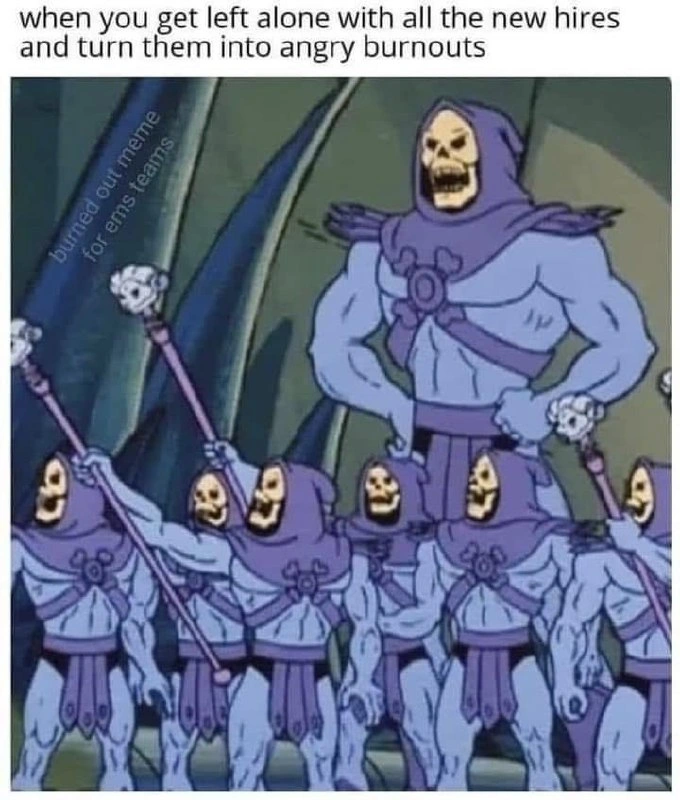
If you’re a junior developer fresh on the job, this meme might feel like an exaggeration — until it isn’t. The image shows Skeletor (a famous cartoon villain from the 80s) as a big, buff skeleton guy in a hood, and in front of him a crowd of smaller Skeletors cheering with skull-topped staffs. In the text at the top, it says “when you get left alone with all the new hires and turn them into angry burnouts.” Here’s what that means in a tech team context: one senior dev is left in charge of a bunch of fresh hires (new junior developers). Instead of those juniors growing into happy, productive team members, they all end up burned out (exhausted, frustrated, and cynical). The meme jokingly likens the senior dev to Skeletor “corrupting” his minions. It’s a playful but pointed way to say bad mentorship and stress can spread like wildfire.

Let’s break down some terms and elements:

  • Senior dev: a developer with a lot of experience (years of coding, debugging, shipping products). They usually mentor or lead others. In the meme, that’s Skeletor – he’s the one in charge.
  • New hires / Juniors: people who just joined the company, often with little real-world experience. They might be recent college grads or bootcamp grads. They’re represented by the smaller Skeletor clones. Think of them as eager newcomers who typically need guidance.
  • Mentorship: this is the process where seniors train or guide juniors. Good mentorship means the senior dev helps the new folks learn best practices, reviews their code patiently, and slowly introduces them to the project. In a healthy scenario, juniors grow more confident and skilled. In the meme’s scenario, mentorship has basically failed or turned twisted – the senior dev isn’t uplifting the juniors; instead, his bad habits or negativity are rubbing off on them.
  • Burnout: a state of extreme exhaustion and stress where someone feels emotionally drained, cynical, and less effective at work. In tech, developer burnout is sadly common when people work too many hours, have constant high pressure, or lack support. The meme literally says “angry burnouts” – meaning these new hires have become burned-out and are presumably pretty angry or disillusioned with their job.
  • Corporate culture: the work environment and shared values at a company. For example, some companies have a crunch culture (expecting overtime and constant pushing), while others prioritize work-life balance. Here, the culture seems bad: leaving one person to handle many newcomers hints at a dysfunctional or neglectful management approach.
  • Team dynamics: how team members interact and work together. In a good dynamic, seniors have time to help juniors, and juniors feel comfortable asking questions. In a bad dynamic (like the one shown), the senior is overwhelmed and probably snapping or giving minimal help, and juniors are collectively losing morale. Everyone’s interaction becomes strained – think short tempers, confusion, and a lack of trust or clarity.

In the real world, a scenario like this might happen if, say, a start-up rapidly hires a bunch of junior developers to speed up development but doesn’t hire enough experienced people to mentor them. The one senior dev on the team ends up with 20 unread messages every morning from juniors asking for help. He’s also expected to do his own coding and maybe even handle planning because the manager assumes he’s “got it under control.” The juniors, meanwhile, often get stuck because they’re new: they have questions about the codebase, they make mistakes that need debugging, or they aren’t sure about the project’s standards. If the senior dev is too busy or stressed to guide them properly, the juniors start feeling lost and anxious. Their initial excitement turns into frustration. They might start working longer hours trying to figure things out (since they don’t want to bother the grumpy busy senior again), which leads to MentalHealthInTech issues like anxiety and burnout.

This meme resonates with a lot of developers because many have either been that struggling junior or that overloaded senior at some point. The JuniorVsSenior dynamic can become a tug of war if not managed well. Instead of a supportive mentor-mentee relationship, it becomes more like a survival game – juniors try not to drown, and the senior is barely keeping the ship afloat. The Skeletor cartoon is a funny exaggeration: Skeletor is literally a villain, so picturing a senior dev as Skeletor implies maybe he’s not the nicest teacher. In reality, the senior might not be intentionally evil at all; they’re just stretched beyond capacity. But from a junior’s eyes, an overworked senior can come off as scary or mean (picture a frustrated engineer saying “Why don’t you know this already?!” in a harsh tone – that can terrify a newcomer). So the “angry burnouts” line suggests the end result: everyone’s angry and burned out, just like a bunch of little Skeletors who are ready to complain or conquer something out of sheer frustration.

The mention of “left alone with all the new hires” also hints at poor Management/PMs oversight. It’s basically saying the bosses or project managers threw a bunch of new people at the senior dev and walked away. That’s why mentorship turned into mayhem. Good management would ideally spread out new hires across teams or assign multiple mentors. When that doesn’t happen, you get exactly what the meme shows – a burnout_meme come to life. The senior dev can’t multiply themselves, so instead their attitude multiplies in the team. The whole thing is a warning (wrapped in humor) about how Mentorship and proper onboarding are crucial. Without them, even the most excited new developer can turn into a disheartened one.

Level 3: Single Point of Failure

When a team design mirrors a single point of failure, you know trouble is brewing. Here the lone senior dev (depicted as a confident Skeletor) is that one critical node, tasked with mentorship for an entire batch of fresh hires. In systems design, we’d never funnel all requests through one server with no backup; in team design, making one person the sole mentor for a new hire onslaught is the human equivalent. The meme captures this absurdity: Skeletor stands tall, arms akimbo, surrounded by cheering mini-Skeletors. Those clones represent the juniors who have been “corrupted” into angry burnouts – essentially mirror images of the overworked senior. It’s a darkly comedic visualization of a CorporateCulture failure where management left a lone_senior_dev to babysit an army of rookies, and the outcome is a legion of frustrated mini-me’s rather than a thriving team.

Why is this funny to seasoned engineers? Because it’s too real. We’ve seen this scenario play out in real life: a company does a mass hire of juniors to speed up development (hello, “more developers = more output” fallacy), but doesn’t pair them with enough mentors. The one senior dev ends up revieweing every code commit, answering nonstop questions, and firefighting production issues simultaneously. This poor soul becomes a living bottleneck. Knowledge doesn’t trickle down – stress does. Instead of high-quality onboarding, you get a crash course in crunch culture. The senior’s day might look like: push a commit, get swarmed with “how do I...?” pings on Slack, skip lunch to unblock someone’s PR, work late fixing a rookie mistake that took down staging, then wake up to another round of questions. It’s the engineering equivalent of a denial-of-service attack on one node. No wonder the senior starts to channel Skeletor’s evil laugh (or rather, a cynical chuckle) by week three.

The humor here also taps into TeamDynamics and the contagious nature of burnout. Ever notice how one burned-out developer can drag down the morale of the whole team? In this meme, Skeletor’s clones are essentially the new hires adopting the senior’s jaded outlook. What began as a group of enthusiastic juniors (bright-eyed newcomers eager to make an impact) turns into an army of Skeletor-like cynics, each wielding their little skull-topped staff of bitterness. The phrase "turn them into angry burnouts" is key – it suggests that burnout is infectious. A senior under chronic stress might unintentionally train juniors to accept long hours, frustration, and disillusionment as “just how tech is.” It’s a burnout cascade: one exhausted dev spawning many others, much like a process spawning zombie processes that hog resources. DeveloperBurnout at scale, if you will.

Let’s not forget the context that makes this meme hit home: Management_PMs with poor planning. Perhaps upper management thought it was genius to hire a dozen grads and let the senior “handle it” while they focus elsewhere. Classic mistake. In engineering lore, this is reminiscent of Fred Brooks’ Mythical Man-Month caution – adding manpower to a late software project makes it later, especially if you ignore onboarding costs. Here, adding 10 untrained devs doesn’t produce 10x output; it produces a mentoring overload and slows everything down. The senior’s productivity plummets, the juniors flounder, and any initial enthusiasm dies a painful death. Veteran coders chuckle at the Skeletor analogy because we’ve survived similar TeamDynamics nightmares. It’s schadenfreude-laced humor: “Been there, done that, got the t-shirt stress rash.” And the fact that it’s Skeletor – an over-the-top cartoon villain – adds a layer of irony. In He-Man, Skeletor is the bad boss with hapless minions; in our world, he’s the burnt-out tech lead accidentally creating mini-villains out of would-be heroes. The watermark “burned out meme for eng teams” drives it home: this isn’t just a silly cartoon, it’s a pointed critique of how neglecting Mentorship and MentalHealthInTech can transform a whole team into something out of a villain’s lair.

Description

This meme features the cartoon character Skeletor from 'He-Man and the Masters of the Universe' standing proudly before an army of smaller, identical Skeletor-like figures. The top text reads, 'when you get left alone with all the new hires and turn them into angry burnouts'. There's also a faint, tilted watermark on the left side saying 'burned out meme for ems teams'. The visual joke implies that a cynical, burnt-out senior employee (Skeletor) has mentored the enthusiastic new hires into becoming jaded, cynical copies of themselves. It's a dark but relatable commentary on how negative corporate culture and burnout can be contagious, quickly extinguishing the optimism of newcomers and perpetuating a cycle of workplace dissatisfaction. For experienced developers, it's a humorous nod to the reality of seeing fresh talent get worn down by the same systemic issues they've faced for years
Comments

7
Anonymous ★ Top Pick Our onboarding process is just a senior dev explaining the CI/CD pipeline until the new hire's soul leaves their body. We call it 'knowledge transfer'
  1. Anonymous ★ Top Pick

    Our onboarding process is just a senior dev explaining the CI/CD pipeline until the new hire's soul leaves their body. We call it 'knowledge transfer'

  2. Anonymous

    They told me to “scale my impact,” so now I’m a misconfigured ReplicaSet - every junior pod comes up with my code style, my cynicism, and a CrashLoopBackOff on work-life balance

  3. Anonymous

    The real curse of knowledge isn't knowing too much - it's being the only one who knows how the legacy auth service works while simultaneously onboarding five juniors who keep asking why we can't just 'migrate everything to OAuth tomorrow.'

  4. Anonymous

    Ah yes, the classic 'inheritance' pattern where junior devs don't inherit your codebase - they inherit your existential dread, your distrust of product managers, and your reflexive eye-twitch at the phrase 'quick question.' Six months in, they're writing the same passive-aggressive Slack messages and attending the same soul-crushing meetings. Congratulations, you've successfully implemented the Singleton pattern on cynicism: one instance, shared globally across the team

  5. Anonymous

    Onboarding juniors unsupervised: from eager greenfields to scorched-earth tech debt in one sprint

  6. Anonymous

    Leadership calls it “mentorship at scale”; I call it an org‑level fork bomb - one senior process spawning N juniors that inherit the same pager fd and 100% CPU on‑call

  7. Anonymous

    They left me with the new hires, so I shipped a burnout ReplicaSet - HPA tied to PagerDuty; bus factor up, morale SLA down

Use J and K for navigation