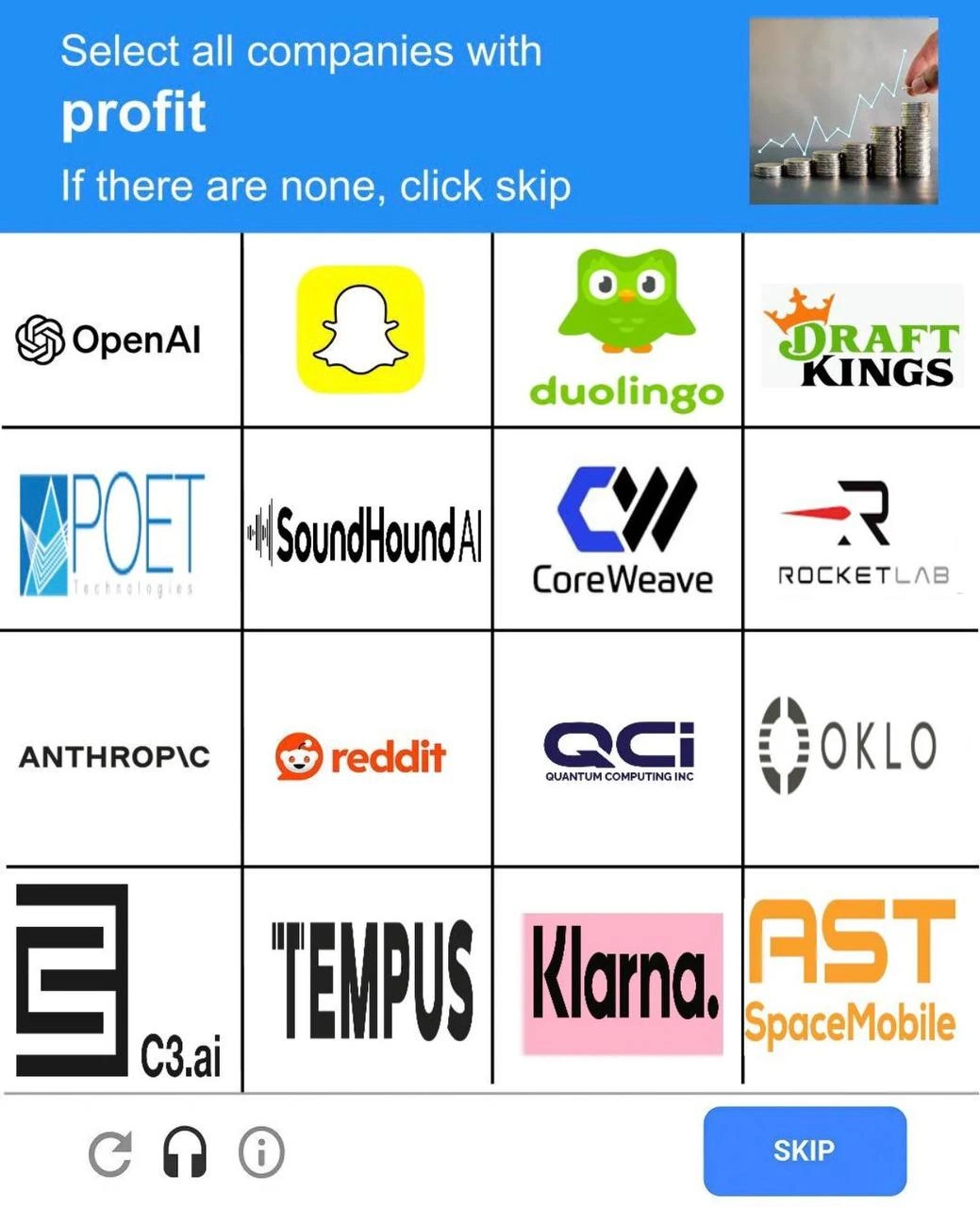
CAPTCHA Challenge: Select All Companies With Profit -- Click Skip
Why is this Startup meme funny?
Level 1: No Right Answer
Imagine your teacher gives you a picture puzzle and says, “Find all the apples in these pictures. If there are none, you can skip.” You excitedly look at the grid of pictures, but guess what? There are no apples at all in any of them—only oranges and bananas! 🟠🍌 The trick is that the right answer is actually “there are no apples”. So you’d just hit the “skip” button because there’s no apple to click on.
This meme is doing the same thing, but with companies making money. It shows a bunch of famous company logos and asks us to pick all the ones that make a profit (that means they earn more money than they spend). The funny part is none of those companies are making a profit right now! It’s like a big trick question. The only correct choice is to say “none of them” — just like skipping the puzzle with no apples. We find it funny because it points out something unexpected: all these big, cool companies that everyone talks about aren’t actually earning money. It’s a bit like if you had a race with lots of flashy runners, but not a single one crossed the finish line – so there’s no winner to pick. The meme makes us laugh at how silly that is, in a simple puzzle format that anyone can understand: sometimes, there really is no right answer, and you just have to press skip!
Level 2: If None, Press Skip
At first glance, this meme looks exactly like a reCAPTCHA test—those little popup challenges that ask you to prove you’re human by clicking on pictures (like “select all images with traffic lights”). The top banner in blue even mimics the style: “Select all companies with profit. If there are none, click skip.” Below that, instead of photos of bridges or buses, we have a 4x4 grid of company logos. And at the bottom, there’s a familiar “Skip” button (big and blue), a circular arrow icon to reload a new challenge, and a headphones icon for an audio version—just like real Google CAPTCHA interfaces. The humor comes from treating “finding a profitable company” as the test. The trick is, all 16 company logos shown are of well-known tech startups or tech companies that, as of 2025, aren’t actually making a profit. So the “correct” user action is to realize “none of these fit” and click the Skip button. It’s a playful way to say: none of these hyped companies are profitable, and that’s so obvious it’s like a CAPTCHA with zero correct options! 😅
Let’s break down the companies and terms shown, for anyone unfamiliar:
- Profit: Profit means a company’s income (money coming in) is more than its expenses (money going out). If a company spends more than it earns (negative profit), it’s running at a loss. The meme’s challenge is asking for companies that have positive profit, which turns out to be none of them.
- Startup Unicorns: A unicorn is startup slang for a private company valued at over $1 billion. Many logos here are or were “unicorn” companies. For example, OpenAI (famous for ChatGPT) got massive funding and a multi-billion valuation, making it a unicorn. Klarna (a fintech company offering “buy now, pay later” services) was one of Europe’s big unicorns. The joke is that these unicorns are magical in valuation but not yet making money.
- VC funding & Burn Rate: Most of these companies survive on Venture Capital (VC) funding. That’s money from investors who pour cash into high-growth tech companies expecting big returns later. Burn rate is how fast a company uses up that cash. A high burn rate means they’re spending a lot (on hiring, marketing, R&D, shiny offices, free user perks, cloud servers, etc.) without equivalent revenue yet. For example, SoundHound AI (which does voice recognition and AI) went public but continues to burn cash as it tries to find a sustainable business model. CoreWeave (in the grid) is a cloud provider for AI computing that raised tons of money to buy expensive GPUs – its burn rate is huge as it builds data centers, betting on future demand. None of this spending has turned into net profit yet.
- Hype vs Reality in Tech: The meme highlights AIHypeVsReality and general StartupHumor. Companies like Anthropic and OpenAI are hot topics in AI (everyone’s excited about their AI models and potential), and companies like Rocket Lab or AST SpaceMobile are hyped in the space industry (launching rockets or satellite networks sounds thrilling). DraftKings was all the rage in sports betting, and Reddit is massively popular as an online community hub. Duolingo is beloved for learning languages. Snapchat (Snap) is a famous social media app. They each have millions of users or big tech breakthroughs – that’s the hype. Reality: when you check their finances, they’re “in the red” (meaning losing money). The meme calls out that disconnect. It’s basically saying, “Despite all the buzz and users, these companies haven’t figured out how to earn more than they spend.” That’s typical StartupCulture: first grab market share or users, worry about profits later.
- “If there are none, click skip.” In real CAPTCHAs, sometimes the instruction says to click skip if no image matches (e.g., no traffic lights in any photo). Here it implies there might be zero profitable companies in this set – and indeed there are zero. It’s a tongue-in-cheek way to acknowledge unprofitable AI startups and others. The Skip button is literally the solution because no tile qualifies. It’s funny to tech folks because we recognize all these logos as big-name companies we read about in tech news, and then we’re hit with the reminder that not a single one is actually profitable yet.
- TAM and Unit Economics: In more corporate terms, many of these companies justify their business model by pointing to a huge TAM (Total Addressable Market). TAM is an estimate of all the possible revenue in the market they could capture in an ideal scenario. For instance, C3.ai (an enterprise AI software company) might say “we have a $100B TAM for AI in business operations.” DraftKings might claim “the total sports betting market is enormous, so our opportunity is huge.” However, TAM is like a big theoretical pie in the sky; it doesn’t guarantee profit. That comes down to unit economics – basically, do you make money per customer or per sale? Many of these firms have poor unit economics (e.g., paying more to acquire or serve each user than that user generates in revenue). Klarna, for example, grew fast by letting shoppers buy on credit easily, but if each transaction yields very little profit or leads to credit losses, the model struggles. As a junior dev or someone new to industry trends, it’s important to realize that big ideas and popular products don’t automatically equal business success. This meme is a humorous reminder of that reality.
In summary, the meme uses a CAPTCHA puzzle metaphor to poke fun at tech IndustryTrends: so many trendy startups (AI companies, fintech, space tech, etc.) are celebrated in headlines but still unprofitable. The AI hype in particular is high – for example, everyone knows OpenAI’s revolutionary tech – yet even such companies haven’t figured out profits. It’s a form of IndustrySatire and CorporateHumor that resonates with developers and tech workers. We often sit in all-hands meetings hearing leadership talk about “long-term monetization” and “path to profitability” while, for now, we’re just burning investor money. This meme simply visualizes that shared joke: if asked to find a profitable star among today’s big tech darlings, you’d come up blank and have to “skip” – because there’s none to be found. 😜
Level 3: The Unicorn Mirage
This meme is styled as a reCAPTCHA challenge that cheekily asks us to “Select all companies with profit”. The punchline is that you look at this 4×4 grid of tech logos—OpenAI, Snapchat, Duolingo, DraftKings, POET Technologies, SoundHound AI, CoreWeave, Rocket Lab, Anthropic, Reddit, QCI (Quantum Computing Inc.), Oklo, C3.ai, TEMPUS, Klarna, and AST SpaceMobile—and you realize none of these flashy, VC-fueled companies are currently profitable. Just like a tricky CAPTCHA where no images match the prompt, the correct action is to hit the “Skip” button. It’s a mordant commentary on the current AI/ML and tech hype cycle: we have a constellation of unicorn startups (valued over $1B) with sky-high valuations and cutting-edge tech—but not a single one is actually making money. In other words, finding a “profitable AI unicorn” in today’s market is about as likely as finding a real unicorn. 🦄✨
Every seasoned engineer who’s been through a few industry hype waves will chuckle here. The meme highlights that familiar disconnect between ambitious projections and cold financial reality. It evokes those late-night war stories where senior devs and architects vent over beers: “Sure, our startup claims a TAM (Total Addressable Market) of $100 billion and ‘disruptive AI algorithms’, but our income statement is nothing but red ink.” The CorporateCulture in many startups implicitly says “growth first, profits later”—so much so that an architect’s dry response to yet another optimistic business forecast might be, “Profit? That must be an AI hallucination.” The meme’s CAPTCHA format brilliantly satirizes this StartupCulture delusion: it’s literally a test with no right answer available, forcing you to acknowledge the uncomfortable truth by clicking “Skip”.
On a technical level, it’s also poking fun at how AI hype has outpaced viable business models. Even AI IndustryTrends darling OpenAI, for example, runs on enormous cloud-compute bills (training and serving large models isn’t cheap) and survives on injections of capital (hi, Microsoft!) rather than its subscription revenue. Similarly, Anthropic (another AI lab) burns cash training giant models with hopes of future profit. Then there’s CoreWeave, which is building massive GPU cloud infrastructure for all this AI—again funded by venture money on the bet that demand will eventually make it profitable. The meme lumps in players from other hype-laden domains too: quantum computing (QCI), commercial space (Rocket Lab, AST SpaceMobile), even a nuclear startup (Oklo). All promise revolutionary breakthroughs and massive future earnings, but present-day profits? Nope. Each one is a case of “spend now in hopes of dominating later.” From a cynical veteran’s perspective, it’s a déjà vu of the dot-com bubble and the 2010s “growth at all costs” era—IndustrySatire pointing out that we’re once again chasing mythical creatures. The AIHypeVsReality gap is laid bare: flashy demo videos, giant user counts, extravagant valuations… and yet no actual profit to show.
In true coding fashion, the meme’s logic could be expressed in pseudocode. It’s essentially:
companies = ["OpenAI", "Snapchat", "Duolingo", "DraftKings", "POET Tech",
"SoundHound AI", "CoreWeave", "RocketLab", "Anthropic",
"Reddit", "QCI", "Oklo", "C3.ai", "Tempus", "Klarna", "AST SpaceMobile"]
profitable = [c for c in companies if c.has_positive_net_income()] # check each company's profit
if not profitable:
click_skip_button() # None have profit, so the CAPTCHA says: press skip
else:
for c in profitable:
select(c.logo_tile)
Almost invariably, profitable ends up an empty list here, triggering the click_skip_button() path. In real life, developers working at these companies joke about when they’ll finally cross into the black. The meme captures that shared understanding among tech workers: so many of our employers (or clients) are celebrated “tech unicorns,” yet their unit economics are upside-down. It’s a bit of dark humor about our industry’s venture capital burn rate culture—AIHype and big dreams fueled by investor cash, with profitability perpetually just out of reach. Essentially, this is an IndustryTrends reality check served with a side of sarcasm. The CAPTCHA format just adds the perfect “are you a human or are you drinking the Kool-Aid?” touch. And every jaded engineer reading it smirks, knowing that the only real solution to this puzzle is to skip the fantasy and acknowledge the truth: the Emperor’s new startups have no profit.
Description
A meme styled as a Google reCAPTCHA verification grid reading 'Select all companies with profit. If there are none, click skip.' The grid displays 16 company logos arranged in a 4x4 grid: OpenAI, Snapchat, Duolingo, DraftKings, POET Technologies, SoundHound AI, CoreWeave, Rocket Lab, Anthropic, Reddit, Quantum Computing Inc (QCi), Oklo, C3.ai, Tempus, Klarna, and AST SpaceMobile. A prominent blue 'SKIP' button appears at the bottom right. The joke implies that none of these companies (many of which are high-profile tech/AI firms with massive valuations) are actually profitable, making the correct CAPTCHA answer to click skip. The inclusion of AI companies like OpenAI, Anthropic, and SoundHound AI alongside other growth-stage companies satirizes the tech industry's valuation-over-profitability culture
Comments
8Comment deleted
This CAPTCHA is impossible to solve because the 'profit' class doesn't exist in the training data for venture-backed AI companies
When due-diligence requires more compute than GPT-4, reCAPTCHA just outsources it - if you can actually click one of these tiles, the finance team thinks you’re hallucinating
The real test isn't identifying profitable companies - it's explaining to your board why your 'pre-revenue' startup with a $10B valuation is actually different from all these other 'temporarily unprofitable' unicorns burning through Series F funding while promising that profitability is just two quarters away... again
This CAPTCHA perfectly captures the AI gold rush paradox: we're building the future with models that cost millions per training run, burning through Series D funding faster than GPT-4 can generate responses, all while investors keep asking 'but when do we see positive unit economics?' The correct answer is always 'skip' - because in 2024, profitability is apparently just another legacy constraint we're disrupting
Vendor due diligence in 2025: the reCAPTCHA says “Select GAAP-profitable logos”; clicking Skip still passes via Adjusted-EBITDA OAuth
Finally, a CAPTCHA that mirrors board review: profit_enabled is still behind a feature flag until Series E and a 70% GPU-bill haircut, so the only correct selection is Skip
Perfect CAP theorem application: these unicorns chose Consistency (of losses) and Availability (of layoffs) over Partition tolerance - er, profitability
I mixed up draft kings logo with Kebab king, too similar Comment deleted