The Development Methodology We Actually Need: Rest-Driven Development
Why is this MentalHealth meme funny?
Level 1: Finally, Nap Time
Imagine you’ve been playing with your LEGO set all day to build the coolest castle ever. You’re following a super complicated guide that’s supposed to make it easy, but there are so many steps and you keep adding more and more rooms because you have new ideas. It’s way past your bedtime, but you refuse to stop. Eventually, you’re so tired that you fall asleep right on the floor surrounded by LEGO bricks. Now your parents come in and see you conked out. They laugh and gently say, “Maybe we should try rest-driven building tomorrow!”
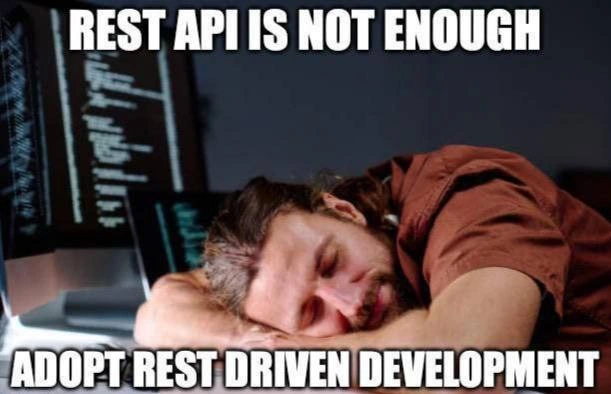
In this scenario, the word “rest” suddenly isn’t about the special building guide anymore – it’s about you actually getting some rest (sleep). That’s exactly what’s happening in the meme. The team was doing a lot of hard work using something called “REST” (which is just a tech way to build things), but the programmer worked so hard that he collapsed on his desk. So the joke is telling the team to switch to “REST-driven development,” which basically means “let the poor guy take a nap!” It’s funny because it plays with the word rest – turning a technical term into a reminder that sometimes you just really need to sleep. In short, the picture makes us laugh and say, “Even computer wizards need nap time.”
Level 2: Exhausted by Endpoints
Let’s break down the joke in simpler terms. In software, a REST API is a common way for different programs or services to talk to each other over the web. REST stands for Representational State Transfer, but you can think of it as a set of rules for how clients (like your web browser or a mobile app) request data from servers. For example, a REST API might have an endpoint (URL) like GET /api/users/123 to fetch the details of user number 123. The key idea of REST is to use standard HTTP methods (GET, POST, PUT, DELETE, etc.) on various URLs (called endpoints) representing resources (like users, posts, products, etc.). A well-designed REST API is supposed to be simple to use and consistent, which in theory should make development easier and maybe give developers less to stress about. The term RESTful even sounds like it should be peaceful or calm, right?
However, the meme jokes that just having a REST API isn’t enough to make life peaceful. In reality, building and maintaining a large RESTful API can be a ton of work – often under tight Deadlines. The developer in the picture is completely wiped out, literally sleeping on the job (head down on the desk next to their code), because they’ve spent too many late nights working. The text “REST API IS NOT ENOUGH – ADOPT REST DRIVEN DEVELOPMENT” is doing a pun on “REST”. The first “REST” refers to the tech term (the API style), but the second “REST” is referring to actual rest (as in sleep or relaxation). Rest-Driven Development is not a real methodology; it’s a tongue-in-cheek twist on phrases like Test-Driven Development. In development, when we say something is “-driven”, it means that thing guides the process. For instance, in Test-Driven Development (TDD), writing tests comes first and guides your coding. So if we apply that pattern humorously here, “REST-Driven Development” suggests a process where getting rest (sleep) comes first and guides the work. It’s basically saying: “We’ve tried driving our work with all these fancy processes and it only made us tired. Maybe we should drive development by making sure we actually sleep!”
Why is this funny? Because it’s relatable humor for developers. Developer productivity paradoxically drops when developers are exhausted, yet in crunch times they often skip sleep to meet a goal. The meme reflects a situation many coders know too well: crunching until 3 AM, running on caffeine, fixing last-minute bugs or adding new features because the project requirements kept changing (“spec creep” is a term for when the project’s specifications or scope keep growing beyond the original plan). The image shows a sleep-deprived programmer who probably had a long list of API endpoints to implement or integrate before morning. They might have been adding extra details like hypermedia links (those are links in an API response that point to related data or actions, kind of like how web pages have hyperlinks – it’s an optional advanced feature of truly RESTful APIs). Doing all this under pressure can be really draining.
So, the team “moves from REST APIs to literal rest-driven dev” as a joke. It implies the team has realized that just using the REST style for their APIs didn’t help their DeveloperBurnout problem – their engineers are still tired and frustrated. So now, “literal rest-driven development” means they’re going to let the developer actually lie down and nap as if that were their new project strategy. It’s a playful way to say “let the poor coder sleep, already!” The humor hits home because in tech culture, unfortunately, working long hours without rest is common, and people joke about running on no sleep. Seeing the phrase turned on its head – from a technical buzzword into advice to take a nap – is both funny and a bit of a wink to the truth that maybe we should value rest more.
For a junior developer or someone new to this, a few terms in the meme might need explanation:
- API: It stands for Application Programming Interface. In simple terms, an API is like a menu in a restaurant: it lists what you can ask for and how to get it. Here, a REST API is a specific style of that menu using web URLs and HTTP methods. It’s how different software pieces talk over the web.
- REST (as a concept): It’s a design rulebook for building those web APIs. It doesn’t relate to sleep at all, despite the name sounding like it. The meme riffs on this coincidence in wording.
- RESTful: A term describing an API that follows REST guidelines closely. People often say “a RESTful service” meaning it’s designed the REST way. Non-tech folks might think it means the service is restful like a good nap – but nope, it’s purely technical.
- Driven Development: In programming, you’ll encounter phrases like Behavior-Driven Development or Test-Driven Development. It just means a particular thing (behavior specs, or tests) is put in the driver’s seat to guide how you write your code. It’s a bit jargony. The meme invents Rest-Driven Development to sarcastically suggest putting sleep in that driver’s seat.
- Developer burnout: This is when a developer (or anyone, really) is overworked and exhausted to the point of feeling utterly drained, both mentally and physically. In software jobs, burnout can happen if you’re pulling too many all-nighters or dealing with constant stress without a break.
- Sleep deprivation: Not getting enough sleep. Even one all-nighter can make you feel awful; string a few of those together and you get a zombie-coder 😴. It significantly reduces concentration and creativity, which are crucial for programming.
- Late-night integration: This refers to merging code or hooking up systems in the late hours. Often, teams will integrate new code into a project (like adding a big feature or connecting modules) at the end of a cycle, and if it goes wrong, they might be stuck fixing issues deep into the night. The meme’s mention of “long nights senior devs spend integrating hypermedia links” evokes exactly that kind of scenario: a seasoned engineer grinding away late to glue pieces together (like adding those hypermedia links into API responses) while fighting new demands popping up (“fighting spec creep”).
All these elements combine to paint a picture that’s both humorous and a little too true. The developer in the brown shirt, passed out at their desk, has essentially hit their limit. The joke suggests that the team’s new strategy is to value actual rest as much as the REST tech. It’s funny to us because tech folks aren’t exactly known for work-life balance during crunch time – hearing “rest” in a meeting usually means the REST API, not “go take a rest”. So this meme does a playful role reversal. Instead of another lecture on some cutting-edge development process, it jokingly prescribes the most basic human need: sleep. And given how many of us have felt like that programmer in the photo, it’s a relief to laugh at the idea that maybe, just maybe, the best new “methodology” is simply closing your eyes for a while.
Level 3: No REST for the Weary
The meme’s text is a cheeky double entendre on the term REST – which normally stands for Representational State Transfer (an architectural style for web API design) – and the ordinary word “rest” meaning sleep. In the image, a developer in a dim workspace has literally face-planted onto their desk, utterly exhausted. The captions hammer home the joke:
REST API IS NOT ENOUGH
ADOPT REST DRIVEN DEVELOPMENT
In other words, merely using RESTful APIs isn’t providing enough rest for the team; so now, tongue-in-cheek, the team is moving to "REST-driven development," implying the dev should just get some sleep. It’s a classic bit of developer humor that plays on a pun: RESTful architecture versus being rest–full (as in well-rested). It highlights the ironic reality that building elegant REST APIs often leads to anything but restful nights for developers.
From a senior developer’s perspective, this meme is painfully relatable humor. We’ve all been the sleeping developer at one point, nodding off at the keyboard after endless deploys. The image screams DeveloperBurnout and SleepDeprivation: two angled monitors glowing in the darkness, code still on-screen, and an engineer so drained that the desk has become an impromptu pillow. It’s funny because it’s true – the DeveloperFrustration behind those late-night integration sessions is real. You can almost smell the cold coffee and feel the stiff neck. The caption wryly suggests that after pushing through back-to-back deadlines and fighting scope creep (here humorously called “spec creep”), the only architecture that matters is a pillow and a horizontal surface.
Digging into the technical side, the meme nods at the complexity of building RESTful APIs to spec. REST is an API design philosophy defined by Roy Fielding in 2000, emphasizing stateless client-server communication, logical resource-oriented URLs, and sometimes the inclusion of hypermedia links (HATEOAS: Hypermedia as the Engine of Application State) in responses. In practice, implementing these REST constraints for a large system under time pressure can be a recipe for late-night integration marathons. The text jokes about “integrating hypermedia links” – a feature of truly RESTful services where each response contains navigation links to related resources. Senior devs know that adding those extra "links" fields in JSON at 2 AM, to make an API technically pure, is a special kind of torture.
{
"id": 101,
"name": "Widget",
"status": "active",
"links": [
{"rel": "self", "href": "/api/widgets/101"},
{"rel": "next", "href": "/api/widgets/102"},
{"rel": "owner", "href": "/api/users/7"}
]
}
// Great for the client – they can navigate to "next" or "owner" easily. Not so great for the dev implementing it bleary-eyed at 3 AM.
The phrase “REST API is not enough” hints at a common scenario in tech teams: adopting every new buzzword or architecture (from REST to microservices to whatever-driven development) in hope of improving productivity, yet still overworking the team. A REST API by itself won’t magically eliminate crunch time or DeveloperBurnout. You can design the most theoretically elegant RESTful system with neat URI endpoints and proper GET/POST usage, and still end up with a team of zombies pulling all-nighters to meet a release date. The bottom caption “Adopt REST-driven development” then absurdly proposes a new methodology that prioritizes actual rest. It’s a play on all the X-driven development methodologies we’ve been told to adopt over the years: Test-Driven Development (TDD), Behavior-Driven Development (BDD), Domain-Driven Design, you name it. After agile, scrum, and CI/CD, why not add “Sleep-Driven Development” to the list? The meme basically says: screw it, let’s make sleeping part of the official development process. It’s a cynical acknowledgement that no process or architectural style is as crucial to project success as having engineers who aren’t running on fumes.
This humor lands well with senior engineers because it riffs on our shared experiences. We know the trade-offs all too well. Sure, RESTful designs can reduce long-term complexity compared to, say, a full SOAP/WSDL enterprise monstrosity (remember those? SOAP ironically stood for “Simple Object Access Protocol” – and it was anything but simple). REST was supposed to bring sanity with its simplicity and uniform interface. Yet here we are, still staring at Wireshark traces and Swagger docs at midnight. The pun on “REST” exposes the gap between theory and reality: Representational State Transfer isn’t about sleep at all, but without actual rest, a dev’s brain hits a literal Stack Overflow. Ever shipped a perfectly RESTful service that strictly followed the spec, only to find yourself deploying hotfixes at 2:00 AM because of last-minute scope creep? It’s a rite of passage. The meme’s dark sarcasm (“REST-driven dev”) is basically a veteran dev’s way of saying, “Forget the fancy terms – I’m exhausted. Let me sleep.”
It also subtly calls out developer productivity myths. Companies push for better architectures (like moving from monolith to RESTful microservices) expecting productivity gains, but then overload developers with so much work (or so tight deadlines) that any benefit is lost to burnout. The truth is, a well-rested developer is a productive developer. It’s almost ironic how rarely that’s prioritized. We’ve all seen the degradation of code quality when the author wrote it at 4 AM after a 20-hour sprint – variable names get weird, edge cases slip through, and the commit message might just be “fix stuff”. By contrast, after a good night’s sleep, that same dev could find and fix the bug in minutes. Sleep deprivation leads to diminishing returns, yet crunch culture persists. This meme takes that pain and turns it into a satirical “new strategy”: treat rest as a first-class part of development. Senior folks smirk at this because we’ve survived those hellish crunch cycles and have the battle scars (and cynical humor) to prove it. We recognize that look of the passed-out programmer, and maybe we’re bitterly amused because we wish management actually endorsed rest-driven development in real life.
To put it in perspective, here’s how expectation vs reality often plays out with trendy tech methodologies versus human needs:
| Buzzwordy Approach | Implied Benefit 💡 | Actual Outcome 😴 |
|---|---|---|
| REST API architecture | “RESTful” design = simpler, calmer integration for services. | RESTless nights for engineers perfecting endless endpoints and chasing changing specs. |
| “REST-driven development” (joke) | Development driven by rest = developers are always well-rested and thus more productive. | Team ends up literally letting the programmer crash on the desk – ironically, probably the first good nap they’ve had in weeks. |
In short, the meme humorously advocates for what every senior dev secretly craves: actual downtime. It highlights the absurdity that in our quest for perfect code and modern APIs, we often neglect basic human needs. The phrase “REST-driven development” pokes fun at our industry’s love for new methodologies – suggesting the most important one might simply be letting developers sleep. After countless nights of fixing CI pipelines or tweaking API payloads under pressure, the idea of officially scheduling nap time becomes hilariously appealing. This mixture of API world problems with human exhaustion is why the joke lands so well. It’s simultaneously a pun, a bit of satire about tech culture, and a commiserating nod to every coder who has ever said, “I’ll rest when this ships” – only to end up, like the guy in the meme, finding out the hard way that their body had other plans.
Description
The image is a meme featuring a developer with longish brown hair and a beard, wearing a brown collared shirt, who has fallen asleep on his desk. His head rests on his folded arms, directly in front of a brightly lit monitor displaying lines of code. The background is dark, highlighting the exhaustion. The image is captioned with white, bold, impact-style font. The top text reads, 'REST API IS NOT ENOUGH', and the bottom text says, 'ADOPT REST DRIVEN DEVELOPMENT'. The humor is a pun on the acronym 'REST' (Representational State Transfer), a common architectural style for APIs. The meme contrasts the technical term with its literal meaning of 'rest' or relaxation. By coining the term 'Rest Driven Development,' the meme humorously proposes a new software development methodology focused on getting adequate sleep, directly addressing the pervasive issue of developer burnout and crunch culture in the tech industry. It's a relatable joke for any engineer who has felt the pressure of long hours and tight deadlines

Comments
8Comment deleted
My new framework is RDD. It's not 'Readme Driven Development,' it's 'Rest Driven Development.' The core principle is that if a feature request requires a meeting after 5 PM, it's not a feature, it's a bug in the project management
At last, a methodology where your 2 AM 500 errors get auto-resolved as “503: Service Unavailable, engineer finally sleeping.”
After 15 years of arguing about whether it's truly RESTful if it doesn't include hypermedia controls, we've finally achieved Level 4 on the Richardson Maturity Model: complete developer exhaustion. Turns out the only stateless transfer we really needed was from consciousness to sleep
When your API design is so RESTful that you've achieved true idempotency - no matter how many times you try to wake up, you return the same 200 OK status: still asleep at your desk. At least your endpoints are stateless, even if your mental state isn't
REST-driven development: six weeks perfecting idempotent PUT semantics and OpenAPI linting, then realizing nobody modeled the domain
We adopted REST-driven development: after a day of 429s from stakeholders, we apply exponential backoff with a nap and eventually return 503 Service Unavailable
REST-driven dev: idempotent naps fixing what rate limiting never could
This post is based on unreal levels Comment deleted