A Moral Stand Against Non-Euclidean Geometries
Why is this Mathematics meme funny?
Level 1: No to Weird Shapes
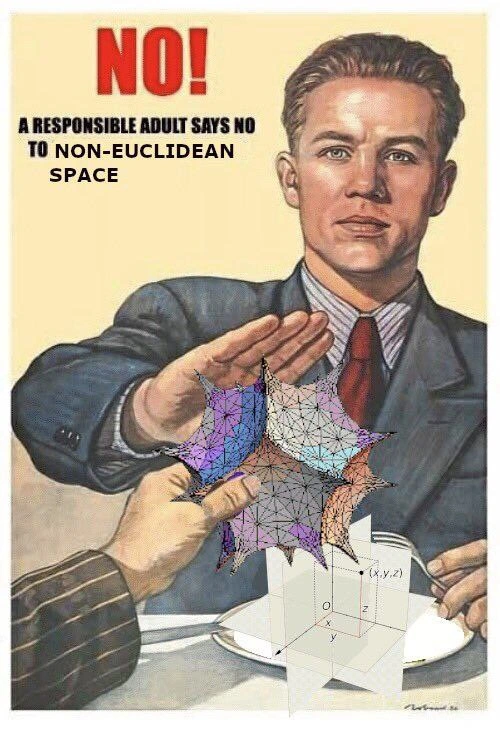
Imagine someone is offering you something really strange and confusing – like a super weird-shaped toy that doesn’t play by the normal rules – and you respond with a big “No, thank you!” That’s basically what’s happening in this picture. The man in the suit is holding up his hand to refuse a crazy-looking colorful shape. Why? Because that shape represents a kind of really complicated math (the kind that can make your head spin). The joke is that he’s acting like this funky math shape is as bad as something like a cigarette or a drink in an old public service poster. It’s funny because usually we don’t treat math like a dangerous thing you have to stay away from! The picture is exaggerating and pretending that “non-Euclidean geometry” – which is a fancy term for a weird curvy kind of space – is something a grown-up should just say “no” to. In simple terms, it’s poking fun at how grown-up experts sometimes avoid overly complicated ideas. Even if you don’t know the math, you can see the humor: a serious-looking adult is refusing a bizarre object as if it’s trouble. It’s like a teacher saying “No way, I’m not doing that crazy puzzle today!” The emotional vibe is playful – it makes us laugh because it’s so over-the-top. It’s basically saying even adults can be afraid of confusing, wacky stuff, and that’s okay (and kind of hilarious when shown in a dramatic poster).
Level 2: Flat vs Curved Space
So, what exactly is non-Euclidean space, and why is our well-groomed poster man so adamant about refusing it? Let’s break it down in plain terms. Euclidean geometry is the normal geometry most of us learn in school – it’s basically the math of flat space. Think of a flat piece of paper, or familiar 3D coordinates with X, Y, Z axes (like the little 3-axis graph you see floating under the strange shape in the meme). In Euclidean geometry, lines are straight, parallel lines stay the same distance apart forever (never meeting), and the angles inside a triangle always add up to 180°. This is how the world seems to work in everyday life on small scales, and it’s the foundation for almost all GraphicsProgramming and game design. When you move an object in a typical 3D game engine, or calculate lighting and camera perspective, you’re assuming a nice, flat, Euclidean space. All our standard math formulas (from the Pythagorean theorem to basic trigonometry) live comfortably in this flat world.
Non-Euclidean geometry, on the other hand, is what you get when you play with those fundamental rules. It describes spaces that can be curved or distorted instead of perfectly flat. One simple example of a non-Euclidean space is the surface of a sphere – this is often called spherical geometry. Imagine drawing two truly “straight” lines (great circle routes) starting at Earth’s equator going perfectly north. At the equator they begin parallel, but as you go toward the North Pole, those lines (say, lines of longitude) will actually meet each other at the pole. Parallel lines meeting?! That’s a no-no in Euclid’s flat planet, but it’s normal on a sphere because the surface itself bends. Triangles on a sphere also have more than 180° in their angles combined. So spherical geometry is one flavor of non-Euclidean geometry (positive curvature).
The weird wire-framed object in the meme is hinting at the opposite kind: hyperbolic geometry, which has negative curvature. If spherical surfaces bulge outward (like a ball), hyperbolic surfaces curve inward or saddle-shaped. An everyday analogy is a Pringles chip or a lettuce leaf – they have a saddle-like shape in places. On a true hyperbolic plane (picture a flared, wiggly surface that keeps flaring out as you go further), parallel lines actually move away from each other faster than normal; they effectively diverge. And a triangle drawn on a hyperbolic surface will have less than 180° total in its corners. This can produce extremely funky-looking surfaces – kind of like the psychedelic multi-colored mesh being offered to the man. In math or computational_geometry class, you might see a model of a hyperbolic plane represented as a disk where shapes get smaller toward the edges (the Poincaré disk model). Or you might see a crochet model of a hyperbolic surface that looks a bit like coral or a ruffly fabric – it’s all wavy and can’t lie flat without crumpling. That’s what non-Euclidean (specifically hyperbolic) space feels like: it defies our normal expectations of “flatness.”
Now, why would a responsible adult (in this case, think of a sensible, battle-tested software developer or mathematician) refuse such a thing? This is where the meme’s parody context kicks in. The image style is a direct nod to a vintage propaganda poster – specifically, many people recognize it as a spoof of a Soviet anti-alcohol poster from the mid-20th century. In those originals, a clean-cut man refuses a glass of vodka being handed to him, with a bold slogan basically saying “No, I won’t do it.” They were literally promoting “Just Say No” decades before that phrase became common. It was all about being a responsible adult by avoiding vodka. Fast forward to this meme: the same serious man is now saying no to a mathematical concept instead of booze! The text “A RESPONSIBLE ADULT SAYS NO TO NON-EUCLIDEAN SPACE” is intentionally over-the-top and MetaHumor. It frames engaging with crazy geometry as if it were a dangerous life choice, like underage drinking or doing something recklessly irresponsible. For people in the GeekHumor / TechHumor crowd, this is funny because it’s a mash-up of scholarly math and a public service announcement style. It’s absurd – math isn’t illegal or immoral, but here it’s treated with the same dramatic refusal one would use for something truly harmful.
The deeper joke is about complexity and sanity in fields like programming and graphics. ComputerGraphics professionals know that incorporating non-Euclidean geometry into a project – say, making a video game where the world has a weird curved space – is incredibly challenging. Imagine telling a junior developer to implement a world where walking in a straight line might bring you back to where you started, or where the internal angles of your game’s triangles aren’t what your engine expects. It’s a recipe for confusion and bugs. So in real life, a “responsible” senior developer often does say “no” to unnecessary fanciness that could jeopardize the project. This meme just casts that idea in a comically exaggerated light: as if touching non_euclidean_space will lead you down a dangerous path. It’s a form of DeveloperHumor that riff on the stereotype that older, wiser devs always choose the stable, known path (Euclidean geometry, in this case) over the risky, exotic new adventure (hyperbolic geometry!). The man’s hand gesture – a firm, polite stop – is basically a meme way of saying: “Nope, not going there.”
Let’s also decode the visual: there’s a little 3D axes graph (labeled X, Y, Z) under the funky object. That represents the normal coordinate system (Euclidean 3D space) – our comfort zone. The non-Euclidean object hovering above it is drawn as if someone is offering an alternative geometry, one that literally warps that coordinate space. If you’re not deep into math or graphics, you might just see “cool spiky shape.” But those in the know see a hyperbolic surface being offered like a shady present. The man in the suit is essentially A) rejecting the “offer” and B) by extension, rejecting the headache of dealing with that exotic shape. The text shouting “NO!” in red at the top nails the parody look and makes the point loud and clear.
In summary, this meme is an inside joke for folks who appreciate both advanced math and the day-to-day realities of programming. It takes something abstract (curved-space geometry), and uses a very down-to-earth, almost absurd framing (a propaganda-style PSA) to make us laugh. We laugh because we get it: playing with hyperbolic_geometry is cool, yes, but it’s also the kind of rabbit hole a prudent coder might avoid unless they have a really good reason. It’s the “just say no” slogan applied to the temptation of overly complicated math. And let’s be honest, that does feel a bit relatable when you think of the times you’ve stayed up late fixing code that got too clever for its own good!
Level 3: Hyperbolic Hangover
At first glance, this meme elicits a knowing chuckle from seasoned developers and graphics engineers: it portrays the quintessential experienced coder move of firmly rejecting an enticing but perilous idea. The well-dressed man with his palm out is copied straight from a famous Soviet-era anti-alcohol poster – in the original, he’s refusing a shot of vodka. Here, the vintage propaganda parody swaps the vodka for a trippy non-Euclidean space model, effectively equating advanced math with 190-proof moonshine. “NO! A responsible adult says no to non-Euclidean space,” the slogan declares, and anyone who’s wrestled with wild theoretical tech can relate. It’s a clever piece of MetaHumor and GeekHumor: we’re treating an abstract geometry concept like an offer of hard liquor or an illicit substance. The humor lands because there’s a grain of truth in it – diving into something like hyperbolic geometry can feel like a reckless, mind-altering leap rather than a prudent engineering choice, especially when deadlines loom.
GraphicsProgramming veterans nod in solidarity here. They’ve been down this road (or watched a wide-eyed junior try it): someone suggests implementing a novel non_euclidean_space rendering trick or a fancy curved-world feature in a game engine, imagining eye-popping visuals. Maybe it’s a level in a game where the space doesn’t behave normally, portals that bend reality, or an VR demo of a hyperbolic_geometry world. It sounds awesome in theory – “think of the possibilities!” – much like a flashy cocktail at the start of a party. But the seasoned dev, like the “responsible adult” in the poster, knows the hangover that follows: twisted collision physics, broken assumptions in the engine, math libraries groaning under the strain of unfamiliar curvature, and a heap of rendering artifacts nobody knows how to debug. It’s the classic scenario of over-engineering: just as a cheap business app probably doesn’t need a quantum AI module, your average 3D project doesn’t need actual curved-space math. An experienced engineer has likely learned (the hard way) to say no to unnecessary complexity. It’s a survival skill in software development – much like knowing when to refactor and when to leave the legacy code alone. The meme’s protagonist, with A+ posture and that determined face, essentially embodies a lead dev at a design meeting, stopping a risky idea in its tracks: “Let’s not go there, folks.”
This also pokes fun at our collective tendency in tech to idolize complex solutions. Sure, tackling CSFundamentals head-on – be it heavy algorithms, hardcore math, or writing your own computational geometry library – can be intellectually satisfying. But in a production environment, it can also be as painful as a next-day headache. The line “A responsible adult says no” drips with irony because as kids or newcomers, many of us were eager to try every cool concept we stumbled upon (“Hyperbolic tiling? Sign me up!”). Eventually, though, after a few 3 AM debugging sessions and war stories of projects gone awry, you become that responsible adult. You learn that just because something is mathematically possible or super cool doesn’t mean it’s a good idea for your current project. This meme nails that sentiment within a single image. It’s TechHumor speaking to the inner grown-up in every developer: the part that has to confront the pragmatic reality over the shiny novelty.
Notice the computational_geometry element being lampooned: the colorful wire-frame model in the meme isn’t a random blob; it resembles a hyperbolic paraboloid or some patch of a curved surface, complete with an X, Y, Z axis graph underneath. It’s exactly the kind of object a graphics nerd might excitedly whip up in a demo when experimenting with advanced math – and the kind of thing that would make their project manager break into a cold sweat. The meme’s message is clear: “A true adult in the room will refuse that crazy curved-space demo before it derails the whole plan.” The contrast is hilarious. Instead of warning against vodka or bad habits, the poster warns against geometry. It satirizes the idea that too much theoretical math can be a dangerous temptation. In a way, it’s an affectionate jab at our own community: we geeks sometimes need to be protected from ourselves and our wild curiosities. The DeveloperHumor here comes from recognizing that feeling – that mix of fascination and horror – when someone suggests injecting a bit of non-Euclidean weirdness into an otherwise straight-laced, Euclidean project. It’s funny because it’s true: ComputerGraphics experts know that going down that curved road without a very good reason will lead to nights of debugging bizarre spatial bugs. In summary, the meme resonates with senior devs as a witty reminder that not every brilliant idea is worth the headache, and sometimes saying “Nyet!” to mind-bending math booze is the wisest course.
Level 4: Parallel Postulate Prohibition
In pure mathematics, non-Euclidean geometry is the forbidden fruit that emerges when you tinker with Euclid’s famous fifth postulate (the one about parallel lines). Euclid assumed that given a line and a point not on that line, only one unique parallel line can be drawn through that point. For two millennia, this held true as the bedrock of “normal” (Euclidean) geometry. But in the 19th century, adventurous mathematicians like Gauss, Lobachevsky, and Bolyai dared to ask: what if there’s more to life than just one parallel or none at all? Thus were born the non-Euclidean realms – geometries where the ordinary rules of space warp like bad physics in a video game. In hyperbolic geometry (one flavor of non-Euclidean space with constant negative curvature), an infinite number of distinct lines can pass through that off-line point without ever intersecting the original line. Parallel lines diverge like they’re allergic to each other. Triangles drawn in this curved space have angle sums less than 180°, and circles’ circumferences grow freakishly large relative to their radius. (Spherical geometry, by contrast, curves space the other way and makes parallel lines eventually meet, with triangles summing to more than 180° – think of lines of longitude meeting at the poles on Earth.) In hyperbolic space, you could actually fit an exponential amount of area into a finite region – it’s a geometric rabbit hole where surfaces frill out endlessly like a mathematical coral reef.
To a theorist, these ideas are intoxicating: the Riemannian geometry of curved surfaces underpins everything from abstract art to Einstein’s general relativity (where mass warps spacetime itself). But to a hardened engineer on a project deadline, non-Euclidean space can be as unsettling as contraband. Why? Because all our familiar tools assume flat Euclidean space. The linear algebra powering your game engine or GPU shaders faithfully follows Euclidean rules. Throw in a curved-space metric and suddenly distances, angles, and rendering equations twist into unfamiliar forms. Visualizing hyperbolic space, for instance, often requires projecting it onto Euclidean space (like the wire-frame hyperbolic surface depicted in the meme). This projection inevitably distorts distances and angles, hinting at the underlying mind-bending truth: you can’t fully embed an infinite hyperbolic plane into normal 3D without some compromise, as guaranteed by the mathematics of curvature. In computational terms, simulating a non-Euclidean world means redefining fundamental operations: the “straight lines” (geodesics) aren’t straight anymore, and even simple tasks like calculating a triangle’s area or a shortest path turn into advanced exercises in differential geometry. There’s a reason game devs and engine architects rarely stray into curved spaces – it’s like going off the map of established computer graphics. As academically exhilarating as it is, working in non-Euclidean geometry is a bit like engaging in mathematical moonshine: potent, exotic, but liable to leave you reeling with a hyperbolic hangover if you’re not extremely careful. In fact, a number of research papers and experimental projects have flirted with hyperbolic visualization (for instance, to display huge hierarchies or maps in a compact way, since hyperbolic space “naturally” accommodates tree-like expansion), but these remain niche and complex. The fundamental constraints of our hardware and brain wiring act like the prohibition against this kind of spatial indulgence. The meme cheekily casts advanced geometry as a dangerous vice – one that a responsible math-adult would abstain from, echoing how earlier generations viewed such non-Euclidean ideas as almost heretical. (Historically, Gauss even kept his non-Euclidean findings private for years to avoid “slaying Euclid” in the eyes of his contemporaries.) Thus, the image’s retro propaganda theme aptly frames hyperbolic geometry as a seductive but subversive substance – a contraband of the mathematical world that’s equal parts brilliant and brain-breaking.
Description
A parody of a vintage Public Service Announcement (PSA) poster. The image features a man in a suit with a serious expression, holding his hand up to refuse something being offered. At the top, bold red text exclaims 'NO!', followed by the caption 'A RESPONSIBLE ADULT SAYS NO TO NON-EUCLIDEAN SPACE'. The object being offered is a complex, 3D geometric shape with a colorful, triangulated mesh surface, representing a non-Euclidean manifold. Below this interaction, a simple diagram of a standard three-dimensional Cartesian coordinate system (x, y, z) is shown, symbolizing the 'safe' and familiar Euclidean space. The humor arises from applying the moralistic and alarmist tone of old anti-drug or anti-vice campaigns to a completely abstract and fundamental concept in mathematics and physics. For developers, especially in graphics, simulation, or data science, it's a clever satire on the resistance to adopting more complex but powerful mathematical tools over simpler, more intuitive ones
Comments
7Comment deleted
First they told us to say no to non-Euclidean space. Then they came for our quaternions. Now we're all stuck using Euler angles and pretending gimbal lock is a feature
I’ve seen what happens when you merge non-Euclidean space: suddenly the AABB collision check demands a Riemann tensor and the PM wants to know why our story points are now imaginary numbers
After twenty years of debugging coordinate transforms in game engines, I've learned that non-Euclidean geometry isn't the problem - it's junior developers who think quaternions are "just fancy vectors" that keep me up at night
When your architect suggests implementing a hyperbolic geometry-based data structure for a CRUD app, sometimes the most senior thing you can do is channel your inner 1950s PSA and just say no. Sure, non-Euclidean spaces are mathematically elegant, but your on-call rotation at 3 AM doesn't need to involve debugging why the shortest path between two database records requires understanding Riemannian manifolds. There's a reason we call it 'straightforward' architecture - because parallel lines that never meet are a feature, not a bug
“Say no to non‑Euclidean space,” says the exec who also wants a single, globally consistent timestamp across all microservices
Non-Euclidean space: where your matrices summon NaNs faster than a prod outage pager
Proposed hyperbolic embeddings for the taxonomy; architect vetoed - our KD‑trees, FAISS, and SLAs only live in flat space