Skip to content
DevMeme
2500 of 7435
Remote Work vs. Office: The Illusion of Availability
RemoteWork Post #2774, on Feb 21, 2021 in TG

Remote Work vs. Office: The Illusion of Availability

Why is this RemoteWork meme funny?

Level 1: Please Knock First

Imagine you’re at home trying to do your homework, and you really need to concentrate. You put on big headphones and start working on a tough math problem. Your family sees you looking super focused with your headphones on, so they decide, “Let’s not bug her right now, she’s busy.” That’s like being in the office with headphones – people see you’re concentrating and politely wait until you’re free.

Now think about chatting online. Say the homework is on your computer, and you’re logged into a chat app with your friends. You might look “online” to them because you’re active on your computer. Your friend sees the little green dot next to your name (meaning you’re online) and immediately sends you a message, “Hey, can you help me with this game level right now?” They don’t realize you’re in the middle of that tricky math problem, because all they see is that you’re there. Being “online” is kind of like having your bedroom door wide open – people assume they can just come in and talk. Wearing headphones in person was like having the door closed with a sign that says “busy”. But online, there’s no obvious “door” to close, so everyone thinks it’s okay to interrupt.

The meme is funny because it shows this unfair difference. In real life, your colleague would knock first or wait if they saw you concentrating. But online, it’s as if they barge into your room just because the light is on. It’s highlighting how something as simple as a little green online indicator can trick people into forgetting manners they normally have in person. We laugh at it because we all kind of do it or have it done to us – it’s a reminder that just because someone is connected to the internet, doesn’t mean they’re free to chat. In simple terms: headphones or not, busy is busy – we should remember to “knock” (or ask politely) before interrupting, even on the internet!

Level 2: Focus Signals 101

Let’s break down the scenario for those newer to the developer world or RemoteWorkCulture. Developers often need long stretches of concentration (often called deep work) to solve problems or write quality code. Imagine coding like solving a complex puzzle in your head – any interruption can make you lose track of the puzzle pieces. In a shared office, developers use body language and gadgets to signal “please don’t disturb me right now.” One common signal is headphones on. Big noise-cancelling headphones are not just for music – they’re practically a “busy light.” It’s an unwritten rule in many offices: if a programmer has headphones clamped on and is staring intensely at the screen, you think twice (or thrice) before tapping them on the shoulder. You might wait until they take a break, because clearly they’re focused. This helps everyone maintain DeveloperProductivity by reducing needless interruptions during critical thinking time.

Now consider what happens when everyone is working remotely from home. You can’t see those physical cues through the screen. You don’t pass by someone’s desk and notice the subtle “I’m in the zone” vibe. Instead, teams rely on digital communication tools – like Slack, Microsoft Teams, Zoom Chat, etc. These tools have status icons. Typically, a green dot or a “Online/Active” label means the person’s app is open and presumably they’re at their keyboard. It’s meant to indicate presence, but not necessarily availability. This is where the miscommunication happens: some colleagues mistakenly treat the green dot as if it’s saying “I’m free, come on in!”, when really the person might be very busy (just without a way to show it). This is the status_icon_misinterpretation the meme jokes about. The colleague in the tweet sees “[working remotely] WELL THEY’RE ONLINE” and assumes that means “definitely available for whatever I might need.” In reality, the developer might be knee-deep in code, just as focused as when wearing headphones at the office – but the online status gives no hint of that focus.

This difference boils down to synchronous vs. asynchronous communication styles.

  • Synchronous communication is like a face-to-face conversation or a phone call: it happens in real-time and usually expects an immediate back-and-forth. When someone walks up to your desk and asks a question, that’s synchronous – you’re both engaged at the same moment. A chat message that someone expects you to answer right away is also being treated like synchronous communication.
  • Asynchronous communication is more like email or leaving a note: you send the message, and the other person can respond whenever they’re free. No immediate interruption is assumed or required; it’s more flexible.

In a healthy RemoteWork setup, much of the communication should shift to an asynchronous mindset. For example, instead of calling someone immediately for a non-urgent question, you’d drop them a message or email and let them reply in an hour or two (or whenever they next check in). This allows people to maintain their focus and manage their own time. However, not everyone adapts to this right away. If a team still behaves as if everyone is in a physical office, they might use chat like it’s a constant live conversation – expecting instant replies just because they see you “online.” This can create a lot of communication_overhead, meaning you spend a chunk of your day context-switching to answer pings instead of doing actual project work.

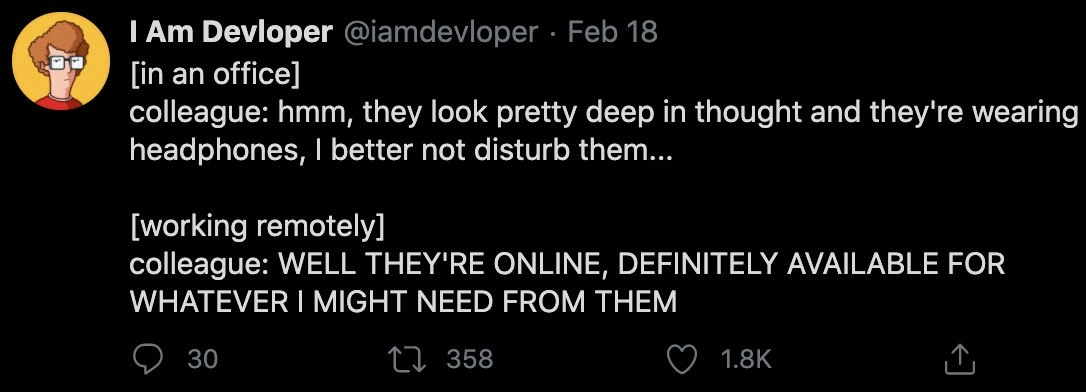
The tweet in the meme gives a perfect example. It contrasts two situations:

  • In an office setting, a colleague observes the developer is deeply concentrating and wearing headphones, and they think to themselves, “Hmm, better not disturb them right now.” They intuitively understand the headphones_focus_signal and respect it.
  • In a remote setting, that same colleague only has the developer’s online status to go on. They see the green dot or the word “Online” next to the name and assume, “Oh, they’re definitely available!” and immediately reach out with whatever request they have.

So essentially, the physical “do not disturb” sign (headphones) isn’t translating into the digital world. Unless the developer explicitly marks themselves as “Away” or “Do Not Disturb” (which many folks forget to do, or hesitate to do because they don’t want to seem unapproachable), teammates might just assume everything’s fair game. There are features to help – for instance, Slack lets you set a status message (like “🕑 In focus mode, back at 3pm” or an emoji of headphones) and also a Do Not Disturb mode that silences notifications. But here’s the catch: colleagues have to actually notice and respect those indicators. Not everyone does. Some people either don’t see the tiny icon, or they think, “Eh, I’ll message them anyway; they’ll answer when they can.” The problem is, human nature being what it is, even seeing the message notification can break a person’s focus. It’s like hearing a knock on your door – even if you don’t answer immediately, you’re now aware someone’s waiting.

Let’s visualize the contrast to make it crystal clear:

Situation (Dev’s context) Colleague’s reaction
At the office: Developer has headphones on and is intensely coding. (This usually signals they’re busy.) “They’re probably deep in thought. I’ll wait or come back later.”   (Colleague decides not to interrupt.)
Working from home: Developer’s status icon is green (showing “Online” on the company chat app). “Oh, they’re online right now! I can ping them immediately about my issue.”   (Colleague sends a message straight away.)

In the first case, the colleague exercises restraint; in the second, they dive right in. The meme exaggerates the remote colleague’s enthusiasm with all-caps text (“WELL THEY’RE ONLINE, DEFINITELY AVAILABLE…”), which is a humorous way to highlight how oblivious or eager people can be when they see someone “online.” It’s relatable to developers because many of us have experienced that exact scenario: you log on in the morning, maybe still getting caffeine in your system or reviewing yesterday’s code, and suddenly ping! someone is asking for help as if you were just sitting there waiting for requests.

This is a common pain point in RemoteWorkCulture. It’s not that colleagues intend to be rude – often they think a quick question in chat is less intrusive than walking up to your desk. And it can be, if handled correctly. The issue is with the expectation of immediate response (that synchronous mindset creeping in). If each person sending a message thought, “They might be busy; I’ll let them answer when they have a moment,” it would be asynchronous and probably fine. But if ten people think you’re free and all ping you at once… well, you’ve got a day full of interruptions. The overhead of constant context switching can really drain DeveloperProductivity. Every time you respond to “just a quick thing,” you have to reload the mental state of your work afterwards, which is exhausting.

For junior developers or those new to working from home, it’s important to learn both sides of this. If you’re the one asking a question: try to gauge urgency. Could it be an email instead of an instant message? Can it wait an hour? If you do message a colleague and they don’t reply immediately, that’s okay – they might be focusing, and you shouldn’t take the silence as anything negative. That’s normal for async work. If you’re the one needing focus: consider using the tools at your disposal – set your status to “busy” or use an emoji like 🎧 to indicate you’re heads-down. You can even snooze notifications for an hour or use app features that show when you’re in a meeting or focus mode. And don’t feel guilty about it! Protecting your focus is part of doing quality work. It might also help to communicate with your team about this challenge – often, once people are aware, they’ll be more considerate (chances are they’ve struggled with the same thing).

The meme’s popularity (just look at those 1.8K likes and many retweets in the screenshot) shows that this isn’t just an isolated incident. It resonated widely because so many of us are living this reality in the era of widespread remote work. It’s classic DeveloperHumor to take a slightly frustrating everyday experience and exaggerate it in a tweet or comic. By laughing at it, we also acknowledge it – “Yes, this is a thing, and it happens to me too!” In a way, it’s also an invitation to do better: maybe next time you see someone online, you’ll think twice about assuming they’re free, or you’ll drop a message like “whenever you have a moment…” instead of “got a sec?”.

Level 3: Green Dot, Red Alert

In the trenches of RemoteWork life, a developer’s online status has become a cruel parody of availability. In a traditional office, seeing a teammate with big over-ear headphones, eyes laser-focused on the screen, is a universally understood focus signal: “Don’t bother them; they’re in the zone.” It’s practically the developer equivalent of a church’s quiet pew or a Do Not Disturb sign hung on a door. But flip to a WorkFromHome setting and suddenly that courtesy evaporates. The mere sight of a little green dot next to your name – the infamous “online” status icon in Slack, Teams, or any chat – and colleagues assume you’re free for an impromptu chat about anything under the sun. The meme nails this absurd contrast: headphones mean focus, but an online icon apparently means open season on your time.

This highlights a classic remote communication pitfall: the clash of asynchronous_vs_synchronous expectations. In theory, remote teams should embrace asynchronous communication – send a message and let the person respond when it fits their flow. In practice, many office cultures dragged their old habits into the digital realm: if you’re “Online”, it means drop everything and respond right now. The result? An interruption_culture where pings and DMs fly at all hours, decimating any hope of DeepWork. We’ve essentially replaced the tap on the shoulder with a flurry of digital nudge-nudge notifications. The tweet’s format exaggerates this for comic effect, but every developer reading it is probably nodding (or maybe crying) in recognition.

Let’s talk DeveloperProductivity. Writing code or debugging a gnarly issue requires mental juggling of countless details – it’s delicate work. A single “Hey, got a minute?” message can blow up a developer’s mental stack like an unexpected exception. Studies (and painful experience) have shown that recovering your focus after an interruption can take significant time (some say ~20-30 minutes to fully regain flow). So those innocent pings carry a heavy communication_overhead. The meme is poking fun at how colleagues seem blissfully unaware of this overhead when everyone’s remote. It’s too real: you might be deep in a critical section of code, but if your status is green, a coworker might still lob a “quick question” grenade into your chat window, instantly shattering that fragile concentration.

Why does this happen? Partly because remote work strips away the subtle human cues we rely on. In person, you can physically see when someone is engrossed in thought – hunched over the keyboard, maybe mouthing through a tricky logic problem, big headphones on. Social etiquette kicks in and you think, “Hmm, better come back later.” Remotely, all you see is an abstract status indicator: Online. Many chat apps default everyone to “available” whenever their computer isn’t sleeping. There’s no equivalent of those giant headphones or a furrowed brow in a chat list. Unless a developer remembers to manually set an away status or a 🔕 do-not-disturb mode (and colleagues actually notice it), the default assumption becomes always_online_expectations: “If they’re online, they must be free to talk!” It’s a classic status_icon_misinterpretation.

Even seasoned teams fall into this trap. Maybe it’s a bit of anxiety: when working remotely, if you see your teammate go “offline,” you worry they might not see your question for hours. So, folks tend to jump on anyone showing as active. It doesn’t help that some workplaces equate a constantly active status with being a “good, responsive employee” (one of those unspoken pressures of RemoteWorkCulture). The result is an environment where that little green dot can feel like a leash. A cynical veteran dev knows this feeling all too well: one minute you’re blissfully lost in solving a performance bug, and the next your focus is obliterated by a barrage of chat messages because someone saw you were active on Slack at 9 AM and assumed you were idly awaiting their urgent request to resize a logo or attend an impromptu meeting.

To illustrate the contrast, consider how the exact same colleague behaves in-office versus remote:

Scenario Colleague’s Thought Process
Office – You’re at your desk, wearing headphones, deep in code.
Visual cues: Headphones on, intense concentration.
“They look pretty deep in thought… and those headphones are practically screaming ‘do not disturb.’ I better not interrupt them right now.”
(Respects your focus)
Remote – Your status is “Online” in the chat app.
Visual cues: Just a green dot next to your name.
“WELL, THEY’RE ONLINE! Definitely available for whatever I might need from them, right? Let me just send a quick ping…”
(Assumes instant availability)

In code, the colleague’s logic might look a bit like this:

def should_interrupt(colleague):
    if colleague.location == "office" and colleague.wearing_headphones:
        return False  # They look busy; hold that thought.
    elif colleague.location == "remote" and colleague.status_icon == "online":
        return True   # Green dot means go! Time to DM them immediately.
    else:
        # Default behavior: if unsure, probably still interrupt (YOLO).
        return True

# Example usage:
colleague = Developer(location="remote", wearing_headphones=False, status_icon="online")
if should_interrupt(colleague):
    ping(colleague, message="Hey, quick question, got a sec?")

(Above: Pseudocode of a well-meaning but interrupt-happy colleague’s thought process. Notice how “online” status triggers an immediate ping.)

The humor here has a bite of truth: we laugh, but only because it’s painfully relatable. The tweet from @iamdevloper exaggerates with ALL-CAPS for the remote colleague’s line, which is exactly how it feels when you’re on the receiving end of these interruptions. It’s like your coworker is virtually shouting, “Oh, you’re ONLINE so you’re DEFINTELY AVAILABLE for whatever I need – never mind what you were doing.” Developers share this meme because it captures a collective frustration in distributed teams: the struggle to preserve deep focus time in a world of constant connectivity. Anyone who’s been in a long stretch of WorkFromHome has stories of being bombarded on chat for trivial things simply because they forgot to toggle “away” while deep in thought. It’s a tongue-in-cheek critique of how remote work tools and habits sometimes backfire, turning what used to be quiet, productive hours into a gauntlet of pings and pop-ups.

At a broader level, this meme is a commentary on communication norms. It subtly advocates for more respect of asynchronous communication: just because someone’s computer is awake doesn’t mean they are free. Seasoned devs (especially the battle-scarred introverts among us) often develop strategies to cope: from setting calendar blocks labeled “Deep Work” (and praying others respect them) to using Slack statuses like “🤫 Focusing, please DM if urgent” or even going invisible when they need to hunker down. Some teams establish explicit rules to fight the always_online_expectations: for example, “If you have a non-urgent question, drop it in chat and don’t expect an immediate response.” But not every workplace has caught on. There are still managers who might ping every 15 minutes if they see you green, or coworkers who assume silence equals wasted time.

In summary, the meme’s humor lands because it’s grounded in the real, somewhat absurd experience of modern remote development. It’s calling out the misinterpretation of status icons and the lack of remote etiquette with a hearty dose of sarcasm. The senior engineers reading it chuckle (or smirk) because, yeah, we’ve all lived this. We’ve gone from physical headphones_focus_signal at our desks to the digital “active now” light – and discovered the hard way that one does not replace the other. Communication is harder when you’re not face-to-face, and this meme shines a flashlight on that gap in the funniest possible way.

Description

A screenshot of a tweet from the account 'I Am Devloper' (@iamdevloper). The tweet contrasts coworker perceptions in two different environments. The first scenario, '[in an office],' describes a colleague noticing someone deep in thought with headphones on and deciding, 'i better not disturb them...'. The second scenario, '[working remotely],' portrays a completely different mindset: 'colleague: WELL THEY'RE ONLINE, DEFINITELY AVAILABLE FOR WHATEVER I MIGHT NEED FROM THEM'. The humor stems from the loss of physical cues in remote work. In an office, headphones and intense focus signal 'do not disturb,' but online, a green 'active' status is often misinterpreted as immediate availability, leading to constant interruptions and a misunderstanding of deep work
Comments

7
Anonymous ★ Top Pick In the office, headphones are a firewall. Remotely, your green dot is an open port with no rate limiting
  1. Anonymous ★ Top Pick

    In the office, headphones are a firewall. Remotely, your green dot is an open port with no rate limiting

  2. Anonymous

    In the office my over-ear cans act like a mutex - threads see it and back off; remote, that green Slack dot is just an optimistic lock: everyone writes anyway and my focus keeps rolling back

  3. Anonymous

    The green dot on Slack is like a production server health check - just because it's returning 200 doesn't mean you should start deploying breaking changes to someone's concentration

  4. Anonymous

    The cruel irony of remote work: In the office, headphones were the universal 'Do Not Disturb' sign respected by all. Now, a green Slack dot means you're fair game for 'quick questions' at any hour - because clearly, being online means you're not in a flow state debugging that race condition that only reproduces in production. The headphones are still on, but now they're just for show while you context-switch between three Zoom calls and a 'quick sync' that could've been an async message

  5. Anonymous

    The green dot is a liveness probe, not a readiness probe - stop sending blocking RPCs to a human mid-deploy

  6. Anonymous

    In the office, headphones were a mutex; remote, the Slack green dot is treated like a 24/7 SLA - I'm running a long batch job called “thinking,” please use the async queue instead of the interrupt handler

  7. Anonymous

    Office headphones: respected mutex lock on your focus. Remote green dot: wide-open semaphore inviting a stampede of pings mid-refactor

Use J and K for navigation