The Timezone-Ignoring Slack Menace
Why is this RemoteWork meme funny?
Level 1: Midnight Wake-Up Call
Imagine you’re fast asleep in your bed in the middle of the night and BOOM, your phone rings or buzzes. It’s your friend who lives on the opposite side of the world, calling you to ask for help with something because, for them, the sun is out and it’s the middle of the day. They completely forgot that it’s nighttime for you. You wake up, all confused and groggy, thinking, “Why are they calling me now? It’s the middle of the night!” You’d probably be a bit annoyed, right?
That’s what’s happening in this meme. One person is trying to sleep at 3 AM, and another person who lives far away (in a very different time zone) needs something and decides to message them on a work chat. The second person isn’t trying to be mean – it’s daytime for them and they have a question – but from the sleepy person’s point of view it feels really inconsiderate to get a message in the middle of the night. It’s a funny situation because it’s so relatable: we can all imagine how irritating it is to have our sleep interrupted by someone who just happens to be on a different schedule. It’s like if your brother or sister barged into your room at midnight asking for homework help or to find a lost toy. You might help them eventually, but you’d definitely be grumpy about the timing! The humor comes from that everyday clash of schedules – when someone’s morning becomes someone else’s midnight problem.
Level 2: Time Zones Are Hard
This meme boils down to the challenges of working across different time zones in a RemoteWork setup. In simpler terms: you (the developer) are trying to sleep at 3:00 AM, but a teammate who lives on the other side of the world is at work (for them it’s 3:00 PM in the afternoon) and they send you a message on Slack. Slack is a popular workplace chat app – basically a messaging tool that many dev teams use instead of email for quick communication. A Slack “ping” means you get a notification or alert that someone sent you a message.
A 12-hour time difference basically means when it’s midnight or early morning for you, it’s noon for them (and vice-versa). For example, if you’re in New York and a colleague is in Hong Kong, then when it’s 3 AM in New York, it’s 4 PM in Hong Kong. They’re wide awake and working, and you’re sound asleep. The meme jokingly calls the coworker “some asshole” because from your perspective, that late-night Slack message feels like a rude awakening. Of course, the coworker isn’t literally trying to be a jerk – they probably just need help and might not realize what time it is for you (or they hope you muted your notifications).
Let’s break down how this scenario plays out with timings:
| My Local Time | What I’m doing | Their Local Time | What my coworker is doing |
|---|---|---|---|
| 3:00 AM | Sleeping (off the clock) | 3:00 PM (same day) | Working (sends me a Slack message) |
| 9:00 AM | Waking up & seeing their message | 9:00 PM (same day) | Off work (they won’t see my reply until their next morning) |
At 3:00 AM your time, you’re comfortably asleep. That’s when your colleague pings you on Slack, because for them it’s 3:00 PM and they’re in the middle of their workday needing something from you. By the time you wake up at 9:00 AM and finally see their message, it’s already 9:00 PM for your colleague, and they’ve signed off for the night. Essentially, they disturbed your sleep, yet they still didn’t get an answer until the next day anyway! This little table shows the misalignment: one person’s work time is the other person’s personal time. All the back-and-forth delays and disruptions are what we call communication overhead in a distributed team — the extra effort and frustration involved in coordinating across different schedules.
For a new developer on a global team, one of the first lessons is how to handle asynchronous communication. Asynchronous means not expecting an immediate response; you send a message or email and the other person replies when they can, as opposed to calling them on the phone and getting an answer right away. In our scenario, ideally the teammate could have left you a Slack message without expecting you to answer until your morning. The problem was that the message still sent you a notification at 3 AM and grabbed your attention. Tools like Slack do have features to help with this, such as “Do Not Disturb” mode or scheduled send. For example, you can set Slack so that between 10 PM and 8 AM your time, it won’t buzz or pop up new messages — the messages will wait silently until you’re back online. That way, late-night pings don’t actually wake you up. But not everyone uses these settings, and sometimes people mark a message as urgent and override the quiet hours. (Slack will actually warn you like “This person is in Do Not Disturb. Do you want to notify them anyway?” if you try to DM someone off-hours — and yes, some folks will hit “Notify anyway” for something silly.)
The saying “TimeZonesAreHard” is popular because dealing with time differences is tricky for both humans and computers. We have to calculate time conversions, schedule meetings across continents, and remember that not everyone is on the same clock. It’s easy to mess up. Ever scheduled a video call thinking it’s a good time for everyone, and then realized it’s 2 AM for one of the participants? Oops. Programmers even have to consider time zones in code (like converting timestamps, or handling daylight savings changes), and there are countless stories of software bugs caused by these conversions. So if coordinating a simple chat can cause this much headache, it’s no wonder developers joke about time zones being hard.
In a RemoteWork environment, you often work with colleagues in different cities or countries, which is called a distributed team. Collaboration can still be great, but you have to manage expectations about response times. The meme is expressing a classic developer frustration: getting bothered during your off-hours. It highlights why communication norms are important. Ideally, teams establish rules like “no non-critical messages outside someone’s working hours” or they at least encourage using scheduling features (e.g. Slack has “Send later” so your message can be delivered at, say, 9 AM their time instead of immediately). New team members learn quickly to check each other’s time zones – many people put their time zone or local hours in their Slack status. You might see a status message like "Sleeping – will reply in my morning" (often with a little moon icon) to remind others of the difference. Over time, everyone becomes more mindful: if you absolutely need to reach someone in an emergency, you do it, but for normal tasks, you let them sleep and wait for their next workday.
This meme is funny to developers precisely because it’s true. We’ve all either done this or been on the receiving end. It’s a light-hearted way to poke fun at the pitfalls of global team collaboration. When you see the text “ruin your 3 AM developer sleep,” you can’t help but cringe and laugh, remembering the last time your sleep was cut short by that ping from afar. It’s a nod to the new reality of work: your teammates might be literally a half-day ahead of you, and managing that requires a bit of patience, technology help, and good old-fashioned understanding.
Level 3: Distributed Denial-of-Sleep
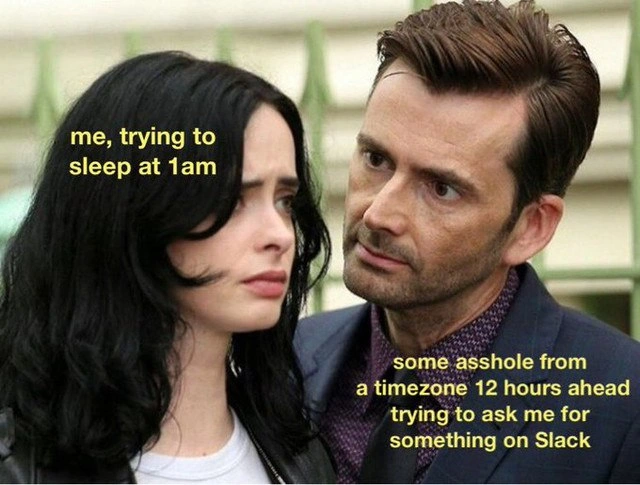
"some asshole from a timezone 12 hours ahead trying to ask me for something on Slack" – the meme’s blunt caption says it all. If you’ve ever worked on a globally distributed team, this scenario is painfully familiar. The image itself shows a woman with the label “me, trying to sleep at 3am” and a man beside her labeled as that coworker. He’s leaning in with a pushy, wide-awake expression, while she looks exhausted and annoyed. It perfectly captures the vibe: you’re trying to catch some Z’s, and this relentless colleague just won’t let you. It’s 3 AM in your time zone, you’re finally catching some sleep after a long coding session, and suddenly your phone or laptop buzzes with a Slack notification. It’s a coworker from across the world who’s on their mid-day grind, innocently (or not-so-innocently) asking for help. In that bleary-eyed moment, anyone disturbing your sleep feels like, well, some asshole. The humor lands because it’s a shared frustration in dev life: remote collaboration can turn into a nightmare when your teammates’ work hours become your off-hours.
This meme highlights what could be jokingly called a Distributed Denial-of-Sleep (DDoS) attack. In networking, a DDoS overwhelms a service; here it’s your sleep that’s getting overwhelmed by distributed work schedules. With a team spread over a 12-hour difference, someone’s always online – which sounds great for productivity until it translates into a 3AM ping on your end. The phrase “TimeZonesAreHard” isn’t just about scheduling conference calls; it’s also about the human cost of misaligned clocks. When half the team is essentially living in the future (half a day ahead), coordinating becomes a twisted game of “tag, you’re it” across the international date line. This often results in async miscommunication: one person’s urgent end-of-day request detonating in another’s deep slumber. It’s 3 AM for you but 3 PM for them, so of course they’re in full swing and assume you might be around.
Slack as a tool blurs the line between synchronous and asynchronous communication. It’s meant for quick team chats, but it also creates an expectation of presence – those little green “online” dots and typing indicators that psychologically pressure everyone to reply now. A senior engineer knows that feeling of dread when a Slack ping arrives at odd hours: is the site down? Is there a production Sev-1 incident? Or is it just Bob from the other side of the planet, asking “Hey, got a minute to review this PR?” (cue exhausted groan). Your brain doesn’t care if it’s a server outage or a trivial request – a ping is a ping, and adrenaline kicks in either way. It’s essentially Pavlovian conditioning from too many late-night incidents. So even if the message isn’t critical, the act of being woken up triggers the same fight-or-flight response we associate with pager alarms. It’s darkly comic: in the remote work era, we’ve re-created the 3 AM emergency wake-up feeling for completely mundane reasons.
From an organizational perspective, this scenario says a lot about RemoteWork culture and CommunicationOverhead. Companies boast about “follow-the-sun” workflows and around-the-clock progress, but without proper guardrails it turns into Follow-The-Sun Burnout. Instead of gracefully handing off tasks between time zones, teams often end up with people effectively working 24/7. The “asshole” in the meme probably isn’t trying to be inconsiderate – they just need info before their day ends. Maybe they assume you’ve set your Slack to Do Not Disturb, or they think you’ll just see it in the morning. But Slack’s design can betray you here: by default, if you don’t manually snooze notifications, that ping will do its best to get your attention. And let’s be honest, many of us forget to toggle DND, or we worry we’ll miss something truly urgent. I’ve seen developers sleep with one eye open on their phone, paranoid about missing a critical alert. That’s how boundary-less our work can become.
The meme resonates because it underscores how global team collaboration can inadvertently erode personal boundaries. In theory, we should embrace asynchronous workflows: leave that question in a message and accept that the answer might come hours later. In practice, there’s often subtle (or not-so-subtle) pressure to sync up immediately. Power dynamics play a role too: what if the person pinging you at 3 AM is a tech lead or, worse, your manager from another region? It puts you in a tough spot – either ignore it and risk looking unresponsive, or sacrifice your sleep to demonstrate you’re a “team player.” Many of us have been there, groggily typing “On it, give me a sec” at 3:05 AM while wondering why we ever agreed to a global sprint timeline. It’s both absurd and normal in modern distributed teams.
Historically, this is a new spin on an old problem. Even before Slack, teams spread across continents struggled with time differences via email and phone calls. Back then, though, the friction (like expensive international calls or slower communication) made people think twice before disturbing someone off-hours. Now, with Slack and other instant messengers, the barrier is so low that a quick DM feels as casual as tapping a coworker on the shoulder in the office. Except it’s not the office – it’s someone’s bedroom at 3 AM. We’ve gained immediacy at the cost of context. It’s telling that Slack eventually introduced features like scheduled messages and automatic DND windows; these are band-aids for the exact problem this meme highlights. Without explicit norms, CommunicationOverhead turns into a 24-hour stress cycle. The popularity of this meme is basically the dev community collectively saying, “Yep, been there. This is fine.” 🔥😴
Description
A two-panel meme featuring characters from the Netflix series 'Jessica Jones.' On the left, a weary and distressed-looking Jessica Jones (played by Krysten Ritter) is labeled 'me, trying to sleep at 1am.' On the right, the villain Kilgrave (played by David Tennant) leans in close with an intense, demanding expression. He is labeled, 'some asshole from a timezone 12 hours ahead trying to ask me for something on Slack.' The meme uses the characters' dynamic to represent the frustration and helplessness felt when colleagues in drastically different timezones disregard local working hours. For senior developers in global companies, this is a deeply relatable scenario, highlighting the communication breakdowns and lack of consideration that can occur in distributed teams, leading to burnout and a poor work-life balance
Comments
17Comment deleted
The true 'follow-the-sun' support model is when a Slack notification from the other side of the world follows you directly into your REM cycle
Slack pings from the APAC shard at 03:00 have turned my circadian rhythm from strongly consistent to embarrassingly eventual
The real distributed systems challenge isn't achieving consensus across nodes - it's achieving consensus on when it's acceptable to ping someone about that P2 bug when your team spans from San Francisco to Singapore
The real distributed systems problem isn't CAP theorem - it's the Chronological Availability Problem: you can have either sleep, global team collaboration, or sanity, but the laws of physics dictate you can only pick two. And let's be honest, in most organizations with 'follow-the-sun' support, nobody's picking sanity
Follow-the-sun sounded great until someone in UTC+12 turns Slack into a blocking RPC with a 3am timeout on my sleep SLO
Slack isn’t gRPC; it’s an eventually consistent queue with human consumers - set a 24-hour SLO and stop triggering wake locks on my brain
Global teams' real clock skew: 12 hours, where no NTP syncs your sleep to their 'urgent' Slack commits
Было бы смешно, если б не было так грустно... Comment deleted
вы будете в шоке, если узнаете, что такое dnd… Comment deleted
Ещё бы его не игнорил каждый первый начальник с той стороны Comment deleted
omg cyrillic letters Comment deleted
Russkie vpered🦾 Comment deleted
нет, следуй правилам no, follow the rules Comment deleted
Не понел No understando Comment deleted
говори англійською або не говори зовсім speak english or don't speak at all Comment deleted
It's your fault if you're not disabling notifications based on your working hours. Comment deleted
yeah i know this is a meme but in the other hand who cares about notifications Comment deleted