

Redis: The High-Performance Vehicle for Architectural Nightmares
Description
This image utilizes the popular 'Slaps Roof of Car' (or 'Car Salesman') meme format to comment on the misuse of Redis. In the meme, a car salesman is enthusiastically pitching a vehicle to a customer. The car itself has been replaced by the Redis logo - a red, three-dimensional, multi-layered block with geometric shapes on top. Above the scene, a caption in bold white text reads, 'THIS BAD BOY CAN FIT SO MANY TERRIBLE ARCHITECTURAL DECISIONS IN IT'. The humor is targeted at experienced developers and architects who understand Redis's power and flexibility as a fast, in-memory data store. Because it is so versatile and performs so well, it often becomes a 'dumping ground' in software architecture - used simultaneously as a cache, a primary database, a message queue, and more, often without forethought. This leads to an accumulation of technical debt and creates a critical, complex single point of failure. The meme hilariously captures the sales-pitch-like enthusiasm with which developers sometimes adopt a tool for everything, only to create a legacy of poor architectural choices


Comments
11Comment deleted
Redis is the intern's best friend and the principal engineer's recurring nightmare. It solves today's performance problem by becoming the foundation for tomorrow's multi-day outage
Sure, it’s blazing fast - right up until your product manager asks for multi-AZ persistence and suddenly you’re inventing PostgreRedisQL on a Friday night
The real architectural decision was choosing Redis for everything because 'it's fast' - right up until your 64GB instance OOMs at 3am, you realize your persistence strategy is 'hope the AOF doesn't corrupt', and you're explaining to the CTO why your 'database' evicted half the user sessions because someone forgot to set TTLs on that new feature's cache keys
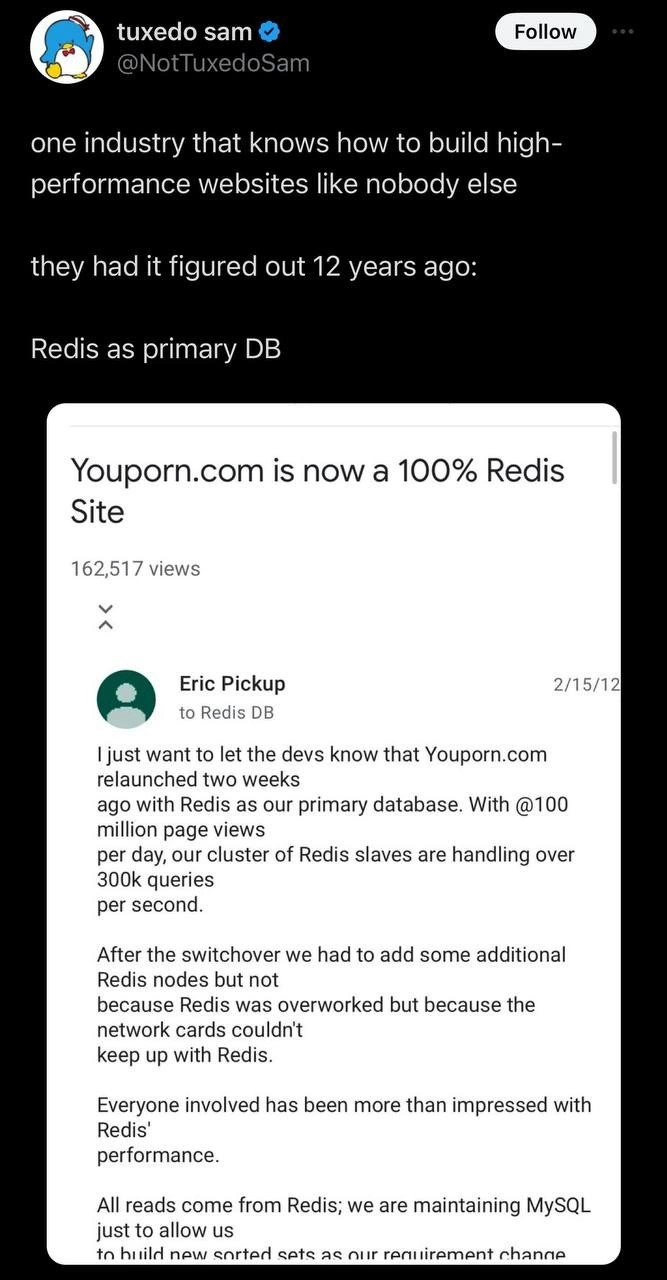
Redis: because why architect a proper solution with message queues, relational databases, and distributed caches when you can just shove everything into a single in-memory key-value store and call it 'microservices'? It's the Swiss Army chainsaw of backend engineering - technically capable of doing everything, but probably shouldn't be your first choice for most of it. Bonus points when it becomes your primary database, session store, pub/sub system, and task queue simultaneously, all while your team insists 'it's just temporary' for the third year running
Nothing says enterprise architecture like using Redis for cache, queue, lock manager, and primary database - then labeling the outage a “cache miss.”
Our Redis does sessions, queues, locks, config, and 'source-of-truth'; we call it C.A.P. - Cache As Primary - because it partitions our availability and our sanity
Horizontal scaling perfected: problems now distributed across 47 services with zero observability
lmao, name a better alternative Comment deleted
What is it? Comment deleted
LEGO Comment deleted
Redis Comment deleted