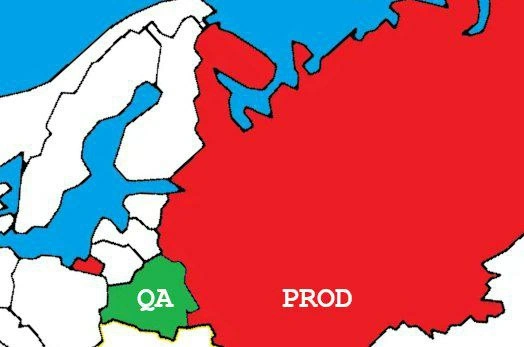
QA: The Last Buffer State Before Production's Iron Curtain
Why is this QA meme funny?
Level 1: Toy House vs Real House
Imagine you built a little toy house out of blocks and it looked perfect. You might think, “Building a real house will be just as easy!” But when you try to build a real full-sized house, it’s a completely different story. The real house needs heavy bricks, it has to survive wind and rain, and a lot more can go wrong. The joke in this picture is just like that. The small green QA area is like the toy house where we practice, and the big red PROD area is the real house where people actually live. It’s funny because the tiny practice world (QA) was so simple that everything seemed fine, but the real world (Production) is HUGE and complicated. It’s like practicing in a kiddie pool vs. swimming in the ocean – the ocean has big waves you never saw in the little pool. In the end, we laugh because of course a small test can miss things that become obvious in a big reality. The little QA world fooled us into thinking we were ready, and Prod’s giant world gave us a surprise. It’s a playful way to say, “Don’t be too confident just because it worked in the small test – the real thing might be a lot tougher!”
Level 2: QA Pond, Prod Ocean
In software development, we set up separate environments to safely test changes before they go live. QA (Quality Assurance) is the testing environment where engineers and testers check new code. Production (often just “Prod”) is the real environment that actual customers use. Think of QA as a small practice stage and Production as the big public stage. We run our app in QA first to catch bugs in a low-stakes setting. Only when we’re confident it works in QA do we deploy it to Production. In an ideal world, QA would be a miniature replica of Prod – same settings, same data, just smaller. That way, anything that happens in Prod would presumably happen in QA too. This is the idea of environment parity: keeping the test and live environments as similar as possible. The goal is to avoid nasty surprises during a Deployment.
The meme highlights a common reality: the QA environment is much smaller and simpler than Production. In the image, the tiny green QA territory sits next to the massive red PROD empire, illustrating how a test environment often pales in comparison to the Production environment. For example, your QA might run on a single server with maybe 100 fake user accounts, whereas Production might use 50 servers and serve 100,000+ real users. In QA, you might test with a few hundred data entries; in Prod, there are millions of records, with all the messy, unpredictable data that real users create. QA might have certain features turned off or use dummy services (like a fake payment gateway or stubbed APIs) to keep testing simple. Production has everything turned on and integrated – it’s the full, real-world system. This size and complexity mismatch — an env_size_imbalance — is what the meme humorously shows on the map. QA looks like a tiny pond next to the ocean of Prod.
Because of this QA vs Prod discrepancy, we get the classic scenario: “It worked in QA, but then it broke in Production.” Newer developers eventually stumble into this. You might run all your tests in QA and think the code is solid. Then you deploy to Prod and (boom!) something unexpected goes wrong. Maybe the code couldn’t handle the volume of real users, or an edge-case data value in Prod causes an error that never showed up with the clean test data. It’s a notorious trope in DeveloperHumor and TestingHumor precisely because it happens so often. This gap between environments is also why many of us feel anxious during deployments – an unease captured by tags like DeploymentAnxiety. No matter how good your QA process is, if QA isn’t close to Prod in scale or configuration, there’s a risk that a bug will slip through testing and only appear once real customers are using the system.
Engineers try hard to reduce these differences. We might use the same OS, databases, and configurations in QA as in Prod. Modern DevOps practices like using Docker containers or cloud VMs help ensure that the code runs in a similar environment setup everywhere. For instance, if Prod runs on Linux with a certain version of Python and specific library versions, we make sure QA uses the same. We also create “staging” environments — basically a pre-Production setup that’s larger than QA — to do final rehearsals with more data or heavier load. But even with those efforts, it’s usually impractical to make QA an exact clone of Prod. There are practical limits: duplicating a massive production database or simulating tens of thousands of users in QA can be incredibly costly and complicated. Companies often compromise by testing just with a subset of data or a lower traffic volume. That’s why Production issues still manage to surprise us. In short, it’s hard to simulate the real world perfectly.
This meme is a funny reminder of that truth. By using an over-the-top map (huge Prod, tiny QA), it jokes about how out-of-proportion our test vs. live environments often are. If you’re a junior dev, the takeaway is: don’t assume passing QA means problem-free in Prod. Always be aware of what’s different between your test setup and the real thing. Maybe QA had 1,000 records in the database and Prod has 1,000,000 — that difference can uncover performance issues or memory leaks. Or QA had one user role active, but Prod has dozens of different user types doing crazy things. This mismatch is exactly why deploying new code can be nerve-racking. The meme resonates because every developer has learned that a tiny QA test can miss something that a colossal Production environment will definitely reveal. It’s both a joke and a gentle warning: works in QA is good, but works in Prod is the real victory. Make your tests as real as you can — and still keep an eye out for those prod-only surprises!
Level 3: Everything Is Bigger in Prod
The colossal red landmass labeled “PROD” on this meme’s map absolutely dwarfs the little green “QA” speck. This exaggerated geography strikes a nerve because it’s scarily accurate in many companies. In the world of software Deployment pipelines, the Production environment often sprawls like an empire, while the QA environment is a tiny province. The humor comes from that qa_vs_prod_discrepancy we’ve all experienced: code that sails through the QA tests, then promptly sinks like the Titanic in the vast ocean of production. Why? Because the environment setup and scale in QA are nothing like the colossal chaos waiting in Prod. This meme is classic DeveloperHumor born of pain — a tongue-in-cheek indictment of poor environment parity (or rather, the lack thereof) between testing and live systems.
Let’s translate the map labels: QA stands for the Quality Assurance environment (where we run tests before release), and PROD is the live Production environment (the real deal serving users). In theory, QA is supposed to mimic Prod. In theory. In practice, QA is often a mere toy model. We spin up maybe one or two servers, use a scrubbed tiny dataset, and call it a day. Meanwhile, Production is running on a fleet of beefy servers across data centers, churning through real user data 24/7. The meme’s joke is that expecting QA to catch all bugs is like expecting a goldfish bowl to have the same waves and sharks as the Pacific Ocean. Environment parity is more myth than reality – we talk a good game about matching configurations, but budgets and time constraints mean QA stays a minuscule sandbox next to Prod’s sprawling empire of code.
Why do senior devs smirk (or cringe) at this image? Because we’ve lived the “Works in QA, blows up in Prod” saga. That bold red PROD blob gives us flashbacks to 3 AM on-call incidents and DeploymentAnxiety. It’s the embodiment of ProductionIssues that seem to come out of nowhere. In truth, those issues were hiding in plain sight – masked by the comfortable limitations of QA. In a tiny QA environment, your new feature might get exercised by 5 testers clicking around fake data. It seems rock solid. But push that code to Prod, where tens of thousands of real users, real data, and real traffic hit it, and suddenly you discover all the edge cases and performance bottlenecks your QA never exposed. Surprise! That innocent-looking query that ran in 0.1 seconds against QA’s 1k rows now scans 10 million rows in Prod and locks up the database. The image’s comical scale difference is a nod to how a QA process often fails to simulate “real world” scale or weirdness.
To paint the picture, here’s how the two environments typically stack up:
| QA Environment (Tiny green patch) | Production Environment (Giant red empire) |
|---|---|
| Handful of test users and dummy accounts | Millions of real users doing unpredictable things |
| Small, sanitized dataset (e.g. a few MB) | Gigantic live database (e.g. terabytes, with messy real data) |
| Runs on one or two servers/containers | Runs on dozens of servers across clusters/regions |
| Many features stubbed or using fake services (to simplify testing) | All integrations live: real payment gateways, APIs, microservices at scale |
| Light load – testers click leisurely | Heavy load – peak traffic, concurrent transactions hitting all at once |
| Bugs just annoy QA team briefly | Bugs in Prod can knock out services, trigger pager alarms, and anger customers |
Looking at this table, it’s obvious why test_env_shrinkage is a running joke. The env_size_imbalance is real: QA is a kiddie pool, Prod is the Atlantic. A bug that causes a ripple in QA can create a tidal wave in Prod. Seasoned engineers have internalized this. We know that a Production environment has all the “unknown unknowns.” There are always more users, more data, and more weird edge conditions than you accounted for. That’s why deployment day can feel like rolling dice – hence all the DeploymentAnxiety memes floating around.
The industry has tried to bridge this gap. We preach “environment parity” as one of the holy grails of DevOps. (Heck, the Twelve-Factor App manifesto literally has “Dev/Prod parity” as a principle.) We containerize our apps with Docker, orchestrate with Kubernetes, script our infrastructure as code — all so that QA and Prod at least run the same stuff. And yes, these practices eliminate a whole class of “Works on my machine” problems by standardizing software stacks. But here’s the kicker: you can clone the software environment, you can’t clone the scale. You can’t realistically generate the exact chaos of thousands of users clicking at once, or the quirky data that accumulates over years, without essentially running a second production. Most companies aren’t going to pay for a full-size Production clone just for testing – so QA stays a tiny kingdom. We set up a “staging” environment as a compromise, maybe a half-sized Prod, but even that often lags behind or uses synthetic data. There’s always something different – and that something is where bugs love to hide.
Every battle-hardened developer has a war story: the feature that “passed QA with flying colors” only to cause a sev-1 outage in Prod. TestingHumor like this map comes from those bruises. The meme delivers a cynical chuckle because it labels the elephant in the room (literally a giant red one) – the fact that our testing QA process is usually a far cry from reality. We’ve all heard (or uttered) the famous last words: “But it worked in QA!” 😅. This image is basically that phrase drawn as a world map. It’s funny in that dark way because we know the Production empire holds countless surprises that a dinky QA duchy never encountered. The next time a manager innocently asks, “Why didn’t QA catch that bug?”, well, just show them this meme. The prod_dominance illustrated here says it all: QA was simply too small to reveal the dragons that live in the vast lands of Production. And as every jaded engineer knows, “Here be dragons” is practically stamped on the Prod environment. We laugh so we don’t cry – welcome to software development, where Deployment to the PROD empire is always an adventure, no matter how peaceful the QA village looked.
Description
The image displays a simplified, color-coded political map of a portion of Eastern Europe. A large area corresponding to Russia is colored bright red and labeled 'PROD' in white capital letters. Adjacent to it, the country of Belarus is colored green and labeled 'QA'. The surrounding countries and bodies of water (like the Baltic Sea) are colored white and blue respectively, but are unlabeled, focusing the attention on the two key areas. The visual is a geopolitical metaphor for the software development lifecycle. The humor is derived from mapping software environments onto a politically charged map. 'PROD' represents the live, customer-facing production environment, which, like a vast and powerful nation, is critical and where mistakes have severe consequences. 'QA' (Quality Assurance) is depicted as a smaller, essential buffer state. Its role is to stand between the development environments (not shown) and the high-stakes production environment, catching bugs and issues before they can cause a 'diplomatic incident' with users. The analogy resonates deeply with experienced engineers who understand the immense pressure and importance of the QA process as the final gatekeeper of stability
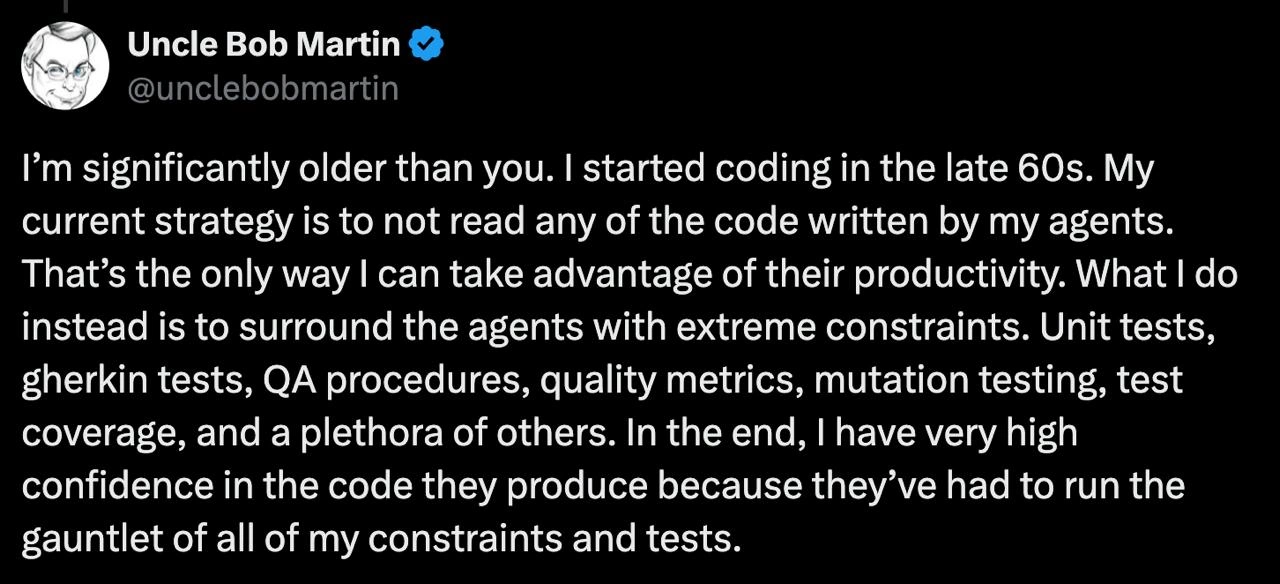
Comments
24Comment deleted
Some orgs treat QA like a speed bump. Here, it's apparently the Brest Fortress on the border of production
“Identical environments,” they said - QA’s a single-node Minikube, PROD’s a 200-node federated cluster marinating in five years of legacy data; border control for bugs is strictly ceremonial
After 20 years in tech, I've learned that QA environments are like Poland in 1939 - vastly outnumbered, under-resourced, and somehow expected to hold the line against the massive production forces that inevitably overwhelm them with scale issues nobody could have tested for
The eternal paradox: QA signs off after testing on their modest three-server cluster, then production deploys to a distributed system spanning 47 data centers across 6 continents with 10,000 edge nodes, custom hardware, and that one legacy mainframe in Frankfurt nobody's allowed to touch. Naturally, the bug only manifests under production load at 3 AM on a Saturday when the on-call engineer discovers the QA environment was running PostgreSQL 14 while prod is still on 9.6 because 'the migration is scheduled for Q3 2019.'
QA's Poland: quick blitz. PROD's Russia: ask Napoleon how that retreat goes
“It passed QA” - on a t3.small with mocks and no time zones; then we ship to prod, a multi‑region sprawl with config drift, real traffic, and one undocumented cron with root
QA mirrors prod - except for traffic, data, IAM, feature flags, autoscaling, regions, and consequences
майор тебе не вычислить их Comment deleted
I will start an investigation of how it happened and will post findgings as soon as I will have any Comment deleted
Там есть шутка, и однажды мы её поймём. Но не сейчас. Не сегодня Comment deleted
Может быть прод намного больше, чем QA готово покрыть? Сложно в любом случае. Comment deleted
I will start an investigation of how it happened and will post findgings as soon as I will have any Comment deleted
Репрессивные меры скорее Comment deleted
^ this Comment deleted
I will start an investigation of how it happened and will post findgings as soon as I will have any Comment deleted
А что же тогда Украина? Comment deleted
Кривые тесты Comment deleted
I will start an investigation of how it happened and will post findgings as soon as I will have any Comment deleted
"Вы что, хотите как в заваленных тестах?" Comment deleted
Dev Comment deleted
Please, stick to usage of English within this nice chat ^_^ Comment deleted
В Украине всю эту ерунду как раз тестировали... Беларусь и РФ это как раз уже продакшн ) Comment deleted
I will start an investigation of how it happened and will post findgings as soon as I will have any Comment deleted
Чето в проде все упало. Comment deleted