The Dark Theme of Life
Why is this DeveloperExperience DX meme funny?
Level 1: Dark is Cozy
Think about how cozy it feels to be in a dim room with only a soft light on – like when you watch a movie with the lights off, or when you read a comic book under the blankets using a flashlight. It's nice and calm, and the bright screen or page is easier to look at because nothing else is shining in your eyes. Nighttime is basically the whole world doing that: the sun goes down, things get darker and quieter. This meme jokes that programmers might like working at night for the same reason. They love having their computer in dark mode (that means the screen shows light-colored text on a black background instead of a blinding white screen), so they find night time extra comfortable because everything around them is also dark and quiet. It's like the entire day switched to a "night theme" just for them! In other words, a lot of coders feel more focused and relaxed when the room is dark and there's no harsh light – just like you might prefer a small night-light instead of a bright lamp when you’re getting ready to sleep. So the funny idea here is that programmers treat the night like it's the world's own dark mode, and that makes them happy and productive.
Level 2: Lights Off, Code On
Let's break down the joke in simpler terms. Dark theme (or dark mode) refers to a color scheme used in apps and coding tools where the background is dark (usually black or gray) and the text is light-colored (often white or neon). This is the opposite of a light theme (black text on a white background, like a typical document or website). Many programmers toggle their IDEs and text editors to dark mode because it can be gentler on the eyes during long coding sessions, especially in a dimly lit room. If you've ever opened up a code editor or even a site like YouTube or Twitter at night, you might have seen a "night mode" option – that’s the app switching to a dark theme so your screen isn’t so bright. Developers in particular have a reputation for preferring this style. Part of it is practical (less glare when you're staring at text on a screen for hours), and part of it is personal taste (some just think it looks cool, kind of like how the green text on black in the movie The Matrix looked awesome).
Now, what about preferring night itself? The meme joke suggests that maybe programmers literally favor the nighttime because it's like the whole world has switched to a dark theme. In reality, plenty of developers do end up coding late at night. Late-night coding is really common in the programming world. You might have experienced this if you’ve ever lost track of time working on a school project or personal coding challenge, and suddenly it's 1 or 2 AM. There are a few reasons for this nocturnal trend: at night there are typically fewer distractions (no emails or meetings if it's outside work hours, and if you live with family or roommates, they're probably asleep), so it's a quiet stretch to focus on complex problems. Some companies even have actual night shift programmers or on-call developers – these folks might be working or monitoring systems during the night in case something goes wrong (like a website crashing at 3 AM). But even outside of official "night shift" jobs, a lot of coding culture informally glorifies the all-nighter. Hackathons often run overnight, and there's a bit of a romantic image of the lone programmer, hoodie on, coffee in hand, lit only by the glow of the monitor.
The phrase "dark theme of life" in the meme is a play on words. In software, a theme is a setting that changes how an application looks. By saying night is the "dark theme of life," the meme is jokingly treating life (or the day-night cycle) as if it's an app that can have themes: daytime is the default light theme (bright and white), and nighttime is the optional dark theme (dark and shadowy). Since a lot of developers love setting everything to dark mode on their devices, the meme imagines that maybe they prefer when the real world itself is in dark mode (i.e., after the sun sets). It's a goofy metaphor. We normally don't think of day and night as "themes" – that's software lingo – so hearing it applied to life is unexpected and funny. Basically, it's saying, "Hey, maybe programmers stay up all night not just because of work or habit, but because subconsciously they enjoy that the world feels like it's in their favorite dark mode!"
To a newcomer in programming, it’s useful to know that this is a popular bit of developer humor. The tags like DeveloperCulture and CodingLife point out that this is an inside joke about everyday life as a coder. You'll encounter a lot of these nerdy jokes as you get involved in the community. For example, dark mode versus light mode is a surprisingly passionate topic – there are endless debates on forums and Twitter about which is better for productivity or eye health. (There's even a tongue-in-cheek saying: "Light mode users will inherit the earth because they’re the only ones who can still see!" This pokes fun at the idea that staring at dark text on a bright background might strain your eyes less in the long run, or conversely that dark mode might make you squint. And the dark-mode fans joke that "light mode is blinding".) So this meme is tapping into that cultural reference. It exaggerates it in a fun way by extending the preference to the entire concept of day vs. night.
Let’s also touch on UX/UI since the categories mention them. UI (User Interface) is about how an app or software looks and is organized (the buttons, menus, colors, etc.), while UX (User Experience) is about how easy and pleasant it is to use. Offering a dark mode option has become an important part of UI/UX design. A good user experience often means letting people choose a visual style that's comfortable for them. So nowadays, many apps will automatically shift to a dark theme at night or let the user toggle it manually. Developers, being power users of their tools, have driven a lot of this trend. It’s considered part of good Developer Experience (DX) too: if you're writing code for hours, you want your editor or IDE to be easy on the eyes and customizable. Having a dark theme available is almost expected in programming tools now. In other words, the people who make software (developers) and the people who design software interfaces (UX/UI designers) both recognize that a dark display can be beneficial, especially during late hours.
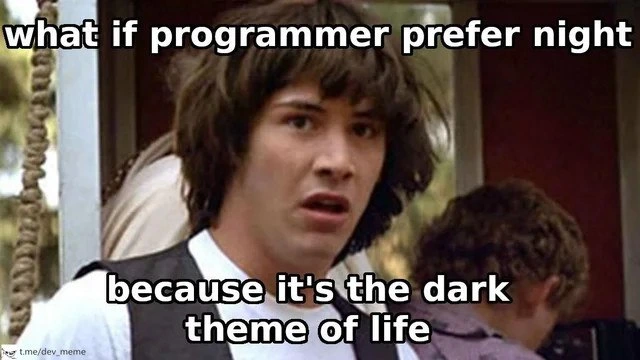
In simpler terms, this meme connects two things: programmers love dark-themed screens, and many programmers also happen to be night owls. It’s highlighting that connection in a joking way. The top text "what if programmer prefer night" sets up a question, and the bottom text "because it's the dark theme of life" delivers the punchline answer. It makes us laugh because it frames a normal life cycle (day and night) in geeky computer terms. Even if you're new to coding, you might already relate if you've ever chosen the "night mode" in an app or found yourself coding or gaming late into the night. The joke simply says: maybe those two things are related! It's a playful exaggeration that takes a common developer preference (dark mode everything) and imagines it influencing a personal habit (staying up all night). In the end, it’s a lighthearted take on CodingHumor and DeveloperCulture – poking fun at ourselves (developers) for being the kind of people who would turn the whole world dark if we could, just to match our terminal color scheme.
Level 3: Night Mode Enabled
Seasoned programmers often joke that their natural habitat is the midnight hour. (Just check the timestamps on those commits: plenty of code gets written while normal folks are asleep.) This meme nails that inside joke with a classic format (the famously befuddled Conspiracy Keanu image) and a punchline that merges life and UI themes. It shows white meme text asking:
"what if programmer prefer night ... because it's the dark theme of life"
This caption humorously suggests an absurd yet relatable idea: developers love dark mode so much that they prefer the entire world in dark mode, i.e. nighttime. It's as if all those hours spent in a code editor with a black background and brightly colored text have conditioned us to find actual daylight too bright. Why settle for a blindingly white sky (the ultimate "light theme") when you can have the sun go down and enjoy the planet’s "dark theme" instead? Turning off the sun to reduce glare — the ultimate developer life hack!
From a User Experience (UX) and User Interface (UI) standpoint, dark mode has evolved from a mere aesthetic option into a near-religion for many developers. Veteran coders often reminisce about early computers where dark backgrounds were the default: think of old terminals and CRT monitors with glowing green text on black — essentially dark theme by necessity. Then came modern IDEs and text editors: while some shipped with light backgrounds (to resemble paper), a huge portion of the developer community immediately sought out dark color schemes with names like Monokai, Solarized Dark, or Dracula. We tweak contrast, background hue, and syntax highlight colors with the zeal of a painter mixing pigments. It's all about reducing eye strain during marathon coding sessions and, let's admit it, looking cool while doing so. The meme riffs on this by pushing the logic to comedic extremes: if our VS Code and terminals are set to dark mode 24/7, maybe we also subconsciously favor working at night to surround ourselves with the ultimate dark theme ambiance.
On a deeper level, the humor resonates because it carries a kernel of truth recognized by experienced devs. Working late at night often does feel different: it's quieter, no meetings or Slack notifications, fewer interruptions — a bit like having the world to yourself in "do not disturb" mode. Many of us have found that difficult problems suddenly seem solvable at 1 AM, or that creative flow comes easier when it's just us, a dark room, and the glow of the screen. There's a shared cultural image of the developer as a nocturnal creature: code by night, deploy at dawn. This meme encapsulates that in a single witty line. Developer culture has even embraced self-deprecating jokes about being vampires (hissing at sunlight and thriving in dark basements lit only by monitors). By calling night time "the dark theme of life," the meme cleverly uses software jargon to label a lifestyle: it's saying, hey, maybe we work at night because we've literally set our life to dark theme! It's an exaggeration, sure, but one that makes programmers smirk because it feels oddly plausible after your third all-nighter in a week.
Technically speaking, the ecosystem has started to catch up with these preferences. Operating systems offer system-wide dark modes; web developers use CSS media queries like prefers-color-scheme: dark to automatically serve up dark-themed websites to users who like them. But in reality, there’s no API to switch the sun off — so some coders do it manually by adjusting their schedule. At an architectural level of career and workflow, senior devs often talk about protecting "focus time" or "deep work". For many, late-night coding is the hack to achieve that focus when the daytime world (meetings, emails, daylight itself) feels like an intrusive bright theme. The meme finds its mark by blending this genuine developer sentiment with a dash of Conspiracy Keanu-style stoner logic. It's as if an epiphany hit: What if all those nights spent coding in dark mode weren't a coincidence, but because night literally matches our preferred aesthetic?
For the experienced engineer, there's also a nod to the notion of Developer Experience (DX). We invest in mechanical keyboards, large monitors, custom dotfiles, and yes, meticulously crafted editor themes to optimize our productivity and comfort. Choosing dark mode is part of that optimization, letting us stare at code for hours with less fatigue from bright light. The "dark theme of life" joke extends this idea of optimization to a tongue-in-cheek extreme: why stop at software settings? Optimize the very environment by embracing the night! It’s a playful reminder that sometimes the quirks of developer life (like being nocturnal or obsessively tweaking our tools) can blur the line between practical improvements and comedic exaggeration. In summary, the meme is richly layered for those in the know: it's simultaneously a nod to UI design trends, a commentary on coding lifestyles, and a lighthearted self-own about how far our preferences might go if taken literally.
Description
This meme uses the 'Conspiracy Keanu' format, which features a still of a young Keanu Reeves from the movie 'Bill & Ted's Excellent Adventure,' looking puzzled and slightly shocked. The overlaid text poses a pseudo-philosophical question: 'what if programmer prefer night because it's the dark theme of life'. The humor stems from drawing a parallel between the widespread preference for 'dark mode' or 'dark themes' in integrated development environments (IDEs) and other software tools, and the common stereotype of programmers being nocturnal. It reframes the habit of working late into the night not as a personal quirk but as a consistent aesthetic choice, applying a software UI concept to real life
Comments
7Comment deleted
My IDE is dark, my terminal is dark, and my coffee is dark. It's not a phase, it's a compilation flag for my life
Dark theme isn’t a preference; it’s integration testing - if the UI, the logs, and my circadian rhythm all survive 2 a.m., we can ship
After 20 years of explaining why the production incident happened at 3 AM, you realize you weren't debugging in the dark - you were training for it
The real reason senior engineers prefer dark themes isn't just reduced eye strain during those 3 AM production incidents - it's because after 15 years of staring into the abyss of legacy codebases, the abyss has finally customized our IDE preferences. We don't choose dark mode; dark mode chooses us when we realize the void we're debugging is actually our own architectural decisions from 2015
Night coding isn’t about dark mode; it’s about acquiring the global mutex called “everyone else is asleep” and finally avoiding context-switch thrash
Dark mode: the only theme where light theme users' codebases look appropriately invisible
My circadian rhythm is a feature flag toggled by PagerDuty - prefers-color-scheme: dark, SLA: 99.95%