Skip to content
DevMeme
5059 of 7435
The Programmer's Wardrobe Dilemma: Corporate Suit or Thigh-Highs?
DevCommunities Post #5538, on Sep 29, 2023 in TG

The Programmer's Wardrobe Dilemma: Corporate Suit or Thigh-Highs?

Why is this DevCommunities meme funny?

Level 1: The Dress-Up Dilemma

Imagine you’re a kid standing in front of two roads. One road leads to a fancy party at a castle where everyone is wearing suits and ties and looking really proper. The other road leads to a cozy living room on a stormy night where you get to wear your comfiest socks and pajamas and do whatever you want. The meme is joking that programmers (people who write computer code) feel like that kid making a big choice.

One choice is like going to a serious office job where you have to dress up nice and be all formal – kind of like wearing a school uniform or your best clothes to impress the grown-ups. That’s the “suit” path. The other choice is like working from home, where you can wear your fun or comfy clothes – even silly long socks – and nobody will tell you otherwise. That’s the “socks” path.

It’s funny because usually when we talk about a career or a big life decision, we don’t literally think about what socks or jacket we’ll wear, right? But here the meme uses clothing as a symbol for the whole lifestyle. Wearing a suit stands for being traditional and formal in your work life (like saying “Yes sir, I’ll be in the office at 9 sharp!”). Wearing thigh-high socks (really tall, striped socks that are kind of goofy and cozy) stands for being laid-back and working in a comfy, personal way (like saying “I’ll just code from my couch with my favorite snacks and no one watching”).

So the kid labeled “Programmers” is basically every coder deciding, “Hmm, do I want the shiny, respectable path or the comfortable, free path?” The left side looks sunny and safe, the right side looks wild and stormy, which makes the whole thing extra silly – it’s like saying comfort is somehow the naughty option. That’s why it’s humorous: it’s an exaggerated way to show how developers sometimes feel torn between being a dressed-up professional or being an at-home comfy geek.

In simple terms: it’s like if you had to choose between going to a formal family dinner (where you have to wear nice clothes and behave) versus having a fun movie night at home in your pajamas. Both are fine, but they’re super different vibes! The meme makes us laugh because the difference is so relatable – everyone loves being comfortable, but we also know sometimes we have to play the part and dress up. For programmers, this contrast can be pretty big, and seeing it shown as two extreme paths (one with a suit, one with goofy socks) is just plain funny and true to life.

Level 2: Office vs. Home Dress Code 101

Let’s break down the meme in simpler terms and explain why it’s funny to people who work in tech:

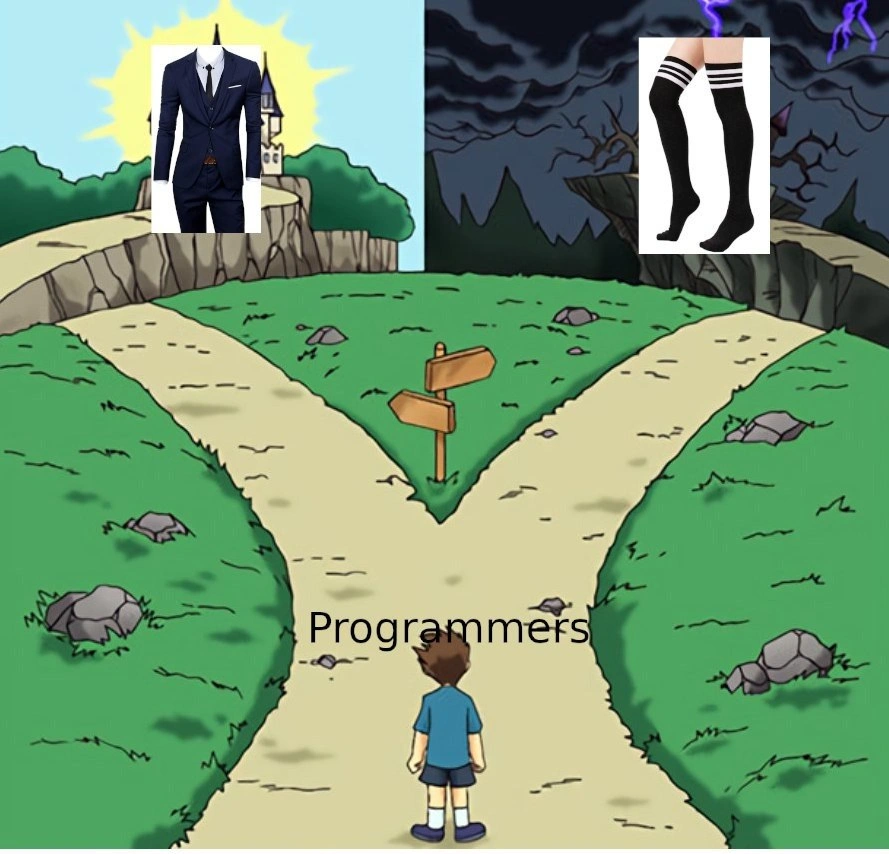
The Image and Template: We have a cartoon of a fork in the road – literally a career_crossroads_meme where a character has to choose between two paths. This “fork in the road” image is commonly used in memes to illustrate a tough decision or a split in life choices. Here the character at the crossroads is labeled “Programmers” (meaning it represents developers as a whole facing a decision). Each path is decorated with a very different clothing item: one path has a picture of a formal business suit, and the other path has a picture of thigh-high striped socks. The left side is bright with a sunny sky and a castle at the end of the road, which gives a positive, almost fairy-tale feeling. The right side is dark with storm clouds and lightning, looking ominous or foreboding. This visual contrast sets up the joke: one choice looks proper and safe, the other looks wild or risky. It’s immediately funny because socks (especially thigh-high, kind of funky socks) are such an odd thing to compare to a suit in terms of life choices!

Path 1 – The Suit (Corporate Life): The suit represents a typical corporate job or any workplace with a formal or semi-formal dress code. In many traditional companies, especially outside of the super casual tech startups, you’re expected to dress in business attire – maybe a full suit and tie, or at least a tucked-in shirt and nice pants (business casual). This is what we mean by CorporateCulture in this context: more conservative, polished, and professional in appearance. When the meme shows the suit on the sunny path to a castle, it’s saying “this is the conventional successful career path.” The castle could symbolize reaching a high position or a stable job at a big company. The sun and nice scenery imply this path is socially approved or seen as the respectable choice. For a programmer, taking this path might mean working at a large corporation (imagine working at a big bank’s IT department, or a huge tech firm where people wear ID badges and go to big meetings). Every programmer understands this scenario: maybe your family or non-tech friends think this is what a “good job” looks like – dressing up and going to an office building every day.

What do programmers actually do on this path? They might follow regular office hours, attend a lot of meetings, and yes, often wear nicer clothes especially if they interact with clients or executives. A junior developer might not have experienced it yet, but picture your software engineering team having to present a product demo to important stakeholders – you’d likely put on a crisp shirt or even a suit for that day. It’s about looking professional. There’s also a bit of humor among tech folk that suits and coding don’t naturally mix – code doesn’t care what you wear, but office culture does. So the suit path implies playing by those office rules.

Path 2 – The Socks (Remote or Casual Tech Life): The other path has thigh-high socks with black and white stripes. That’s a very casual, even playful clothing item. Why socks? It’s highlighting the extreme opposite of a suit. Instead of formal shoes and trousers, imagine a developer working from home in comfy socks, possibly even without proper pants (since no one can see you in a video call below the waist!). The striped thigh-high socks in particular have become a funny symbol in developer communities. There’s an inside joke about “programmer socks” – which started from online discussions where some programmers (often guys) mentioned wearing long, cute socks as a quirky and comfortable choice when coding alone. It became a meme of its own, symbolizing ultimate comfort and a bit of nerdy whimsy. So these socks stand for the RemoteWork or very casual startup environment style of dressing: basically, wear whatever you want. If the suit was “dress code,” the socks are “no dress code.”

Notice how the sock path is drawn with storm clouds and lightning. That dramatic imagery humorously suggests that this choice, while comfortable, is somehow the “dark” or risky one. Why would it be considered risky or frowned upon? Because traditionally, showing up in such casual or funky attire would be seen as unprofessional. Working from home in your PJs or in eccentric fashion might make an old-school boss cringe. The meme exaggerates this with the dark storm — as if choosing personal comfort over dress rules is akin to doing something mischievous or rebellious. Many developers find that funny because from our perspective, wearing comfy clothes is harmless and even helps us focus, but we know it challenges the old-fashioned idea of “professional = suit and tie.”

The Decision for Programmers: The label “Programmers” on the character at the fork tells us this is about developers deciding between these two types of work life. It’s a career crossroads choice: Do I go the formal route or the casual route? In real life, this might translate to choices like:

  • Joining a large enterprise company (maybe requiring formal attire and adhering to corporate policies) versus joining a small startup or freelance life (with flexible hours and no strict dress code).
  • Or literally, if a company is forcing people back to the office vs. taking a remote job elsewhere.

Why it’s Relatable: This meme is relatable humor because a lot of tech workers have experienced both sides, especially after 2020 when remote work became super common. For instance, during lockdowns, many developers started working from home full-time. Suddenly, nobody was wearing slacks or formal shoes – it was all T-shirts, shorts, and fun socks or slippers. Then, as offices reopened, some companies expected folks to come back and “dress appropriately” again. Switching back felt odd – we got used to the freedom! Even without that situation, within the tech industry there’s a long-running contrast: some companies are famously casual (think of startup folks in hoodies, or developers at companies like Google wearing sandals), whereas more traditional companies or client-facing roles might still expect the suit or at least a nice button-down.

So the humor comes from exaggerating this difference. It’s basically saying, “Programmers have two modes: corporate suit mode, or comfy sock goblin mode, and nothing in between.” Everyone knows in reality you can mix and match (you can work at a big company that allows casual dress, for example), but memes usually deal in extremes for comedic effect. The reason techies find it so funny is we recognize a truth in it – we do often talk about how nice it is to just roll out of bed and code in whatever we’re wearing. There are countless WorkFromHome jokes about engineers only getting dressed from the waist up for video calls. For example, someone might keep a blazer on their chair to quickly look formal if a meeting pops up, while still wearing gym shorts or pajama pants off-camera. Or the classic joke, “I got a standing desk not for health, but so I don’t accidentally show I’m in boxer shorts during a Zoom.” These are common enough that even junior devs or interns see it in our Slack channels or meme pages.

Dress Code in Tech Explained: In many tech workplaces, even before remote work was big, dress codes were relaxed compared to other industries. It’s not unusual to see engineers in t-shirts and jeans at the office. Companies realized that coding is a creative, sometimes intense focus activity, and people are happier and more productive when comfortable. Plus, the tech boom brought a younger work culture that rejected stuffy suits (think of Mark Zuckerberg famously wearing a hoodie to meetings, or the “casual Friday” turning into casual every day in many startups). Still, there are scenarios where developers “suit up.” If you’re meeting clients, especially non-tech clients, dressing well can be a sign of respect and professionalism. Or if you work in sectors like banking, defense, or consulting, the norm might be formal attire no matter your role.

So programmer_dress_code really varies: there’s no uniform, but each path (corporate vs. casual) has its expectations. This meme simplifies it into a fun visual choice.

The Joke about a Third Road: The post’s caption mentions a humorous “third road” if programmers have just one pair of pants. This is basically another joke layered on – if you’re a scruffy developer who owns exactly one decent pair of pants, maybe that is your only choice for any situation 😆. It’s poking fun at the stereotype that some programmers (especially those deeply focused on work or somewhat absent-minded) might not pay much attention to their wardrobe at all. They might re-use the same jeans all week or have a limited rotation of geeky t-shirts. So the commenter is saying, hey, what if there’s a path where you’re not really choosing between suit or socks, you’re just stuck with whatever clean pants you can find! It’s a lighthearted addition showing that in reality, many of us aren’t as fashion-considered – we might default to the one comfortable pair of jeans whether we go to office or stay home.

In summary for this level: This meme is a funny take on WorkplaceHumor in the tech world. It uses the fork_in_the_road_template to show a programmer’s two possible “styles” or ways of working: the traditional office route (with its suits and sunshine) versus the home/alternative route (with its cozy socks and stormy rebellion). Even if you’re new to the developer scene, you likely know the feeling of wanting to just be comfortable versus knowing you’re expected to dress up. The meme exaggerates it with a castle and thunderclouds to make it silly and clear. It’s basically saying, “When it comes to what to wear and how to work, programmers have two extremes to choose from – and it’s a tough (but hilarious) choice!”

Level 3: Suits vs Socks Saga

At first glance, this meme hilariously dramatizes a career crossroads every developer secretly recognizes. The cartoon fork-in-the-road template shows Programmers as a kid confronted with two diverging paths: one leading to an idyllic castle under a bright sun, the other into a stormy abyss. Superimposed on these paths are a formal navy business suit on the sunny side and a pair of black thigh-high striped socks on the dark side. This absurd contrast between a tailored corporate suit and quirky over-the-knee socks is more than just visual gag – it’s a commentary on the split identity in tech CorporateCulture versus the wild freedom of RemoteWork.

On the left, we have the corporate path: the suit-clad route to the castle. That castle represents the classic corporate ladder – think prestige, stability, maybe even a fancy office (the proverbial ivory tower or Silicon Castle 😄). The bright sun suggests this is the “proper” path blessed by society: dress sharp, follow formal norms, climb that managerial chain. Many of us have been there: polishing our shoes and our résumés, donning our best business casual or outright suits for big-client meetings or job interviews at Fortune 500s. In developer terms, this is the main branch of a career – structured, approved, and merged with traditional expectations. The humor here is a nod to WorkplaceHumor about how developers often feel pressured to “suit up” to be taken seriously by non-tech management. It’s a gentle jab at the professional image game: writing clean code might not require cufflinks, but try telling that to the VP who side-eyes your Star Wars t-shirt. We’ve all heard corporate dress code guidelines that implicitly say “wearing a tie = writing better code,” which of course is nonsense (your code doesn’t compile faster just because you’re in Armani). Still, the suit symbolizes playing by those CorporateCulture rules. This side of the meme captures that classic CorporateHumor scenario: the developer who transforms into a respectable, blazer-wearing “adult” at the office, at least on the surface.

Now, the right path throws us into the dark side – quite literally drawn with thunderclouds and purple lightning, crowned by a giant image of comfy thigh-high socks. Why socks? It’s referencing a delightful in-joke in developer communities: so-called “programmer socks”. This quirky term has floated around online tech forums and TechMemes, referring to a trend (half serious, half ironic) where some programmers wear knee-high or thigh-high striped socks for comfort or personal flair while coding at home. It’s the ultimate symbol of comfort-first RemoteWork wardrobe. Instead of slacks and collars, it’s stretchy socks and maybe pajamas or shorts — basically, whatever makes you feel good (as long as your camera is off or only shows your top half!). The thigh-high sock specifically has a tongue-in-cheek vibe: it’s a bit flamboyant, even sexy in a goofy way, something no sane traditional office would include in a dress code 😜. By choosing that extreme example, the meme emphasizes the freedom (and maybe rebellious joy) of working in your own space, your own style. The stormy backdrop and lightning are pure comedic exaggeration: as if choosing personal comfort is a daring, almost villainous act against the polished corporate world. It’s a playful inversion — usually you’d think wearing a suit is hard mode and chilling in socks is easy mode, but the meme’s art style paints the comfy choice as a dramatic, ominous adventure. This resonates as RelatableHumor for developers: we joke that once you’ve tasted the freedom of coding in a Snorlax hoodie and fluffy socks, going back to a necktie feels like entering a thunderstorm.

Deep down, this image pokes fun at the dual identity many of us in tech juggle. By day (or when HQ calls), a programmer might present a buttoned-up image: maybe not a full suit and tie at all companies, but at least a crisp shirt for that important Zoom with the client — essentially playing the part in the corporate castle. By night (or when logs are the only thing watching us), we revert to our true form: a hoodie gremlin in sweatpants and outrageous socks, hacking away in the glow of multiple monitors. Modern tech work, especially with WorkFromHome being so prevalent, has blurred the line between these personas. This meme nails the comedic tension: Programmers are standing at that fork daily. Do I keep up appearances or embrace comfort?

Importantly, this isn’t just about clothes; it’s symbolic of career lifestyle choices. The “suit path” implies working for a BigCo or a more formal industry role (think fintech, government contract, or a company with strict programmer_dress_code policies). It often comes with stability, a clear structure, maybe a higher paycheck or fancy title — hence the shiny castle and bright future imagery. But it can also mean conforming to non-engineering culture, possibly extra meetings, bureaucracy, or feeling like a cog in the machine wearing the same bland outfit as everyone else. On the other side, the “socks path” implies a less conventional route: maybe joining a startup with a relaxed culture, going freelance, or a fully remote dev team where nobody cares if you’re wearing pants as long as you deliver features. It could be riskier or less certain (hence the dark clouds) but offers personal freedom and authenticity (you get to be yourself, stripy socks and all). A seasoned engineer reading this will chuckle knowingly, because we’ve watched this exact suit_vs_thigh_highs drama play out in our own lives or among colleagues. Some of us even oscillate between the two: dress formally for the board meeting at 10 AM, then by 6 PM we’re deploying code in a bathrobe and novelty socks.

The meme’s exaggerated visuals also hint at how outsiders or old-school folks might perceive the comfy route as “the dark side.” Not long ago, if you showed up to work in anything less than business casual, you’d get side-eye or a talk from HR. Even in 2023, debates rage on about returning to office and dress codes vs. the productivity of remote teams. This image humorously sides with the devs who know that great code can be written in a Star Wars t-shirt and programmer socks just as well as in a suit – maybe even better, because you’re relaxed. It also references WorkplaceHumor around video calls: the well-known phenomenon of the “Zoom mullet” (formal on top, party on the bottom). We joke that during WFH, developers might keep a blazer or nice shirt handy for surprise video calls, while off-camera they’re in shorts or perhaps knee-high rainbow socks. That dichotomy is precisely the crossroads our cartoon programmer is facing.

One delightful meta-joke is that someone commented about a “third road” in the meme – “when programmers have just one pants or something.” 😅 This adds an extra layer of humor: the idea of a third path for those who neither dress up nor have funky socks, but simply have one trusty (and possibly unwashed) pair of jeans that they live in. It’s a wink to the stereotype that some devs aren’t exactly fashionistas – if you have only one pair of acceptable pants, your choice is kinda made for you! This commenter’s quip fits perfectly with the DeveloperHumor vibe: self-deprecation and practicality (hey, if it’s clean enough and nobody can smell you through code, it’s good to go, right?). It underscores that beyond the two “extremes” in the meme, many of us just throw on whatever’s available – another relatable truth that makes this meme funny.

In summary at this senior level analysis: the meme uses the absurdity of a suit vs. thigh-high socks choice to encapsulate a very real tech-world decision. It’s riffing on CorporateHumor by portraying the conventional career path as literal sunshine and castles, and RemoteWork culture as an epic, slightly forbidden quest marked by personal comfort and eccentric style. Seasoned programmers find this hilarious because it exaggerates a truth we live: we constantly toggle between being the professional engineer who can interface with management (and maybe even literally suits up for that role), and the hardcore coder gremlin who solves tough bugs at 2 AM in comfy clothes with no one watching. It’s a classic fork-in-the-road meme delivering a spot-on satire of our programmer_dress_code dilemmas and, by extension, the broader lifestyle choices in tech careers. Whether you lean to the suit side or the sock side (or you’re rocking the fabled one-pants third path), the struggle is real and oh-so-relatable.

Description

This is a 'Two Paths' meme format depicting a character labeled 'Programmers' standing at a fork in the road. The path to the left leads towards a bright, sunny castle, and superimposed over it is a formal business suit. This represents a traditional, professional, corporate career path. The path to the right leads towards a dark, stormy landscape with jagged cliffs and lightning, and superimposed over it is a pair of black and white striped thigh-high socks. This path symbolizes an alternative, online-centric subculture stereotype often associated with programmers. The meme humorously presents these two starkly contrasting stereotypes as the primary career and identity choices for developers. The caption provided, 'The third road exist too when programmers have just one pants or something,' adds a self-deprecating layer of humor about the supposed lack of fashion sense among programmers
Comments

20
Anonymous ★ Top Pick The real third path is realizing both the suit and the socks are just cosplay for different kinds of daily stand-ups, but only one of them is honest about being a costume
  1. Anonymous ★ Top Pick

    The real third path is realizing both the suit and the socks are just cosplay for different kinds of daily stand-ups, but only one of them is honest about being a costume

  2. Anonymous

    My wardrobe’s gone full n-tier: polished blazer in the presentation layer, striped thigh-highs in the data layer - just pray nobody requests a full-stack demo

  3. Anonymous

    After 15 years of arguing about tabs vs spaces and vim vs emacs, we've finally found the real architectural decision that matters: whether your lower-body compiler flags include -fthigh-high-optimization

  4. Anonymous

    Ah yes, the eternal fork() in every programmer's career: do you exec() into the well-lit corporate path with its predictable salary and PTO (but mandatory suits and endless meetings), or do you venture down the darker path of indie development where the dress code is 'optional' and your compensation package is measured in GitHub stars and existential dread? The signpost doesn't mention that both paths eventually converge at the same destination: Stack Overflow at 2 AM

  5. Anonymous

    Eventually every engineer hits fork(): exec() to management - with suits, OKRs, and QBRs - or stay IC optimizing cache lines in comfy socks at 2am; both are multithreaded, only one enforces a dress code

  6. Anonymous

    CAP theorem for souls: programmers pick Consistency in commits over Availability for dates, Partition-tolerant of solitude

  7. Anonymous

    Programmer’s fork: suit up and refactor org charts, or thigh‑highs and refactor the monorepo; one has OKRs, the other has PagerDuty - pick your complexity class

  8. @callofvoid0 2y

    each road is for one different gender right...?

  9. @Bitals 2y

    Classic.

    1. @callofvoid0 2y

      project manager senior dev pentester C# junior programmer

      1. @unrealmahan 2y

        C# or Rust? 😆

        1. @callofvoid0 2y

          both

        2. @callofvoid0 2y

          wait a minute

  10. @SamsonovAnton 2y

    What about more casual and classic style?

  11. @SamsonovAnton 2y

    How a truly self-confident senior programmer might look like

  12. @qwnick 2y

    I never actually saw or spoke to a person from 4th picture who works as programmer, I think it's not true

    1. @s2504s 2y

      those are nodejs guys or frontend

      1. @ishyfishy 2y

        t. RoR/haskell dev

    2. @LonelyGayTiger 2y

      I know several.

  13. @LonelyGayTiger 2y

    He's definitely not a junior programmer tho.

Use J and K for navigation