Skip to content
DevMeme
2403 of 7435
Before StackOverflow, programmers faced coding despair and no easy answers
DevCommunities Post #2672, on Jan 24, 2021 in TG

Before StackOverflow, programmers faced coding despair and no easy answers

Why is this DevCommunities meme funny?

Level 1: No One to Ask

Imagine you’re trying to solve a really hard puzzle or homework question, and you just can’t figure it out. You look around for help, but there’s no one to ask – no friend, no teacher, not even a book with the answer. You’d probably feel super frustrated and upset, like you want to give up. That’s the feeling this joke is talking about. Now, think of a time when you were stuck on a problem but then you found someone who helped you or you found an answer in a book or on a website. Remember how relieved and happy you felt once you got the help? For computer programmers, that helpful friend is often a website called Stack Overflow where they can ask questions and get answers from other programmers. The meme is saying that before that website existed (a long time ago, before 2008), coding could feel terribly lonely and hopeless because you had no one to turn to for quick answers. The little cartoon in the picture is doing something very extreme – putting a rope around its neck – to show in a silly, over-the-top way just how hopeless and desperate a programmer might feel when completely stuck and alone. In simple terms, the meme jokes that having help makes all the difference: with Stack Overflow available, programmers are saved from that awful “I’m totally lost and might as well quit” feeling. It’s a funny (if a bit dark) way of saying we all need a lifeline sometimes, and for coders, that lifeline is often the online community that’s ready with answers.

Level 2: Before Online Answers

Stack Overflow is a famous question-and-answer website where programmers help each other by sharing solutions. It was launched in 2008 as a free, community-driven place to ask coding questions and get answers from other developers. Nowadays if you run into a weird error or don’t know how to format a date in Python, you can just search on Google or Stack Overflow and usually find that someone has asked the same question – with a bunch of answers and code examples ready to copy. This meme highlights how reality changed once that site (and similar DevCommunities) came along. It suggests that before such convenient Q&A platforms existed, programmers had no easy answers and felt deep despair when stuck on a problem. The joke claims that being a programmer pre-2008 was so bad that you’d metaphorically want to harm yourself out of sheer hopelessness (a very dark joke!).

But what did coders actually do pre-2008 when they hit a snag? They couldn’t simply hop on Stack Overflow because it wasn’t around. Instead, they relied on more old-school resources: thick reference books, official documentation pages, or searching the web for any hint of a solution. There were forums and mailing lists (like early online message boards or group emails) where you could ask questions, but you might wait days or weeks for a reply – if you got one at all. You might email an expert, read through archived discussions, or just experiment on your own for hours. Often, trial and error was the norm. If you were a newcomer, this slow hunt for help made the LearningCurve of programming even steeper. Imagine trying to learn complicated new technologies with only scattered blog posts and a few example code snippets in a textbook! No wonder DeveloperFrustration was high – solving a tough bug could feel like an endurance test.

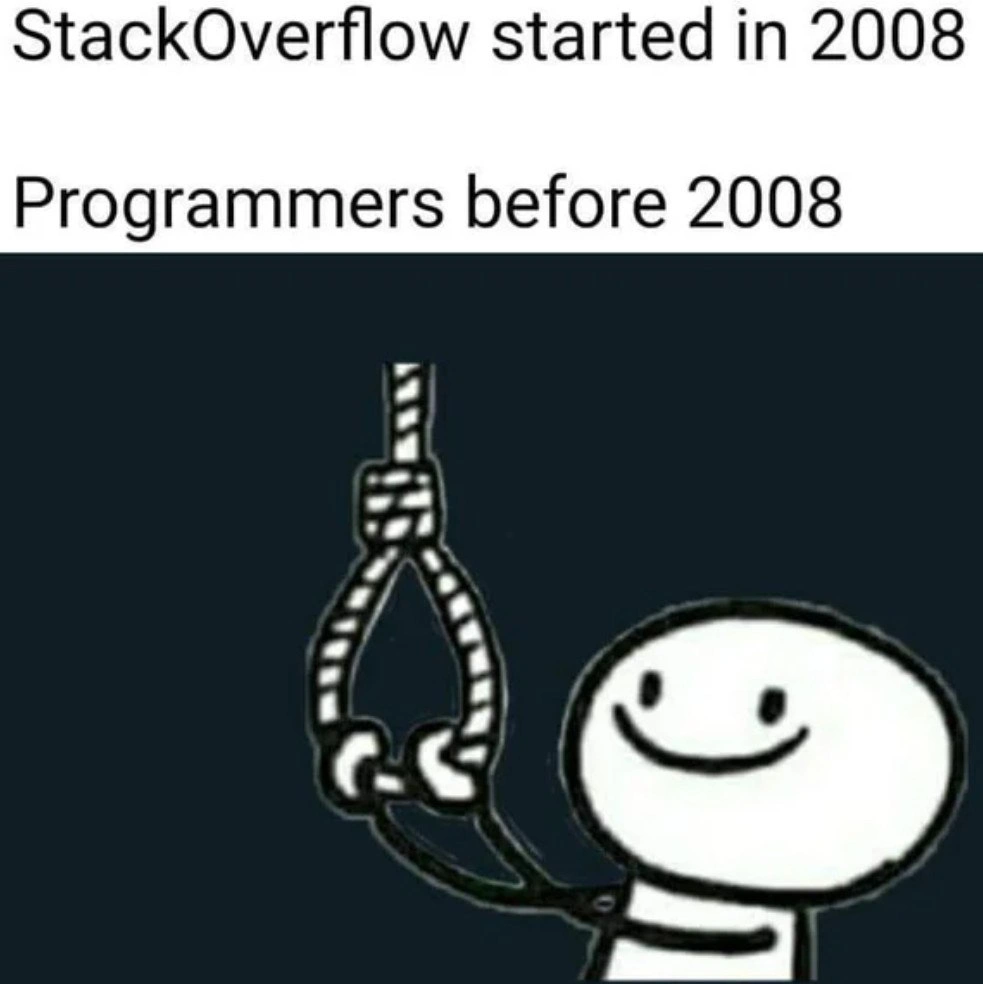
The image uses dark comic style to get this point across. It shows a simple cartoon stick-figure character happily putting a rope noose around its neck. This is obviously a very extreme and morbid representation of frustration – it’s black humor, meaning it jokes about something serious (self-harm) in order to emphasize how desperate the situation felt. The text above the image sets up a contrast: “StackOverflow started in 2008” followed by “Programmers before 2008.” In other words, once Stack Overflow was created, it saved programmers from despair; before then, things were so bad it’s as if programmers felt like this cartoon. Of course, in reality programmers weren’t literally committing suicide left and right – this is exaggeration for comedic effect. The stick-figure’s goofy smile while doing something so grim adds to the dark humor: it’s portraying a dire situation in a deliberately absurd way.

To put it plainly, the meme is saying: Stack Overflow is such a lifesaver for coders that without it, programming used to feel impossibly difficult and lonely. It underscores a key point about developer life: having a community and shared knowledge base massively improves both productivity and morale. Being stuck alone with a bug is frustrating and can even affect your mood or confidence. By contrast, knowing you can quickly find a solution or ask others for help is a huge relief. This has implications for MentalHealth in tech – feeling supported and resourceful can prevent the hopelessness that the meme jokingly depicts. Nowadays, developers lean on sites like Stack Overflow (and other communities like Reddit, GitHub, etc.) as a normal part of the problem-solving process.

Let’s compare what it was like before vs. after 2008 for a programmer with an issue:

Pre-2008 (No StackOverflow) 🔍 Slow, Lonely Debugging Post-2008 (With StackOverflow) 🚀 Fast, Community-Powered
Sources of Help: Books, official manuals, maybe a mailing list or forum thread if you could find one. Often had to dig for hours through text. Sources of Help: StackOverflow threads, online tutorials, Q&A sites. A quick search usually surfaces a relevant solution that someone already shared.
Speed of Answers: Could be very slow. You might wait days for a reply on a forum, or never find an answer and have to figure it out yourself. Speed of Answers: Immediate or quick. Many questions have already been asked, so you get answers almost instantly by finding the existing Q&A.
Feeling When Stuck: Very isolated and frustrated. You might feel stupid or hopeless when you can’t solve a bug and nothing you find addresses it. High chance of banging your head on the desk. Feeling When Stuck: More supported and hopeful. It’s reassuring to see that others had the same problem and solved it. You’re not alone, and you often regain confidence after finding a fix online.
Knowledge Sharing: Mostly one-to-one or one-to-few. Tips were exchanged in niche communities or not at all; solutions stayed in personal notebooks or company wikis. Knowledge Sharing: Crowd-sourced and global. Problems and answers are documented publicly. This builds a huge global knowledge base that everyone can learn from, reducing duplicate effort.

As the table shows, Stack Overflow and similar platforms fundamentally changed the code help resources landscape. The meme uses a dark joke to stress just how indispensable these resources have become. It implies that programmers prior to the Stack Overflow era were basically in constant despair when facing tricky bugs, whereas today we have a safety net. In reality, programmers before 2008 weren’t literally doomed – they found ways to solve problems – but it definitely required more patience and grit. The shared DeveloperFrustration of being stuck alone is something almost every coder has experienced at least once. That’s why this meme hits home: it reminds us (through shock humor) how grateful we are to live in an age of instant answers. It’s a nod to both DeveloperMemes and genuine DeveloperPainPoints – we laugh because we empathize, having felt that “UGH, I have no clue what to do!” feeling. And we also breathe a sigh of relief that nowadays, when we’re lost, the hive mind of the internet is just a click away to shine a light.

Level 3: The Stack Underflow Era

In the dimly lit days before 2008, debugging felt like wandering through a maze with only a flickering candle. Stack Overflow didn’t exist yet, and this meme grimly jokes that the era of life_before_stackoverflow was practically a developer’s dark age. The top text sets the stage: “StackOverflow started in 2008 – Programmers before 2008.” Below it, a simple stick-figure tightening a noose around its neck delivers the punchline. It’s an extreme visual metaphor, a piece of DeveloperHumor employing dark comic style to exaggerate a real DeveloperPainPoint: being utterly stuck with no one to turn to.

For seasoned devs, this image triggers knowing groans and chuckles. It satirizes a time when getting code help resources was a slow, solitary battle. Back then, a coder faced an inscrutable bug or cryptic error and often had only a few options: scour a thick programming book, read official documentation (“RTFM” was practically a mantra), or post a question on a forum or mailing list and pray for a reply within a week. Googling an error message in the early 2000s might return a few obscure blog posts or (infamously) a paywalled Experts-Exchange thread. In that developer self-help era, knowledge wasn’t aggregated in one handy place. Every fix you discovered felt hard-won, like reinventing the wheel. If you were lucky, you had a colleague or an IRC chatroom to consult, but often you toiled alone. It’s no wonder that being a programmer pre-2008 could feel isolating and maddening.

The meme’s black-humor imagery of a smiling stick-figure with a noose captures this isolation perfectly. It implies that without our beloved Q&A sites, a baffled programmer’s morale can drop to rock bottom. Of course, it’s an exaggeration – a morbid one – playing on the idea that a particularly vexing bug might make you feel “at the end of your rope.” DeveloperFrustration can indeed be intense: imagine an all-nighter debugging memory leaks with zero guidance, or a production issue with only a cryptic error code and no StackOverflow thread to consult. The DeveloperCommunity safety net we take for granted today simply wasn’t there, and this meme wryly suggests that programmers back then were on their own, to a despairing degree.

Under the joke lies a reflection on MentalHealthInTech. Constantly hitting dead-ends can chip away at any coder’s psyche. The meme resonates because many of us have felt that surge of hopelessness when nothing seems to fix a bug. It’s funny in a twisted way (gallows humor, quite literally) because it’s true: before easy online answers, coding problems could make you feel hopelessly stuck, like your sanity’s loop might break. The launch of Stack Overflow in 2008 was a turning point that ushered in a collective sigh of relief across the industry. Suddenly, there was an ever-growing repository of solutions, ready to rescue you at 3 AM when you’re tearing your hair out over an error. In hindsight, seasoned developers half-joke that the arrival of Stack Overflow saved countless keyboards from being thrown out the window – and perhaps saved a few programmers from existential despair. The meme cranks that sentiment up to 11 with its dark visual: “before Stack Overflow, you might as well have been hanging by a thread.” It’s hyperbole with a kernel of truth that makes every experienced programmer smirk and think, “Thank goodness those days are over.”

Description

The meme is split into two parts on a white-on-black color scheme. Top text (black letters on white background) reads: "StackOverflow started in 2008" followed by a line break and then "Programmers before 2008". Below the text, on a dark navy rectangle, a minimalist stick-figure with a round white head and a simple smile is shown tightening a rope noose around its own neck. The intentionally dark gag exaggerates that, prior to the Q&A site’s launch, developers had no reliable, crowd-sourced place to copy-paste solutions and therefore felt hopeless when debugging. The image relies on black humor to underscore how indispensable online developer communities like Stack Overflow have become for troubleshooting, learning, and preserving mental health

Comments

12
Anonymous ★ Top Pick Before Stack Overflow, you’d fire off a plea to comp.lang.c++, then tighten the rope one turn per NNTP hop - same “minimal reproducible example” ritual, just 48-hour latency and stronger knots
  1. Anonymous ★ Top Pick

    Before Stack Overflow, you’d fire off a plea to comp.lang.c++, then tighten the rope one turn per NNTP hop - same “minimal reproducible example” ritual, just 48-hour latency and stronger knots

  2. Anonymous

    Back when 'RTFM' was the only answer you'd get, and Expert Exchange wanted $9.99 to show you why your null pointer was segfaulting - we just accepted that some bugs would outlive the project's funding

  3. Anonymous

    Before Stack Overflow, debugging meant reading 800-page O'Reilly books, deciphering cryptic man pages, or waiting 3 days for a response on a mailing list - only to be told 'RTFM' by someone who last touched production code in 1987. Now we just copy-paste the accepted answer and pretend we understood the underlying algorithm. Progress!

  4. Anonymous

    Before StackOverflow, debugging was a sharded knowledge base of MSDN DVDs, Usenet, and the office greybeard - StackOverflow just added a global index and removed the Experts‑Exchange paywall

  5. Anonymous

    Before 2008, the incident runbook was ‘RTFM and wait on Usenet’; after 2008 it’s ‘paste the accepted answer, hope it matches your runtime, and promise to refactor when OKRs allow’

  6. Anonymous

    Pre-SO debugging: tracing core dumps by candlelight. Post-SO: bounty the ghost of answers past

  7. @sylfn 5y

    * in 2008 bc

  8. Deleted Account 5y

    true

  9. @novaksm 5y

    Exactly

  10. @NiKryukov 5y

    Nothing changed honestly

    1. @Kerlios 5y

      Absolutely true

  11. @diafour 5y

    «Programmers before 2008» написали Stackoverflow без подсказок со Stackoverflow.

Use J and K for navigation