Skip to content
DevMeme
5327 of 7435
The Duality of Pull Requests: Epic Features vs. Trivial Fixes
CodeReviews Post #5844, on Jan 25, 2024 in TG

The Duality of Pull Requests: Epic Features vs. Trivial Fixes

Why is this CodeReviews meme funny?

Level 1: Tortoise vs. Hare

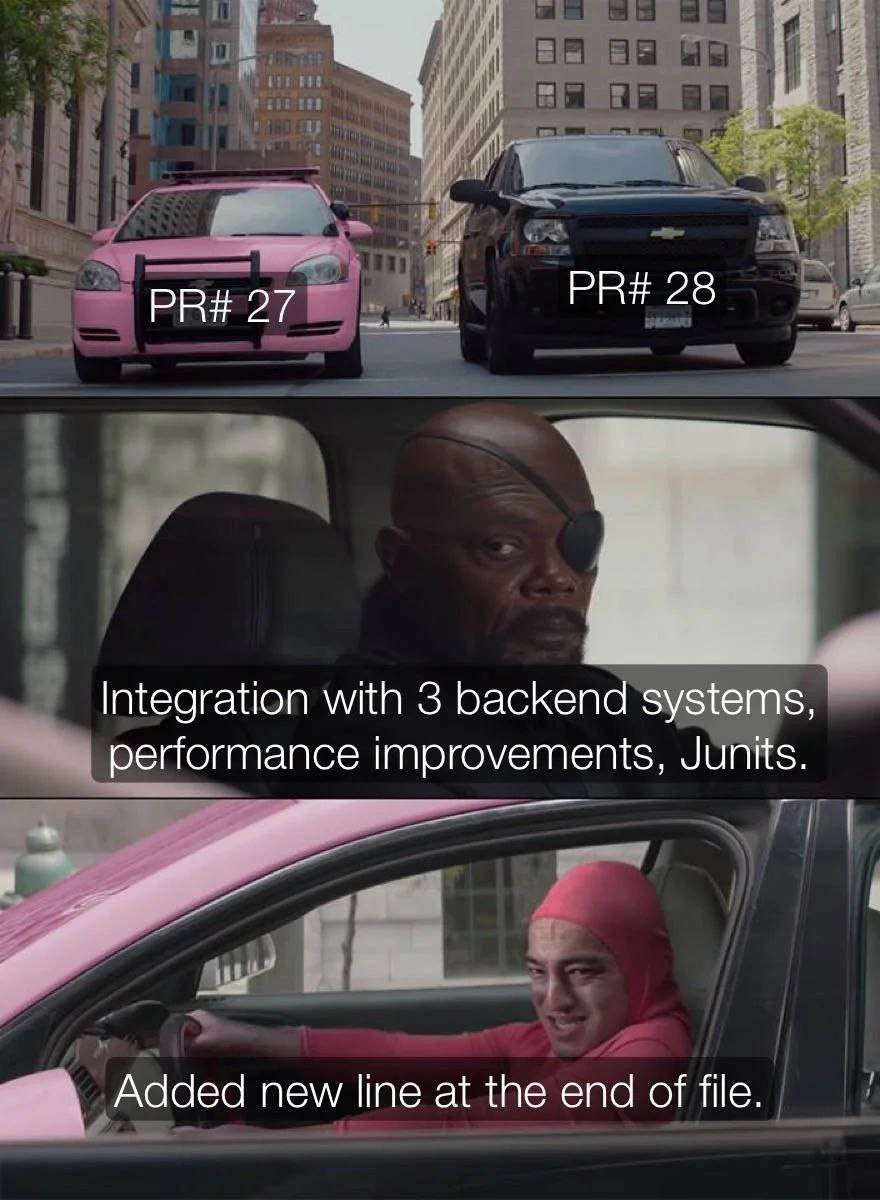
Imagine you and a friend both have to show your homework to the teacher. You worked really hard and wrote a big 10-page report with drawings and details (that’s like the big PR with 900 lines of code). Your friend just fixed one tiny spelling mistake on his paper (that’s like adding one newline). Now, the teacher has to check both. What happens? The teacher quickly checks your friend’s tiny fix first – it’s so quick and easy, done in a second. But your big report? The teacher keeps postponing it because it’ll take a lot longer to read. It’s a bit like the story of the tortoise and the hare, except here the quick little change (the hare) zooms ahead and gets “approved” first, while the slow heavy work (the tortoise) is left waiting. It’s funny (and a little unfair) because we’d expect the important big work to get attention first, but in reality the small easy thing gets dealt with before the big complicated thing. So the meme is joking that in code review, sometimes the tiny effort wins the race against the big effort, just because it’s easy to finish.

Level 2: Big PR Bottleneck

Let’s break down what’s happening in simpler terms. In software development, a Pull Request (PR) is when a developer finishes some code changes and asks their team to review and merge them into the main codebase. The meme shows two PRs side by side as if they’re cars at a race. PR#28 (the black SUV) is a huge code update – it touches three different backend systems (the behind-the-scenes servers and services that power features), it includes performance improvements (making the software run faster or handle more load), and it even comes with unit tests (specifically JUnit tests, which are small programs to automatically test that the code works as expected). All of that is a lot of work in one bundle – 900 lines of code changed, according to the meme’s text. That’s a massive change for reviewers to digest. They’ll need to read through all those changes, understand how three systems are affected, and run those JUnit tests or check that they’re meaningful. It’s the kind of PR that might take hours of careful review and possibly multiple discussion comments back-and-forth to fully approve. In other words, big PRs often create a bottleneck in the review process because everyone knows they take a lot of effort and time to review properly.

Now PR#27 (the pink car) is the total opposite: a trivial change with just one line altered — adding a newline character at the end of a file. This basically means someone edited a file and inserted a blank line at the very end. (Fun fact: Many coding style guides or tools will warn if a text file doesn’t end in a newline, so this could be just satisfying a nitpick from a linter or a teammate’s request.) This change doesn’t affect any logic or behavior of the code at all; it’s purely a formatting thing. Reviewing that PR is super easy: you open the diff (the list of changes) and you literally see one line added, likely something like \n at end-of-file. No complex reasoning needed – it’s obviously not going to break anything. So a reviewer can approve it almost immediately, and it can get merged (applied to the main code) in minutes.

The meme’s humor comes from comparing these two PRs in a race. Normally, you might expect the big important update (PR#28) to get attention first because it’s more significant. But in reality, what often happens is the opposite: the small easy change (PR#27) gets reviewed and merged right away (“cruises through”), whereas the giant PR sits waiting (“stalls”). This happens a lot in real dev teams. Why? Because reviewers are human. If you’re a developer tasked with reviewing code and you see one item that will take you 2 minutes and another that might take you 2 hours, you often do the quick one first – it’s satisfying to check something off your list. Also, big PRs can be intimidating; you might be afraid of missing a bug in those 900 lines, or you just don’t have the energy at the end of the day to tackle it. So people postpone it, sometimes hoping someone else on the team will handle it. Meanwhile, any small PRs that come in get snapped up quickly because they’re easy wins. This can lead to a queue or line of PRs where the big ones keep getting pushed back as newer small ones jump ahead in priority.

There’s also a hint in the meme about metrics and how they can be misleading. Some teams track statistics like how many PRs a developer reviews or how fast PRs get reviewed on average (to measure Developer Productivity or team efficiency). If those metrics don’t consider the size or complexity of PRs, they can be gamed unintentionally. Merging a one-line PR counts the same as merging a 900-line PR in the raw count. So if a team or individual is trying to look productive, doing a bunch of tiny PRs (or reviewing a bunch of tiny PRs) will boost their numbers quickly. No one’s doing this explicitly just to cheat (usually), but it’s a natural side effect: people gravitate to easier work when under time pressure or when trying to meet certain KPIs. It’s a known CodeReviewPainPoint that lines of code (LOC) changed is not a linear measure of effort or value. A 1-line change can sometimes be extremely important (fixing a critical bug) or utterly pointless (adding a newline). A 900-line change can be a huge new feature or just lots of boilerplate. Review complexity isn’t just about LOC, but human nature often reduces it to that when deciding what to review first.

For a junior developer or someone new to VersionControl and code reviews, the lesson here is: keep your PRs small when you can. Teams often advise breaking big changes into smaller PRs exactly because smaller ones get reviewed faster and more thoroughly. If you throw a giant 900-line patch at your team, it might sit around or get superficial reviews. It’s easier for things to slip through unnoticed. Smaller chunks are friendlier for your reviewers – they can focus and catch issues. In our meme’s case, PR#28 probably could have been split into a few separate PRs (maybe one for integrating each backend system, another for performance tweaks, another for adding tests). If each was say 200-300 lines, they might move quicker. However, sometimes you can’t avoid a big PR (maybe the changes are all connected and have to be reviewed together). In those cases, it’s good to communicate with your team: maybe give them a heads-up, provide a clear overview in the PR description of what to look for, and be patient (yet proactive with reminders). On the flip side, if you’re a reviewer, it’s important to not let big PRs rot forever – it can block progress and demoralize the author. Many teams use tactics like assigning reviewers or setting SLA (service level agreements) for reviews to avoid this stall.

In summary, this meme is a funny exaggeration of a real developer experience: trivial fixes often get cleared out quickly, whereas chunky, complex code updates tend to lag in the review queue. It’s highlighting the imbalance and a bit of the absurdity (a newline change “winning” a race against a major feature update). If you’ve ever waited on a code review or if you’ve been that person who cherry-picked the easy review from the list, this scenario is highly relatable. It’s basically saying: in code review, sometimes the effort it took to write the code is inversely proportional to the effort it gets in review attention. And that irony is what makes it humorous to developers.

Level 3: Shortest PR First

In the grand circus of code reviews, this meme nails a classic PullRequest phenomenon: big changes stall while trivial ones zoom through. Here we have two PRs (pull requests) depicted as cars revving at the starting line. PR#28 (the black SUV with our stoic driver) bundles a 900-line mega-change: integration with 3 backend systems, serious performance improvements, and even thorough unit tests (JUnits in Java lingo). In contrast, PR#27 (the pink car with the goofy driver) is a joke of a change – it literally just adds a newline at the end of a file. The punchline? The gigantic, important PR is left idling, while the one-line wonder floors it through the review queue. This highlights a pr_size_bias in many teams’ review practices: reviewers subconsciously favor quick wins (like a tiny diff) and procrastinate on the intimidating 900-line behemoth.

From an experienced dev’s perspective, this is too real. That massive backend integration PR is probably critical for a feature or a fix, but everyone’s thinking, “I’ll review it right after my coffee… or maybe tomorrow.” Why? Because diving into hundreds of lines across multiple systems requires intense focus, deep understanding, and a chunk of uninterrupted time. There’s the fear of missing something important in those changes – a misused API call here, a performance regression there – so the mental load is high. Plus, touching 3 different systems means you need context on all of them. It’s like a mini-architectural review in one go. Meanwhile, the newline-only PR is the ultimate low-hanging fruit. Anyone can glance at a one-line diff and hit “Approve” in seconds. No risk, no deep thought – it’s practically a drive-by code review. In a team with a queue of pending reviews, it’s no surprise everyone grabs the easy one first (who doesn’t like clearing an item off their to-do list with minimal effort?).

This dynamic skews all the metrics: if your organization foolishly tracks DeveloperProductivity by counting PRs merged or average review turnaround time, the numbers look great for that trivial change. One more PR merged! Average wait time: 5 minutes! Meanwhile, the 900-line PR languishes for days (or weeks), a victim of review_queue_starvation while more and more tiny PRs might hop ahead of it. It’s a form of queueing inversion: the tasks that should take priority (big, important code changes) get overtaken by irrelevant trifles (like fixing a newline to please a linter). This is darkly humorous because it rings true in many teams – the notion of prioritizing by Lines of Code or effort is turned on its head. We end up with a code_review_metrics_gaming scenario where people might even game the system: got something urgent and complex? Better slice it into bite-sized PRs or it’ll rot in review purgatory. Otherwise, a colleague’s silly text fix (or as this meme exaggerates, adding a blank line) will ship before your critical code does.

Under the hood, this reflects an organizational anti-pattern. Reviews are often done by volunteers or whoever has time. There’s no strict FIFO (first-in, first-out) queue discipline; it’s more like a free-for-all. If you’ve ever triaged GitHub PRs on a busy project, you know the guilty relief of picking the “typo fix” PR to review because you can close it out in 30 seconds, while marking the huge feature PR as “needs more time, maybe later”. Multiply that by everyone on the team, and big changes suffer. The meme’s Fast & Furious imagery accentuates this contrast comically: the serious driver with an eyepatch (like he’s about to do something epic) sits in a powerful SUV (loaded with heavy changes), facing off against a comically eager pink-suited guy in a silly car (a trivial change personified). When the light turns green, guess who leaps ahead? The pink clown car, of course – representing that trivial PR sailing through code review while the heavyweight PR screeches to a halt. It’s an absurd inversion of what should happen in an ideal world where we review in order or by importance.

Seasoned developers will laugh (or more likely groan) at this because we’ve lived it. We know that feeling when our monumental PR – into which we poured days of work and careful testing – is collecting dust with no reviews, while we see a flurry of “Merged #27 Add newline at EOF” notifications. It’s both hilarious and exasperating. And it often leads to coping strategies: breaking large changes into smaller PRs (to avoid reviewer intimidation), pestering colleagues on Slack to please review the big one, or in some cases, managers implementing rules like “no PRs over X lines” or dedicating meetings to chew through big diffs together. The meme succinctly mocks the reality gap between our ideals and actual behavior. In theory, code reviews should be prioritized by importance and tackled systematically; in practice, they’re often governed by human psychology – procrastination, desire for quick accomplishments, and avoidance of hard tasks at the end of the day. As any Cynical Veteran of code will tell you: “If it’s a one-liner fix, it’ll be in production by lunch. If it’s a 900-line overhaul, better pack a lunch – it’s gonna be waiting a while.”

Description

A three-panel meme contrasting the scale of different pull requests using the 'Nick Fury and Pink Guy in Cars' format. The first panel shows a serious, black SUV labeled 'PR# 28' alongside a ridiculous, small pink car labeled 'PR# 27'. The second panel features Nick Fury from the Marvel universe, looking stern inside the black SUV, with the caption: 'Integration with 3 backend systems, performance improvements, Junits.' This represents a complex, high-effort pull request. The third panel shows the character Pink Guy grinning maniacally from the driver's seat of the pink car, with the caption: 'Added new line at the end of file.' This represents a trivial, low-effort change. The meme humorously illustrates the vast difference in substance and effort between various pull requests that go through the same development workflow, a universally relatable experience for software engineers
Comments

14
Anonymous ★ Top Pick Both pull requests get the same number of 'LGTM' comments, but only the newline fix will be blamed for breaking the production build five minutes after being merged
  1. Anonymous ★ Top Pick

    Both pull requests get the same number of 'LGTM' comments, but only the newline fix will be blamed for breaking the production build five minutes after being merged

  2. Anonymous

    Our review queue is basically a priority queue keyed by 1/LOC - so the EOF newline has logarithmic latency while the 600-line refactor times out

  3. Anonymous

    After 15 years of architecting distributed systems, I've learned that the probability of a PR getting approved is inversely proportional to its complexity - which explains why my microservices migration sits at 47 comments while Bob's whitespace fix got merged in 3 minutes

  4. Anonymous

    The real architectural decision here is whether PR#28's EOF newline will pass the linter checks that PR#27's three-service orchestration layer somehow bypassed. Bonus points if PR#27 gets 47 comments about variable naming while PR#28 triggers a 6-hour CI pipeline because someone forgot to update the integration test fixtures

  5. Anonymous

    In every enterprise repo, the newline PR outruns the three‑backend integration because our review algorithm is human: O(lines_changed) ≫ O(operational_risk)

  6. Anonymous

    Backend integration via newline: finally aligning EOF across three services without triggering the monorepo linter apocalypse

  7. Anonymous

    Our merge queue runs SRPT scheduling - shortest-remaining-diff-first - so newline PRs preempt three-system integrations every time

  8. @Araalith 2y

    Integrating with three backend systems in one PR? Give me a brick; I want to beat the crap out of that idiot.

    1. @RiedleroD 2y

      I was thinking the same lmao split up your changes into smaller PRs, mfer

    2. @EricKotato 2y

      At least it's not simply PR named "changes" with 7000 additions and 3000 deletions.

      1. @ArchangelRaphael666 2y

        that so true

      2. @Araalith 2y

        Fix

      3. @anysound 2y

        Typical “upd vendor” PR

  9. @ArchangelRaphael666 2y

    i saw so many pr with "new changes" with bunch of file modified

Use J and K for navigation