Post-Quantum Cryptography: The New 'Blue Steel' of Security
Why is this Cryptography meme funny?
Level 1: The Cool New Toy
Imagine you and your friends all have secret decoder rings (little toys that can scramble and unscramble messages you send to each other). These rings are like the locks and keys for your secret messages. Now, you hear a rumor that next year a master decoder device might come out – a super gadget that could easily figure out any message made by your current ring. Even though that device doesn’t exist yet, everyone gets a bit scared and excited. Some clever folks start making a new kind of decoder ring that the future super gadget won’t be able to crack. Suddenly, all the kids are talking about this new ring. It’s like the latest cool toy – even if the super decoder isn’t here yet, having the “future-proof” secret ring becomes a trend. The meme is joking that in the world of grown-ups and computers, this exact thing is happening: a new kind of unbreakable code is the cool new thing everybody wants, just to be ready for a super code-breaking machine that might show up later. It’s funny because everyone is treating a very serious thing (keeping secrets safe) like a fashion craze or playground fad, where something can be “so popular right now.” In simple terms, the meme says: “Everyone is going crazy about this new fancy lock for secrets, because it’s the hot new thing to have!”
Level 2: Quantum-Proof Locks
For those newer to the field, let’s break down what’s going on. Cryptography is the science of secret codes – it’s how we securely send information so that only the intended people can read it. When you hear terms like RSA or AES, those are specific algorithms (recipes or methods) used to lock up data with a “key” so that only someone with the right key can unlock it. Now, quantum computing is a new kind of computing (still in experimental stages) that uses principles of physics to solve certain problems much faster than normal computers can. Why does that matter for cryptography? Because some of our most common security locks – for example, RSA which secures a lot of internet traffic – rely on problems that are tough for ordinary computers (like factoring a huge number into primes) but would be much easier for a future quantum computer running Shor’s algorithm. It’s as if we learned that in a few years, there might be super lock-picking tools that can easily pick the locks we use today. That sounds scary, right?
Enter post-quantum cryptography. This term (sometimes you’ll see “quantum-resistant cryptography”) just means new kinds of encryption algorithms designed so that even a quantum computer can’t easily break them. They’re like new locks built to resist those future super lock-picks. A bunch of mathematicians and cryptographers have been working on these for years in preparation. In fact, a big deal in the community has been a nist_standardization project – basically a contest run by NIST (a U.S. standards body) to choose the best new algorithms that everyone should use in the future. Think of it like a science fair or a competition, but for encryption methods. They submitted many candidates and tested them to see which are secure and practical. By 2020, this contest had announced some finalists, and the buzz was that the winners would soon be picked as the new standards. This is why all of a sudden you might have heard people in security circles talk about things like CRYSTALS-Kyber or Dilithium – those are not fantasy game items, but actually names of the new encryption and signature algorithms that were looking likely to become standard. It’s a bit like when a new technology gets close to release and everyone starts talking about it – the IndustryTrends phase when a topic leaps from academia to tech headlines.
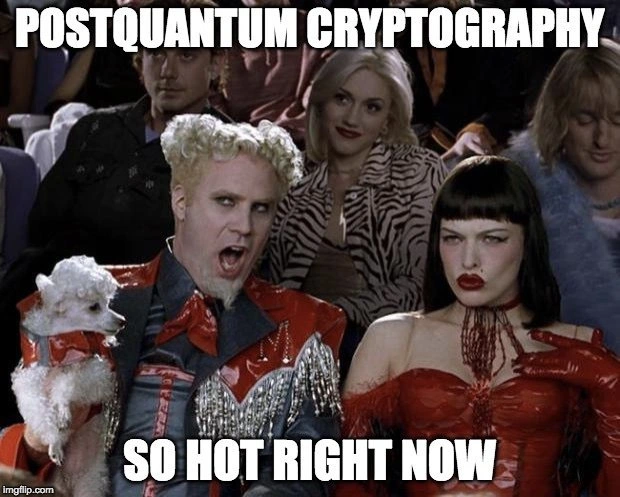
Now, the meme itself shows a scene from the comedy movie Zoolander. In this scene, the fashion designer character Mugatu (holding a little dog, with wild hair and an outrageous outfit) is watching a fashion show and exclaims that a model (Hansel) is “so hot right now.” This phrase has become a popular meme format – people use it to joke that X is suddenly extremely popular or trendy. The image usually has Mugatu passionately praising whatever text you put on the image. In this version, the top caption reads:
POSTQUANTUM CRYPTOGRAPHY
SO HOT RIGHT NOW
So, effectively, Mugatu is made to declare “Post-quantum cryptography – so hot right now!” The joke is comparing the TechHypeCycle of cryptography to the world of high fashion. It suggests that post-quantum cryptography is the hot new trend in security, just like a new style on the runway. For a junior developer or someone new to security, this meme is saying: “Hey, have you noticed how suddenly everyone is talking about quantum-proof encryption? It’s everywhere – the cool new thing!”
And indeed, around that time (late 2010s into 2020), if you read tech blogs or went to security meetups, quantum-resistant encryption was a big buzzword. People might have mentioned that Security teams need to start thinking about upgrading to these new algorithms to protect against future QuantumComputing threats. You might have seen articles with dramatic titles like “The Quantum Apocalypse: Will All Encryption Collapse?” followed by discussions of how CryptographicKey sizes need to grow or algorithms need to change. It became an industry trend to speculate about quantum computers and what they mean for cybersecurity.
Let’s define a couple of key terms in simpler words:
Quantum threat model: this is basically a what-if scenario that assumes attackers will have quantum computers powerful enough to break current encryption. Under this model, even if quantum computers aren’t here yet, we plan for them as if they’re coming. It’s like planning for a future where the burglars have laser cutters that can crack any safe – so you start making better safes now.
Post-quantum signature schemes (pq_signature_schemes): digital signatures are a way to verify something is authentic (like ensuring a software update really comes from the company and not a fake). Post-quantum signature schemes are new methods to do those signatures in a way that quantum computers can’t fake. This was part of what NIST was evaluating, alongside encryption schemes for confidentiality.
NIST standardization: NIST stands for National Institute of Standards and Technology. When they “standardize” something in cryptography, it means they’re picking and recommending certain algorithms for everyone to use (like they did with AES for encryption, or SHA-3 for hashing). It carries a lot of weight because industry and government will follow those standards. So when NIST was close to standardizing post-quantum algorithms, it created a lot of buzz. It was like waiting to find out which design wins “outfit of the year” in a fashion show, except here it’s which encryption will secure the internet for years to come.
For someone early in their career, this meme is a lighthearted way to get that “post-quantum cryptography” is the phrase on everyone’s lips. If you’ve just learned about RSA or elliptic curve crypto, you might be surprised: “Wait, are these going out of style?” The answer is: eventually, probably yes, but not overnight. Companies and governments are starting to prepare now because changing crypto is like turning a big ship – it takes time. And of course, the meme exaggerates it by treating it like a sudden fashion craze. It’s poking fun at how our field can sometimes jump on the next big thing and hype it up. But underneath the joke, there’s truth: you’ll want to familiarize yourself with these new algorithms in the coming years, because they really will be “the next trend” in keeping data safe. Just as everyone eventually had to learn AES when older ciphers got retired, the next generation will be learning terms like “lattice cryptography” and using new libraries that implement these post-quantum algorithms. Today it’s hype, tomorrow it will be routine — that’s the cycle.
Level 3: Algorithm Pageant
For seasoned developers and security engineers, this meme hits on an IndustryTrends_Hype truth: cryptography has its own fashion cycles. Seeing Mugatu from Zoolander (played by Will Ferrell) enthusiastically declaring something “so hot right now” immediately signals we’re talking about a trend that’s reached fever pitch. Here that trend is post-quantum cryptography, the current darling of the security world. Why is this funny? Because only a few years ago, post-quantum algorithms were a niche topic discussed mainly by PhDs and government researchers. Suddenly, after some high-profile news (like NIST announcing finalists, or agencies like the NSA advising to prepare for quantum-safe cryptography), every tech conference, security blog, and vendor pitch is all about “quantum-proof” this and “quantum-safe” that. It feels like the cryptographic equivalent of a new fashion line dropping and everyone scrambling to be on trend. A senior engineer recognizes the pattern: we’ve been through hype cycles before, whether it was blockchain being the magic fix for everything, or microservices becoming the mandatory architecture. Now “quantum-resistant security” has entered that hype phase where not talking about it makes you seem behind the times.
The combination of elements in the meme — a flamboyant fashion mogul and the stodgy world of encryption — creates comedic contrast. Cryptography is usually a dry, rigorous field concerned with math and formal proofs, not something you’d call “glamorous.” Yet here we have it treated like a haute couture item on a runway. It’s poking fun at how even in security, we’re not immune to chasing shiny new trends. The so_hot_right_now_format of the meme typically mocks fads, and it implies a bit of sarcasm: yes, post-quantum crypto is important, but the meme suggests it’s being hyped almost as a fad by industry marketing and tech media. A veteran dev might chuckle remembering past “unbreakable” schemes or standards that everyone hyped — until they weren’t. For example, recall how SHA-1 was everywhere until it wasn’t (broken and phased out), or when 1024-bit RSA was the gold standard until it started showing its age. Each time, the next thing (SHA-256, RSA-2048, then ECC) was “so hot right now.” This meme casts post-quantum algorithms as just the latest contestant in that parade.
There’s an undercurrent of shared experience here: the Security community collectively knows that preparing for quantum attacks is a serious long-term need, but we also know how management and media can overreact. A senior engineer might have attended meetings where suddenly upper management is asking “Are we quantum-proof yet?” because they read an article online. It’s that TechHypeCycle effect — early on, only specialists care; then a trigger (like NIST announcing something or Google achieving a quantum computing milestone) pushes the topic into mainstream awareness. Suddenly budgets are allocated for “quantum readiness,” vendors start slapping “Quantum Safe!” labels on products, and consultants offer to protect you from the quantum apocalypse. 🔐 The experienced folks are often caught between genuine concern and a bit of an eyeroll. They understand both sides: on one hand, quantum computing threats are real (the physics isn’t science fiction anymore) and data that needs to remain secret for 10-20 years should start migrating to new algorithms now. On the other hand, they know large-scale quantum computers capable of breaking RSA don’t exist yet and likely won’t for years (perhaps decades). It’s a classic tension: prepare in advance vs. avoid jumping on an immature solution. The meme humorously emphasizes how everyone appears to be jumping on the bandwagon right now, as if it’s a fashion statement.
In real-world scenarios, this plays out in things like companies starting “Post-Quantum readiness” projects. A senior engineer might share war stories of how hard it was to replace an algorithm even in a minor way — say, migrating from an old hashing algorithm to a newer one across a big system. They know that swapping in a whole new cryptographic primitive is a massive undertaking: protocols have to change, software libraries need updates, hardware security modules might require upgrades, and all of it must be interoperable with partners and older systems. It’s not like changing your outfit; it’s more like changing the locks on every door in a giant building that’s always in use. But during the hype phase, higher-ups might not grasp this complexity. They just hear “quantum = danger, post-quantum crypto = solution” and want it done ASAP. That disconnect can be both funny and painful to those in the trenches.
The meme also winks at how cryptography’s “hotness” can be fleeting or superficial. Today’s hot algorithm could be tomorrow’s broken garbage. Veterans recall algorithms once declared uncrackable that later got torn to shreds by new attacks or academic breakthroughs. So there’s an ironic wisdom: Sure, it’s hot now, but let’s see if it lasts. In the context of the NIST contest, some folks have their favorites (like rooting for an algorithm the way you’d root for a contestant in a reality show). When those favorites win, we celebrate; if they lose (or get broken), we move on to the next big thing. An experienced dev or cryptographer might chuckle because they know this process isn’t really about fashion at all — it’s meticulous and often slow — but the way people chatter about it online sometimes does feel like gossiping about the latest fashion trend. “Have you tried implementing Kyber? Its public key is huge! But oh, the performance is great.” “Oh, did you hear about Rainbow? Totally busted, so embarrassing – last year everyone was raving about it.” These could be real water-cooler snippets in a security team these days. It’s both deeply technical and oddly reminiscent of discussing a fashion line’s hits and misses.
By referencing zoolander_mugatu_meme, the image choice amplifies this comic lens: Mugatu’s exaggerated passion mirrors the exaggerated enthusiasm in the industry. The line “Post-quantum cryptography – so hot right now” could practically be a tongue-in-cheek quote from a security keynote or an overexcited vendor brochure. Seasoned folks find that hilarious because it rings true: we’ve all seen buzzwords rise to supermodel status overnight. This meme is basically a senior developer whispering, “Yes, it’s important, but also… look how everyone’s flocking to the new thing like it’s high fashion.” It’s a gentle roast of our industry’s tendency to chase trends, tempered by the understanding that, trend or not, we do need to address the quantum threat eventually. In other words: keep perspective, even as you strut the latest tech down the enterprise runway.
Level 4: Lattices on the Catwalk
At the cutting edge of post-quantum cryptography, encryption algorithms are strutting their stuff like models on a runway. In this deep technical context, the meme’s text refers to cryptographic schemes designed to resist quantum attacks. The sudden spotlight on these schemes is because of a fundamental threat: Shor’s algorithm. Shor’s algorithm, running on a hypothetical large-scale quantum computer, can factor large integers and compute discrete logarithms in polynomial time, effectively breaking today’s ubiquitous RSA and ECC cryptosystems. In other words, if a powerful quantum computer arrives, the “classic” public-key algorithms (based on the hardness of factoring or elliptic curve discrete log) would fall apart like last season’s fashion. This looming vulnerability defines the quantum threat model in security: we must assume adversaries may eventually have quantum capabilities that undermine our current cryptographic keys and protocols.
To counter this, cryptographers have been developing new mathematical problems that even quantum computers can’t easily solve. These include lattice-based cryptography (built on problems like the Learning With Errors assumption, which is believed to be hard for quantum and classical computers), code-based cryptography (e.g. schemes using error-correcting codes, like the venerable McEliece encryption), hash-based signatures (leveraging one-way hash functions in structures like Merkle trees), and multivariate quadratic equations, among others. Each of these is like a new designer collection in the world of CryptographyAlgorithms. They offer alternative hardness assumptions: for example, finding a short vector in a high-dimensional lattice (the basis of CRYSTALS-Kyber encryption and Dilithium signature, two recently selected algorithms) is considered astronomically difficult even with quantum tricks. Unlike RSA’s factoring, no efficient quantum algorithm is known for these problems – at least, none that our algorithmic catwalk judges (the cryptanalysis researchers) have discovered so far. This is why the community is cautiously optimistic that these new systems are quantum-resistant or “quantum-proof.” It’s as if we are choosing new lock designs that even a master quantum locksmith could not pick.
The meme specifically nods to the NIST standardization process, which has been a high-stakes algorithm pageant over the past few years. Starting around 2016, NIST (the National Institute of Standards and Technology) invited the global cryptography community to submit candidates for standard postquantum_cryptography algorithms. Dozens of submissions were winnowed through multiple rounds (like fashion elimination rounds, or cryptographic Project Runway). The finalists were announced and scrutinized intensively by experts worldwide. By 2020, excitement was building as certain schemes emerged as front-runners – for example, lattice-based key encapsulation mechanisms (like Kyber) and pq_signature_schemes (like Dilithium and FALCON). The meme’s timing (2020) aligns with when this NIST competition hype reached mainstream security conversations: everyone was talking about which algorithm would “win” and become the new AES or RSA for the quantum era. In the deep-tech circles, each algorithm’s performance, key size, and security proofs were hot topics. It’s akin to evaluating models for durability and style: some algorithms had tiny signatures but huge public keys, others were lightning-fast but had larger ciphertexts – trade-offs everywhere!
Yet, even amidst this excitement, seasoned cryptographers remain vigilant. A few promising contenders stumbled before reaching the finish line. For instance, one highly anticipated contestant (the SIKE protocol based on elliptic curve isogenies) dramatically collapsed under classical cryptanalysis in 2022 – a research team found a clever mathematical attack that broke it without even needing quantum powers. This was a bit like a fashion model tripping on the runway – a spectacular failure for something billed as “quantum-safe.” Such events, while disappointing, are actually a healthy part of the vetting process: they ensure that only truly secure algorithms get standardized. It underscores a fundamental in cryptography: no algorithm is truly proven secure, we only gain confidence over time as it withstands all kinds of attacks. The fact that some schemes got knocked out by conventional means reminds us that cryptography isn’t just about quantum vs classical, but about robust design against all known attacks.
In summary, the top caption “POSTQUANTUM CRYPTOGRAPHY” evokes this cutting-edge field of cryptographic research, and the bottom caption “SO HOT RIGHT NOW” wryly highlights how these quantum-resistant algorithms have become the latest craze in security engineering. The humor at this deep level comes from recognizing the interplay of advanced theory and trendiness: we’re dealing with quantum physics, abstract algebra, and computational complexity (serious stuff!), yet here it is being likened to a flashy fashion fad. For those fluent in this area, the meme conjures images of cryptographers poring over academic papers and NIST reports, all while being playfully compared to Mugatu admiring the latest high-fashion ensemble. It’s a perfect collision of QuantumComputing science and pop culture reference, capturing both the intellectual gravity and the almost absurd hype around the next generation of encryption.
Description
This meme uses the popular 'So Hot Right Now' format from the 2001 movie Zoolander. The image features the flamboyant fashion mogul Jacobim Mugatu (played by Will Ferrell) in a red and silver outfit, holding a small white poodle. He is shouting with a dramatic expression. Next to him sits the severe-looking Katinka Ingabogovinanana (Milla Jovovich). The overlaid text, in a bold white font, reads 'POSTQUANTUM CRYPTOGRAPHY' at the top and 'SO HOT RIGHT NOW' at the bottom. The meme humorously applies the fickle and trend-obsessed nature of the fashion world to the tech industry. It satirizes the intense hype and buzz surrounding post-quantum cryptography (PQC), a field dedicated to creating cryptographic algorithms secure against attacks from future quantum computers. For senior engineers and security professionals, this is a relatable take on how a deeply complex, decade-spanning academic discipline can suddenly become a mainstream industry trend, attracting immense attention and discussion
Comments
7Comment deleted
I'm migrating our infrastructure to use CRYSTALS-Kyber, not because I fully understand the lattice-based key encapsulation mechanism, but because it's so hot right now
The board wants Kyber-512 rolled out this sprint “before the quantum apocalypse,” but our load balancer still negotiates TLS 1.0 - pretty sure Shor’s algorithm is the least of our problems
We've been migrating to post-quantum algorithms for three years now, but the quantum computer that can break RSA-2048 is still "5-10 years away"... same estimate as it was in 2015
Post-quantum cryptography is indeed 'so hot right now' - mainly because every CISO just realized their 'encrypt data at rest' strategy from 2015 might become 'store plaintext with extra steps' once quantum computers mature. Nothing says 'urgent architectural refactoring' quite like the prospect of adversaries harvesting your encrypted traffic today to decrypt in 2030 when they finally get their hands on a sufficiently powerful quantum machine. Time to start that migration to lattice-based schemes before your RSA keys become as fashionable as Mugatu's poodle
We shaved 5ms off p99 TLS, and now the CISO wants Kyber+Dilithium hybrid - our ClientHello is bigger than the MTU; compliance really is “so hot right now.”
Post-quantum crypto is so hot right now - every slide deck says “hybrid TLS,” every appliance says “firmware pending,” and every packet says “fragmented.”
Post-quantum crypto: Rushing to lattice-based keys before quantum hits prod, only to debug side-channels in the hybrid transition hell