Skip to content
DevMeme
7056 of 7435
Post-Deploy Anxiety: Chain-Smoking While Waiting for Production to Break
Deployment Post #7737, on Feb 20, 2026 in TG

Post-Deploy Anxiety: Chain-Smoking While Waiting for Production to Break

Why is this Deployment meme funny?

Level 1: Waiting for the Tower to Wobble

It's like carefully pulling a block out of a giant Jenga tower that the whole family is playing with — and then just standing there, frozen, watching it. The tower looks fine. It's probably fine. But you can't relax, because if it falls, everyone will know it was your block. The man with a dozen cigarettes is what that waiting feels like on the inside: nothing bad has happened yet, and somehow that's the most stressful part. The joke is that the worry doesn't fix anything — the tower will stand or fall either way — but no one in history has ever pulled the block and then calmly walked away.

Level 2: Why "Deploying to Prod" Is Scary

Deploying to production ("prod") means pushing your code changes to the live system that real users are using — as opposed to staging or test environments, which are private copies where mistakes are free. The fear comes from an asymmetry: in prod, every bug has a blast radius. A typo can take down checkout, corrupt data, or page a teammate at 3 AM.

The defenses you'll hear about: automated tests (catch bugs before deploy), monitoring dashboards (graphs of errors, latency, traffic that reveal problems after deploy), alerts (automatic notifications when those graphs go bad), and rollback (the ability to quickly return to the previous working version). The meme's protagonist clearly has the dashboards open — that's what "waiting for something to break" means in practice: watching error-rate graphs and the team Slack channel, braced for a message that starts with "hey, is anyone else seeing..."

The first time you deploy something significant yourself, you'll discover the feeling isn't proportional to the size of the change. A one-line config tweak can produce the full eleven-cigarette experience, because you've heard the stories: it's always the "trivial" change that takes the site down.

Level 3: The Silence Before the Pager

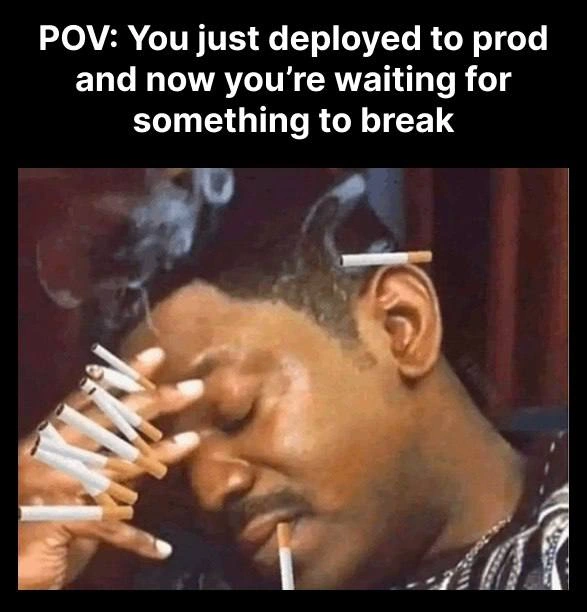
"POV: You just deployed to prod and now you're waiting for something to break"

The man in the photo — eyes squeezed shut, one cigarette in his mouth, roughly ten more lit and wedged between his fingers, one staged behind his ear like a reserve battalion — is not smoking. He is load balancing anxiety across all available channels. That's the precise emotional architecture of the post-deploy window, and every engineer who has shipped anything non-trivial recognizes it instantly: the change is live, the dashboards are green, and the green is the problem.

Here's the uncomfortable truth the meme encodes: a quiet dashboard immediately after a deploy carries almost no information. Most production failures don't announce themselves at kubectl rollout status time. They wait for the cache to expire, the hourly cron to fire, the connection pool to slowly exhaust, the one customer in a weird timezone with the weird locale settings to log in. Latency between cause and symptom is what makes deployment dread rational rather than neurotic — you're not waiting to find out if you broke something, you're waiting out the observation window during which breakage would have already happened but hasn't surfaced yet. The brain handles open loops badly. Hence: eleven cigarettes.

The systemic satire runs deeper. The industry has spent fifteen years building machinery specifically to delete this exact feeling — CI/CD pipelines, canary releases, feature flags, automated rollback, blue-green deployments, SLO burn-rate alerts. The promise of all of it was "deploys become boring." And yet the meme is from the 2020s and still universally relatable, because most teams have the vocabulary of safe delivery without the investment: tests that don't cover the risky path, a staging environment that diverges from prod in exactly the ways that matter, a rollback script nobody has run since the person who wrote it left. So the real safety mechanism remains what it has always been — a human staring at Grafana, manually refreshing, ready to revert. The cigarettes are the on-call rotation of one.

There's also a human-cost reading that the format makes literal: release stress as a health hazard. The hunched posture, the closed eyes — this is alert fatigue rendered as a body. Teams that deploy rarely make each deploy enormous and terrifying; the terror then justifies deploying even more rarely, which makes the next one bigger. Smart people perpetuate this loop not because they don't know better, but because "improve deployment confidence" never fits in a sprint and "ship the feature" always does.

Description

A meme with white text on black background at top: 'POV: You just deployed to prod and now you're waiting for something to break.' Below is the famous photo of a man hunched over with eyes squeezed shut in visible stress, smoking one cigarette in his mouth while holding roughly ten more lit cigarettes wedged between his fingers, another tucked behind his ear, smoke filling the air. The image captures the universal post-deployment dread: the change is live, the dashboards look quiet, and every engineer knows the silence before the first alert is the most stressful part of the release - waiting for pagers, error spikes, or that one Slack message that starts with 'hey, is anyone else seeing...'

Comments

2
Anonymous ★ Top Pick The deploy succeeded, the metrics are flat, and that's exactly the problem - healthy graphs just mean the incident hasn't picked a timezone yet
  1. Anonymous ★ Top Pick

    The deploy succeeded, the metrics are flat, and that's exactly the problem - healthy graphs just mean the incident hasn't picked a timezone yet

  2. @NaNmber 4mo

    holyyyy me

Use J and K for navigation