Skip to content
DevMeme
RecruiterMon Test: Spot the Pokémon in the Tech Stack
Career HR Post #12, on Jan 22, 2019 in TG

RecruiterMon Test: Spot the Pokémon in the Tech Stack

Why is this Career HR meme funny?

Level 1: The Quiz Hidden in the Homework

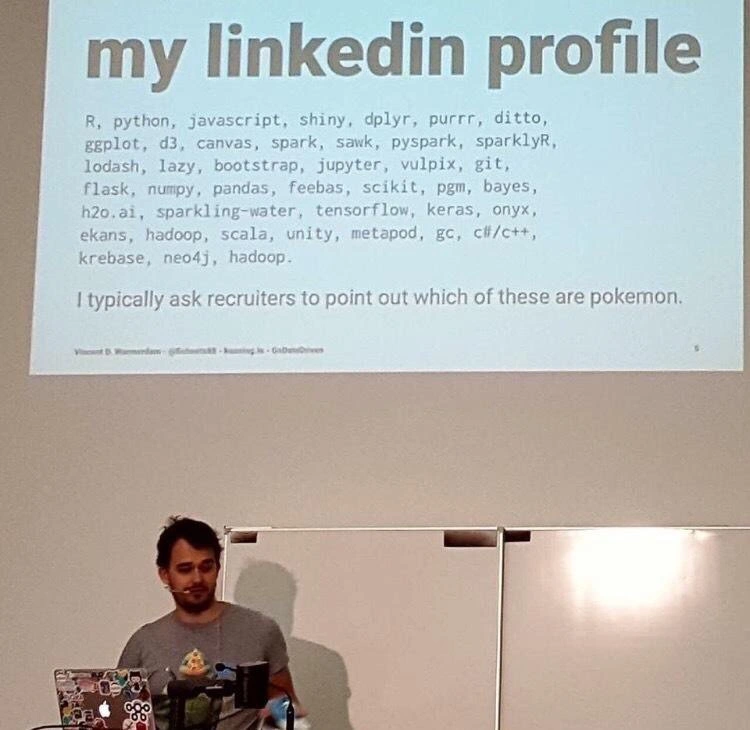
A man shows the audience his job profile — a giant list of all the things he supposedly knows. But he's secretly mixed cartoon monster names in with the real computer tools, and he tells job recruiters: "Find the cartoon monsters." If they can't, it proves they never understood the list — they were just matching words like a word-search puzzle. It's the same trick as a teacher slipping "unicorn" into a science vocabulary list to catch students who memorize without reading. The funny part is that the made-up names and the real names sound exactly alike — and grown-up job hiring really does work like a word search more often than anyone admits.

Level 2: Decoding the List

A field guide to what's real on that slide:

  • Real data-science stack: python, R, numpy/pandas/scikit (Python data analysis and ML), tensorflow/keras (deep learning), spark/pyspark/hadoop (distributed big-data processing), jupyter (notebooks), ggplot/dplyr/purrr/shiny (the R tidyverse and dashboards), d3 (data visualization), flask (Python web), neo4j (graph database), git (version control).
  • Actually Pokémon: ditto, sawk, vulpix, feebas, onyx, ekans, metapod. (Trivia for the savvy: Ekans is "snake" backwards — arguably more honest naming than half of Apache's project list.)
  • Recruiter keyword matching — the practice of filtering candidates by counting how many job-post terms appear in a resume, often via ATS (applicant tracking system) software, without understanding any of them.

The early-career lesson is double-edged. First: the skills-list arms race is real, and you'll feel pressure to inflate yours — this slide is what that inflation looks like from the other side. Second: the gatekeepers often can't evaluate the keywords they're gatekeeping, which means a rejected resume frequently measures string overlap, not your ability. Knowing that makes the process less personally crushing — and makes a focused, honest skill list a quiet flex.

Level 3: A Honeypot Disguised as a Skills Section

The projected slide, titled "my linkedin profile", is one of the most surgically constructed jokes in data-science conference history — and it's a live experiment, not just a gag. The comma-separated skill wall reads like every over-stuffed profile you've ever screened: R, python, javascript, shiny, dplyr, purrr, ditto, ggplot, d3, canvas, spark, sawk, pyspark, sparklyR, lodash, lazy, bootstrap, jupyter, vulpix, git, flask, numpy, pandas, feebas, scikit, pgm, bayes, h2o.ai, sparkling-water, tensorflow, keras, onyx, ekans, hadoop, scala, unity, metapod, gc, c#/c++, krebase, neo4j, hadoop. Then the deadpan kicker:

"I typically ask recruiters to point out which of these are pokemon."

Salted into the legitimate stack — and invisible to anyone keyword-matching — are Ditto, Sawk, Vulpix, Feebas, Onyx (Onix), Ekans, and Metapod. The camouflage works because the naming aesthetics of Pokémon and big-data tooling converged years ago: if sparkling-water (a real H2O.ai/Spark integration) sounds like a Water-type move and purrr (a real R functional-programming package) sounds like a cat Pokémon's cry, the genres have genuinely collapsed. The slide layers in deeper traps for careful readers: hadoop appears twice — keyword-stuffing parody at its finest, since no human proofreads what no human reads — plus filler words like lazy and gc masquerading as skills, and krebase which is neither a tool nor a Pokémon but sounds plausibly like both.

The satire's true target is the keyword-matching pipeline that mediates tech hiring. Recruiters and applicant-tracking systems reduce candidates to bag-of-words vectors and compute overlap with a job description — a process with zero semantic understanding, which this slide weaponizes into a falsifiable test: anyone who contacts the author about his "Vulpix experience" has revealed exactly how the resume was read. It's the hiring-funnel equivalent of a honeypot field in a web form. And there's a self-aware second blade: the legitimate portion of the list is itself an indictment of data-science tooling sprawl, where being employable in 2016-era ML meant credibly listing thirty frameworks (spark, pyspark, sparklyR — the same engine three times, in three languages) that churn faster than anyone can master them. The ecosystem demanded buzzword accumulation; the slide just follows the incentive to its absurd conclusion. Gotta list 'em all.

Description

The image shows a presenter on stage in front of a large projection screen during a tech talk. The slide is titled 'my linkedin profile' in a bold, sans-serif font. Below the title is a comma-separated list of numerous technologies and terms, including 'R, python, javascript, shiny, dplyr, purrr, ditto, ggplot, d3, canvas, spark, sawk, pyspark, sparklyR, lodash, lazy, bootstrap, jupyter, vulpix, git, flask, numpy, pandas, feebas, scikit, pgm, bayes, h2o.ai, sparkling-water, tensorflow, keras, onyx, ekans, hadoop, scala, unity, metapod, gc, c#/c++, krebase, neo4j, hadoop.' At the bottom of the slide, a concluding sentence reads, 'I typically ask recruiters to point out which of these are pokemon.' This meme humorously critiques the practice of keyword stuffing on professional profiles and simultaneously pokes fun at non-technical recruiters who may not be able to distinguish legitimate technologies from fictional creatures. For experienced developers, it's a relatable commentary on the signal-to-noise problem in tech recruiting, where candidates are often evaluated based on keyword matches rather than actual expertise


Comments

8
Anonymous ★ Top Pick My LinkedIn profile is so optimized for recruiter keyword searches that it's started to attract Pokémon trainers. At least their outreach messages are more personalized
  1. Anonymous ★ Top Pick

    My LinkedIn profile is so optimized for recruiter keyword searches that it's started to attract Pokémon trainers. At least their outreach messages are more personalized

  2. Anonymous

    I list Ditto, Vulpix and Metapod between Spark and Keras - any recruiter who endorses me for them clearly runs a “151-microservice, gotta-catch-’em-all” architecture I’d rather not inherit

  3. Anonymous

    The recruiter who confidently circles "krebase" as the Pokemon is the same one who just sent you a "perfect fit" opportunity for a Java role because you mentioned JavaScript once in 2012

  4. Anonymous

    The cruelest part: 'big data tool or Pokemon' stopped being a quiz the moment both ecosystems adopted the same strategy - evolve every six months and make you catch 'em all

  5. Anonymous

    When your LinkedIn profile reads like a Pokédex and recruiters can't tell if you're a full-stack engineer or just really good at catching 'em all. Bonus points if you list 'Hadoop' twice - once as a legitimate distributed computing framework and once because you genuinely forgot you already mentioned it, which is honestly the most relatable part of maintaining a tech resume in 2024

  6. Anonymous

    My recruiter filter: list Spark, TensorFlow and Metapod - if the ATS endorses me for “5+ years of Metapod,” it’s clearly overfitting to keywords with zero semantics

  7. Anonymous

    Recruiters classifying 'Metapod' as a Big Data tool: peak overfitting on buzzword embeddings with zero validation set

  8. Anonymous

    LinkedIn hack: slip Vulpix and Metapod between Spark and TensorFlow; if a recruiter schedules a “Senior Vulpix” screen, you’ve just unit-tested their ATS - bag-of-words in prod. Ditto

Use J and K for navigation