When the team optimizes the crash instead of removing it
Why is this Performance meme funny?
Level 1: Missing the Point
Imagine you have a bicycle with a flat tire that makes it impossible to ride. You ask your friend to help fix the tire so the bike can work again. Instead, your friend works for hours to oil the bike’s chain and pump up the pedals, and then proudly says, “Good news! Now you can reach the flat tire problem 63% faster and the bike is a bit lighter too.” 🤦♂️ The bike is slightly faster and lighter, but the tire is still flat, so you still can’t ride it anywhere. Your friend completely missed the point. They improved something unimportant while the real problem (the flat tire) remains. That’s exactly why this meme is funny: the team was supposed to fix a big error in the program, but instead they just made the program crash faster using a tiny bit less memory. It’s like they polished the car but didn’t fix the engine – it might look or run a little better, but it still doesn’t work when it counts. The leader’s baffled face in the meme says it all: “Why on earth would you make it faster to fail?!”
Level 2: Fix vs Optimize
In this meme, a team leader asks if the bug at line 2036 has been fixed. A “bug” means a mistake or error in the code that causes the program to behave wrongly (often even crash – which is when a program stops working unexpectedly). The number 2036 refers to a specific line in the source code file. It implies the codebase is large (over two thousand lines in one file) and that’s where the error happens. The expectation is that the team would debug the issue at that line and correct it so the program stops crashing.
However, the team’s reply is comically off-target. They say that after a long period of testing (12 hours!), they can reach the same error 63% faster and using 163 KB less memory. In simple terms, they made the program run faster and a bit more efficiently (using slightly less memory), but the program still crashes with the exact same error. They essentially optimized the crash instead of eliminating it. This hints at premature optimization: they improved performance (a PerformanceOptimization) before ensuring the program actually works correctly. It’s like making a broken car go faster – you haven’t fixed the car, you’re just speeding up the failure.
Let’s break down those numbers: 63% faster means if something originally took 100 seconds, now it takes only 37 seconds. Or if it originally took 1 second, now it happens in roughly 0.37 seconds. That’s a big speed-up. 163 KB less memory means the program is using 163 kilobytes less RAM than before – that’s a small amount of memory (about the size of a small image or a few pages of text). So, the team is proudly reporting performance metrics: how quickly the error happens and how much memory is saved. Normally, faster execution and lower memory usage are good things in software. Those are typical performance metrics developers care about when optimizing code. But here’s the catch: those improvements are useless if a bug still makes the program fail. Usually, you’d want to remove the error first so that the program doesn’t crash at all, then optimize its speed or memory if necessary.
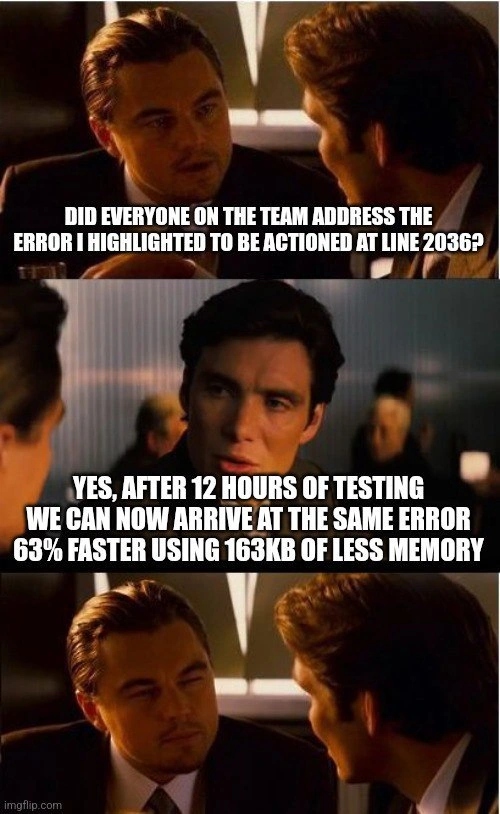
The meme uses the Inception meme format, a popular template where two characters (in this case played by Leonardo DiCaprio and Cillian Murphy in the movie Inception) have a deep conversation. In meme form, the first character asks a serious question and the second gives an answer that is surprising or ironic. In the top panel, the text in white uppercase letters is the lead asking, “Did everyone address the error I highlighted to be actioned at line 2036?” In the middle panel, the second character responds with the absurd update about arriving at the same error faster with less memory. The bottom panel shows the first character’s stunned face, emphasizing how shocked or disappointed he is. This visual format helps deliver the punchline: the lead can’t believe the team optimized something trivial instead of actually debugging_troubleshooting the real issue. His expression = every developer’s face when a simple bug fix is ignored and someone instead tweaks something unnecessary.
Key concepts:
- Debugging: The process of finding and fixing bugs (errors) in the code. Here, debugging should have happened at line 2036 to find out why that error occurs.
- Optimization: Improving code to make it run faster or use fewer resources. This can involve refining algorithms, reducing memory usage, etc. It’s generally a good practice only after the code works correctly.
- Premature Optimization: A concept in programming that warns against optimizing too early or focusing on performance before you need to. The famous phrase “premature optimization is the root of all evil” reminds developers that you shouldn’t waste time making something a little faster until you are sure it’s correct and that the performance is actually a problem. In our meme, the team’s optimization was premature (and misguided) because the code still doesn’t do the right thing.
- Performance vs Correctness: This meme is a lesson in priorities. Correctness (fixing the bug so the program works properly) is usually more important than minor performance gains (speed or memory improvements). The team in the meme chose performance over correctness, which is why the lead is upset.
For a junior developer or someone new to coding, the humor comes from this obvious mix-up of priorities. It’s DeveloperIrony – the team acted as if the bug was a secondary issue and that making the program more efficient was the real goal. But to any experienced developer (or even a user), a program that runs fast but crashes is far worse than one that runs a bit slower but actually works. The scenario is relatable in development teams: sometimes people get excited about cool optimizations or fancy new techniques (RelatableDevExperience), but they forget the basic step of ensuring the code functions correctly. This meme is a light-hearted reminder: don’t put the cart before the horse – fix the bug first, then worry about optimizations.
Level 3: Micro-Optimize, Macro-Fail
The meme highlights a classic premature optimization anti-pattern that senior engineers know all too well. In the first panel, a lead developer urgently asks if the team addressed a bug at line 2036 – presumably a crash or serious error in the code. Instead of fixing the defect, the team boasts about making the program fail faster and use less memory:
“Yes, after 12 hours of testing we can now arrive at the same error 63% faster using 163 KB less memory.”
This deadpan response is both hilarious and horrifying. The team spent half a day tweaking performance metrics (speed and memory usage) while the original error still triggers. They literally optimized the crash itself. It’s like bragging that your app now crashes in 0.37 seconds instead of 1 second, as if that’s an achievement! 🚀💥
Why is this so funny to seasoned developers? It satirizes misplaced priorities in software development. We have a known saying: “Premature optimization is the root of all evil.” Here the team focused on micro-optimizations (shaving milliseconds and kilobytes) before fixing functionality. In terms of CodeQuality, this is a big no-no. The result is an illusion of progress – better performance metrics on paper, but zero improvement in correctness or user experience. The program still crashes at line 2036 every time, just a bit quicker.
From a debugging perspective, it's maddening. The manager or tech lead (Leonardo DiCaprio’s character in the Inception meme) is staring in disbelief in panel 3, representing pure debugging frustration. You can imagine the code review or stand-up meeting: “Did we resolve that critical null pointer exception?” — “Great news! The null pointer crash happens 63% sooner now, and we freed 163KB of memory along the way.” 🙄 This highlights a developer irony: the team treated the bug like a feature request for performance improvement. Instead of removing the fault, they fine-tuned the path to failure.
Technically, what might this look like in code? Perhaps the offending function at line 2036 still throws an exception or segfaults, but the team optimized some loop or memory allocation leading up to it. For example, maybe they replaced an expensive routine with a slightly faster one or reduced a buffer from 200KB to 37KB (hence saving ~163KB memory). The outcome: the code runs lighter and reaches the bad logic sooner, but the bug at line 2036 remains untouched:
// Pseudo-code illustrating the absurd fix
void processData() {
// ... [some optimized code here] ...
// Still triggers the same error:
throw std::runtime_error("Error at line 2036: something went wrong");
}
This is a textbook micro_optimization_over_bug_fix scenario. The team likely measured some performance metrics – e.g. execution time or memory usage – and saw improvement. But those metrics are meaningless without functionality. It’s like proudly claiming your website loads 20% faster, even though it still shows a 500 error for all users. The relatable dev experience here is that many of us have seen projects where people chase minor performance gains, or refactor code for elegance, while glaring bugs or user-facing issues languish.
There’s also a hint of technical debt and organizational dysfunction. Perhaps the team wasn’t empowered or skilled enough to fix the error, so they did something tangible to show progress. Maybe their KPI was to reduce memory usage or to improve response time, so they optimized whatever they could measure instead of addressing the harder logical fix. In some corporate cultures, performance numbers are celebrated in sprint demos, while quality gets overlooked – a cynical veteran developer would shake their head at this bug vs. feature mix-up. Debugging_Troubleshooting was sidestepped in favor of a quick win on a graph. The meme uses the serious tone of the Inception format to amplify that absurd contrast between what was asked (fix the bug) and what was delivered (pointless performance tweak).
Ultimately, the humor lands because it rings true: focusing on PerformanceOptimization at the wrong time leads to performance_metrics_without_functionality. It’s a gentle industry jab: faster, smaller, but still broken. Senior engineers have learned that a correct, stable program is priority one – only then do you squeeze out extra speed. This meme is essentially laughing at the folly of polishing the speed of a train that’s headed off a cliff. You fixed the symptoms (speed, memory) but not the cause (the error at line 2036), illustrating a perfect case of missing the forest for the trees in software development.
Description
Three-panel Inception-style meme with two suited characters in a dim lounge, faces blurred for anonymity. Panel 1 text (white, all-caps): “DID EVERYONE ON THE TEAM ADDRESS THE ERROR I HIGHLIGHTED TO BE ACTIONED AT LINE 2036?” Panel 2 shows the second character replying, text: “YES, AFTER 12 HOURS OF TESTING WE CAN NOW ARRIVE AT THE SAME ERROR 63% FASTER USING 163KB OF LESS MEMORY.” Panel 3 returns to the first character staring in disbelief. The humor centers on premature micro-optimisation - shaving milliseconds and kilobytes - while the original defect at line 2036 still triggers. Senior engineers will recognise the classic anti-pattern of celebrating performance gains on a path that still deterministically fails, highlighting misplaced priorities between fixing functional bugs and chasing benchmark numbers

Comments
6Comment deleted
Great news - our segmentation fault now has single-digit latency, so the pager wakes you up before you even fall asleep
We successfully reduced the time-to-failure metric by 63% and decreased the memory footprint of our crash dumps, which should really help with our Q4 OKRs around system efficiency
Ah yes, the classic 'we optimized the Titanic to sink 63% faster while using less deck space' approach to bug fixing. Nothing says senior engineering quite like spending 12 hours making an error message arrive faster instead of, you know, fixing the actual error. It's the software equivalent of polishing the rearview mirror while the engine is on fire - technically an improvement, but spectacularly missing the critical path. This is what happens when performance metrics become the goal rather than the means, and why experienced engineers know that 'works correctly' always trumps 'fails efficiently.'
We’ve optimized the failure path - p95 time-to-line-2036 dropped 63% and the crash uses 163KB less heap; pity the SLO was "doesn't crash."
Ah yes - optimizing the exception hot path: time-to-failure improved 63%, memory down 163KB; shame correctness wasn’t part of the SLO
Line 2036: the tech debt black hole where one unchecked TODO accretes until it boosts perf 63% post-bugfix marathon