Parrot Learns 'Is It Scalable?' and Becomes a Tech Manager
Why is this Management PMs meme funny?
Level 1: The Bird Who Knew the Magic Word
Imagine a classroom where one kid discovers that whenever anyone shows their drawing, you can stroke your chin and ask, "But will it work if it's REALLY big?" — and everyone nods like that kid is super smart, even though he says it about every single drawing, every single time. Now imagine a pet parrot learns that one sentence, and the school is so impressed they make the parrot the teacher. That's the whole joke: the bird in the little suit got the job, the desk, and the name sign just for repeating one clever-sounding question — and the funny, slightly sad part is that everyone has met a person who did exactly the same thing.
Level 2: Vocabulary for the Standup
- Scalability — a system's ability to handle growing load (more users, data, traffic) by adding resources. Vertical scaling means a bigger machine; horizontal means more machines. It's a real and important property — for systems that actually face growth.
- Premature scaling — engineering for hypothetical millions of users before you have hundreds. It costs real money and complexity now in exchange for imaginary benefits later. The boring truth: a single Postgres instance and a monolith carry most products further than anyone admits in meetings.
- Cargo-cult — imitating the surface rituals of success without the underlying mechanics, named after islanders who built bamboo control towers hoping cargo planes would return. Saying "is it scalable?" without understanding load profiles is cargo-cult engineering management.
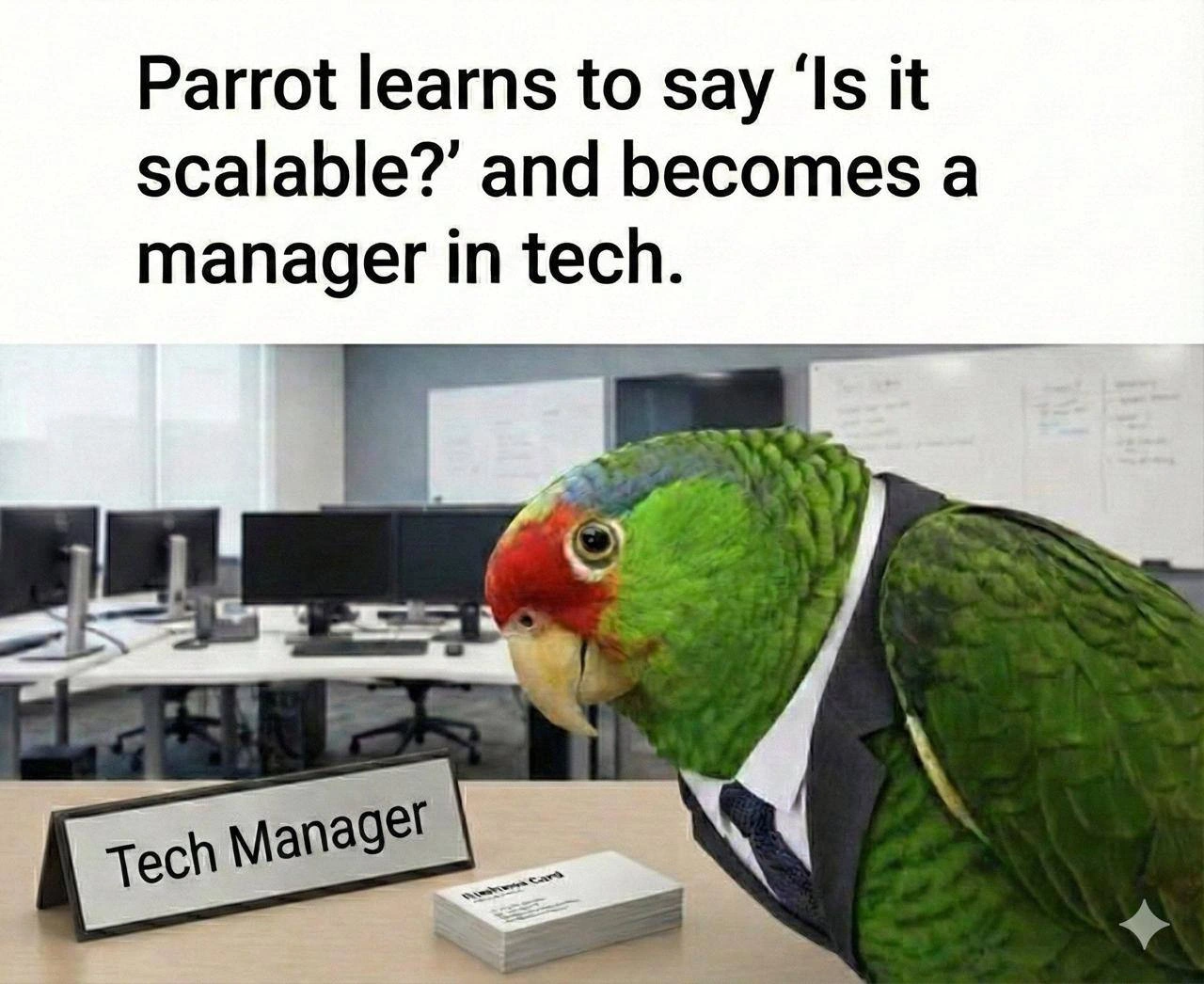
- Buzzword-driven leadership — managing through fashionable vocabulary (synergy, web-scale, AI-first) rather than understanding. The nameplate and business cards in the image are the punchline props: the artifacts of authority, fully present; the substance, fully absent.
If you're junior, here's the survival tip encoded in the meme: when someone asks "will it scale?", the strong answer is a question back — "to what load, by when?" Half the time the room discovers the product has 200 daily users and the conversation improves immediately. The other half, you've just done actual capacity planning, which the parrot cannot do.
Level 3: Cargo-Cult Architecture Review
The composition is fake-news-headline format played completely straight:
Parrot learns to say 'Is it scalable?' and becomes a manager in tech.
Below it, a green parrot with a red face — photoshopped into a dark suit, white shirt, and navy tie — perches at a desk beside a "Tech Manager" nameplate and a neat stack of business cards, with the empty open-plan office, dead monitors, and whiteboards of every mid-size startup stretching out behind him. The bird even has the posture: leaning slightly forward, expression unreadable, exactly like someone about to derail your design review.
The satire is about signaling versus substance in technical leadership. "Is it scalable?" is the perfect cargo-cult question because it is never wrong to ask. It sounds rigorous, requires zero context to deploy, can be aimed at any artifact — a database schema, a hiring plan, a lunch order — and shifts the burden of proof entirely onto the presenter. The asker risks nothing; they never have to define scalable to what, along which axis, at what cost. It's the management equivalent of a chess engine that always plays check.
Veterans recognize the deeper wound: this question, asked reflexively, has done real architectural damage. The industry spent a decade building Kubernetes clusters for ten users, sharding databases that fit in RAM, and decomposing CRUD apps into microservices because someone in a meeting asked the parrot's question and nobody had the standing to answer "no, and it doesn't need to be." Premature scaling is the respectable cousin of premature optimization — same root pathology, but it gets you promoted instead of code-reviewed. The lineage runs straight back to the "webscale" mockery of the early NoSQL era; the buzzword changed, the bird is the same species.
Why does the parrot become a manager? Because incentive structures reward legible performance over illegible competence. Asking sharp-sounding questions is visible in every meeting; quietly knowing the system handles 50 requests per second and will for years is invisible. An organization that can't evaluate technical depth evaluates technical theater — and a parrot is, by definition, the cheapest possible implementation of theater. There's also a sly 2026-flavored bonus reading available: the field's most famous critique of large language models calls them "stochastic parrots," and here is a literal parrot achieving management by repeating one high-status phrase. The meme doesn't insist on it, but the feathers fit.
Description
A satirical news-style meme. The headline reads: 'Parrot learns to say "Is it scalable?" and becomes a manager in tech.' Below, a photoshopped image shows a green parrot with a red face wearing a dark suit, white shirt, and navy tie, perched at an office desk in front of a 'Tech Manager' nameplate and a stack of business cards, with empty desks, monitors, and whiteboards in the background. The meme skewers cargo-cult management speak: the observation that reflexively asking 'will it scale?' - regardless of context, load profile, or whether the product has ten users - is sufficient signaling to pass as technical leadership
Comments
7Comment deleted
The parrot got promoted because, unlike most managers, it at least repeats the question consistently across all standups - true horizontal scaling
Hahahahaha guys the parrot says what managers say hahahahahah 😂 Comment deleted
August 16th 2026. Comment deleted
"Is it done?" 🦜 Comment deleted
I'm from Iran. LoL you guys have internet. Comment deleted
No, I'm posting comments from a FidoNet gateway, using a floppy disk to bring my messages to the dial-up node and back. 💾🐶☎️🌎 Comment deleted
At least you have Dial-up. But in Iran we don't have this. Comment deleted