Why is this developer meme funny?
Level 1: Magic Piggy Bank
Imagine you have a piggy bank that has a little digital counter on it showing how many dollars are inside. But this piggy bank’s counter has a limit – it can only show numbers up to a certain point (say 99, since it’s just two digits). Now, normally, if the piggy bank is empty, it shows 0. If you add a dollar, it shows 1. If you take a dollar out, it would show -1… but uh oh, it actually can’t show a negative number! The counter isn’t made to go below 0. So what happens? In our magical (or rather, faulty) piggy bank, if you try to go below 0, the counter gets confused and flips to the highest number it can display. It’s like if it can’t go down, it wraps all the way around to the top. So instead of showing -1, it suddenly shows 99!
Now your piggy bank thinks you have 99 dollars when in reality you had 0 and took 1 away. You’ve magically tricked it into giving you a much bigger number because it didn’t know how to handle going negative. The meme is joking that if a baby’s savings account worked like this broken counter, a parent could do a sneaky trick: give the baby $1, then set up the baby’s official account (which resets to $0, ignoring that $1), then take the $1 back. The account tries to go to -$1, panics because it can’t show that, and jumps to a huge number instead – in the joke, it’s about 2 billion (which is like 2,147,483,647, an oddly specific huge number, but basically “a ton of money”).
Of course, in real life banks and Social Security don’t work like a goofy digital piggy bank. They won’t actually glitch out and make your baby a billionaire over a missing dollar. 😛 But it’s funny to imagine! It’s like a cartoonish cheat code for life: do something in a special silly order and suddenly you’ve broken the system and hit the jackpot. The humor comes from that childlike idea of “cheating the rules” combined with a very nerdy understanding of how computers count. So, picture that piggy bank with the wonky counter – that’s essentially what the joke is about. It’s saying the world could be gamed just like a bug in a video game, where if you go one below zero lives, you loop around to tons of lives. In simple terms: the counter went so low it came back around to very high. And that’s why this is funny – it’s a playful take on messing up a counting system to get a crazy result.
Level 2: Wrap-Around 101
Let’s break down what’s going on in simpler terms. The meme is joking about an integer overflow, which is a classic concept in programming and computer science (CSFundamentals). To understand that, first recall what a 32-bit integer is: it’s a way computers store whole numbers using 32 bits (binary digits). With 32 bits, there’s a fixed range of numbers you can represent. For a typical signed 32-bit integer:
- The smallest value is -2,147,483,648 (that’s negative two billion and some change).
- The largest value is 2,147,483,647 (positive two billion and some change).
Those specific endpoints might seem random, but they come from the limits of 32 bits. If you have 32 bits, there are 232 possible bit patterns. Half are used for negative, half for positive (with zero in the positive side), hence 2^31 - 1 is the max positive. In an unsigned 32-bit integer (where you only allow zero and positive values), you’d get 0 up to 4,294,967,295 as the range, because you’re using all 32 bits for the magnitude.
Now, what is overflow (or its sibling, underflow)? It’s what happens when an arithmetic operation tries to go beyond that allowed range. Imagine a car’s odometer that goes from 0 to 999,999. If you drive one mile past 999,999, it flips back to 000,000 – that’s overflow (rolling over to the start). Similarly, if an odometer could somehow go below 000,000 (which ordinarily it can’t, but suppose you tried to reverse the numbers), it might roll under to 999,999 – that’s underflow (going below 0 wraps to the maximum). In computing, if you add 1 to a 32-bit integer that’s already at 2,147,483,647, it will wrap around to -2,147,483,648 (overflowing the positive range into the negative range). And if you subtract 1 from 0, a naive system might wrap it to 2,147,483,647 or sometimes to 4,294,967,295 depending on how it’s treating the number internally (that’s an underflow wrapping to a huge positive). This wrap-around is a kind of bug if it’s not intended – the program suddenly produces a wildly incorrect number because it “wrapped around” the limit.
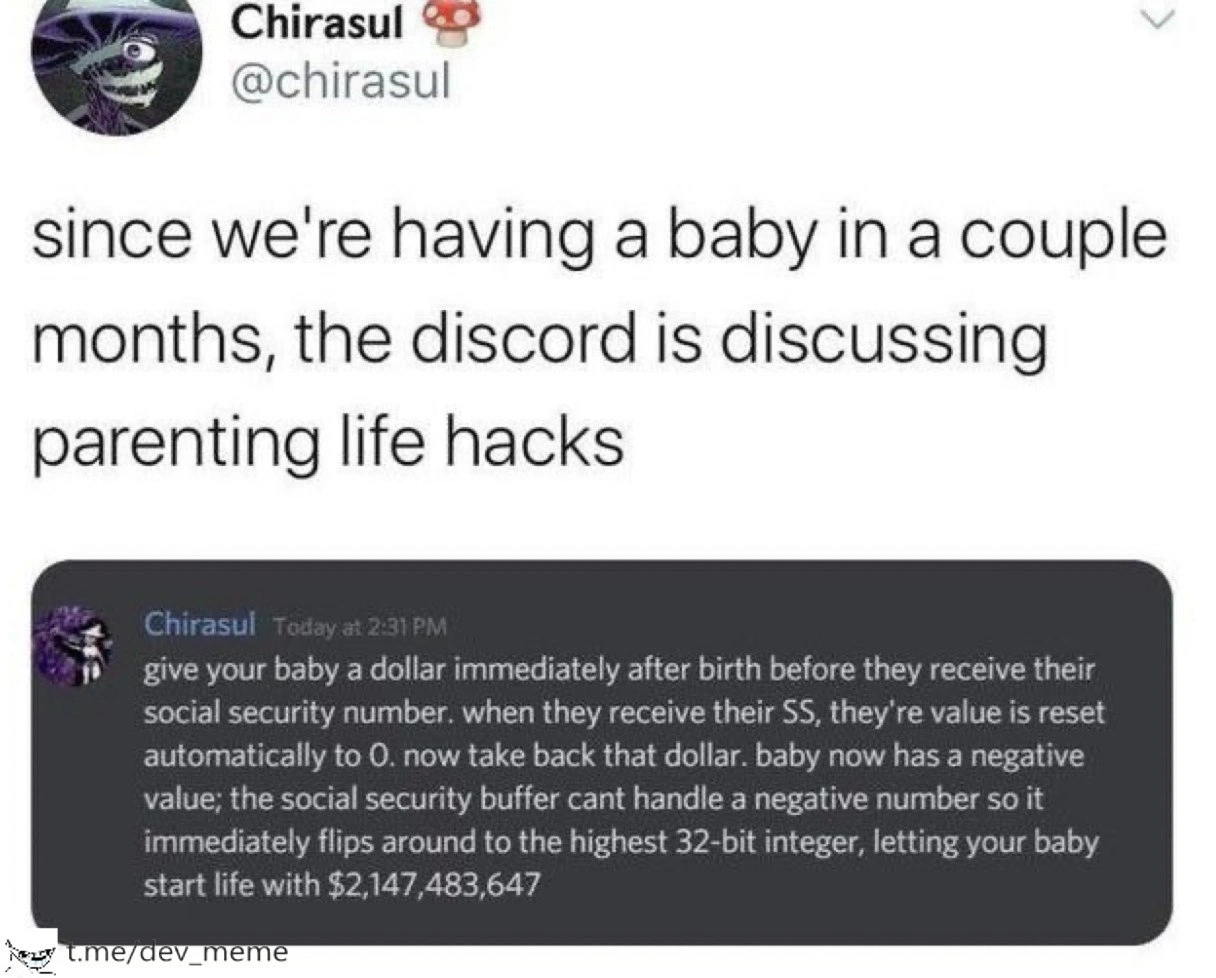
The meme specifically talks about giving a baby a dollar, then doing some trick with their Social Security number assignment, and ending up with the baby having $2,147,483,647. Why that number? Because that’s the highest value for a 32-bit signed int, as mentioned. The joke assumes some hypothetical system (some social_security_number_logic in a computer system) where:
- Before the baby is officially in the system (before they have a Social Security number or any official record), you give them $1 and it’s somehow recorded in a temporary place.
- When the baby gets registered (gets an SSN), the system resets their recorded value to $0 (perhaps it didn’t carry over that temporary data).
- Now you take back the $1 you gave (so physically you’re just even, you gave a dollar and took it back, baby has nothing in reality). But in the system’s eyes, it tries to subtract $1 from $0 (because the baby’s account on record says $0 now).
- Subtracting 1 from 0 in an unsigned or non-negative field causes an underflow. The system doesn’t know how to represent a “-1” balance (maybe it wasn’t allowed or it’s a bug), so it wraps around and ends up showing the baby’s balance as a huge number: $2,147,483,647.
It’s essentially describing a bug or exploit: an edge case where the programmers didn’t anticipate someone doing things in that order. In real software, if you don’t put checks, an integer overflow/underflow can happen exactly like that — the number jumps to an extreme value by wrapping around the limit.
Let’s clarify some terms:
- Buffer: In computing, a buffer usually means a chunk of memory reserved to hold some data. In the meme, when they say “social security buffer can’t handle a negative number,” they’re referring to some part of the program (maybe a variable or database field) that is meant to store the baby’s money. It’s jokingly called a buffer, conjuring the image of a low-level storage that overflows. The idea is that this storage was maybe a 32-bit unsigned integer that should never go negative. If a negative is forced in (like -1), it “can’t handle” it and thus treats it as a huge positive due to wrap-around.
- Signed vs Unsigned: A signed integer can be positive or negative (uses one bit for the sign), whereas an unsigned integer is always non-negative (uses all bits for the value). If an unsigned int tries to go below 0, it wraps around to the maximum value. If a signed int goes below its min or above its max, you also effectively get wrap-around at the binary level, but in many languages that’s considered an error or undefined behavior. The meme plays loosely with the concept, but basically it leverages the idea of an unsigned wrap.
- IntegerOverflow bug: This is a type of bug where arithmetic exceeds the limit of what the data type can store, causing wrap-around. Such bugs have led to things like scores or counters resetting in games, or security exploits where attackers deliberately overflow a value to get unexpected behavior (though that’s more often with buffer overflow, a related concept where memory is overwritten – here it’s specifically numeric overflow).
For a junior developer or someone new to these concepts, the meme is a humorous exaggeration of what could go wrong if you don’t account for extreme cases. It’s both funny and educational:
- Funny because it’s clearly ridiculous to think you could hack real-life finances with a trick like this — it’s taking a programming quirk and pretending the real world works that way.
- Educational because it highlights the importance of handling edge cases. If you’re writing software that tracks something (like money, or inventory counts, etc.), you better consider what happens at 0, or at the max limit. Otherwise, your program might do something crazy like this example. No one wants a baby to accidentally become a billionaire due to a coding mistake (well, the baby might want that… but the devops team wouldn’t!).
To connect it to everyday programming experiences: have you ever had a situation where a counter in your code suddenly became a huge number or went negative when it shouldn’t have? Maybe you were iterating one too many times, or you didn’t anticipate an empty list and you did something like count-- from 0. These are common bugs in software, especially in languages like C, C++, or others where you manage your own integer sizes. Part of learning to code robustly is learning to think about these edge cases (like “what if the value is already at zero and we try to decrement?”). This meme is basically one giant edge-case scenario, wrapped in a humorous “life hack” packaging. It’s exactly the kind of thing a group of programmers might joke about when someone is having a baby: instead of normal advice, they propose a geeky, developer humor kind of “trick.”
Lastly, note the medium: it’s shown as a tweet and a Discord message. Many dev communities discuss tips or share jokes on Discord servers. And Twitter is often where tech jokes go viral. The meme’s author (Chirasul) sets it up on Twitter saying they’re discussing parenting hacks in Discord, then delivers the hack in Discord chat form. This dual format is relatable — a lot of us have seen screenshots of funny Discord chats or tweets that escalate like this. It adds to the authenticity of the joke, making it feel like a real conversation snippet, which adds charm to the humor.
In short, the meme is a play on a classic computer science edge case: the 32-bit integer overflow. It’s explained as if it were a crafty real-world trick, which makes it absurd and amusing. For someone new to coding, the takeaway is: computers count in fixed sizes, weird things happen if you go past the limits! And for a developer at any level, it’s a reminder (in jest) of the importance of handling those weird cases, or else you might accidentally create a billionaire baby in your codebase.
Level 3: Bit Flip Billionaire
At this level, we see why experienced developers smirk at this scenario. The meme takes a programmer’s inside joke and plays it out in an absurd real-life context: using a numeric overflow bug as a “parenting life hack”. It’s the kind of humor that makes a seasoned coder chuckle “oh, if only financial systems were that naive!”
The absurd instructions are phrased just like an exploit tutorial. Step 1: give the baby $1 before they’re officially in the system. Step 2: when the baby is issued a Social Security number (i.e., when their official record is created, presumably setting their balance to a default of 0), immediately take that $1 back. Step 3: voilà, the baby’s account shows -$1, which a poorly designed social security buffer can’t represent, causing it to wrap around to $2,147,483,647. The baby effectively wins the integer overflow lottery, starting life as a billionaire.
For developers, each element here is loaded with meaning:
- $2,147,483,647 is instantly recognizable as INT_MAX for 32-bit signed integers. Seeing that exact figure tips off anyone who has dealt with numeric limits that this is an overflow gag. It’s the highest positive number a signed 32-bit variable can hold. Many of us have seen that number in error logs or as a max counter value, so it’s a giant neon sign saying “32-bit limit reached!”
- The idea that a system would “reset the baby’s value to 0” upon getting a Social Security number sounds like a subtle dig at how real systems might initialize or override data during an onboarding process. (Think of a bug where initial transactions or pre-registrations get wiped out because the record was re-created — a scenario not too far-fetched in poorly coded systems.)
- “Social security buffer can’t handle a negative number so it flips around” directly references a classic edge case bug: the system didn’t expect an account to go negative (maybe infant accounts weren’t supposed to have debt!), and because it’s not handled, the negative value is processed as a huge unsigned number. This is exactly the kind of oversight that causes bugs in software — and if it happened in a real government database, it would be a career-limiting fiasco for some developer! DeveloperHumor often comes from dramatizing these potential mistakes in a safe, fictional way.
- The delivery format itself is part of the humor for tech-savvy folks. It’s presented as a Twitter post (wide white background, like a tweet) followed by a Discord message screenshot (dark background chat bubble). This format parodies how such kooky ideas might actually be discussed among friends or in a developer Discord channel. The Twitter portion sets up: “we’re discussing parenting life hacks.” The Discord message then punches in with a super-nerdy hack. The contrast between the wholesome idea of “parenting life hacks” and the ridiculously technical exploit is comedy gold. It’s like two layers of social media in-jokes: Twitter for broadcasting a thought, and Discord for the deep-dive among buddies.
- There’s also a wink to how programmers share knowledge. The Discord text is in a monospace/code-like font, almost formatted like a snippet of code or a step-by-step algorithm. It reads as if someone couldn’t resist actually writing out the exploit mechanics in detail. This mimics how devs often explain things in a pseudo-code style even when chatting. It’s visually telling the viewer, “this is a code-like solution to a life problem.”
Seasoned developers find this funny because it plays on CS fundamentals we’ve internalized, and on the archetype of the programmer who views every problem — even baby finances — through a computery lens. There’s an old joke that to a person with a programming hammer, everything looks like a nail (or rather, a nail you can solve with an algorithm). Here, a new baby’s financial start is treated like a variable initialization problem to exploit! It’s a parody of both life hack culture and programmer thinking. Instead of a normal tip (“open a savings account” or “start a college fund”), the “hack” is basically perform an underflow exploit.
Importantly, everyone in on the joke knows this wouldn’t actually work in reality. Social Security numbers and bank balances don’t function this way; real systems have checks and balances (no pun intended) to prevent nonsense like this. If you somehow tried to give a newborn money and then remove it, you’re not going to confuse the government into minting billions. 😅 But that’s the humor: it’s satirizing the way we think about systems. It tickles the same part of a developer’s brain that enjoys finding a glitch in a video game to get unlimited coins or discovering an API quirk. It’s the outrageous idea that the world could have a bug as simple as an integer overflow.
For the veteran coders, there’s also a hint of “I’ve seen this in real code” laughter. Many have encountered or heard of real bugs where an unexpected negative number led to huge values. For instance:
- In finance or gaming, a balance dropping below zero due to a timing issue or logic bug might suddenly turn into some massive number if not properly handled. There are legendary tales of games where if you went below 0 health or score, your value wrapped to the max and you became invincible or top-scoring. This meme is basically that glitch applied to a baby’s bank account.
- There’s a larger commentary on edge cases: The scenario concocted (give money before account exists, then account initialization resets it) is an edge case that a lazy programmer might not anticipate. It’s a nudge and wink among developers: “hey, did we remember to handle weird sequences like this in our code?” An experienced dev might jokingly think, “I hope the actual Social Security Administration doesn’t literally use a 32-bit int that could overflow like that… and if they do, we have bigger problems!”
- Even the phrasing “highest 32-bit integer” and using an exact large number satirizes how we talk in bug reports or technical discussions. It’s not “makes your baby super rich” in plain English, it specifically says the baby starts life with $2,147,483,647. That hyper-specificity is funny because it’s so programmatic. It’s exactly how a coder would describe a result—down to the last digit—rather than rounding or generalizing (“about two billion dollars”). It’s an easter egg for those who recognize the significance of that exact figure.
In summary, the meme humorously combines computer science fundamentals with an everyday scenario. It pokes fun at both programmers (for thinking about babies in terms of exploits and buffers) and at the quirks of computer systems (like integer overflow) that can lead to wildly disproportionate outcomes. It’s a prime example of developer humor — if you know, you know. And if you’ve been burned by an integer overflow bug in the past, you’re probably laughing extra hard (maybe with a slight groan) at the absurdity of using that bug as a get-rich-quick scheme for newborns. It’s a joke that says: “We’ve all seen how a tiny off-by-one error can blow things up. Imagine if life worked like our flawed code.” The result? A billionaire baby thanks to a bit flip.
Level 4: Two’s Complement Loophole
At the lowest machine level, integers operate under modular arithmetic rules, meaning they "wrap around" upon reaching fixed limits. In a 32-bit signed integer (a common data type in C/C++ and many systems), values are stored using two’s complement representation. This gives a finite range from -231 up to 231-1 (which is -2,147,483,648 to 2,147,483,647). When an arithmetic operation tries to produce a value outside this range, a wrap-around occurs due to the fixed 32-bit width. Essentially, the calculation discards any overflow beyond 32 bits, causing results to cycle through the allowed range.
In two’s complement binary, -1 is represented as all 1s (0xFFFFFFFF in hex for 32 bits). If you start at 0 and subtract 1 in an unsigned 32-bit context, the result wraps to 232-1, which is 4,294,967,295 (the maximum value for 32 bits interpreted as unsigned). However, the meme cites 2,147,483,647, which is 0x7FFFFFFF in hex – the maximum positive for a signed 32-bit int. This specific number is a dead giveaway: it’s the classic INT_MAX. It suggests a scenario where a negative value was interpreted in a way that underflowed into the highest positive number representable. How could that happen? One plausible low-level explanation: if a system reserves one bit for the sign, trying to represent -1 in a context that doesn’t allow negative could flip that sign bit to 0 (making the value positive) without changing the magnitude bits (which all turned to 1 from the underflow). The result would be 0x7FFFFFFF, since the sign bit is cleared but all other bits are 1. In other words, the sign was dropped from -1, leaving the largest positive number. This is a bit of creative license, since typically an overflow from -1 would produce 0xFFFFFFFF (which as signed is still -1, and as unsigned is 4,294,967,295). But the joke imagines a system that simply cannot handle negative and thus treats -1 as an overflow condition that yields INT_MAX. It’s lampooning how software might mishandle an unexpected negative by saturating to a max value.
Under the hood, this relies on how arithmetic circuits and variable storage work. In hardware, an add or subtract operation on fixed-size registers naturally wraps around if there’s no carry bit or higher register to capture overflow. For example, using 8-bit arithmetic for simplicity: 0 - 1 would underflow and wrap to 255 (since 255 + 1 = 0 mod 256). Likewise, in 32-bit arithmetic, 0 - 1 becomes 232-1 (wrap-around). If interpreted as signed, 0 - 1 leads to the binary pattern for -1 (which is a valid negative). But if a piece of code mistakenly treats that pattern as unsigned or otherwise doesn’t expect a negative, it could be seen as a huge positive. This is how an integer overflow (or here specifically an underflow) can manifest as a gigantic number suddenly appearing.
This behavior is a known source of bugs in software and even security vulnerabilities. Many programming languages define that unsigned integers will wrap on overflow (performing arithmetic modulo 2n), while signed integer overflow might be undefined behavior (meaning compilers don’t guarantee wrap-around, but on typical two’s complement hardware it often does wrap in practice). Robust programs need to guard against such overflow conditions. If not, you can get absurd outcomes – like a bank account going from $0 to $2 billion due to a $1 deduction underflow! In fact, similar overflow issues have caused real-world problems: the infamous Year 2038 problem is due to a 32-bit signed Unix time counter reaching 2,147,483,647 seconds since epoch and then overflowing to a negative value. Historically, we’ve seen glitches like the Pac-Man level 256 kill screen, where an 8-bit level counter overflowed causing half the screen to turn into garbled fruit symbols. The meme’s scenario slyly references this kind of wrap-around error, but portrays it as a feature to exploit. It’s a tongue-in-cheek nod to how fundamental numeric limits (like 32-bit limits) can lead to wild outcomes if you push beyond expected bounds. The key computer science fundamental at play is understanding integer representation and overflow: what happens in that buffer of bits when you go below the minimum or above the maximum value it can hold. The answer, mathematically: it wraps around modulo 232. In practice: baby gets $2,147,483,647 due to an underflow trick. 🎉
To illustrate the concept in code, consider a simplified C example of an unsigned 32-bit wrap-around:
#include <stdio.h>
#include <stdint.h>
int main() {
uint32_t balance = 0;
balance -= 1; // subtract 1 from 0 causes underflow in unsigned
printf("%u\n", balance); // would print 4294967295 (which is 2^32 - 1)
return 0;
}
Here we used an unsigned 32-bit integer (uint32_t). Starting at 0 and subtracting 1 makes it wrap to 4,294,967,295. That’s the principle the meme is riffing on, but with a signed_int_max twist. In a pseudo-code scenario closer to the joke, it might look like this:
#include <limits.h>
#include <stdio.h>
int main() {
// Baby is given $1 before they have an official record
int baby_balance = 0;
baby_balance += 1; // give $1
// Now the baby gets registered (social security number created)
// and the system resets their balance record to 0 by mistake:
baby_balance = 0;
// Take back the $1, making balance -$1
baby_balance -= 1;
if (baby_balance < 0) {
// System can't handle negative, so it rolls over to max 32-bit int
baby_balance = INT_MAX;
}
printf("Baby's balance: %d\n", baby_balance); // prints 2147483647
return 0;
}
The above pseudo-code demonstrates the logic flow described in the meme: an initial deposit, an unintended reset to 0, then a withdrawal causing an underflow. The check if (baby_balance < 0) baby_balance = INT_MAX; is a made-up failsafe representing the “buffer can’t handle a negative” behavior. This isn’t standard in real APIs, but it dramatizes how an overflow bug could theoretically propel a value to the max. In real high-level code, you usually won’t manually wrap to INT_MAX on underflow — either the language runtime does it (for unsigned types) or it’s undefined. But some poorly written systems might inadvertently do something like this if they convert between unsigned/signed or use sentinel values.
Fundamentally, this level of detail shows why the meme resonates with developers: it’s built on bedrock CS fundamentals (IntegerOverflow and wrap-around arithmetic) that we learn about in computer architecture and programming. It lampoons the idea of exploiting those fundamentals in a real-world context. The notion of unsigned_integer_wraparound turning a negative into a giant positive is both technically sound (in low-level terms) and absurd when applied to something like a newborn’s bank balance. It’s the clash of rigorous binary logic with the real world’s expectations – and that dissonance is both enlightening and hilarious to those in on the joke.
Description
This image could not be processed due to an error
Comments
7Comment deleted
I'd make a joke about this image, but I can't see it. Maybe it's a 404 error?
Forget 529 plans - my kid’s college fund is a uint32_t allowance ledger; I just decrement once a year and let two’s-complement compound interest handle the rest
The same developer who wrote the Social Security system's validation logic is now maintaining your company's financial microservices, and yes, they still think signed integers are "just a nice-to-have."
Ah yes, the classic parenting strategy: exploiting integer overflow vulnerabilities in legacy government systems. Just remember, when your baby inevitably causes a stack overflow by crying at 3 AM, there's no rollback transaction - and the production incident will last approximately 18 years with no SLA guarantees
Parenting pro tip: deposit $1 at birth and withdraw it after the SSN - if the ledger wraps to 2,147,483,647, you didn’t hack life, you just found an org that models money as signed int32
SSN zeroing meets signed int: the only parenting hack that turns debt into dev windfall
Ambitious plan - teach two’s complement before tummy time - but government ledgers run BigDecimal with overflow checks; the only wraparound you’ll hit in prod is the diaper