OSS Maintainer Out-Suffers a Masochist in 'Fame & Riches' Comic
Why is this OpenSource meme funny?
Level 1: The Free Bridge Builder
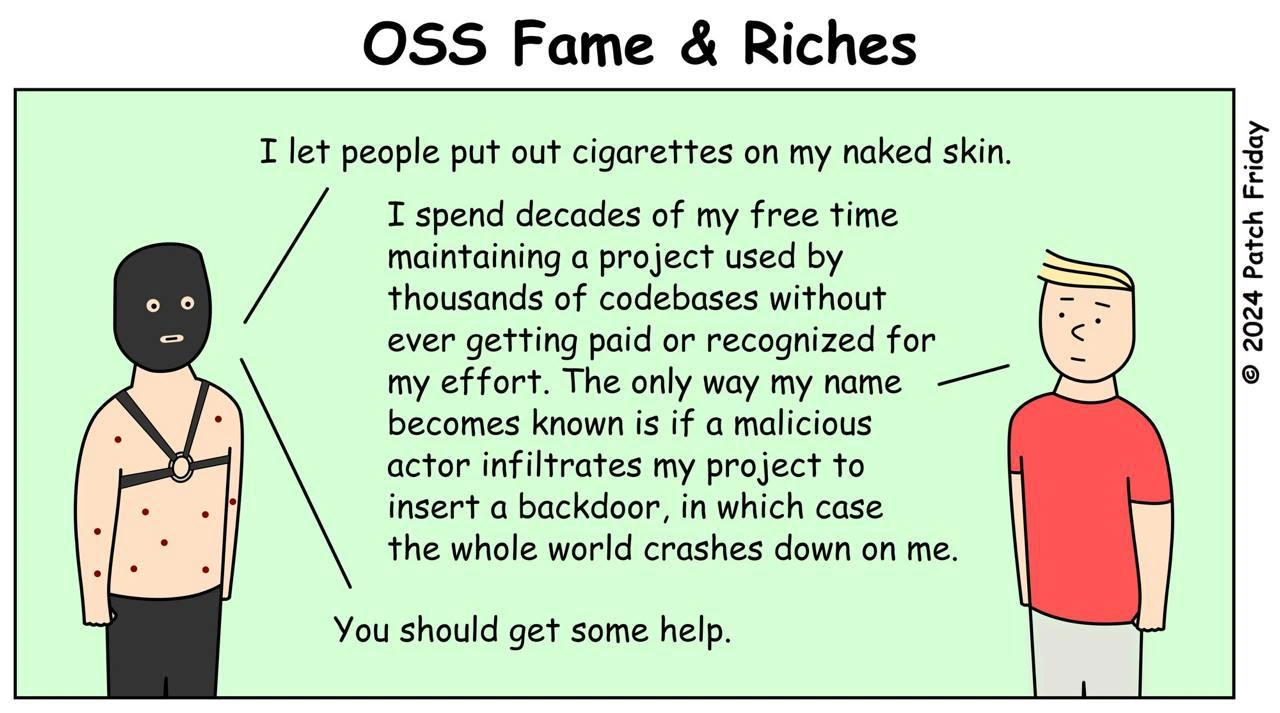
Imagine someone who builds and repairs a bridge in their spare time, for free, for years. Thousands of people drive over it every day without knowing the builder's name. The only way anyone will ever learn that name is if a villain sneaks out one night and loosens the bolts — and then everyone will blame the builder for it. In the comic, this person explains their life to a man whose hobby is letting people hurt him on purpose, and even he is worried about them. That's the joke: the volunteer's situation sounds more painful than actual, deliberate pain.
Level 2: Terms From the Dungeon
- OSS (Open Source Software): code published for anyone to use, read, and modify. Free as in freedom — and, for the maintainer's invoice, free as in unpaid.
- Maintainer: the person who reviews contributions, fixes bugs, triages angry issues, and cuts releases. Often one volunteer for software embedded in millions of systems.
- Backdoor: hidden functionality letting an attacker bypass authentication. In the xz case, smuggled into the build process so the published source looked clean while release artifacts were poisoned.
- Supply chain attack: compromising software upstream — a library, a build tool — so the malicious code is distributed by its trusting victims. Far more efficient than attacking targets one by one.
The junior-career connection: that npm install or apt upgrade you run without thinking pulls in work by people like the red-shirt guy. When you file an issue titled "URGENT: fix this NOW" on a volunteer's project, you are — in the comic's framing — handing someone a lit cigarette. The "Fame & Riches" of the title is the joke's frame: the two things OSS maintenance reliably does not provide.
Level 3: The xz Files: Trust No Tarball
The comic's escalation structure is surgical. A man in a gimp mask and harness, skin dotted with cigarette burns, opens with "I let people put out cigarettes on my naked skin" — establishing the baseline for voluntary suffering. The developer in the red t-shirt then calmly out-bids him: "I spend decades of my free time maintaining a project used by thousands of codebases without ever getting paid or recognized for my effort. The only way my name becomes known is if a malicious actor infiltrates my project to insert a backdoor, in which case the whole world crashes down on me." The masochist's reply — "You should get some help." — is the punchline because it's true on both readings: psychological help, and literally help, as in a second maintainer.
This is a barely-veiled retelling of the xz-utils backdoor saga. The real sequence deserves its place in the anti-pattern hall of fame: a solo maintainer of a compression library that sits in the dependency chain of sshd on most Linux distributions burns out; a patient persona ("Jia Tan") spends years contributing useful patches and manufacturing social pressure — including sock-puppet accounts berating the maintainer for slow releases — until commit access is handed over; sophisticated obfuscated backdoor code rides into release tarballs; and the entire scheme is caught essentially by accident, because one Microsoft engineer noticed SSH logins were ~500ms slower than they should be. Every element the comic compresses is real: the decades of unpaid labor, the anonymity, and the precise mechanism by which an OSS maintainer's name finally trends — as a suspect.
The systemic critique lands because the economics are absurd and everyone has agreed not to look at them. Trillion-dollar revenue streams rest on infrastructure maintained by individuals for free — the xkcd load-bearing-dependency tower made flesh. Corporations consume; foundations write reports about "supply chain risk"; security teams add SBOM line items; and the actual fix — paying maintainers — remains everyone's favorite topic to discuss and nobody's budget line. Worse, the attack demonstrated that maintainer burnout is itself a vulnerability class: the exploit's first payload wasn't code, it was empathy-shaped social engineering aimed at an exhausted human. There's no CVE category for "guy needed a break and the internet weaponized it," but there should be.
Description
A 'Patch Friday' (© 2024) webcomic titled 'OSS Fame & Riches' on a pale green background. On the left stands a man in a black BDSM gimp mask and chest harness, skin dotted with burn marks, saying: 'I let people put out cigarettes on my naked skin.' On the right, an ordinary developer in a red t-shirt replies with a long monologue: 'I spend decades of my free time maintaining a project used by thousands of codebases without ever getting paid or recognized for my effort. The only way my name becomes known is if a malicious actor infiltrates my project to insert a backdoor, in which case the whole world crashes down on me.' The masochist responds: 'You should get some help.' The comic riffs on the xz-utils backdoor saga and the broader plight of unpaid open-source maintainers, framing OSS maintenance as a form of suffering so extreme even a professional masochist is concerned
Comments
2Comment deleted
OSS maintenance: the only hobby where the safe word is 'CVE'
... or when malicious actors include your handy utility into their rootkit, so everyone starts thinking that your utility is malware and should be blocked by all anti-virus and anti-spam software with extreme prejudice. Comment deleted