Skip to content
DevMeme
5097 of 7435
Microservices Meet the Monolith Counterargument
DesignPatterns Architecture Post #5579, on Oct 14, 2023 in TG

Microservices Meet the Monolith Counterargument

Why is this DesignPatterns Architecture meme funny?

Level 1: One Big Box

Imagine building a sandwich by sending the bread, cheese, tomato, and plate to four different houses, then paying someone to carry each piece back. That might make sense for a giant restaurant, but for one sandwich it is silly and expensive. The joke is that programmers sometimes split work into many tiny boxes because it sounds smart, then rediscover that one well-organized box can be much cheaper.

Level 2: Services and Monoliths

A monolith is an application where many features are built and deployed together. It can be simple to run because there may be one codebase, one process, and one deployment path. It can also become hard to change if unrelated parts are tightly tangled.

Microservices split an application into smaller services that communicate over the network. This can help teams move independently and scale specific parts separately. It can also introduce complexity: service discovery, API contracts, retries, monitoring, deployment ordering, and debugging across multiple systems.

The meme is not saying one style is always better. It is showing the funny reversal when microservices, often treated as the modern solution, become the thing being rejected. The top cartoon lists common complaints about monoliths. The article headline then suggests a famous company saved money by doing something more monolithic.

For a junior developer, a simple example is image processing. If every step is separate, one service extracts frames, another analyzes audio, another stores results, another coordinates progress, and another reports status. That can be useful if each step scales differently. But if every request always needs every step, and huge data is passed around each time, a single combined service might be faster, cheaper, and easier to reason about.

The important skill is not memorizing "microservices good" or "monolith good." The skill is asking what changes together, what scales together, what fails together, and what the team can actually operate at 2 AM.

Level 3: Monoliths Strike Back

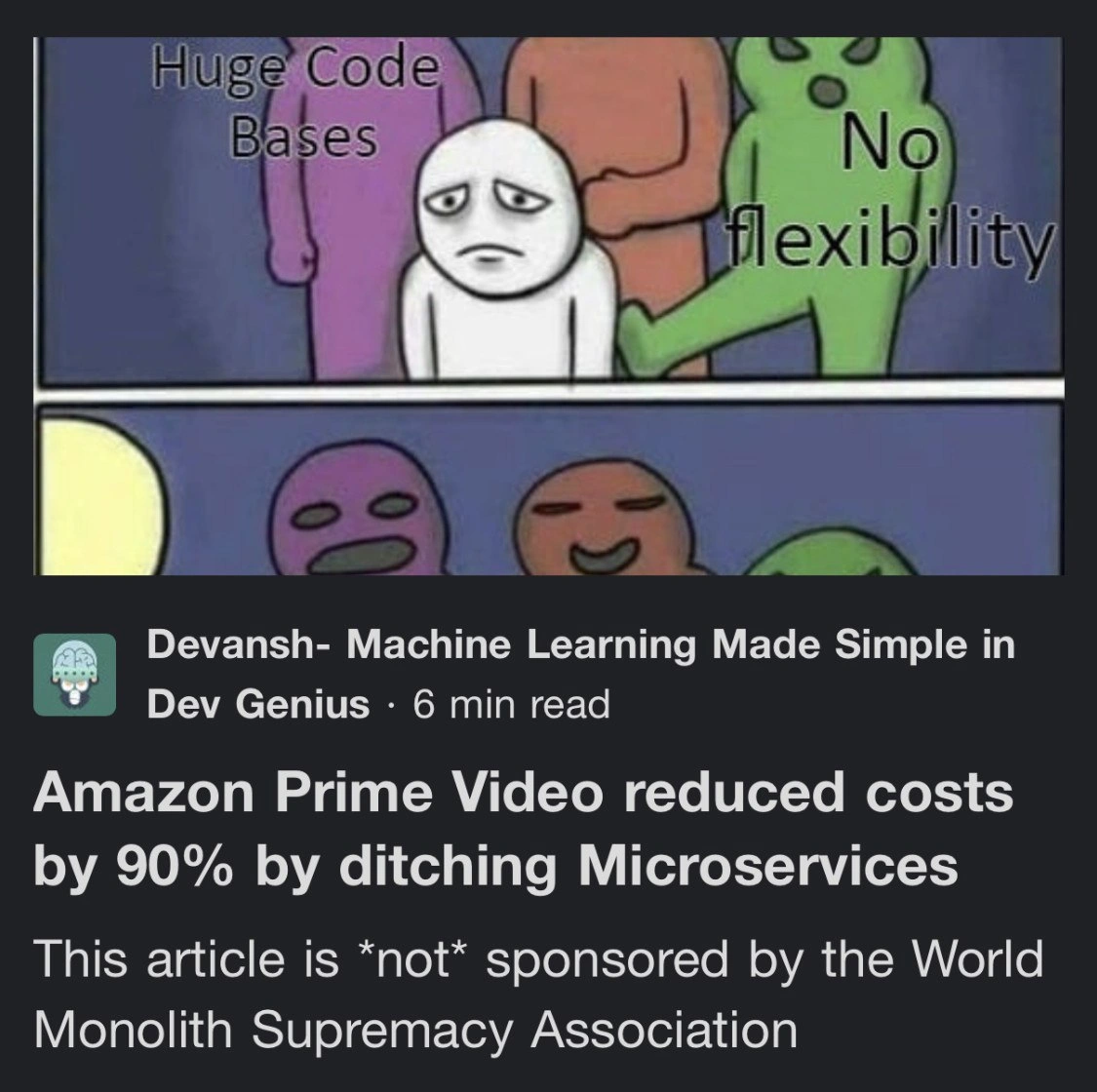
The image pairs a sad white character surrounded by critics with an article card that appears to vindicate the thing being mocked. The top panel says monoliths suffer from Huge Code Bases and No flexibility; the bottom headline says Prime Video "reduced costs by 90%" by leaving microservices behind. Then the caption twists the knife:

This article is not sponsored by the World Monolith Supremacy Association

That line works because architecture debates often behave like sports fandom with sequence diagrams. Microservices became the default symbol of sophistication: independent teams, independent deploys, elastic scaling, fault isolation, and clean domain boundaries. Monoliths became the villain: one giant repo, one risky release train, one database nobody wants to touch. The meme makes the monolith side look smug for once.

Senior engineers laugh because they have seen the cycle. First, a monolith becomes painful. Then an organization decomposes it into services. Then the services accumulate synchronous dependencies, shared schemas, duplicated business rules, cross-team meetings, tracing requirements, versioning problems, and production incidents where every dashboard is green except the user experience. Eventually someone asks whether this one workflow actually needed twelve deployable units and four message formats. The answer is usually followed by an uncomfortable silence and a spreadsheet.

The Prime Video example became especially provocative because it came from Amazon, a company strongly associated with service-oriented architecture and cloud infrastructure. That made the story feel like architectural irony from the source. If even a high-scale Amazon team can say "this part is cheaper as a single service," then maybe the real best practice is not microservices or monoliths, but choosing boundaries based on evidence.

The meme also mocks how the industry turns local lessons into universal commandments. A team fixes one workload by consolidating it, and suddenly people claim microservices are dead. Another team fixes a giant codebase by splitting it, and suddenly monoliths are dead. The corpse count in software architecture is impressive considering all these ideas keep showing up to work on Monday.

Level 4: The Fan-Out Tax

The visible article headline says:

Amazon Prime Video reduced costs by 90% by ditching Microservices

That headline is doing a lot of work, and the meme is funny because experienced backend engineers know both why it is seductive and why it is dangerous when repeated too casually. The real architectural lesson is not "microservices bad, monolith good." It is that every distributed boundary has a cost: serialization, network transfer, retries, observability, deployment coordination, data copying, throttling, queueing, cold starts, and the human overhead of owning the boundary after the diagram has stopped looking elegant.

In a distributed system, a simple logical operation can become a chain of separately scaled components. That is powerful when those components have different scaling profiles, ownership boundaries, failure modes, or release cycles. It is expensive when they are just stages of one tightly coupled computation pretending to be independent services. If the workflow always runs together, changes together, fails together, and moves large intermediate payloads between stages, then the "micro" in microservices may describe only the individual billing events.

That is where the Prime Video story became such good meme fuel. The architecture being discussed was a specific monitoring workflow, not a mystical proclamation that all of Prime Video moved into a single binary under someone's desk. But the cost-reduction narrative hit a nerve because it contradicted a decade of architecture cargo culting. Teams had been told, explicitly or implicitly, that microservices are the grown-up architecture and monoliths are the shame basement. Then a high-profile Amazon example appeared to say, "Actually, putting tightly coupled work in one process can be dramatically cheaper."

The underlying distributed-systems constraint is locality. Moving compute closer to data, avoiding repeated marshaling, reducing orchestration overhead, and collapsing unnecessary network boundaries can turn a system from "cloud-native" to merely "not burning money for sport." The machine does not care that the architecture review board enjoyed the boxes-and-arrows diagram. It cares about bytes moved, invocations triggered, states persisted, retries scheduled, and idle capacity paid for.

The meme's cartoon top half labels the social argument against monoliths as:

Huge Code Bases

No flexibility

Those are real risks. Large monoliths can become tangled, slow to test, painful to deploy, and politically impossible to change. But those risks are not eliminated by splitting the code into services; they are transformed. A bad monolith becomes a bad distributed monolith, now with latency, partial failure, and a monthly invoice that reads like a ransom note.

Description

The image combines a two-panel cartoon reaction meme with a dark-mode article screenshot. The top cartoon shows a sad white figure surrounded by colorful figures labeled "Huge Code Bases" and "No flexibility," implying common complaints about monoliths. Below, an article card by "Devansh- Machine Learning Made Simple in Dev Genius" is marked "6 min read" and titled "Amazon Prime Video reduced costs by 90% by ditching Microservices," followed by the line "This article is *not* sponsored by the World Monolith Supremacy Association." The humor comes from using a high-profile Prime Video architecture story as a smug rebuttal to blanket microservices dogma.

Comments

6
Anonymous ★ Top Pick Nothing redraws service boundaries faster than finance discovering your fan-out graph.
  1. Anonymous ★ Top Pick

    Nothing redraws service boundaries faster than finance discovering your fan-out graph.

  2. @hlvlad 2y

    "Monolith Supremacy Association"

  3. @SamsonovAnton 2y

    The real Monolith Supremacy association.

  4. @ZgGPuo8dZef58K6hxxGVj3Z2 2y

    Who would have guessed simplicity is improvement

  5. @Strangerx 2y

    Truly unbelievable thing is that they reduced costs just by 90% I would guess they should reduce it by 100%, coz there is no cost management for service without micro-services 😅

  6. @deerspangle 2y

    This thing was actually interesting. It was for some small task that they drastically over engineered, and were paying through the nose on network costs and stuff

Use J and K for navigation