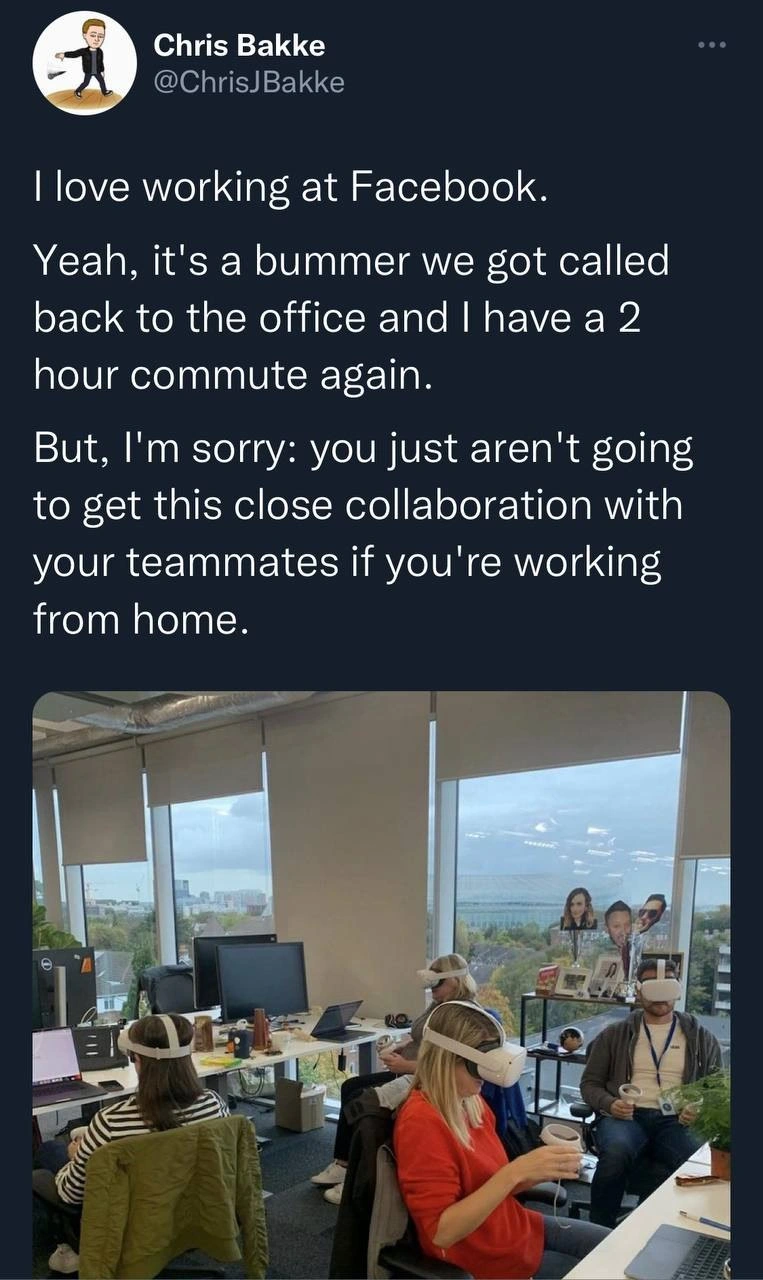
What close collaboration looks like after a two-hour commute and mandated VR goggles
Why is this RemoteWork meme funny?
Level 1: The Silly Playdate
Imagine you and your friends all bike for a long time to meet at a playground because a teacher or parent said, “It’s really important to play together in person.” But when you finally get there, instead of actually playing tag or talking face-to-face, everyone has to put on blindfolds and use toy walkie-talkies to communicate. You’re all right next to each other, but you can’t see anyone and you’re basically just talking through a gadget as if you were far away. You’d probably think, “We could have just done this from home on the phone! Why did we even come out here?” It’s a pretty silly situation, right? That’s exactly why this picture is funny – the grown-ups in the office are doing the same kind of silly thing: traveling a long way to be together, only to pretend they’re far apart. It makes you laugh because it’s so goofy and backwards, and maybe a little sad because it wastes everyone’s time. In simple terms, the meme is saying: Sometimes adults make rules that don’t make sense, and all you can do is shake your head and laugh at how silly it is.
Level 2: Virtual Office, Real Commute
Let’s break down the scenario in simpler terms and define some buzzwords. The meme shows a tweet about working at Facebook (which is now called Meta). Meta is big on Virtual Reality. VR means wearing goggles that cover your eyes and show you a 3D computer-made world. In VR, you can meet people as avatars (like cartoon versions of yourselves) in a virtual meeting room. The idea is you feel like you’re together even if you’re actually far apart. Another term often mentioned alongside VR is AR, which stands for Augmented Reality. AR is when you see the real world but with digital info overlaid (imagine wearing glasses that show holograms on top of what you see). In this case, though, the people are using full VR – those white headsets in the photo are VR devices that block your real vision and immerse you in a virtual space.
Now, RemoteWork became extremely common in 2020 due to the pandemic – that means working from home, using your computer to communicate. RemoteWorkCulture refers to the habits and norms that developed around that: using tools like Zoom for video meetings, Slack or Microsoft Teams for chat, and doing tasks independently without coming to a central office. Many developers learned it’s quite possible to be productive from home (sometimes more productive, with fewer interruptions!). But in 2022, a lot of companies started return_to_office mandates. “Return to office” or RTO is basically: “Alright everyone, time to come back and work from the company office building again, at least for some days of the week.” Companies often said this was for better communication and teamwork – things they felt were harder when everyone was apart.
The tweet in the meme is poking fun at Facebook/Meta calling people back in. It says: Sure, I have a 2-hour commute again (ouch), but you just can’t get this kind of close collaboration over Zoom. The sarcasm is that the picture shows what that “collaboration” actually looks like: six people in an office, all wearing VR goggles and not interacting in person at all! A two-hour commute is a very long travel time to work – imagine driving or taking a train for two hours in the morning and two hours in the evening. That’s four hours lost each day just getting to and from work. Understandably, people who had been working from home (with a 0-minute commute) weren’t thrilled to start commuting long hours again. It impacts their work-life balance and even their energy at work.
Now consider what’s happening in the photo: These employees are physically in the same office (you can see they’re at desks next to each other), but they’re engaged in a virtual meeting or activity through their headsets. In a normal office setting, if you’re next to your teammate, you’d just talk or look at the same screen. But here they’ve put on headsets, so each person is probably seeing a virtual environment. Maybe they’re all in the same virtual meeting room, or maybe they’re in separate training sessions – we don’t know, but the key is they’re not looking at or talking to the actual people right beside them. The company likely provided those VR headsets as part of their push into the “metaverse,” which is basically a fancy word for shared virtual spaces. Meta has been encouraging something called Horizon Workrooms, a VR meeting software, where you sit at a virtual table with colleagues’ avatars. So these employees might be testing that out.
CorporateCulture is at play here too. That term refers to the values and behaviors that a company promotes. Meta’s culture, as implied by this, might value being on the “cutting edge” – using the latest tech (like VR) even in everyday work. It also shows a bit of a top-down decision style: the higher-ups decided everyone should return to office and also presumably that everyone should adopt these new VR collaboration tools. The employees in the picture are complying, but as the tweet hints, not everyone is genuinely happy about it (“it’s a bummer we got called back to the office”). This is a form of WorkplaceHumor where employees joke about decisions that feel silly or irritating. Specifically, this is a WorkplaceIrony joke: the situation is the opposite of what you’d expect. They came back for in-person teamwork, yet they’re working as if remote.
Let’s explain a few more terms and visual cues:
- Open-plan office: The photo shows an open-plan layout (desks in a big room with no walls between people). Many tech offices use this design to encourage interaction (and also it fits more people in less space). However, open offices can be noisy and full of interruptions. It’s common to see people in open offices wearing headphones to concentrate. Here they took it up a notch – VR headsets! So open-plan was meant for collaboration, but the irony is people often end up isolating themselves to get work done.
- VR headset: a device you wear on your head, covering your eyes (and often ears) to immerse you in a game or virtual meeting. The ones in the pic are white Oculus (Meta) Quest headsets. They have screens inside and sensors. When you wear it, you see a 360-degree virtual environment. You might have controllers in your hands to interact (the people have their hands free to hold coffee cups at the moment, but likely controllers are nearby). It’s pretty high-tech gear – great for certain tasks like VR gaming, simulations, or remote meetups. But most people wouldn’t expect to use them when your teammates are literally side by side.
- TeamDynamics: This means how team members interact and work together. Good dynamics might mean people share ideas freely, trust each other, and communicate well. The joke here is that forcing people into a certain mode (like VR meetings) doesn’t necessarily improve dynamics – it might even make interaction more awkward. Some new engineers might assume if the boss says a tool will help teamwork, it must. But real-world experience shows tools are just tools; if misused, they can hinder rather than help. For example, if half your team finds VR uncomfortable or distracting, they might participate less, harming teamwork.
- Communication tools: It’s useful to know the range. In person, you just talk or use a whiteboard. Remotely, common tools are video calls (Zoom, Google Meet), voice calls, chat apps (Slack, Teams), and collaborative docs. VR is an emerging tool – Meta and others have been trying to introduce VR meeting apps. The idea is you’d see a virtual conference table and avatars of your colleagues, maybe have a virtual whiteboard or post-it notes in 3D. It’s an innovative idea, but not widely adopted yet because the tech is still a bit clunky for everyday use. You need to put on a bulky headset, and some people get motion sickness in VR or find it tiring after a while.
- “Close collaboration”: This phrase in the tweet is basically management-speak for “working together really well.” It usually implies brainstorming in person, quick discussions, pairing up on tasks, etc. The tweet jokes that you won’t get “this close collaboration” at home – implying that what we see in the photo is supposedly that great collaboration. Of course, it looks ridiculous. So it’s mocking the idea that just being physically in the same location automatically means better collaboration, especially when you’re actually not interacting normally anyway.
To a junior developer or someone just entering the tech world, the key takeaway is: this meme is highlighting a contradiction. The company (Meta/Facebook in this case) says one thing (“being together in the office is essential for teamwork”) but does something that seems to contradict it (everyone still working in a virtual manner). It also reflects a lot of the skepticism tech workers have about sudden management decisions. If you ever find yourself thinking “Huh, we’re doing this thing that doesn’t make much sense,” chances are you’re not alone – that’s a common vibe in WorkplaceHumor memes. They’re a way to vent and bond over the silliness that can happen in big organizations.
Level 3: Commuting to Virtual Reality
Why is this scene so absurdly funny (or depressing, depending on your coffee levels)? Because it perfectly captures a CorporateCulture contradiction that many developers have experienced in recent years. The company line is “return to the office for close collaboration with your teammates” – a phrase parroted by managers everywhere as the pandemic remote-work era began to wane. The promise: magic serendipitous teamwork and spontaneous brainstorming that supposedly can’t happen over Zoom or Slack. The reality, as this meme shows: employees suffer a two-hour commute (each way, perhaps) only to sit in an open-plan office isolated by VR headsets. They’re physically together but virtually apart. It’s the ultimate WorkplaceIrony: drag everyone back in-person… so they can interact as if they were remote! 🤦
This resonates with developers because it’s “too real.” Many of us have commuted in just to spend the day on virtual calls or chats with colleagues in other locations. Here it’s dialed up to eleven: not just a Zoom call at your desk, but full-on VR meeting goggles. The tweet’s sarcastic tone (“I love working at Facebook… you just aren’t going to get this close collaboration from home”) pokes fun at the official corporate stance. It reads like an overly eager employee giving a phony testimonial, but the attached image totally undermines it. The supposed “close collaboration” is clearly nonexistent – everyone’s literally blind to each other, plugged into digital worlds. No one is making eye contact or huddling around a whiteboard. In fact, each person might be off in a separate virtual meeting or training simulation. If someone stood up and waved, the others wouldn’t even notice because those VR headsets have them totally cut off from the room. So much for those spontaneous hallway conversations that were meant to justify coming back.
This is a stab at the return_to_office mandates many tech companies imposed around 2022. After extended RemoteWork, employees had reorganized their lives – some moved farther away, enjoying less commute and more focus time. Suddenly being “called back” to the office felt like a regression, especially if the work was still largely digital. Here, Meta (formerly Facebook) is specifically in the crosshairs. Meta invested heavily in the “metaverse” – essentially trying to make VR the next big platform for work and play. Internally, they likely encouraged employees to use their VR collaboration app (rumored to be Horizon Workrooms) for meetings as a form of dogfooding (testing their own product). So imagine the memo: “Team, starting Monday we’ll collaborate in VR! (Oh, and by the way, you need to be on-site to do it.)” It sounds ridiculous, but big organizations often do things like this to promote their own tech. The meme’s photo could very well be a real Meta office during a mandated VR training or meeting session – a bunch of devs and designers obediently wearing the latest prototype headsets, coffee mugs in hand, sitting at their regular desks. The intention: prove that even in-office work can be enhanced (or at least Meta-fied) by VR. The outcome: a scene that to any outsider looks like a dystopian gag.
There’s also commentary here on the TeamDynamics and actual effectiveness of such setups. The whole selling point of bringing people back to the office is the human connection – being able to tap a teammate on the shoulder, read the room’s energy, brainstorm on a physical whiteboard, or simply have lunch together. But strap everyone into VR, and you eliminate most of those advantages. In an open-plan area, colleagues might overhear useful discussions or quickly ask a question across desks. With everyone in their own virtual cocoon, they might as well be on different planets. It’s a classic case of corporate doublethink: saying one thing (“we value face-to-face interaction”) but doing another (putting faces behind screens). A senior developer will also note the productivity trade-off: after a brutal 2-hour commute, these folks are likely drained. Now add VR goggles that can cause eye strain, motion sickness for some, and just general discomfort after long periods. Are we really getting better work quality here? Or is it just for show – so some director can say “look, our employees are collaborating in the metaverse”? Experienced tech workers have a finely tuned BS-meter for these situations. Many remember prior fads and mandates that were all hype, no benefit (looking at you, forced fun team-building exercises and Friday beer o’clocks that nobody asked for). This VR-in-office scenario triggers that same feeling: it’s collaboration theater. It might check a box for leadership (“we foster innovation with VR!”) while the team silently rolls their eyes behind those headsets.
We should also talk about the RemoteWorkCulture clash. During 2020-2021, a huge experiment in remote work happened – and by many accounts, it went pretty well in tech. People delivered projects from home, companies saw profits, and a lot of developers found a new level of work-life balance. However, some companies (often upper management) grew nostalgic or anxious about the office culture. They missed the buzz of the office, or perhaps worried about losing control and company identity. So they pushed RTO (return to office) with the argument that creativity and collaboration suffer when we’re apart. That’s exactly the argument the tweet mocks: “you just aren’t going to get this close collaboration… if you’re working from home.” It’s dripping with sarcasm because here “close collaboration” looks anything but close. If anything, working from home and hopping on a normal video call would feel more personal than this! At least on a video call you see coworkers’ real faces and expressions, not legless cartoon avatars or blank visors.
There’s a layer of satire aimed specifically at Meta/Facebook too. Meta rebranded and bet its future on VR/AR technology, envisioning people doing everything from work meetings to birthday parties in VR. They even pitched the idea of colleagues working in VR offices with avatars – essentially metaverse meetings. So here we have Meta employees living that dream... and it looks comically soul-crushing. The tweet coming from Chris Bakke (a known Twitter humorist in the tech/job space) pretends to be a Meta employee praising this arrangement in corporate-speak, while the imagery screams the opposite. It highlights how out-of-touch top-down decisions can be: developers know the pain of a two_hour_commute (that’s 4 hours total daily – practically another part-time job, just unpaid). After enduring that slog, being told to sit and wear a goofy headset to do what you could have done from your couch is peak absurdity. It’s a feeling of frustration wrapped in farce.
In summary, at the senior-dev perspective, this meme is a perfect storm of tech industry irony:
- Return-to-office mandates justified by “collaboration” vs. the reality of people still interacting via tech mediation.
- Management fetishizing a new tool (VR) without considering if it’s appropriate, reminiscent of other ill-fated corporate tech experiments (cough Google Glass meetings? cough).
- The eternal disconnect between what higher-ups imagine (an office humming with innovation because bodies are present) and what actually happens (Slack DMs, Zoom calls, and apparently VR hangouts, even on-site).
- And of course, the shared trauma of commuting – every dev who’s spent long hours in traffic or on a train to get to a job, only to do work that could have been done remotely, feels this meme in their bones. It’s laughing so you don’t cry, basically. 😅
Level 4: The Latency Paradox
At the most technical level, this meme showcases a communication medium mismatch – adding layers of technology where none are needed. In an office, co-workers normally talk face-to-face with ~0 ms latency and infinite bandwidth (the human eye/ear in person has extremely high "resolution"). But here, despite sitting a few feet apart, everyone is using Virtual Reality (VR) headsets and presumably meeting in a virtual space. This introduces unnecessary network overhead and latency into what could have been immediate in-person conversation. It’s a paradox of modern tech: we’ve taken a zero-lag, high-fidelity channel (real life) and swapped it for a compressed, digital channel that can only ever imitate reality imperfectly. Essentially, the team has voluntarily (or by mandate) re-created the limitations of remote communication even while physically co-located.
From a systems perspective, this is like using a satellite link to talk to someone standing next to you. Each VR headset (likely an Oculus/Meta Quest) must encode audio/video, send data over Wi-Fi to a server or peer, then decode it for the coworker sitting in the same room. The network latency might only be tens of milliseconds, but that’s still tens more than an in-person nod or a glance takes. There’s also potential packet loss, Wi-Fi interference, battery drain on the headset, and all the usual points of failure of online communication. By forcing a virtual interface, the setup reintroduces failure modes that simply don’t exist in direct human interaction (no one ever says “Sorry, I didn’t catch that, your face lagged” in person). The extreme irony is that Meta’s metaverse tech – meant to bridge distant people – is used when distance is zero, effectively adding distance in a physical office.
To put it in engineering terms, this is over-engineering collaboration. It’s akin to refactoring a simple function call into an HTTP POST request on the same machine – a distributed monolith of communication 😂. We’re adding layers that don’t solve a problem but actually create new ones. Here’s a comparison of in-person vs VR-mediated collaboration to illustrate the overhead:
| Aspect | In-Person (same room) | VR Meeting (virtual in office) |
|---|---|---|
| Visual cues | Direct eye contact, full real expressions 😃 | Avatar faces, limited or cartoonish expressions 😐 |
| Audio | Natural speech (no devices needed) 🎙️ | Digitized audio via network, compressed 🎧 |
| Latency | Essentially zero (instant feedback) ⚡ | Network latency (tens of ms even on fast Wi-Fi) 📶 |
| Setup | None – just turn and talk 🙌 | Wear headset, launch app, join room, calibrate 🤖 |
| Reliability | High – doesn’t “drop out” unless you do | Can glitch, freeze, or drop if software/network fails 🔄 |
In person, you get unfiltered, high-bandwidth communication – every nuance of tone, every micro-expression. In VR, you’re downsampling human interaction into pixels and avatars. There’s a rich body of HCI (Human-Computer Interaction) and telepresence research on this: real-life presence provides contextual cues (like peripheral vision, body language) that even advanced VR struggles to replicate. Ironically, the folks in this photo have real presence (they’re literally in the same room), but the VR gear is blocking it. It’s a bit like taking a Formula 1 race car (ultra-fast direct human interaction) and forcing it to go through city traffic (the network stack and headset limitations) – all slowdown, no benefit.
This scenario is almost a textbook example of when technological solutionism overshoots. VR and Augmented Reality (AR) are fantastic for bridging actual physical gaps – e.g., having a life-like meeting with colleagues across the globe in a metaverse meeting. But using them when everyone’s physically together is bizarre. It violates the principle of choosing the simplest tool that gets the job done. The fundamental engineering joke here is that management solved a non-existent problem (“lack of in-person collaboration”) by introducing a complex system that mimics in-person collaboration, complete with all the quirks and bugs of software and hardware. As a crusty veteran might say: we’ve added a failure point where we already had a solid solution (talking).
From a historical lens, there’s a whiff of retro-futurism here too. Decades ago, visionaries imagined people in 2020s would work in virtual worlds (think Snow Crash or early VR labs) to connect across distances. Those technologies (teleconferencing, virtual offices) were built to defeat geography. Now we have the tech – and ironically, we’re defeating proximity with it. It’s like we’ve come full circle, using the fancy Metaverse to simulate a meeting that could literally happen at the coffee machine next to those desks. In summary, at the deepest level this meme highlights a latency inversion: the path to “close collaboration” got longer (in terms of signal path and processing) than it was originally. High-tech lowers the fidelity here. The result? A head-scratching inversion of the whole point of co-locating humans in an office.
Description
Screenshot of a tweet by “Chris Bakke @ChrisJBakke” on a dark Twitter UI. Full tweet text: “I love working at Facebook. Yeah, it's a bummer we got called back to the office and I have a 2 hour commute again. But, I'm sorry: you just aren't going to get this close collaboration with your teammates if you're working from home.” Beneath the text is an office photo: six open-plan desks bordered by large windows; every visible employee wears a white VR headset while sitting silently at their computers, coffee mugs in hand. Monitors, laptops, water bottles, and typical developer desk clutter surround them, yet no one makes eye contact because the headsets block their view. The meme satirizes return-to-office mandates - forcing a long commute for “in-person collaboration” that is actually mediated by virtual reality - highlighting corporate culture contradictions, remote-work debates, and Meta’s metaverse push

Comments
6Comment deleted
We drove two hours for “face-to-face bandwidth,” then strapped on VR headsets and added 120 ms of WebRTC jitter - leadership calls it eliminating latency, I call it distributed denial of common sense
Nothing says "synergy" quite like six engineers in the same room, each debugging different microservices in their own VR headsets, occasionally bumping into each other while reaching for coffee they can't see
Ah yes, the classic Big Tech RTO mandate: 'We need you in the office for collaboration!' *proceeds to strap everyone into VR headsets*. Nothing says 'synergy' quite like commuting 2 hours to sit next to your colleagues while you're both in separate virtual meeting rooms. At least when we were remote, we saved the commute time and could use our own bathrooms. But hey, at least middle management can now physically observe that we're wearing the company's own VR hardware while ignoring each other - that's some next-level dogfooding right there. The real metaverse was the office space we wasted along the way
Meta's RTO genius: Commute 2 hours for zero-latency VR elbow-bumps in a physically distributed metaverse
RTO: spend 120 minutes commuting to shave 2 ms off WebRTC to the person at the next desk - then put on a headset and add 100 ms motion‑to‑photon anyway
RTO logic: commute two hours to collaborate in VR - on‑prem cloud for humans; higher cost, same interface, worse latency