The NixOS Incident: When a Review Request Becomes a 3500-Person Spam Blast
Why is this OpenSource meme funny?
Level 1: Yelling in the Library
Imagine you’re in a huge library where everyone is quietly working. You have a question about a book, and instead of asking the librarian or a nearby helper, you grab a loudspeaker and shout, “Hey, everyone here, stop what you’re doing and help me with this now!” What do you think would happen? Probably the library staff would rush over, take away your loudspeaker, and firmly tell you, “You can’t do that. It’s not okay to disturb everyone.” Plus, all the people in the library would be pretty annoyed, right?
That’s basically what happened here, but in a coding community online. One person effectively shouted a request to all 3500 people in a project at once. It was way too loud of an ask for a simple help request. The project’s guardians (like the librarians in our story) immediately stepped in to quiet things down and explained that this behavior wasn’t acceptable because it bothered everyone. The funny part is how quickly and predictably it went wrong – it’s obvious in a library you shouldn’t yell to get help, and in the same way, in a coding community you shouldn’t try to get everyone’s attention all at once. The result? A swift hush and a polite scolding, and hopefully our over-eager friend learns to raise their hand one at a time next time instead of shouting at the whole class.
Level 2: Open Source Etiquette 101
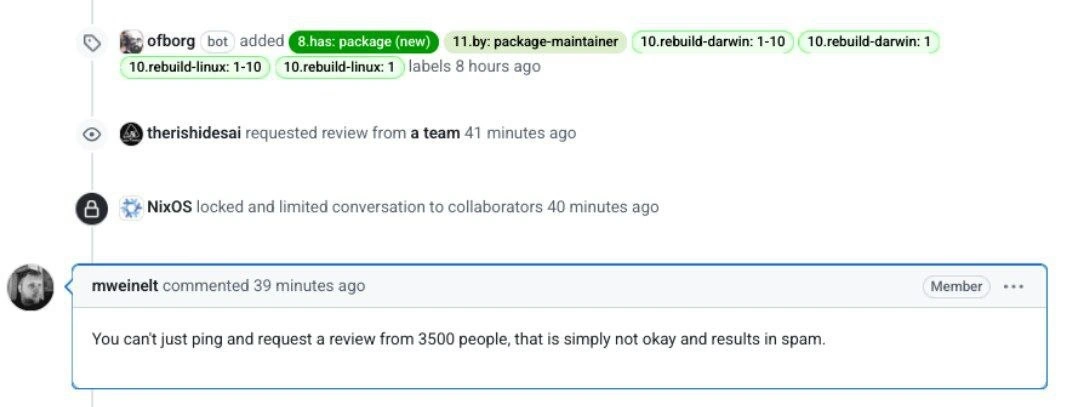
Let’s break down what’s happening in this GitHub pull request timeline. A pull request (PR) is a request by a contributor to merge their code changes into a project. Here, a contributor opened a PR on an open source project (specifically the NixOS/nixpkgs repository, which is a community-driven collection of packages). The first line of the image shows an automated bot named ofborg adding labels like “8.has: package (new)” and “10.rebuild-linux: 1-10”. These labels are part of NixOS’s automation: they indicate things such as the PR is adding a new package and roughly how many dependent packages will need to be rebuilt on Linux and Darwin (macOS) if this PR is merged. In big projects, bots often help categorize or test PRs, so this was a normal, routine step and not part of the drama — at first, everything is going smoothly with the bot doing its job.
The issue begins when the user therishidesai requested a review from “a team”. On GitHub, you can ask others to review your code by using the “Request Review” feature. Typically, you choose one or a few specific people who are knowledgeable about that part of the code. But GitHub also lets you request a review from an entire team (which is a group of people defined in the project’s organization). In this case, the team he chose had about 3,500 members – basically most of the NixOS maintainers. Requesting a review from such a huge team meant that every single person in that team got a notification saying “therishidesai requested your review on [PR title]”. This is highly unusual and considered very impolite. It’s essentially spam: an unwanted mass notification. Usually, if a team is that large, you’d never ping all of them for one PR – it’s like sending an email to thousands of people who aren’t directly involved, which clogs up their inbox. In open source communities, that’s a big no-no. It’s not aligned with good communication practices or community guidelines. Every project has an unwritten rule: don’t needlessly ping unrelated people, especially not hundreds or thousands of them.
What happened next? The NixOS bot/account locked the conversation just one minute after that review request. “Locking” a conversation on GitHub means only the core maintainers (collaborators) can continue to comment; everyone else (including the person who opened the PR) is prevented from adding more comments until it’s unlocked. Maintainers lock threads when something goes off the rails – for example, if there’s a heated argument, spam, or in this case, a mass ping that they want to immediately stop. By locking the PR, the project maintainers basically put the discussion on pause to prevent a flood of “Please don’t do that” replies from dozens of irritated maintainers or any further noise. It’s like hitting the mute button on a chaotic chat. This repo lockdown is not common, but it’s a moderation tool to keep the project’s communication channels civil and manageable.
Finally, we see a comment from mweinelt, who is one of the project’s maintainers (the label “Member” next to their name indicates they’re an authorized member of the organization). Their comment is essentially a gentle scolding and a clarification of rules: “You can't just ping and request a review from 3500 people, that is simply not okay and results in spam.” In plainer terms, they’re telling the contributor: “What you just did is not acceptable. You notified way too many people unnecessarily.” This message serves two purposes: it directly tells therishidesai what was wrong, and it also stands as a public reminder to any other contributors who might not know – basically reinforcing the OpenSourceContribution etiquette. The maintainer is being polite but firm. There’s no yelling or insults, just a clear statement that this behavior isn’t allowed. In many open source communities, maintainers have to do this kind of moderation to educate newcomers on the right way to communicate and collaborate.
Why is pinging 3500 people such a bad idea? For one, it’s inconsiderate. Those maintainers might have nothing to do with this particular PR. Each of them now has a notification to potentially clear or ignore – it wastes their time. In a large project like NixOS’s package repository (often called nixpkgs), there are typically designated maintainers for specific packages or areas. The proper way would be to request a review from only those relevant maintainers or simply post the PR and maybe ask for help in the project’s chat or forums if it’s not getting attention after a reasonable time. By requesting a review from an entire team, the contributor basically said “Hey everyone, drop what you’re doing and look at my code!” which can rub people the wrong way. It’s a CommunicationBreakdown because the contributor’s attempt to communicate their need for a review actually broke the normal communication protocol. Instead of attracting help, it caused annoyance.
This scenario highlights a common CollaborationPainPoints in big developer communities: newcomers might not know the boundaries or features of tools and accidentally do something that frustrates the whole group. GitHub’s interface might have made it seem tempting or easy to ask a whole team for review – perhaps therishidesai thought “more reviewers = faster approval.” It backfired because in communities, quality of communication matters more than quantity. One well-placed request to a relevant person is far better than a blast to thousands. The project’s swift response (locking and commenting) shows that they have zero tolerance for such spammy behavior. It might feel a bit harsh to the person who just wanted their code looked at, but it maintains order for everyone else. After this, likely a maintainer or moderator will unlock the conversation later and possibly guide the contributor on how to properly request reviews (for example, “please don’t use the team mention, instead wait or ask in our Matrix/IRC channel after a few days”). In summary, this meme is a snapshot of an open source community guidelines violation being handled in real-time. It’s educational: if you’re contributing to open source, remember to be respectful of maintainers’ time. Don’t use the @everyone approach on GitHub – it’s better to ask for help the right way than to become known as “that person who pinged the whole team.”
Level 3: Team Ping Avalanche
This meme captures a spectacular faux pas in an open source project’s code review process. Picture a huge GitHub repository (like NixOS’s package repo) where thousands of volunteer maintainers keep things running. Along comes an eager contributor who, perhaps impatient for feedback, hits the nuclear option: requesting a code review from an entire team of maintainers. In one click, they essentially unleashed a notification avalanche on ~3500 people. It’s the GitHub equivalent of a Denial-of-Service attack on maintainers’ inboxes – a review_request_spam event of biblical proportions.
Within minutes, the project’s safeguards kicked in. The timeline shows the ofborg bot quietly adding CI labels (green tags like “8.has: package (new)” to classify the PR), oblivious to the chaos about to ensue. Then user therishidesai requests a review from “a team,” which in this context is likely the @NixOS maintainers group encompassing thousands of folks. Cue the immediate fallout: the NixOS bot (or an admin acting through the NixOS account) locked the conversation, limiting it to collaborators only. This is basically the repo saying “Emergency brake pulled – everybody out!” Locking a thread is a drastic measure usually reserved for spam or heated fights; here it’s deployed preemptively to halt a communication breakdown. When 3,500 developers suddenly get pinged, you bet some of them will start replying or reacting in confusion or annoyance – a recipe for notification hell. Locking stops that in its tracks.
Finally, a seasoned maintainer (mweinelt) drops the hammer with a calm but scathing explanation of why that stunt was unacceptable. You can almost hear the collective facepalm of the maintainer team. The comment in the screenshot reads:
“You can't just ping and request a review from 3500 people, that is simply not okay and results in spam.”
Translation: Buddy, requesting reviews from the entire world is not how we do things here. This is a gentle way of saying “please RTFM on contribution etiquette.” In open source, especially in a large community, spamming everyone is a cardinal sin. It’s akin to walking into a library and screaming through a megaphone – you’ll get shut down immediately. The humor (and horror) of this situation stems from how over-the-top the request was and how swiftly the project’s guardians reacted. As experienced devs, we cringe because we’ve seen variations of this mistake before. It’s a classic CollaborationPainPoint: a newcomer, likely frustrated with slow reviews (a common CodeReviewPainPoint in any project), decides to scorch the earth by pinging every maintainer in sight. Instead of a quick review, they earned a quick rebuke.
From the perspective of a battle-scarred maintainer, this incident triggers PTSD of those dreaded “reply-all email storms” in corporate life. You know, when someone accidentally hits “Reply All” to a company-wide list and thousands of people start getting useless emails (Re: Please remove me from this list… ad infinitum). Here it’s on GitHub: one naive click effectively sent a “Dear all 3500 maintainers…” message. The result? A mix of annoyance, amusement, and a teachable moment about community_guidelines_violation. The seasoned folks have seen this movie before – their notification feeds blow up, their phones buzz like a hornet’s nest at 3 AM (because some maintainers are in other time zones — of course this happened at 3 AM for somebody). As the cynical veteran crowd would say, “At least it wasn’t a production outage this time, just a rookie setting off the pager for everyone.” Still, waking up to 2000+ GitHub emails about a random pull request is every maintainer’s nightmare.
Why is this so not okay? Well, open source maintainers are usually juggling dozens of issues and pull requests. They volunteer their time, and many of them specialize in certain areas of the project. When you blunderbuss-blast a review request to everybody, 99% of those people have nothing to do with your change (like a package update affecting only a small component), yet now they’ve all been annoyed. It’s a classic case of communication overkill. Instead of getting attention, you get negative attention. In fact, it’s counterproductive: maintainers might intentionally ignore or delay a PR that came in with such a disrespectful approach, or, as we see, lock it down altogether. It’s also a matter of scale – GitHub’s team-mention feature isn’t meant to ping thousands of people at once for a trivial update; it’s there so you can notify, say, a team of 5-10 relevant folks. Abuse of this feature forces projects to consider restricting it or employ bots to auto-detect and defuse mass pings.
The meme nails the comedic timing: therishidesai presses the big red “request review from team” button, and one minute later the project slams the doors shut with a lock, followed by the maintainer’s “simply not okay” scolding. It’s funny to seasoned devs because it’s an exaggerated example of what not to do – an instant karma scenario. It also highlights real open-source community dynamics: the delicate balance between welcoming contributions and enforcing norms. The poor contributor probably thought tagging 3500 people would magically expedite their PR review. Instead, they got a crash course in Open Source Etiquette: you earn reviews by being patient and considerate, not by spamming the entire community. In the end, the situation resolves with a bit of public shaming and (hopefully) a lesson learned for the contributor, while everyone else gets a chuckle (and perhaps double-checks their own understanding of the project’s review policies). In short, this meme is the perfect storm of a Collaboration fail – one that every experienced dev can appreciate with a mix of amusement and secondhand embarrassment.
Description
A screenshot of a GitHub pull request timeline within the NixOS repository. The sequence of events shows a user, 'therishidesai', requesting a review from a team. This is immediately followed by the NixOS organization locking the conversation. A community member then comments, 'You can't just ping and request a review from 3500 people, that is simply not okay and results in spam.' The image captures a classic open-source faux pas, where a contributor, likely unintentionally, triggers a mass notification to thousands of people by requesting a review from a large, top-level team. The humor and relatability for developers come from the sheer scale of the resulting notification spam and the swift, decisive administrative action required to shut it down. It's a painful but public lesson in understanding the social and technical etiquette of large collaborative projects
Comments
12Comment deleted
Some developers use '@everyone' on Discord. This developer discovered the enterprise-grade, asynchronous version on GitHub
Broadcast-storming 3,500 maintainers with a single @team mention is the Layer-8 equivalent of running `forkbomb.sh` - the repo’s STP (Stop-The-Pinging) kicked in exactly as designed
Ah yes, the classic 'CODEOWNERS file with * @everyone' strategy - because nothing says 'thoughtful code review' quite like treating your maintainer community like a DDoS target. Next up: requesting review from Linus Torvalds on your hello-world PR
Ah yes, the classic 'spray and pray' code review strategy - because nothing says 'I value your time' quite like pinging 3500 engineers simultaneously. It's like a distributed denial-of-service attack, but for your team's notification channels. The maintainer's response is the engineering equivalent of 'we need to talk,' followed immediately by the repo locking the conversation faster than a production incident gets escalated. Pro tip: if your review request strategy requires scientific notation to describe the recipient count, you might want to reconsider your approach to collaborative development
Scaling reviewers horizontally? GitHub's spam heuristics gatekeep harder than your monorepo merge queue
Requesting review from 3,500 people isn’t distributed consensus - it’s a GitHub-scale notification DDoS; try CODEOWNERS instead of @org-everyone
Pro tip: if your review process doesn’t scale, pinging 3,500 maintainers isn’t horizontal scaling - it’s a notification DDoS with human SLOs
I love dementia Comment deleted
NixOS mentioned, LETS GO Comment deleted
Arch* Comment deleted
why is that team mentionable? Comment deleted
Time to remember that classic PR Comment deleted