Skip to content
DevMeme
2251 of 7435
Learning Fortran: A Seance with Native Speakers
TechHistory Post #2506, on Dec 22, 2020 in TG

Learning Fortran: A Seance with Native Speakers

Why is this TechHistory meme funny?

Level 1: Learning from Ghosts

Imagine you want to learn a language that nobody speaks anymore. It’s like trying to learn Ancient Egyptian today – you can’t just find a person from ancient times to chat with, because all those native speakers are long gone. You might joke, “Well, maybe I’ll ask a mummy or a ghost to teach me!” That’s exactly the funny idea here. Fortran is such an old programming language that learning it feels like learning a long-lost language. The meme shows a guy using a ghost-speaking board (a Ouija board) as if he’s trying to talk to someone from the past. It’s funny because normally, if you want to learn something, you just find a teacher. But in this case the “teachers” are from another era, almost like characters in a history book. So the joke is that you’d have to have a haunted lesson with a ghost from the 1950s to get advice. In simple terms: Fortran is so old that learning it would be like asking your great-great-grandparent’s ghost for help, which is a silly way to show how rare that knowledge is now.

Level 2: Ghosts of Code Past

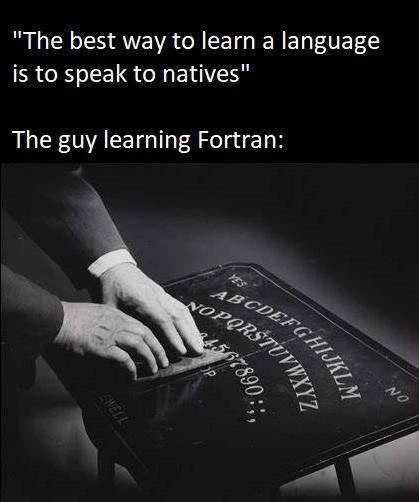
Let’s break down the joke in simpler terms. The meme text says, “The best way to learn a language is to speak to natives.” Below that, it shows a guy using a Ouija board, with the caption “The guy learning Fortran:”. So what’s going on? It’s saying that if you want to learn Fortran, you’d have to find a "native speaker" of Fortran to talk with — but because Fortran is so old, the only “natives” left might be ghosts of the past! In other words, finding an experienced Fortran mentor in real life is so hard that the meme jokingly suggests you might need to ask someone from beyond the grave for help.

Now, what is Fortran, and why is it associated with ancient history? Fortran is one of the very first high-level programming languages, created way back in the 1950s. (Its name comes from “Formula Translation.”) Think of the earliest computers you’ve seen in history books – giant machines with punch cards and blinking lights. Those machines ran code in languages like Fortran. Fortran was a big deal for scientists and engineers because it made writing math formulas in code much easier than using raw binary or assembly language. Fast-forward to today: Fortran is not a common language for a new coder to pick up. Most people learn languages like Python, JavaScript, or Java first. However, Fortran hasn’t completely vanished. It’s still used in some niche areas, especially in scientific and engineering circles. For example, some weather forecast models or physics simulations (the kind that run on supercomputers) are written in Fortran because it’s super fast at crunching numbers. In fact, using Fortran for heavy number-crunching on supercomputers is part of what’s known as High Performance Computing (HPC) – an area where Fortran persists due to its efficiency. But outside of those specialized fields, you’ll hardly ever encounter Fortran in 2020 unless you stumble into a very old codebase. That’s why we call it a legacy language: it’s from an earlier era of technology, and while it’s still around, it carries the feeling of an old relic.

The meme plays with the phrase "speak to natives." Normally, if you’re learning Spanish, you’d try to talk with a native Spanish speaker to immerse yourself in the language. In the programming world, “speaking to natives” translates to finding an expert who’s been using that technology for years. The joke here is that a native Fortran programmer – someone who was “fluent” in Fortran back when it was widely used – might be really hard to find now. Many of the early Fortran experts are senior citizens, retired, or, humorously put, no longer alive. So the poor guy trying to learn Fortran imagines taking that advice literally: he’s using a Ouija board to ask the spirits of long-gone Fortran gurus for pointers. It’s a tongue-in-cheek way to say “there’s practically no one around to teach me this language anymore!”

Let’s talk about the Ouija board in the image. A Ouija board is a tool people use in spooky stories or seance rituals to “talk” to ghosts. It has all the letters of the alphabet on it. Participants lightly place their fingers on a planchette (a small flat pointer) and wait for it to slide around, supposedly spelling out messages from spirits. Of course, it’s usually just a game and the movement comes from people’s hands, but it’s a famous symbol of trying to communicate with the dead. In the meme, the Ouija board is a perfect visual joke: it instantly tells us this guy isn’t just asking a question on Stack Overflow or reading a manual – he’s literally attempting to ask someone from the afterlife about Fortran. Picture him saying, “Hello, is there anyone out there who coded in Fortran IV? Please send me a sign!” It’s an exaggerated, funny image that matches the absurd situation.

What makes this especially humorous to developers is the nugget of truth behind it. Legacy code and legacy systems (which mean old, existing software that a company still relies on) can be really hard to learn. If you’re a new developer and suddenly tasked with updating a program written in the 1970s, you might feel like you’ve been handed a foreign text from another century. You can’t Google much about it because the language isn’t popular anymore; tutorials and active forums are scarce. In a modern office, you might not find anyone who knows Fortran well, because most people learned newer languages. This is why the meme resonates: it dramatizes the very real challenge of legacy language training. It’s basically saying, “Short of dragging a retired engineer out of retirement (or out of the grave!), how on earth am I supposed to learn this stuff?”

Fortran is often mentioned in the same breath as COBOL when talking about legacy programming languages. Both are old, both still run important systems, and both have fewer and fewer practitioners as time goes on. Companies sometimes hire back retirees or run training bootcamps for young developers when they desperately need to maintain these old systems. The meme’s guy skipping straight to a one-man seance is a comical extreme of that idea. Instead of an internship with a senior Fortran guru, he’s like “I’ll just summon one from the spirit world, I guess!” It’s silly, of course, but it highlights the feeling a developer might have: Is learning this language so out-of-date that I need magical help?

In summary, the meme uses a playful spooky scenario to illustrate how rare and old Fortran expertise has become. For a junior developer, the takeaway is: Fortran is a very old programming language that isn’t commonly spoken anymore, so joking about needing a ghost teacher is how developers express that it’s really hard to find mentors or resources for it. It’s a bit like saying, “Learning this is like digging up knowledge from a graveyard.” The exaggeration makes us laugh, and it also indirectly teaches us that technology moves fast — what was common knowledge in one generation can become mysterious in the next. Don’t worry, though: if you ever do need to learn Fortran, you can find books, online communities (small but existent), and maybe even a friendly gray-bearded engineer to help. No actual Ouija board required! It’s just far funnier to imagine it that way.

Level 3: Legacy Code Séance

The meme ironically applies a common language-learning tip to programming: “The best way to learn a language is to speak to natives.” It's a DeveloperHumor twist on an old adage, pushed to absurdity with a Ouija board. This combination of everyday advice and occult imagery is classic TechHumor among programmers, mixing real frustrations with a supernatural spin. Here, the "language" in question is Fortran, a 1950s-era programming language. Where do you find “native speakers” of such an outdated programming language? The punchline: they’re likely long gone. So our hapless Fortran student tongue-in-cheek resorts to a séance, essentially contacting dead programmers for guidance. It’s a witty cross between TechNostalgia and the occult, highlighting just how antique Fortran is in the grand timeline of TechHistory.

To seasoned developers, this dark humor hits close to home because it caricatures a real scenario in legacy code maintenance. Fortran (short for Formula Translation) is one of the oldest high-level programming languages, first developed by John Backus’s team at IBM in 1957 for early mainframe computers. It’s a living fossil in computing history – a language born in the era of punch cards and vacuum tubes. Many of its original "native" practitioners have long since retired or passed away. The meme exaggerates this reality: to truly chat with a native Fortran programmer, you might as well break out a spirit board and summon someone from the Eisenhower era. The Ouija board gag perfectly symbolizes how LegacySystems often feel sealed in a past life. It playfully suggests that to understand a system written in the 1960s, one might need advice from an actual 1960s engineer… who is no longer around in corporeal form.

Beyond the gag, there’s an element of truth that senior engineers know all too well. In many organizations (think scientific labs, banks, aerospace agencies), critical software still runs on decades-old codebases. High-performance computing clusters at research centers, for instance, are infamous for harboring Fortran code from the 70s and 80s that nobody has dared to rewrite. There's often that one retired expert who wrote the climate model or physics simulation back in 1985, and now nobody on the current team fully understands its innards. When a new developer is tasked with updating that code, they basically become a digital archaeologist. The experience is equal parts tech nostalgia and terror: sifting through archaic DO loops and GOTO statements, deciphering all-caps variable names like MAXTEMP or ICTRNT, and reading scant comments in an ancient style. It’s the quintessential ModernVsLegacy dilemma disguised as a ghost story. The meme nails this feeling by showing a dev literally conducting a séance with a Ouija board, as if to ask, “Oh spirit of the original programmer, what does this cryptic subroutine do?”

This scenario also hints at the gaps in knowledge transfer that plague the industry. It’s funny because it’s true: sometimes the only documentation for an old system is tribal knowledge in someone’s head – and if that someone is gone, you’re left guessing. In real life, teams facing a legacy codebase might joke about needing a Ouija board when they’re straining to understand code written before they were born. The meme amplifies that joke visually. It underscores the very real risk of losing information over time. We’ve seen similar scenes play out for real: consider how government agencies scrambled to find COBOL programmers during a crisis, because the people who “spoke” COBOL fluently had long since moved on. Here, Fortran represents that same kind of legacy technology: venerable, reliable, but a bit like a sealed tomb of code. The meme’s humor comes from mixing this serious TechHistory lesson with comically dramatic imagery – a frustrated coder summoning the ghost of a 1950s IBM engineer for a tutoring session.

From an industry perspective, the meme invites a bit of self-reflection (wrapped in laughter). It’s poking fun at how our fast-moving field sometimes leaves behind “lost languages” and LegacyCode that younger generations struggle with. Why hasn’t all that old Fortran been rewritten in something modern? Well, because it ain’t broke (and it runs blazingly fast on big number-crunching tasks), so nobody fixed it. Many scientific institutions have tons of validated Fortran libraries that would be risky or expensive to replace. So here we are in the 2020s, occasionally performing a legacy code séance – trying to commune with 40-year-old logic using modern brains. The meme captures this absurdity in one image. It’s funny and a little macabre, and experienced devs laugh while nodding knowingly. After all, who hasn’t jokingly wished they could ask a system’s long-departed creator “Hey, what were you thinking here?!” The answer is usually lost to time… unless, of course, you have a Ouija board handy. In other words, this meme is hauntingly accurate about the challenges of LegacySystems and the folklore-like status of old languages in today’s tech world.

Description

A two-part meme with a dark background. The top text states the common advice, '"The best way to learn a language is to speak to natives"'. Below this, a second line of text reads, 'The guy learning Fortran:'. The bottom panel is a black-and-white photograph of a person's hands on a planchette, moving across a Ouija board, which is a board marked with letters, numbers, and other signs, used to communicate with spirits. The humor lies in the implication that Fortran, a programming language dating back to the 1950s, is so old that its 'native speakers' - the original programmers who used it fluently - are no longer alive. Therefore, the only way to communicate with them and learn the language is through supernatural means like a Ouija board. This joke resonates with experienced engineers who understand the age and relative obscurity of foundational languages like Fortran in the face of modern software development

Comments

7
Anonymous ★ Top Pick I tried to hire a Fortran developer, but the recruiter just sent me a Ouija board and an invoice for a medium. Apparently, their last sprint planning was in the spiritual realm
  1. Anonymous ★ Top Pick

    I tried to hire a Fortran developer, but the recruiter just sent me a Ouija board and an invoice for a medium. Apparently, their last sprint planning was in the spiritual realm

  2. Anonymous

    Code review escalated to a séance: the ghost of a 1968 Fortran IV author explained that his punched-card loop still outruns our entire Kubernetes fleet

  3. Anonymous

    The irony of maintaining a critical weather simulation that's been running since 1978 while the last person who understood the COMMON blocks retired during Obama's first term

  4. Anonymous

    The real challenge isn't learning Fortran's syntax - it's finding someone who remembers why COMMON blocks seemed like a good idea at the time. At least with the Ouija board, you might get answers faster than waiting for that one remaining Fortran expert to respond to your Stack Overflow question from 2009

  5. Anonymous

    Fixed-form Fortran via Ouija: column 7 starts always, even if the planchette ghosts it

  6. Anonymous

    Followed the “talk to natives” rule for Fortran and ended up at a seance; the planchette spelled “columns 7 - 72, GOTO, COMMON,” and now our HPC job is haunted by global state

  7. Anonymous

    Our Fortran onboarding uses pair‑programming with a planchette - the only teammate who still remembers COMMON blocks and why column 6 matters

Use J and K for navigation