Learning COBOL by Speaking to the 'Natives'
Why is this TechHistory meme funny?
Level 1: Talk to Your Elders
This meme is funny even if you don’t know much about coding. It’s basically saying: if you want to learn something really old, go ask the old folks! Imagine you found a very old video game or a VCR (an old movie player) and you have no clue how it works. Who would you ask for help? Probably your grandparents or someone who used that gadget back when it was common. That’s what’s happening here. The “language” the guy wants to learn is so old that only people as old as your grandma and grandpa really know it well. So he literally goes to a retirement home to learn it! It’s like if you wanted to learn a secret card game that only your grandpa’s friends remember — you’d have to sit with them and have them teach you. The meme makes us smile because it flips the usual situation: instead of a young person teaching an older person about new technology, here a young programmer is learning old technology from senior folks. In other words, sometimes the best teachers are your elders, especially when it comes to really old knowledge (even in the world of coding!).
Level 2: Learning from the Locals
COBOL is one of the oldest computer programming languages still in use today. The name stands for COmmon Business-Oriented Language, and it was first developed way back in the late 1950s. Think of COBOL as the grandparent of languages like Python or Java. It’s a language mainly used for business applications on large servers and mainframe computers. Because it’s so old, COBOL is considered a legacy language – meaning it comes from an earlier era of technology but is still around in many organizations. In fact, a lot of banks, insurance companies, and government agencies have COBOL programs quietly running their core systems (handling things like credit card transactions, payrolls, and airline bookings). These are what we call legacy systems: older software and hardware that are still doing important work because replacing them would be difficult or risky.
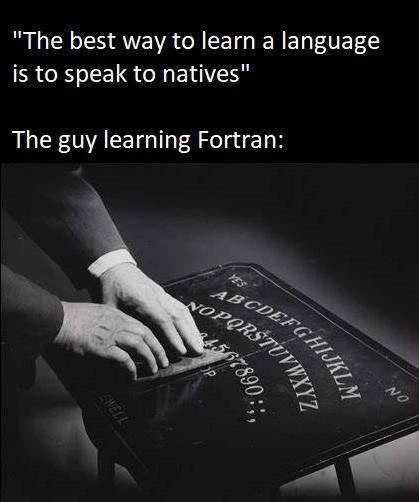
Now, the meme’s text plays on a common phrase: “The best way to learn a language is to speak to natives.” In everyday life, that means if you want to learn Spanish, you should chat with people whose first language is Spanish (native speakers). You’d immerse yourself in conversation with locals to pick up the language naturally. The meme applies this advice to learning a programming language – specifically COBOL. But here’s the funny twist: programming languages don’t have native speakers in the usual sense. You don’t grow up speaking COBOL at home like you would English or Spanish. So who are the “natives” of COBOL? The joke answer: the veteran programmers who have been using COBOL for decades, many of whom are now senior citizens. In other words, the locals who are “fluent” in COBOL are basically the retirees who wrote and maintained all that COBOL code long ago!
In the top panel of the meme, we see the setup text: “The best way to learn a language is to speak to natives.” Right below it, there’s the line “The guy learning COBOL” next to a COBOL logo. So we’re led to expect: where would someone find native COBOL speakers? Then the punchline is the image in the bottom panel: a retirement home with elderly residents sitting in a common room (one gentleman in the background is even playing guitar). This suggests that our eager COBOL student has gone to a nursing home to find COBOL experts to talk to. It’s a lighthearted way to show that most people who know COBOL well are much older – essentially, grandparent-aged. The image of a young developer sitting down with a group of seniors to talk about coding is absurd and funny because it’s a situation you’d hardly ever see in real life. But it exaggerates a real issue: COBOL is not widely known among younger programmers, so sometimes organizations have to seek help from an older generation of engineers.
Let’s break down some terms and context to make it clearer:
- Legacy code: This means old source code that’s still in use. It often was written many years ago and might not follow modern coding practices or style. Working with legacy code can be challenging because the original authors might no longer be around, and documentation (the written explanations of how the code works) might be incomplete or outdated.
- Maintenance burden: This refers to how hard or costly it is to keep a system running over time. Legacy COBOL systems can have a high maintenance burden because they require specialized knowledge to update or fix. If only a few older experts know how the system works, it becomes difficult to maintain when those experts retire or leave.
- Talent gap: This phrase means there’s a shortage of skilled people in a certain area. In tech, we say there’s a talent gap for COBOL when a lot of companies need COBOL programmers but can’t find many, especially among younger developers. New coders often learn newer languages, so not many choose to pick up COBOL these days. This gap means COBOL expertise is relatively rare now.
So why is COBOL still around at all if it’s so old? The simple reason is that it works, and it’s deeply entrenched. Many big organizations have relied on COBOL software for decades, and those systems are embedded in their operations. Rewriting or replacing them with a modern language is often very expensive and risky. For example, a bank might have a COBOL program handling its ATM transactions. That program might be 30 or 40 years old, but it’s been tested and running fine for all that time. Replacing it could introduce bugs or require retraining everyone, so the bank keeps using the COBOL system – relying on it year after year. This illustrates a classic dilemma in tech: the push-and-pull between maintaining reliable legacy systems and trying to modernize with newer technology. The meme is poking fun at how in some places, modernization hasn’t happened yet – if you want to “speak COBOL,” you practically have to find someone from that earlier era.
To give you a sense of what COBOL looks like, here’s a tiny example of a COBOL program:
IDENTIFICATION DIVISION.
PROGRAM-ID. HELLO-WORLD.
PROCEDURE DIVISION.
DISPLAY "HELLO, WORLD!".
STOP RUN.
That is a “Hello, World!” program in COBOL, one of the simplest programs you can write (it just prints a greeting). Notice how COBOL code is very verbose and almost reads like plain English sentences. It has parts called divisions, and keywords like PROGRAM-ID and DISPLAY, and it even ends statements with periods. This old-fashioned style was deliberate – COBOL was designed so that business people like managers or accountants could read the code and understand it, not just computer specialists. In contrast, modern languages (like Python, which would do the same task with just print("Hello, World!")) are much more compact and use syntax that looks more like algebra or simple scripts. Seeing COBOL’s verbose, English-like syntax can feel like reading something out of a 1960s computer manual! This little example helps show why a young coder today might not immediately be comfortable with COBOL – it’s quite different from the languages taught in schools or coding bootcamps now.
Now, imagine you are a new developer and suddenly your company asks you to help with a COBOL-based system. How would you learn this unfamiliar language and all the quirks of an old system? One smart approach is to find a mentor – someone who has worked with it extensively. And indeed, the people who know COBOL deeply are likely the ones who used it when it was widespread, which is decades ago. That often means an older colleague nearing retirement or even someone already retired who is brought back as a contractor. In fact, it’s not unheard of for companies or government departments to re-hire retirees temporarily because they have that rare expertise in COBOL programming. That scenario is exactly what the meme humorously portrays: learning COBOL by speaking to “natives” = visiting the retirement home. It’s highlighting the generation gap in this area of technology knowledge.
For a junior developer or someone new to tech, the meme is a tongue-in-cheek way of saying “COBOL is so old-school that you’ll only find experts among an older generation.” It’s both a joke and a bit of commentary. The joke works because you’d never literally expect to go to a senior center to solve a coding problem – the idea itself is absurd. But at the same time, it hints at a real-world challenge: a lot of critical software is running on a language that fewer and fewer people know how to use. That’s why this meme resonates in developer circles – it’s funny and it points out an issue in software culture and language adoption. People share it because they find it relatable humor: maybe they’ve been the newbie who had to consult an old hand to understand some legacy system, or they simply find the image of a “COBOL conversation club at the nursing home” amusing.
In short, COBOL is an old programming language mostly mastered by an older generation. The meme jokes that if you truly want to master COBOL, you might have to go find those folks (who might now be in retirement homes) and learn directly from them, since they’re the native speakers of that tech language. It’s a playful exaggeration that points out how quickly the tech world moves on, sometimes leaving behind languages that only the “original” users still speak.
Level 3: Council of COBOL Elders
“The best way to learn a language is to speak to natives.” This familiar advice for mastering a foreign language gets a comical tech twist here. The meme sets up that wise saying in a programming context: the language in question is ancient COBOL, and the "native speakers" happen to be a room full of senior citizens. For veteran developers, the image of a coder going to a nursing home to learn COBOL is hilariously on-point. It implies that COBOL is such a legacy technology that only the elders of the programming world truly speak it fluently. This is tech humor playing on a language analogy—treating a programming language like French or Spanish where you’d find native speakers to practice with. In reality, of course, you typically don’t “chat in COBOL” with someone over tea—but this joke imagines exactly that, highlighting how outdated COBOL’s user base has become.
Under the hood of the joke is a serious industry truth. COBOL (which stands for COmmon Business-Oriented Language) was created back in 1959 and became one of the dominant languages for business and government software through the ’60s, ’70s, and ’80s. That means many of the engineers who built massive COBOL systems are literally old enough to be grandparents or great-grandparents today. Most modern developers grew up with languages like Python, JavaScript, or C# – languages that emerged decades after COBOL. So when a bank’s core accounting system or a government’s payroll platform is still running on COBOL, the only people who intuitively understand that legacy code are the ones who wrote or maintained it in those early days. They’re now the retiring or retired experts in their 70s and 80s. The meme humorously suggests that learning COBOL is almost like an archaeological expedition: you have to seek out the tribal elders to impart the ancient knowledge of this language. It’s as if COBOL fluency is a fading oral tradition and the sages who hold it happen to hang out in retirement homes.
Seasoned programmers chuckle at this because it rings true. Critical legacy systems in finance, airlines, insurance, and government still run on COBOL code that’s decades old. There’s a well-known talent gap around these systems – fewer young engineers learn COBOL in school or bootcamps (why learn a “dying” language?), yet billions of lines of COBOL still handle essential business workflows every day. Banks process credit card transactions, airlines schedule flights, and social security offices issue checks using programs written in COBOL long before many of us were born. Maintaining this code often means diving into an outdated environment: mainframe computers, green-screen terminals, and programs with very different patterns than today’s microservice or cloud apps. The people who naturally understand that environment are those who lived it. It’s common in big companies to discover that the one person who can debug a production COBOL issue is “Bob from accounting IT,” who’s been there 40 years and is about to retire. Tribal knowledge in these systems is huge – much of the nuance isn’t in any textbook or Stack Overflow post, but rather in veterans’ heads. So the meme’s scenario of literally visiting a nursing home to “speak to native COBOLers” is a tongue-in-cheek exaggeration of how companies sometimes scramble to find old experts.
This humor also alludes to real incidents. Many senior engineers remember the Y2K crisis of the late 1990s, when businesses realized their old COBOL programs stored years as two digits (“99” for 1999) and might wreak havoc when 2000 arrived. Who did they call to fix this? Legions of semi-retired COBOL programmers. Fast forward to the 2020s, and we’ve seen state governments and banks once again desperately hunting for COBOL talent (even coaxing retirees back) when surges in usage or urgent changes overwhelmed these legacy platforms. It’s both funny and a bit concerning that some of the world’s most important software relies on folks who might prefer bingo night over an all-night debugging session. As a sly joke among veteran developers, COBOL knowledge has practically become an endangered skill – the “native speakers” are aging out. So of course, the guy learning COBOL ends up at a retirement home, because that’s where he’ll find his mentors!
Even the visual details reinforce the gag: a row of elderly people in wheelchairs, one of them strumming an acoustic guitar, sitting in a typical retirement home common room. This is the complete opposite of a modern coding bootcamp filled with young folks on laptops. The contrast is golden – normally “language immersion” makes you picture a student conversing with locals in a Parisian café, not a programmer chatting with Grandpa Eugene about punch-card era software. Yet here we are – COBOL’s native habitat isn’t a trendy startup office at all, but rather the memory banks (and literal memories) of an older generation.
In summary, the meme gets a hearty laugh from experienced devs because it spotlights an absurd reality: a programming language so old that to truly learn it, you might feel like you’re interviewing living relics. The humor lands on that mix of truth and exaggeration. It’s relatable because plenty of senior devs have had that “I need to call the retired guy to figure this out” experience when dealing with old systems. And it’s ironic because programming languages aren’t usually thought of as having native speakers at all – you don’t speak code at the dinner table – but in the case of COBOL, maybe you do… if it’s dinner at the retirement home. This is developer humor at its finest, turning an industry quirk (the persistence of COBOL) into a joke that also educates: technology marches forward, but it never fully escapes its past, and someone still has to speak the language of that past!
Description
A two-part meme contrasting advice with reality for learning an old programming language. The top panel has a black background with white text that reads, '"The best way to learn a language is to speak to natives"'. Below this, it says, 'The guy learning,' followed by the official logo for the COBOL programming language. The bottom panel is a photograph taken in what appears to be a nursing home or assisted living facility. A man is earnestly playing an acoustic guitar and singing for a group of elderly people, most of whom are in wheelchairs and appear to be asleep or uninterested. The joke hinges on the extreme age of COBOL, a language created in 1959. It humorously implies that its 'native speakers' - the original generation of programmers who used it extensively - are now senior citizens, making any attempt to learn from them a futile or sleepy affair. It's a classic tech joke about the challenges of maintaining legacy systems
Comments
7Comment deleted
Modernizing a COBOL system is less about writing code and more about applied archaeology. You spend most of your time trying to interpret cryptic comments left by a lost civilization
COBOL onboarding: clone the repo, fire up a 3270 emulator, then race to the retirement home before bingo starts - those are our only two code reviewers and they nap at 2
The real tragedy isn't maintaining COBOL systems from the 1960s - it's realizing your critical banking infrastructure depends on developers who remember when GOTO statements were considered elegant and your disaster recovery plan involves recruiting from assisted living facilities
The real challenge isn't learning COBOL syntax - it's finding someone under 70 who can explain why that 40-year-old batch job runs at 2 AM every third Tuesday, and why the last person who tried to modernize it retired in 1987. At least the documentation is thorough: it's written in comments that predate the moon landing
Finally, a tech stack where 'senior developer' means both expertise and elevator music during code reviews
Mentorship plan: pair with the last CICS whisperer - his retirement date is our SLO
COBOL immersion: office hours with the bank’s heritage team - fluent in EBCDIC, JCL by heart, and SLAs that predate your microservices