Skip to content
DevMeme
2933 of 7435
The 6 AM Programmer's Paradox
MentalHealth Post #3240, on Jun 14, 2021 in TG

The 6 AM Programmer's Paradox

Why is this MentalHealth meme funny?

Level 1: Staying Up vs Waking Up

Imagine you’re reading your favorite comic book late at night. You know you should go to bed so you can get up early the next morning to read more before school. But guess what? It actually feels easier to just keep reading through the night than to stop and wake up super early to start again. Why? Because waking up early is hard! Your bed is warm, you’re sleepy, and your eyes don’t want to open when the alarm rings. On the other hand, if you stay up, you’re already awake and having fun – you don’t have to do the tough part of waking from sleep. That’s exactly what this meme is joking about. Programmers often feel the same way: once they’re already awake and coding late into the night, they’d rather keep going until morning instead of sleeping and trying to wake up at dawn. It’s funny because it’s a little bit true for many people, even if it’s not the healthiest habit. The meme makes us smile and say, “Yep, I know that feeling!” It’s a silly way to show that continuing something (like staying up) can feel easier than starting something new (like getting out of bed), especially when we’re cozy and tired.

Level 2: Burning the Midnight Code

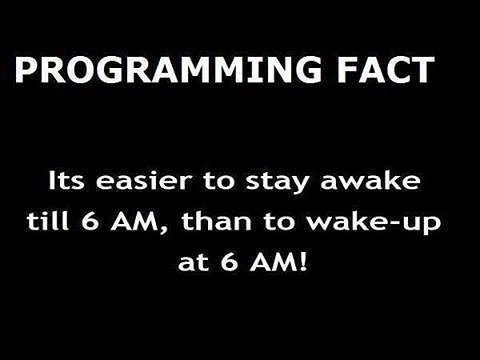
This meme jokes that for programmers, “it's easier to stay awake until 6 in the morning than it is to wake up at 6 in the morning.” It’s a playful nod to the LateNightCoding lifestyle many developers find themselves in. Let’s unpack that: programmers often self-identify as night owls, meaning they feel more energetic and focused late at night (just like an owl is awake at night). The opposite of a night owl is an early bird (a morning person). The meme is saying a lot of coders would rather behave like night owls – coding straight through until dawn – than try to be early birds who go to sleep and pop out of bed at sunrise. If you’ve ever stayed up super late to finish a project (or even to play video games 🙃), you know the feeling: continuing to stay awake can weirdly feel easier than forcing yourself to wake up from deep sleep.

In the programming world, this happens a lot. New developers and students might start a homework or a coding project after dinner, get in the zone, and suddenly notice it’s 3 AM. Being “in the zone” is another way to describe a flow state – that magical focus where you’re so absorbed in coding that you lose track of time. When a programmer is in a flow state, stopping at midnight to get sleep can be really tough; their brain is on a roll solving problems! It feels more natural to just keep going a bit longer... and then a bit longer... until whoops, the clock says 6:00 AM 😅. The meme calls this a “Programming Fact” in a tongue-in-cheek way, as if late-night coding is a scientific law of nature for developers.

There are also practical reasons behind this joke. Late at night, you typically have fewer distractions. Your phone is likely quiet, friends and co-workers are offline, and no one is scheduling meetings at 4:30 AM. For a junior developer, this quiet time can be golden: you can concentrate on fixing that tricky bug or learning a new framework without someone poking you every five minutes. In contrast, waking up at 6 AM might not give you the same uninterrupted time – you might be groggy, or have morning chores, or immediate meetings once the workday starts. So from a productivity standpoint, many developers feel those late hours are their time to really get work done. That’s why we see tags like CodingLife and RelatableHumor on this meme: it reflects a common experience in developer culture.

However, it’s important to know this is framed as humor. In reality, sleep deprivation (not sleeping enough) can make anyone slow and tired. If a programmer keeps staying up until dawn, they’ll be running on fumes the next day. This can affect their mental health, not to mention make it hard to focus or remember things (ironically defeating the purpose of working all night). Many of us have learned the hard way that one all-nighter might be okay, but stringing them together is rough. The meme resonates especially with anyone who has ever said “I’ll just code a little longer” and then seen the sunrise. It’s poking fun at that very habit. Even if you’re new to coding, you might find this funny because it’s relatable: it’s like saying we coders would rather just not sleep at all than have to drag ourselves out of bed early! And honestly, a lot of people, not just programmers, have felt this way at least once. The meme just captures it in a simple, exaggerated statement for comedic effect.

So, why is it easier to stay up late than wake up early, according to developers? In simple terms: when you stay up, you don’t have to break your momentum. Your brain is already awake and active. But when you go to sleep, especially late, and then try to wake up just a few hours later, it’s a shock to your system. Waking up early requires willpower and maybe an aggressive alarm clock (and lots of coffee), whereas continuing to code at 4 or 5 AM just requires… not going to bed. It’s a bit of lazy logic, and that’s why it’s funny. We all know sleeping is healthier, but the meme winks at us and says “hey, haven’t you done this too?” If you have, you’re definitely not alone – just check any programmer forum around 7 AM and you’ll find jokey posts from people who pulled an all-nighter. Developer humor often revolves around these shared experiences, and this meme is a prime example of a relatable coding-life joke that also hints at the not-so-great habit of wrecking your sleep schedule.

Level 3: Infinite Awake Loop

The meme’s bold claim – “Programming Fact: It’s easier to stay awake till 6 AM than to wake up at 6 AM” – hits home for seasoned developers. Why? Because it satirizes a well-known nocturnal coding pattern. Imagine a coder deep in a flow state at 2 AM: the world is silent, server logs are the only conversation, and Slack notifications have finally gone to sleep. In this hush, coding feels effortless and time warps strangely – one moment it’s midnight, the next it’s sunrise. For an experienced dev, this scenario isn’t hypothetical; it’s practically a rite of passage. They chuckle (and maybe wince) at the meme because it’s true: once you’re “in the zone,” stopping to sleep and then rebooting your brain at dawn feels way harder than powering through the night. It’s like treating your brain as a server – never turn it off if you don’t have to – since a cold boot at 6 AM is painfully slow.

From a biological angle, there’s a grain of truth here. We have a built-in clock called the circadian rhythm, and if you’re already awake at 4 or 5 AM, your body’s stress hormones (and probably caffeine ☕) are propping you up. Hitting 6 AM without sleep is essentially circadian rhythm disruption – you’ve “hacked” your internal clock by brute force. Waking up early, on the other hand, means you’d have to interrupt a deep sleep cycle. Any senior dev who’s been jolted awake at 6 AM after a late night deploy can confirm: crawling out of bed then feels like an impossible mission, akin to a system trying to come online after a power failure. Staying awake is the path of least resistance – no context-switching from sleep to wake, just an infinite loop of consciousness continuing from yesterday’s work.

There’s also the culture and practicality of it. Late-night coding sessions are appealing because there are zero interruptions – no meetings, no managers asking for status updates, no new bug tickets at 3 AM. It’s just you and the code. Many programmers relish these quiet hours; it’s when those elusive bugs finally surface or that algorithm you’ve been pondering suddenly clicks. The meme elevates this quirk to a “PROGRAMMING FACT” for comedic effect, implying “every dev knows this to be true.” At 6 AM, a coder might even post a triumphant (or delirious) Git commit like “Fix issue – finally squashed at 5:47 AM”. Senior engineers reading that commit know exactly what happened: a marathon debugging session fueled by cold pizza and energy drinks. They’ve been there, done that, maybe even left a comment like // TODO: fix sleep schedule.

Of course, the experienced perspective also recognizes the dark side of this habit. There’s an unspoken trade-off: those extra hours of productivity in the dead of night often come at the cost of next-day brain fog. It’s the programmer’s version of a memory leak – things work great until resources (your mental energy) are exhausted. In the long run, continually pulling all-nighters accumulates sleep debt, just like accruing technical debt in a codebase. A quick hack (staying up) makes rapid progress now, but you’ll pay interest on it later in the form of bugs you wrote at 5 AM or sheer exhaustion that hits mid-standup. Every veteran developer can recount a war story of the “brilliant” code they wrote bleary-eyed at dawn that turned out to be a nightmare to maintain. In other words:

if (wakingUpEarly.isPainful()) {
    pullAllNighter(); // easier path: skip sleep entirely 
} else {
    getGoodSleep();   // harder path: be well-rested (rarely chosen)
}

Humor aside, this meme also touches on work-life balance and mental health in tech. The fact that so many relate to “staying up till 6 AM” suggests that burnout and irregular hours are common. Seasoned devs might laugh, but they know it’s a cautionary laugh. They’ve learned (often the hard way) that while the LateNightCoding grind can sometimes yield creative breakthroughs, it’s not sustainable to flip the day-night cycle for weeks on end. Still, the cultural image of the night-owl coder persists – from the early days of computing (when engineers literally worked overnight on mainframes) to today’s hackathons that run till morning. The meme distills this decades-old archetype into one punchy “fact.” It’s funny because it feels universally acknowledged in programmer culture: if you see a developer awake at 6 AM, it’s almost guaranteed they haven’t been to bed yet. Even as hardened veterans advise junior coders to get proper rest, they smirk at this meme because, well, some facts in programming are tongue-in-cheek truths born from shared experience.

Description

This is a minimalist, text-based meme presented on a solid black background. The text is white and uses a simple, bold, sans-serif font. At the top, it declares in all caps: 'PROGRAMMING FACT'. Below this heading, the main text states the core joke: 'Its easier to stay awake till 6 AM, than to wake-up at 6 AM!'. This meme resonates deeply with the developer community by highlighting a common aspect of the coding lifestyle: the tendency for late-night work sessions. The 'flow state' required for complex problem-solving is often easier to achieve late at night with fewer distractions. This makes pulling an all-nighter to fix a bug or finish a feature feel more productive than interrupting sleep for an early start. It's a humorous commentary on developer work habits, productivity cycles, and the often-unspoken culture of nocturnal coding
Comments

12
Anonymous ★ Top Pick Staying up until 6 AM is just running on a single, long-lived thread. Waking up at 6 AM is a cold boot with a high probability of a kernel panic
  1. Anonymous ★ Top Pick

    Staying up until 6 AM is just running on a single, long-lived thread. Waking up at 6 AM is a cold boot with a high probability of a kernel panic

  2. Anonymous

    Sleep is just eventual consistency for humans - if I suspend at 2 AM I might reconcile by noon, but the 6 AM stand-up requires strong consistency, so I just keep the transaction open until sunrise

  3. Anonymous

    The real reason we prefer microservices architecture is because our sleep schedule is already distributed across multiple time zones anyway

  4. Anonymous

    This is the architectural decision that every senior engineer has made at 2 AM: 'I'm already in production mode, might as well stay deployed until morning standup.' It's not a bug in your sleep schedule - it's a feature of deep work. The real question is whether you're running on caffeine-driven horizontal scaling or if you've achieved true stateless consciousness. Either way, your circadian rhythm has definitely entered technical debt territory, and the interest compounds faster than your Docker layers

  5. Anonymous

    Staying up till 6 AM is easy - you’re already a hot process; waking at 6 AM is a cold start with cache misses and a Raft election that reliably elects Snooze as leader

  6. Anonymous

    Programmer's CAP theorem: you get sleep Consistency or dawn Availability, never both

  7. Anonymous

    Staying up until 6 AM is just optimizing for reduced contention; waking at 6 AM is a cold-start penalty my human runtime can’t overcome

  8. Deleted Account 5y

    Nope

  9. Deleted Account 5y

    https://youtu.be/jL691iRxFyI

  10. Deleted Account 5y

    Good one

  11. @slnt_opp 5y

    Always do that when have an early train / flight

  12. @secp256 5y

    Exactly 🤣

Use J and K for navigation