Spared No Expense: Yet They Staffed the Dino Park with Just One Dev
Why is this CorporateCulture meme funny?
Level 1: One Zookeeper, Many Dinosaurs
Imagine you have a giant zoo filled with very dangerous animals – let’s say lions, tigers, and even dinosaurs – and the owner says, “I paid for the best of everything! No expense spared!” He built super strong cages and cool attractions. But then you find out he only hired one zookeeper to take care of all those creatures. 😬 That means one person has to feed them, watch them, fix the cages, do everything, all by himself. If that one zookeeper gets sick, goes on a break, or just can’t handle something alone, there’s nobody else to help. The animals could escape and things would get crazy really fast! It’s funny (in a silly way) because it’s so obviously a bad idea – anyone can see that one single person can’t safely control a whole park of wild dinosaurs, no matter how much money you spent on the park itself. The joke is basically showing how silly it is to spend a ton of money on a big fancy project but then be stingy about the most important thing: the people who keep it running safely.
Level 2: One-Man IT Department
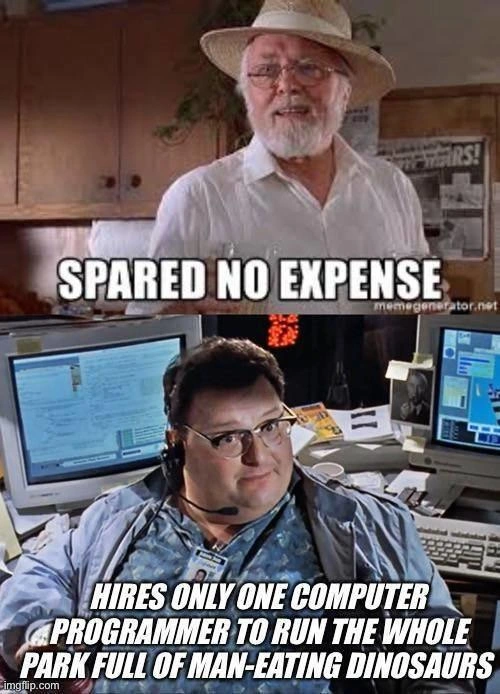
In the top half of the meme, an older gentleman in a white hat (John Hammond from Jurassic Park) proudly says, “SPARED NO EXPENSE.” This is a famous quote from the movie – Hammond uses it to assure everyone that he paid for the best of everything in his dinosaur theme park. The meme then contrasts that with the bottom half: a single systems administrator (the park’s lone IT guy, Dennis Nedry in the film) slumped in front of a bank of computer monitors. The caption on that panel says, “HIRES ONLY ONE COMPUTER PROGRAMMER TO RUN THE WHOLE PARK FULL OF MAN-EATING DINOSAURS.” The juxtaposition is the joke: the boss claims unlimited budget, yet apparently they only budgeted for one IT staff member to manage an entire high-risk park. 🤦♂️
Let’s break down why this is funny (and a bit scary) in tech terms. Running a massive system – whether it’s a dinosaur park’s security grid or a large web application – usually requires a team of people to maintain it. Here, there’s just one IT person in charge of everything: networks, power controls, dinosaur tracking, you name it. That creates what we call a single point of failure. A single point of failure means one piece of the system that, if it fails, can bring everything down. Often we use this term for hardware or software (like one database that, if it crashes, takes out the whole website). But it can also apply to people: if only one engineer knows how the system works, then that person is a single point of failure for the whole operation. In this meme’s story, the single point of failure is the lone programmer. If he messes up or isn’t around when something breaks, the entire park’s systems could fail. And in a park full of dangerous dinos, system failure isn’t just an inconvenience – it’s a life-threatening disaster!
This ties into the concept of bus factor. The “bus factor” (or bus count) is a grimly humorous way to measure how many people on a team can be “hit by a bus” before the project can’t continue. It’s not that we expect anyone to literally get hit by a bus; it’s a metaphor for any event that makes someone suddenly unavailable (they quit, get sick, go on vacation – or in Jurassic Park, get eaten by a Dilophosaurus 🦕). If your project has a bus factor of 1, it means only one person knows enough to keep it running. If that person is gone, the project is stalled or doomed. Here, the park’s IT bus factor is 1 – everything relies on one programmer. The meme humorously exaggerates this risk using the worst-case scenario: a park full of man-eating dinosaurs with only one computer guy. If he’s out of the picture, well, the fences literally go down.
In real-world tech, we consider that a serious critical infrastructure risk. Critical infrastructure (like power grids, hospital systems, or say, the electrified fences keeping T-Rex in) should always have backups and redundancies – both in hardware and in the people operating it. Good practice is to have multiple engineers who understand the system, so no single vacation or accident can take down your operations. You’d also have backup systems, failover procedures, and documented emergency plans. In Jurassic Park, obviously, their planning was… lacking. They had cutting-edge automated systems but apparently zero backup personnel or cross-training. BusFactor = 1 is not a bragging right, it’s a disaster waiting to happen.
Let’s also look at the OnCall_ProductionIssues angle. “On-call” means an engineer is available (often outside normal hours) to respond if something in production breaks. Typically, teams rotate on-call duty so no one gets burned out. But if you have only one programmer for the whole park, that poor person is effectively on-call all the time. Every page, every alarm, every “the raptors are escaping!” 3 A.M. phone call will go to him. That’s what we call an on-call nightmare. It’s both stressful for the individual and risky for the company because an exhausted engineer can miss alerts or make mistakes. In the meme’s bottom image, you see cluttered desks and many monitors — it’s a visual cue that this guy is juggling a lot, likely monitoring all systems solo. In a modern IT setting, we’d have a DevOps or SRE team (DevOps stands for Development & Operations, and SRE means Site Reliability Engineering) to handle this kind of work. They’d share responsibilities, have runbooks, and ensure there’s 24/7 coverage by multiple people. Here, management thought one person was enough, which breaks all the rules of sound engineering oversight.
The meme is tagged under CorporateCulture and ManagementVsEngineering for good reason. It’s poking fun at a certain management mentality. The boss character (Hammond) is boasting about spending freely — “spared no expense!” — to build something grand. This is like when a CEO boasts about investing in innovation or a flashy new product. But then the next moment, they might pinch pennies on less visible things like maintenance, support, or staffing. Many developers have seen projects where the company buys the best hardware, or spends huge on marketing, but then declares hiring another developer or improving tooling is “too expensive.” The result is a shiny outward image with fragile behind-the-scenes foundations. In the Jurassic Park example, they literally built a world-class dinosaur park (fancy DNA labs, imported plants, luxury tour vehicles) but didn’t invest in a robust IT team. It’s satire, but it resonates because it contains truth about real workplaces. BudgetConstraints often force teams to do more with less, but skimping on key personnel for critical systems is a famously bad idea (often realized only when something goes terribly wrong).
So, in simpler terms: the meme is funny to developers because it highlights an obvious oversight with a lot of irony. Jurassic Park reference – check. Single_point_of_failure – check. We all kind of facepalm and laugh because even though it’s exaggerated (dinosaurs and all), we’ve felt that situation: when the higher-ups brag about “We spared no expense!” and yet you, the lone tech person, know they wouldn’t spare a dime for an extra pair of hands to help you out. It’s the ultimate example of having “all your eggs in one basket.” And if that basket drops… well, you get a dinosaur rampage instead of a functioning system. The meme uses a dramatic movie scenario to drive home the importance of proper staffing and backup in any tech endeavor.
Level 3: Single Point of Failure
This meme pulls a scene from Jurassic Park to mock a classic tech blunder: bragging “Spared no expense” on a cutting-edge project, yet skimping on critical DevOps and support staff. In the top panel, park founder John Hammond beams about how he spared no expense building a dinosaur theme park. In the bottom panel, we see the reality: a lone, overworked sysadmin (the film’s hapless IT guy, Dennis Nedry) surrounded by flickering CRT monitors, soda cans, and stress. The caption calls out the absurdity: they poured billions into cloning T-Rexes and building electric fences, but hired only one programmer to run the entire park’s computer system.
From a senior engineer’s perspective, this is both hilarious and horrifying. It highlights a huge single point of failure – in this case, a human one. Having a single engineer in charge of all critical infrastructure is asking for trouble. In reliability terms, the park has a bus factor of 1: if that one developer is unavailable (sick, quits, or gets eaten by a dinosaur), the whole operation is doomed. It’s akin to running a state-of-the-art data center on a single aging server with no backups. What could possibly go wrong? Well, everything:
- Bus factor = 1: Only one person knows how the system works. If he disappears (or
gets hit by a busgets eaten by a raptor), there’s no one else who can log in or restore things. In Jurassic Park, Nedry was the sole programmer; once he went offline (for nefarious reasons, no less), the park’s security systems collapsed. - Lack of redundancy: Good infrastructure design avoids single points of failure. You’d never build a mission-critical system with only one database server and no replica, right? Similarly, you wouldn’t rely on a single employee for a whole critical infrastructure. Here there’s no backup engineer, no second pair of eyes on the code, and no one to catch mistakes. One person holds all the keys (literally — Nedry had all the system passwords!).
- On-call 24/7: With just one IT guy, guess who’s on-call for every issue, day or night? That poor soul is permanently tethered to the system. It’s an OnCall Nightmare: getting paged at 3 AM whenever a dino-tracking sensor blips. In the film, Nedry sneaks away and nobody else is there to handle the ProductionIssues. In real life, this is how you get burnout and outages.
- Management irony: The big joke is on management and corporate culture. Hammond boasts about unlimited budget (“we spared no expense!”) on flashy park attractions, yet he penny-pinched on the unglamorous IT staff. This satire rings true in tech: executives eagerly fund new features, marketing stunts, or shiny hardware, but balk at investing in robust engineering teams and Infrastructure. They’ll buy a million-dollar gadget but hesitate to hire an extra Site Reliability Engineer. The meme exaggerates it with man-eating dinosaurs to make the point crystal clear. 🦖
To seasoned developers, this scenario is a facepalm because we’ve seen it (albeit usually with fewer actual dinosaurs). A startup might boast about their bleeding-edge product but have a single frazzled DevOps person deploying and fixing everything at 2 AM. The result? Fragile systems one incident away from disaster. The CorporateCulture behind these decisions values short-term savings over long-term safety. Everyone nods knowingly at this meme because it captures that “are you kidding me?” feeling when leadership’s priorities are disastrously out of whack. It’s darkly funny: a theme park full of lethal creatures was built with no IT contingency plan. In other words, all eggs in one basket – and that basket is being guarded by one guy eating Doritos at his desk.
[12:00:00] ALERT: Perimeter fence power just went offline.
[12:00:05] WARNING: No backup sysadmin on duty – initiating panic.
[12:00:10] ERROR: Cannot reboot system, single operator not responding.
[12:00:30] CRITICAL: T-Rex containment failure. You're about to have a very bad day.
The humor comes with a side of horror because this hits close to home. The IndustrySatire here says: you claim to spare no expense, yet your entire operation’s safety hinges on one overworked techie. It’s a not-so-subtle reminder that ManagementVsEngineering disconnects can lead to catastrophic ProductionIssues. In summary, the meme is a perfect storm of tech references — a Jurassic Park reference mixed with the concept of a single point of failure — creating a cautionary tale every engineer can chuckle at (and nervously relate to). As the cynical veteran might quip, “Sure, the servers are top-of-the-line and the dinos are genetically engineered marvels, but hey, who needs more than one IT guy? It’s not like lives (or million-dollar attractions) are on the line…”
Description
Two-panel meme using scenes from the 1993 Jurassic Park film. Top panel shows an older man in a white hat and shirt (face blurred) standing in a warmly lit office; bold white impact text across the bottom reads “SPARED NO EXPENSE.” Bottom panel shows a lone systems administrator (face blurred) slouched in front of multiple CRT monitors filled with system dashboards and terminal windows, head-set on, junk food and notes scattered around the cluttered desk; accompanying white impact text reads “HIRES ONLY ONE COMPUTER PROGRAMMER TO RUN THE WHOLE PARK FULL OF MAN-EATING DINOSAURS.” The juxtaposition mocks management’s claim of unlimited budget while penny-pinching on critical engineering staffing, highlighting an extreme “bus-factor-of-one” scenario and the operational risk of under-resourced infrastructure. Developers will recognise the satire of corporate leaders valuing flashy capital expenses (genetic engineering, theme-park attractions) over reliable DevOps, redundancy, and on-call coverage required to keep complex, safety-critical systems running
Comments
6Comment deleted
Nothing says “enterprise-grade” like a $100M dino park designed for five-nines uptime - backed by one root account, zero failover, and a sysadmin whose PTO is your entire DR strategy
"Spared no expense" on the park but couldn't spring for a second engineer to review Nedry's code before it controlled the electric fences - the most expensive technical debt collection in history
Every architect's nightmare: unlimited budget for dinosaurs, but the entire SCADA system running on a single admin with no failover, no monitoring, and apparently no code review. Hammond basically deployed to production with a bus factor of 1 on a system where downtime literally means people get eaten. It's the ultimate argument for why 'we'll just hire one really good engineer' is never the answer for critical infrastructure - though most of us just face angry customers rather than velociraptors when our single point of failure goes rogue
Hammond's park: the ultimate monolith with zero redundancy, where the chaos monkey is literally a T-Rex tearing through fences
“Spared no expense”: SLA 99.99, SRE headcount 1 - congrats, the bus factor now equals the T‑Rex factor
Enterprise HA strategy: N+1 generators, N+0 engineers - the control plane is one mutable human with no runbooks; SPOF‑as‑a‑Service