Skip to content
DevMeme
3759 of 7435
When your first pull request spawns a small novel of review feedback
CodeReviews Post #4099, on Jan 25, 2022 in TG

When your first pull request spawns a small novel of review feedback

Why is this CodeReviews meme funny?

Level 1: So Many Comments

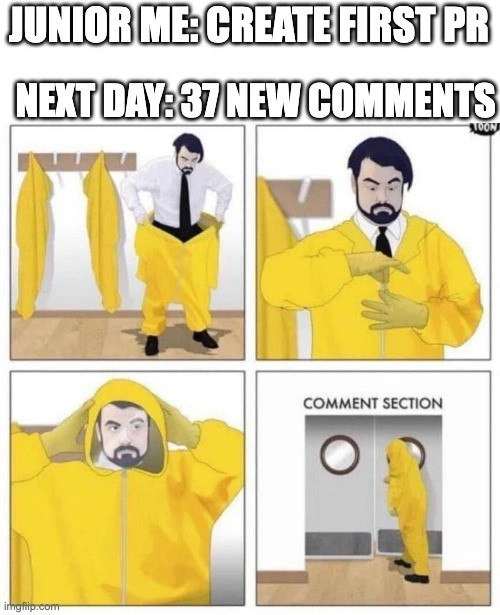
Imagine you draw a big colorful picture and proudly hang it up for everyone to see. The next day, you find lots of sticky notes all over it, each with a little message on how to change your drawing – 37 different suggestions! That’s a bit what’s happening in this joke. The new coder wrote some code (like doing a drawing) and showed it to the team. Then the team wrote a whole bunch of notes back. It’s like the first time you turn in homework and the teacher gives it back with a bunch of red marks and comments. You’d probably feel nervous to read them all, right? You might even jokingly pretend you need a protective suit to face it, like it’s something dangerous. The picture in the meme shows the person putting on a big yellow protective suit before opening a door labeled “COMMENT SECTION.” That’s a funny way of saying, “Uh-oh, there are so many remarks waiting for me, I better brace myself!” But just like your teacher’s notes help you make your work better, those 37 comments are there to help the new coder improve their code. It’s a lot of advice at once, which can feel scary, but it’s all meant to help in the end. The joke is that getting so much help and criticism all at one time is overwhelming – so much so that it’s like stepping into a room full of something really strong, and you need to gear up for it!

Level 2: First PR Fears

Let’s break down what’s happening in simpler terms. A Pull Request (PR) is when a developer proposes changes to a codebase, asking teammates to review and merge their code. Think of it like turning in a project for peer review. A code review is the process where other developers read through that code and leave comments: these can be suggestions, questions, or requests for changes. In a healthy code review culture, this feedback improves the code’s quality and helps everyone follow the team’s coding standards. However, for a junior developer making their first PR, it can be nerve-wracking. They might worry about first PR anxietyWill my code be good enough? Did I follow the style guide? So imagine their reaction upon logging in the next day and seeing “37 new comments” on their PR! 😱 That number feels huge, almost like getting a paper back from a teacher covered in red ink. No wonder the cartoon shows him preparing like he’s about to handle toxic waste!

In the meme’s images, the man putting on the bright-yellow hazmat suit is a funny metaphor. A hazmat suit is protective gear for dangerous environments (like handling chemicals or, humorously, wading into a toxic comment section on the internet). By suiting up, the junior dev is jokingly treating the PR comment section as dangerous. The door labeled “COMMENT SECTION” in the last panel is where he’s headed once fully suited. This is a play on how the “comments section” of websites is notoriously full of harsh or unfiltered opinions. In the coding world, the comment section on a pull request is usually full of review feedback. It’s normally constructive criticism – meant to help, not to insult – but to a new developer, even well-meaning critiques can feel intimidating.

Why so many comments? Often when you’re new, you might not know all the team’s coding standards or best practices yet. Senior team members or reviewers will point out things like:

  • Places where the code could break or bugs might occur (logic errors or missing edge cases).
  • Suggestions to make the code cleaner or more efficient (e.g., “Hey, you can use this built-in function instead of writing your own”).
  • Style guide issues – formatting or naming conventions (like “Use CamelCase for class names” or “Add a space after each comma”). These are often called nitpicks, meaning minor issues that don’t necessarily break the code but keep consistency.
  • Missing pieces like tests or documentation (“Can you add a unit test for this function?”).

For a newcomer, seeing a long list covering all these can be overwhelming. Even if each comment by itself is polite and helpful, the sheer volume feels like “Oh wow, I did 37 things wrong!”. Of course, it’s usually not that the code is terrible – it’s that reviewers try to be thorough. In fact, getting detailed feedback is a sign the team cares about the code and your growth. But emotionally, a junior dev might still panic or feel embarrassed. This is the essence of new_dev_overwhelm: when you’re new, even normal levels of critique can seem like a flood.

The meme’s text “JUNIOR ME: CREATE FIRST PR – NEXT DAY: 37 NEW COMMENTS” uses a common format where the first line is the setup (the junior excitedly making a PR) and the second line is the punchline (the huge amount of feedback waiting next day). Developer humor often uses hyperbole (exaggeration) like this. The junior probably expected a couple of comments or maybe a quick approval, but 37 comments is comically large – almost like he posted on a forum and got spammed with replies! It highlights the gap between expectations and reality in developer experience. We expect a pat on the back; we get a page of critique. The image of painstakingly putting on protective gear is an exaggeration of the mental preparation a new dev might do: “Okay, let’s read these comments… take a deep breath… it’s going to be fine.” It’s funny because we recognize that feeling, and the hazmat suit is a silly over-the-top way to represent being psychologically on guard.

In simpler terms, the meme is saying: when I made my first code contribution, the feedback I got was so extensive it felt like I needed armor to handle it. It’s a lighthearted take on junior vs senior interactions. Seniors aren’t literally attacking the junior, they are helping improve the code. But being new, it’s easy to fear the comment section. Every developer starts there at some point, learning that a big part of programming is iteration and review. Over time, newcomers realize that those comments are gold – they teach you the team’s standards, catch mistakes, and make your code better. But at the very start, it definitely can feel like stepping into a blast zone, just as the meme humorously shows.

Level 3: Code Review Fallout

The humor here targets a code review culture truth that seasoned developers know all too well: a first Pull Request (PR) often triggers an avalanche of feedback. In the meme’s four panels, a junior dev meticulously dons a hazmat suit before opening the doors labeled "COMMENT SECTION." This hazmat imagery is a tongue-in-cheek nod to how toxic an internet comment section can be – except here it’s the PR’s review comments giving off the hazardous vibes. The meme text sets the scene: “Junior me: create first PR. Next day: 37 new comments.” It's a comedic exaggeration (37 comments feels like a small novel of critique) that hits on a real Developer Experience (DX) pain point. Many of us have experienced that moment of dread seeing a high comment count on our code review, bracing ourselves as if stepping into a contaminated zone.

Why is this so funny and painfully relatable? Because it captures the junior vs senior dynamic and the code review pain points in one striking visual. A newbie pushes their first PR, brimming with pride or relief, only to wake up to a long list of review comments: requests for changes, questions, and nitpicks. Suddenly, that simple feature implementation has turned into a multi-page discussion. The hazmat suit is hilariously appropriate: seasoned developers joke that reading review feedback can feel like handling hazardous material – you prepare mentally as if you might get burned or infected by self-doubt. The “COMMENT SECTION” door could double as the door to a reactor core meltdown: prepare for the worst! In reality, these comments aren’t radioactive, but to a junior dev they might as well be; each remark can hit like a blast of imposter syndrome.

This meme plays on developer self-deprecation too. The junior dev (the meme’s narrator) is essentially saying, “I wrote my first code and it was so not up to standard that it generated more text in fixes than I wrote in code!” The 37 new comments number is funny because it’s specific and absurdly high for a first PR – yet not unthinkable. (Many veterans recall PRs with dozens of comments on style, structure, even a dreaded line-by-line roast by the team.) It’s a shared industry joke that pull requests often come back with a barrage of requested changes, especially in well-established teams with strict standards. The meme exaggerates it to highlight the feeling of being flooded: even if some comments are minor nitpicks (like a newline here, a variable rename there), seeing "37" at once feels like a deluge.

From a senior engineer’s perspective, this scenario combines several classic patterns: strict code reviews, comprehensive style guide enforcement, and the “trial by fire” (or by comments) that new developers face. Teams encourage thorough reviews to maintain quality and share knowledge – but the flip side is the new dev overwhelm shown here. It’s funny because it’s true: the first code review often is a baptism by fire. The hazmat suit gag implies an almost adversarial expectation – as if the junior expects the comments to be caustic. This reflects a real tension: even when feedback is well-intentioned and politely phrased, receiving so much of it at once can feel scary or deflating. The image resonates with anyone who’s felt the anxiety of a first PR: we laugh at the absurdity (no, code reviews aren’t actually lethal) while remembering that flutter of nerves seeing a wall of feedback.

The combination of elements here is brilliant. The hazmat suit preparation (gloves, hood, all serious) satirically elevates the importance of psychological safety for reading comments. It’s a visual punchline on how developer humor often masks real vulnerability. By equating code review comments to a toxic spill, the meme calls out a core truth in developer experience: learning through critique is valuable but can be emotionally intense. Every senior dev can recall their own “37-comment” story, making this a unifying joke. And underlying the laughter is a subtle critique of how we deliver feedback – maybe 37 separate comments on a newbie’s first contribution is a bit much, akin to information overload. The meme doesn’t moralize though; it simply commiserates in a humorous way: “Yep, been there. Suit up, Junior, it’s code review time.”

Description

The meme is a four - panel cartoon showing a man methodically donning a bright-yellow hazmat suit, complete with gloves and hood, before approaching a set of double doors marked “COMMENT SECTION.” Large white meme text across the top reads “JUNIOR ME: CREATE FIRST PR,” followed by “NEXT DAY: 37 NEW COMMENTS.” The sequence humorously equates preparing to enter a toxic environment with a junior developer bracing for an avalanche of code-review remarks on their very first pull request. The joke plays on real-world developer culture where extensive review comments, though valuable, can feel overwhelming - especially to newcomers navigating team standards, style guides, and nitpicks

Comments

10
Anonymous ★ Top Pick After 20 years I don’t suit up for the PR with 37 comments - I break out the hazmat when a 6-line hotfix merges with zero questions; that’s how technical debt goes airborne
  1. Anonymous ★ Top Pick

    After 20 years I don’t suit up for the PR with 37 comments - I break out the hazmat when a 6-line hotfix merges with zero questions; that’s how technical debt goes airborne

  2. Anonymous

    Twenty years later, I still get 37 comments on my PRs, but now 35 of them are me arguing with the linter about whether my perfectly valid code needs more semicolons

  3. Anonymous

    37 comments and somehow 35 are about variable naming, 2 are about whitespace, and zero are about the race condition

  4. Anonymous

    Ah yes, the classic junior developer rite of passage: submitting your first PR with confidence, only to return the next day to find 37 comments ranging from 'missing semicolon' to 'this entire architectural approach violates SOLID principles and should be rewritten using the Strategy pattern.' By comment 15, you're questioning your career choice. By comment 30, you're Googling 'how to delete GitHub account.' The hazmat suit is actually underselling it - most juniors need full emotional support gear, a rubber duck therapist, and a printed copy of 'Refactoring' by Martin Fowler just to survive their first code review gauntlet

  5. Anonymous

    Junior PRs: where one function spawns 37 comments, proving bikeshedding scales faster than your code

  6. Anonymous

    First PR, 37 comments: 15 'nit:'s, 10 'non‑blocking' that block, and 12 asking for an ADR - no wonder the comment section requires a hazmat suit

  7. Anonymous

    Your first PR teaches the real lesson: ‘nit:’ is our consensus protocol - 37 comments later you realize pre-commit hooks scale better than human linting

  8. @feskow 4y

    my flameshot commit is still up..

    1. @RiedleroD 4y

      mine is about to be merged (again) (I think)

      1. @affirvega 4y

        oh, that's nice!

Use J and K for navigation