Inverting Trees for Google
Why is this Interviews meme funny?
Level 1: Wrong Upside Down
This is funny because someone was asked to "invert a tree," and instead of doing a complicated computer task, they just flipped a picture of an actual tree. It is like being told to turn a cake recipe backward and simply rotating the cookbook upside down. You followed the words, but not the real meaning.
Level 2: Interview Gravity
A binary tree is a data structure where each node can have a left child and a right child. To invert it, a program swaps left and right at every level:
function invert(node) {
if (!node) return null;
const left = invert(node.left);
node.left = invert(node.right);
node.right = left;
return node;
}
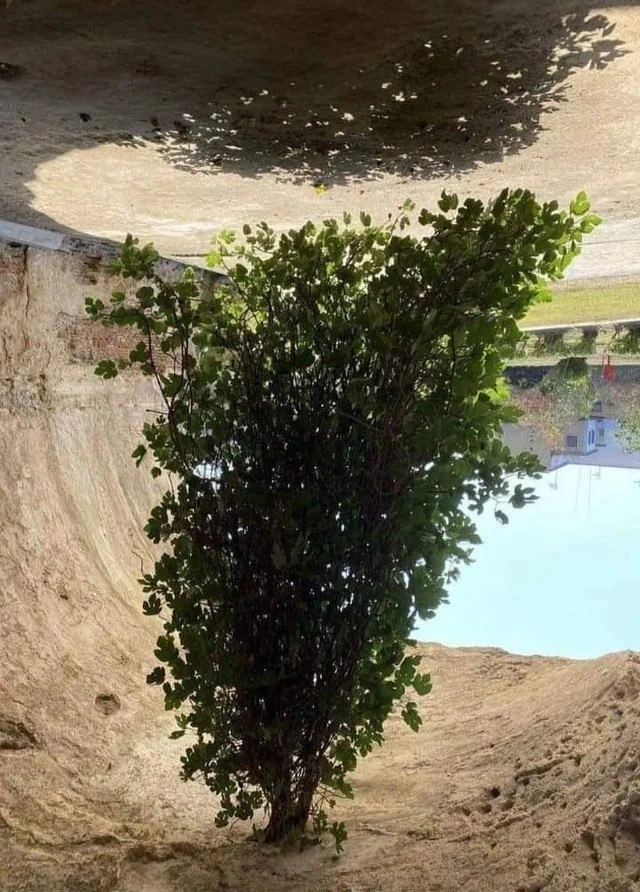
The visible plant makes the word "tree" literal, while the upside-down surroundings show that the whole image was flipped rather than a data structure being changed. That is why the TechnicalInterviews, CodingChallenge, and LeetCodeProblems tags fit: the humor depends on knowing that "invert a tree" is a common interview-style algorithm prompt.
For a junior developer, this meme is basically the moment when everyday language betrays you. A recruiter says "tree," but they do not mean bark and leaves. An interviewer says "invert," but they do not mean turn your laptop around. They mean "please demonstrate recursive reasoning while I silently evaluate whether your variable names reveal moral weakness."
Level 3: Rotate Versus Recurse
The image shows the same tree scene turned upside down: the plant now looks like a normal upright shrub, but the stone arch, ground, shadow, buildings, and sky are inverted around it. The caption supplies the punchline:
I inverted the tree. Can I get a job at Google?
That is a neat little collision between image manipulation and algorithm interviews. In programming, "invert a binary tree" usually means recursively swapping every node's left and right child pointers. It is a classic DataStructures exercise because it tests whether the candidate understands recursion, tree traversal, base cases, and pointer-like relationships. In the photo, the "tree" has also been inverted, but by rotating the entire world in one move. It is the cheapest possible implementation: no recursion, no traversal, no edge cases, just transform: rotate(180deg) and a straight face.
The Google reference matters because big-tech interviews have a reputation for compressing a candidate's career, confidence, and rent money into forty-five minutes of whiteboard theater. The joke exaggerates that dynamic: if the requirement says "invert tree," and the submitted artifact visibly contains an inverted tree, surely that should satisfy the spec. Any engineer who has watched ambiguous requirements become production acceptance criteria can feel the tiny contractual loophole here.
There is also a quiet anti-pattern hiding inside the visual gag: solving the wrong abstraction layer. A real binary-tree inversion changes the relationship between each node and its children. Rotating the photograph changes the representation, not the structure. It is like fixing a failing test by editing the screenshot in the README. Technically, something looks better. Architecturally, nothing useful happened.
Description
The image shows the same leafy tree scene rotated so the plant appears upright while the stone arch, ground, shadow, and background landscape are upside down. There is no overlaid text in the image; the sibling post caption says, "I inverted the tree. Can I get a job at Google?" The joke references the famous invert-binary-tree interview problem, turning a literal rotated tree photo into a mock qualification for big-tech algorithm interviews.
Comments
7Comment deleted
Big Tech loves tree inversion, but rotating the JPG is still the most honest O(1) solution.
No. Comment deleted
Cool, thanks! Comment deleted
is it binary or something? not red-black indeed Comment deleted
Да, но вся твоя работа будет заключаться ТОЛЬКО И ИСКЛЮЧИТЕЛЬНО в разворачивании деревьев. Готовы? Comment deleted
> Lexical error on the line 1 🌚 Comment deleted
Оцените количество деревьев в кампусе Гугла, если известно, что на территории кампуса нет ни одного квадратного люка. Comment deleted