Skip to content
DevMeme
2255 of 7435
Imaginary Numbers: A Self-Inflicted Problem
Mathematics Post #2510, on Dec 22, 2020 in TG

Imaginary Numbers: A Self-Inflicted Problem

Why is this Mathematics meme funny?

Level 1: Making Our Own Mess

Imagine you spread toys all over your room to build the coolest imaginary castle ever. You’re having a great time making this big, complex fortress. But later, you look around and there are toys everywhere – you can’t even walk without stepping on a block. You get upset and start crying that your room is a huge mess. 🙃 Well, who made the mess? You did! This meme is like that. It’s saying people often make a big mess for themselves and then complain that things are messy. In the meme’s case, mathematicians made up “imaginary numbers” (a tricky idea) which made math more complicated, and developers create super complicated code or systems that then give them headaches. It’s a funny way to point out: sometimes we cause our own problems, and it’s a bit silly to cry about a mess that we ourselves created. Just like you wouldn’t dump out all your Legos and then act surprised that the floor is covered in Legos, developers shouldn’t over-complicate things and then act surprised that everything became hard. The humor is a gentle nod, saying “hey, we do this to ourselves!” in a way anyone who’s ever made a self-inflicted mess can understand.

Level 2: Imaginary Numbers & Over-Engineering

Let’s break down the joke in simpler terms. First, imaginary numbers: despite the name, these are a legit thing in math. An imaginary number is basically a number that gives a negative result when you square it. Normally, if you square a real number (positive or negative), you get a positive result (for example, 5² = 25 and (-5)² = 25 as well). So something like √-1 doesn’t make sense in the ordinary real numbers. Mathematicians solved this by defining a new number, called i, where i * i = -1. This i is the basic imaginary unit. If you have a combination of a regular real number and an imaginary number, like 3 + 4i, that’s what we call a complex number. The word “complex” here means it has two parts (real and imaginary), not that it’s complicated – though fittingly, it does feel more complicated to students at first! Imaginary numbers were confusing enough that people historically thought mathematicians were inventing unnecessary problems by using them. (Fun fact: they were initially called “imaginary” kind of as an insult, because people doubted they were “real” or useful. Turns out they are extremely useful in advanced math, engineering, and computing.)

Now, the tweet suggests that the existence of imaginary numbers “is proof that humans create their own problems and then cry.” This is a tongue-in-cheek statement. It’s not literally blaming mathematicians for crying, but joking that we often make things hard for ourselves. And that’s where the programming world comes in.

In software development, there’s a concept of over-engineering – basically, building a solution more complex than what was needed. For example, imagine you need a simple tool to add two numbers. If someone spends a month architecting a whole system with plugins, configuration files, and classes just to add two numbers, that’s over-engineering. It’s like using a chainsaw to cut butter: overkill. Developers sometimes do this because it’s fun, or they anticipate future needs that never actually happen. Later, when something breaks or when others find it too hard to work with that system, everyone gets frustrated. The joke is saying, “see, we humans made this complex thing ourselves, and now we’re upset about it.”

Another important term is technical debt. This isn’t directly mentioned in the meme, but it’s closely related to the idea. Technical debt is a metaphor: imagine you take a shortcut in your code (like copy-pasting code in 10 places instead of writing it cleanly once). It’s easy now, but it’s like taking on debt – eventually you “pay” for it with extra work (maybe fixing a bug in those 10 places later). In short, it means choosing an easier or quicker solution now that will likely cause more work down the road. Often, we developers create our own technical debt by, say, rushing a feature without tests or, yes, introducing an overly fancy concept that no one else understands. Later we “cry” because maintaining or changing that code becomes a nightmare. The meme aligns with this: we created the hard problem we’re dealing with.

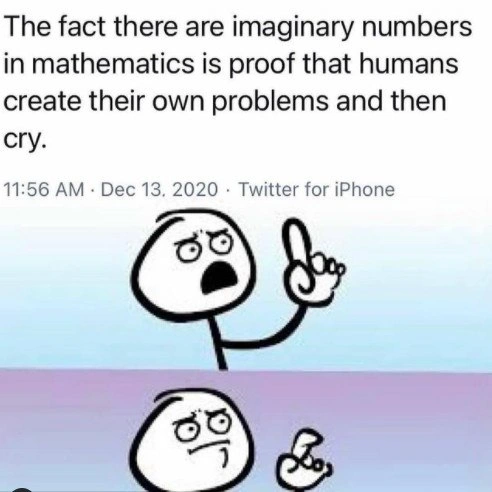
Now, about the rage comic panels under the tweet: those simple cartoon faces are from an old meme style where each face represents a certain emotion or reaction. In the image, the top panel’s stick-figure (with the determined expression and finger pointed up) is like a person declaring something enthusiastically – “Hey, I have a great idea!” or making a bold statement. The bottom panel shows the same character but now with a distressed, tearful look. It’s a comical way to show the reversal: first they were confident, then they regretted something. The tweet + image format is a common meme formula: the tweet delivers the joke in text, and the images act it out or amplify it.

For a junior developer or someone new to these concepts, the meme is basically saying: Math people invented a crazy concept (imaginary numbers) to solve a math problem, which seems like making trouble on purpose; similarly, tech people often invent complicated systems that come back to haunt them. It’s a playful warning. When you’re writing code, you might be tempted to introduce a fancy framework or an extra layer “just in case.” But remember, every new layer or trick you add could be a future headache you’ll have to deal with. The meme uses the math analogy to poke fun at this human tendency. And it resonates because whether it’s math or code, when we get too clever for our own good, we often end up exclaiming, “Why did I do this?!”

In simpler terms: Imaginary numbers = a solution that math people kind of made up, which then made math more complicated for everyone to learn. Developers do the same thing = create extra complexity in projects (often unnecessarily) and then struggle with it. So the tweet in the meme is a humorous, slightly philosophical humor way to say “we are our own worst enemy” in technical fields. It’s meta-humor too, because it’s a joke about the way we humans (specifically devs and mathematicians) joke about our own foibles.

Level 3: Imaginary Solutions, Real Problems

For seasoned developers, this meme hits a little too close to home. It’s poking fun at our industry’s tendency to over-engineer and then complain about the very complexity we introduced. The tweet about imaginary numbers is a stand-in for every time a programmer proudly proclaims, “Look, I solved the problem by adding this new layer/technology!” (that’s the stick figure in the first panel with the raised finger), followed by the same person tearing up when that clever solution complicates everything (the second panel). We’ve all been that stick figure.

In software development, there’s a well-known adage:

"Any problem in computer science can be solved by another level of indirection... except for the problem of too many layers of indirection."
In other words, we love adding new abstractions (our own “imaginary numbers”) to solve immediate issues, and then we inevitably face the fallout of too many abstractions. The meme nails this dichotomy. We invent our own problems via complex solutions and later find ourselves lamenting, “why on Earth did we do this to ourselves?!”

Consider some real-world developer scenarios mirrored by the joke:

  • Microservice Overload: A team breaks a simple application into 50 independent microservices to be “modern” and scalable. Sure, it solves some scaling issues, but now they’re drowning in network latency, API versioning, and distributed debugging nightmares. We created the complexity, and now we’re up at 3 AM crying about it.
  • Abstraction Gone Wild: A developer writes a thick stack of classes (DataHandlerFactoryFactory, anyone?) to avoid duplicating code. It felt architecturally elegant at first (finger proudly raised), but when a bug appears, they have to wade through so many layers that they regret ever inventing this framework-on-top-of-a-framework.
  • Framework FOMO: Chasing the newest, shiniest tools. We introduce, say, a cutting-edge JavaScript library to a stable project just because it’s cool. Fast forward: nothing quite works together, build processes break, and the team is crying while trying to untangle why the app suddenly won’t compile. The fancy tool solved one minor issue but spawned a dozen new ones.

This is essentially technical debt in action – albeit self-inflicted. We take out a “loan” on simplicity: gaining a quick solution or an extra capability now by introducing a new complexity, only to “repay” it with interest later when maintenance becomes harder. The meme’s humor is philosophical too: it suggests a pattern of human behavior in tech. We devise intricate solutions (often unnecessarily elaborate), then act surprised when we’re stuck with intricate problems. It’s like announcing “I have a brilliant idea!” and later, “oh no, that idea has made life miserable.”

Even the format of the meme underscores this. It’s a tweet (a modern soapbox for hot takes) combined with a rage comic style reaction. Rage comics are old-school dev humor – simple line-drawn faces that exaggerate feelings. Here, the top panel’s character is confident, almost smug, echoing a developer confidently implementing a fancy concept. The bottom panel, same character crying, is that developer later on, exhausted and frustrated by the unforeseen consequences. It’s a cycle any programmer with a few years under their belt recognizes. We’ve introduced an overly clever regex that later we can’t decipher, or a “temporary” hack that became a permanent source of pain. The meme distills that universal “oops, I did this to myself” moment.

The reason developers chuckle (or groan) at this is because it’s so relatable. It’s both a hit of TechHumor and a bit of MetaHumor – we’re laughing at the very habit of creating things to laugh (or cry) about later. It gently reminds us: hey, maybe that extra complexity isn’t worth it, and if you introduce it, don’t be surprised when you’re the one dealing with the fallout. In a way, it’s a humorous cautionary tale that our own imaginative solutions can become our real-world problems. After all, as the meme suggests, we humans are absolute pros at creating our own monsters… and then shedding a tear when the monster starts causing trouble.

Level 4: Complex Plane of Pain

At the highest level, this meme bounces off a deep mathematical concept: imaginary numbers. In mathematics, an imaginary number is not a ghostly figure, but a very real (pun intended) extension of our number system. Historically, mathematicians hit a roadblock trying to solve equations like x² + 1 = 0. No real number could satisfy that (since any real x squared is non-negative), so they did something audacious – they imagined a new number. They defined a value i such that i² = -1. This creation expanded numbers into the complex plane, where numbers have a real part and an imaginary part. Suddenly, equations that were unsolvable had solutions in this new domain. This wasn’t just a wild whim: extending to complex numbers made the math world more complete (the Fundamental Theorem of Algebra guarantees every polynomial has a root in the complex numbers).

Of course, calling them “imaginary” was a bit of shade thrown by skeptics (Descartes coined the term as a dismissive jab) – early mathematicians felt these were pretend solutions, a hack to solve a self-imposed problem. And indeed, it was a human-invented concept to patch a gap in the system. But far from being useless trouble, imaginary numbers unlocked powerful results. A famous example is Euler’s identity, which many call the most beautiful equation in math:

$$
e^{i \pi} + 1 = 0
$$

Here one little imaginary unit i ties together e, π, 1, and 0 – fundamental constants – in one elegant relationship. It’s mind-blowing and it shows that this “imaginary” invention wasn’t just mathematicians making their lives harder for giggles; it was a gateway to deeper truths.

So how does this relate back to the meme’s humor? It highlights a grand irony: humans (mathematicians, in this case) willingly add complexity to solve problems (inventing a new number to solve an impossible equation), and in doing so they create whole new fields of study – and, yes, new headaches. It’s a theoretical echo of the programmer’s plight: introduce a new abstraction to handle a tricky case, then wrestle with the increased complexity. The meme wryly suggests that whether in math or engineering, we’re geniuses at creating extra dimensions of complexity and then sobbing over them. It’s a tongue-in-cheek nod to the inventiveness and self-inflicted pain that often go hand-in-hand in both advanced math and software design. Just as imaginary numbers were initially seen as unreal complications born of human curiosity, many engineering challenges are of our own making, resulting from pushing boundaries and having to live with the consequences.

Description

A two-panel meme featuring a screenshot of a tweet that reads, 'The fact there are imaginary numbers in mathematics is proof that humans create their own problems and then cry.' Below the tweet, the first panel shows a simple stick figure with a shocked or revelatory expression, pointing its finger upward as if making a profound point. The second panel below it shows the same stick figure with a smug, self-satisfied expression, having seemingly won the argument. The background is a simple gradient of light blue and purple. The meme humorously connects the abstract concept of imaginary numbers to the human tendency, especially in technical fields, to create complex, artificial problems and then struggle with them. For experienced developers, this resonates with the concept of over-engineering or getting lost in theoretical constructs that may have been avoidable
Comments

8
Anonymous ★ Top Pick Complex numbers are the original form of technical debt: an elegant hack to solve one problem that paved the way for entirely new classes of problems to debug
  1. Anonymous ★ Top Pick

    Complex numbers are the original form of technical debt: an elegant hack to solve one problem that paved the way for entirely new classes of problems to debug

  2. Anonymous

    √-1 is basically math’s first microservice: nobody could deploy it on bare reality, so we wrapped it in an “imaginary” container and spent the next millennium explaining why the whole system is now called “complex.”

  3. Anonymous

    Just like how we invented imaginary numbers to solve x² = -1, we invented microservices to solve problems that monoliths didn't have, then spent the next decade debugging distributed transactions and wondering why our latency graphs look like the Mandelbrot set

  4. Anonymous

    Every senior engineer's relationship with complex numbers: First you're angry they exist, then you realize half your signal processing pipeline depends on FFTs and you can't live without them. It's like discovering your entire codebase runs on a mathematical construct that literally doesn't exist on the real number line - yet somehow powers everything from your WiFi to your quantum error correction algorithms

  5. Anonymous

    Imaginary numbers are what you get when you take the square root of a negative deadline - suddenly the roadmap is complex, estimates switch to polar coordinates, and someone cries in the retro

  6. Anonymous

    Imaginary numbers are to math what microservices are to architecture: invented to make FFTs and org charts work, then you spend quarters adding service meshes and tracing just to stop sobbing over the j‑curve of complexity

  7. Anonymous

    Imaginary numbers: math's original tech debt, invented to solve cubics, now accruing interest in every DSP pipeline

  8. @kolunya1337 5y

    And then there goes the Applications section https://en.wikipedia.org/wiki/Complex_number#Applications

Use J and K for navigation