The Fragile HDMI vs. The Indomitable VGA
Why is this Hardware meme funny?
Level 1: Built Like a Tank
Think of it like two ways of attaching a toy to something. The old cable (VGA) is like using screws or Lego bricks that snap together – once it’s attached, you can shake it or even hang stuff on it, and it stays connected. It’s strong and secure. The new cable (HDMI) is more like just fitting two pieces together loosely, kind of like placing a lid on a jar without twisting it on or stacking blocks without clicking them – if you barely touch it or bump it, it falls apart or comes unplugged. That makes people nervous because it can stop working if you’re not careful. The meme is funny because the old cable is shown holding up something really heavy (which is crazy in real life, but it shows how tough it feels), while the new cable is so sensitive that even looking at it the wrong way might make it stop working. It’s like saying: “They don’t make them as sturdy as they used to!” You can feel the difference – one is fragile and one is strong – and that’s why it makes us laugh. The fragile one is scared of any movement, and the strong one isn’t afraid of anything.
Level 2: Thumbscrew Reliability
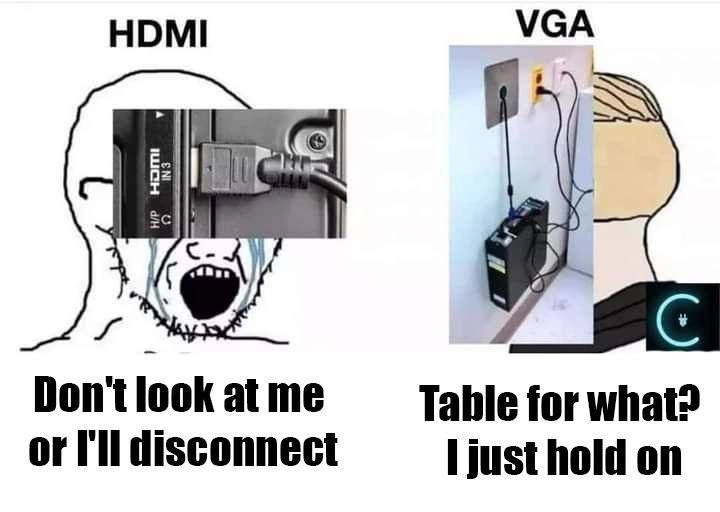
Let’s break down this meme in simpler terms. It’s comparing two types of monitor cables – HDMI vs. VGA – by using a popular internet meme format (often called the “Virgin vs. Chad” comparison). In the left panel, we see a drawn crying face (a Wojak character) labeled “HDMI.” HDMI (which stands for High-Definition Multimedia Interface) is the standard cable you’d use today to connect a computer or gaming console to a TV or modern monitor. It’s a fairly small, flat-ish plug. The meme shows that HDMI plug sitting loosely in its port, as the Wojak cries with blue tears, saying “Don’t look at me or I’ll disconnect.” This dramatizes how touchy HDMI cables can be – if you bump or slightly move them, the connection to the screen might cut out. Many of us have experienced that little heart attack when the display goes dark because the cable wasn’t perfectly seated. The phrase “Don’t look at me” is a humorous exaggeration, implying the HDMI is so sensitive that even looking at it funny might make it lose contact! This captures a real connector_anxiety people have with some modern cables: you’re afraid to even jiggle your device once everything is finally working.
Now, the right panel is labeled “VGA” and shows a very different scenario. VGA (short for Video Graphics Array) is an older type of video cable that was common on computers from the late 1980s through the early 2000s. The VGA connector is larger, with 15 pins, and importantly, it has two screws, one on each side, called thumbscrews. You tighten these by hand (using your thumb and finger, hence the name) to securely attach the cable. In the meme’s photo, a desktop computer tower is literally hanging off the ground, supported only by a VGA cable that’s screwed into a wall outlet plate. Next to it is the outline of the confident Chad meme character (with the strong jawline) who isn’t worried at all. Underneath it says, “Table for what? I just hold on.” This joke text means the VGA cable is so secure that the computer doesn’t even need a table – the cable itself is holding it up! Of course, in reality you wouldn’t actually use a cable as a shelf (that could damage the ports), but the image humorously exaggerates how sturdy and reliable those old VGA connections feel. The “Chad” character represents the tough, no-nonsense attitude: he’s looking at the hanging PC like it’s no big deal. This contrasts with the panicked Wojak on the left.
So, essentially: HDMI is portrayed as fragile, while VGA is portrayed as rock-solid. Why would that be? One reason is the physical design. HDMI cables do not have locking screws. You just push them in, and friction holds them in place. That’s convenient for quickly plugging things in or out – you don’t have to tighten anything. But it also means they can slip out or get loose more easily. There’s even something called “hot-plugging”: HDMI was designed so you can plug it in while devices are on, and it will detect and start displaying without needing a restart. VGA, on the other hand, comes from an older generation where you typically turned devices off before connecting or disconnecting cables (and hot-plug support wasn’t guaranteed). VGA cables were often screwed in because the expectation was that you set up your monitor and then left it connected for a long time. The screws keep the connection stable and ensure the analog signal (which can be prone to interference if the contact is poor) remains consistent. If a VGA plug is slightly loose, you might see flickering or color distortions; screws prevent that by holding it tight.
Let’s clarify some terms in context:
- Legacy hardware/Legacy systems: This refers to older technology that has been largely replaced but might still be around or remembered. In this meme, VGA is the legacy hardware (an old standard that’s mostly phased out by now in favor of HDMI and DisplayPort). Calling something “legacy” isn’t an insult; it often implies it was reliable and long-lasting, just older.
- Modern specs: Short for modern specifications or standards – in this case, HDMI is a modern spec. It has lots of advanced features (digital high-definition video, audio in the same cable, etc.) that old VGA doesn’t. But as the joke highlights, modern doesn’t automatically mean more robust physically.
- Thumbscrew reliability: This phrase isn’t a formal technical term, but here it’s referencing how those little thumb screws on older connectors (like VGA, DVI, serial ports, etc.) gave a reassurance that once you fasten the cable, it’s not coming out on its own. You could tug on it, and it would stay in place because it’s literally screwed in.
- Connector anxiety: Also a playful term – it describes the worry or lack of trust you have in a connector staying put. For HDMI, many people have this mild anxiety that “if I even nudge the cable, I’ll lose the picture or sound.” It’s that feeling when you gently wiggle a cable to see if it’s truly secure, or you tape an HDMI cord in place because you don’t trust it not to slip. The meme jokingly magnifies that anxiety (to the point of being afraid to look at the HDMI).
- Physical layer: In networking and telecom, the “physical layer” refers to the lowest layer of connections – literally the wires, plugs, and signals. This meme is a very literal take on physical-layer issues: one image depicts a kind of ultimate physical stress test (hanging a PC by the cable), and the other shows how even a minor physical disturbance (looking or touching) can break a connection.
It might help to see a quick comparison between VGA and HDMI features to understand why they behave differently:
| Feature | VGA (Legacy) | HDMI (Modern) |
|---|---|---|
| Introduced | 1987 (IBM PC era) | 2003 (digital home entertainment era) |
| Signal Type | Analog (varying electric signals for video) | Digital (binary data for video/audio) |
| Connector Size | Large D-sub 15-pin connector | Smaller flat connector |
| Attachment | Secured by screws (requires manual tightening) | Friction fit (push in, no screws) |
| Hot-Plug Support | Not originally (best to plug/unplug with devices off) | Yes, designed for plugging live |
| Typical Behavior if Loose | Fuzzy or tinted image, but maybe still hanging on partially | Image instantly cuts out to black screen |
| Physical Robustness | Very high – cable stays put even under tension | Moderate – cable can fall out if pulled or jostled |
| Extra Features | Video only (no audio), no DRM, older tech | Carries audio + video, supports HDCP (copy protection), etc. |
In the meme, the emotional punch comes from recognition. Younger developers who maybe haven’t used VGA might still get it if they’ve dealt with an older projector at school or needed an adapter (like HDMI-to-VGA) for some legacy display. Older engineers definitely nod and chuckle – it recalls a time when connectors were literally bolted on. The phrase “Table for what? I just hold on.” is funny even without knowing tech: you see the cable acting like a rope, so of course the VGA doesn’t “need a table.” For someone new to these terms, just remember: HDMI is great for high-quality video/audio but can be a bit finicky physically, and VGA is old and low-tech by today’s standards but was built in an era when cables were made to withstand some abuse. That’s why many in engineering have a nostalgic soft spot for those old chunky connectors – you could trust them not to pop out at a critical moment. This meme is basically saying: “Sure, HDMI is modern and all, but sometimes I miss the dependable old VGA that never let go.” It’s TechHumor bridging generations of tech, using a silly extreme example to make the point.
Level 3: Plug and Prey
At the highest level, this meme highlights a classic Hardware engineering irony: the battle between legacy strength and modern convenience. It’s a piece of HardwareHumor and TechNostalgia rolled into one. On the left, we have HDMI – the sleek digital video connector that promises plug-and-play ease but often delivers plug-and-pray anxiety. On the right, we see VGA, an old-school analog video connector from the LegacyTech era, known for its screw-locks and thumbscrew_reliability. The humor lands because anyone who has jiggled a loose HDMI cable (and watched the screen go black at the worst moment) can relate to that “Don’t even look at me or I’ll disconnect” fragility. Conversely, those of us who grew up with clunky VGA cables remember how indestructible they were – you could practically tow a cart with one. The meme exaggerates this (showing a LegacyHardware VGA cable literally suspending a PC tower!), but it rings true as an allegory. It’s a tongue-in-cheek nod to TechHistory: sometimes the LegacySystems we roll our eyes at were, in certain ways, built tougher than the slick modern gear that replaced them.
From a design perspective, this is a physical_layer_abuse face-off. VGA (Video Graphics Array), introduced back in 1987 by IBM, uses a 15-pin D-sub connector – a chunky plug with two built-in screws you tighten by hand. These thumbscrews are small metal screw knobs that physically lock the cable to the computer or monitor. Why such overkill? Because in the old days of desktop PCs (and heavy CRT monitors), you typically plugged in your display cable once and left it there. Stability and good contact mattered more than quick swapping. The screws kept the signal steady even if your tower got bumped or you tripped over the cable. VGA carried analog signals, so a loose connection might make the screen go fuzzy or tint weirdly; screws ensured a consistently solid electrical connection. Over decades, VGA earned a reputation for robustness – not because analog is better (it’s not, technically), but because the connector hardware itself was literally bolted on. Engineers who’ve wrestled with racks of equipment or dusty KVM switches appreciate how legacy strength can save you from late-night headaches: a secured VGA won’t randomly fall out when you wiggle the desk.
Now enter HDMI (High-Definition Multimedia Interface), a child of the early 2000s (circa 2003) when the tech world pivoted to slim, hot-pluggable cables for TVs, laptops, and game consoles. HDMI carries digital video and audio together, a big leap in functionality over VGA’s video-only analog stream. But in achieving a compact, user-friendly design, the HDMI consortium dropped the bulky screws. The HDMI plug is held in solely by friction and tiny springy contacts – fine for easy plugging and unplugging (no screwdriver or sore fingers needed), but not so great for connector_anxiety. If the heavy HDMI cable gets tugged or even nudged, the plug can loosen just enough to break the connection. And because it’s digital, breaking contact even momentarily means a total signal dropout – your monitor flatlines to “No Signal” in an instant. There’s even a running joke among gamers and AV folks: “Don’t breathe near the HDMI port, the signal might cut out.” The left side of the meme shows a crying Wojak (a meme character embodying frustration) next to a precariously seated HDMI plug, with the caption “Don’t look at me or I’ll disconnect.” This perfectly captures that jittery feeling of setting up a presentation or plugging in your HDMI cable and then carefully backing away as if the cable were a house of cards. It’s EngineeringHumor drawn from real life – a slight brush against the cable or the weight of the cable itself can cause an unexpected disconnect. Seasoned engineers have plenty of war stories: the projector that loses signal in the middle of a talk because someone bumped the table, or the multi-monitor rig where one screen intermittently flickers until you just reposition the HDMI connector.
The right side flips the script with a stoic Chad silhouette (the meme archetype of confidence and toughness) and that insane photo of a desktop PC hanging in mid-air, fully supported by a VGA cable bolted to a wall plate. The caption below reads, “Table for what? I just hold on.” It’s an absurd visual, but any LegacyHardware nerd immediately gets the hyperbole – VGA cables, with their screws tightened, grip like a vice. This speaks to an old-school design philosophy: make the physical connection fail-safe. In reality, of course, you wouldn’t literally hang a computer by its VGA cord (please don’t try this at home, it’s a great way to break connectors or ports!). But the joke lands because it feels like VGA could handle it. We’ve all seen VGA thumbscrews so stubborn that you had to unscrew them ten full rotations, or older cables that essentially became fixtures of the device. This robustness harkens back to an era where hardware was built “like a tank” – heavy, utilitarian, and with big safety margins. It’s the same reason older connectors like parallel ports or SCSI had locking clips or screws: these connections were expected to be solid, immune to accidental unplugs, because losing a connection could crash a system or corrupt data. There’s a comforting SharedPain among veteran engineers remembering how secure those connections were, even if the tech itself (analog video at 640x480 resolution, anyone?) was primitive by today’s standards.
The meme resonates particularly with folks who straddle the transition between LegacyTech and modern tech – the ones who have shelves of old cables and remember when a loose monitor cable was fixed with a screwdriver turn, not a silent prayer. In a broader sense, it’s poking fun at the trade-offs of “progress.” We got higher fidelity video with HDMI, convenient hot-plug capability, and slim ports that fit ultra-thin laptops and TVs. But we lost a bit of the physical reliability that older designs provided. It’s a comedic reminder that “newer” isn’t always “better” in every respect: sometimes what’s modern and sleek also means more fragile or finicky. In true TechHistory fashion, the cycle continues – newer standards like DisplayPort tried to have it both ways (digital signal, higher bandwidth, and they introduced a tiny latch mechanism on the connector for more secure attachment). Yet even today, professional setups (like high-end video cameras or networking gear) often use connectors with positive locking (from SDI coax twist-locks to good old screws) because when you absolutely need a connection to stay put, you go a bit retro with the hardware.
So this “brutal meme” isn’t just about cables – it’s about the engineering ethos behind them. It humorously contrasts the legacy systems that were perhaps over-engineered but reliable, against the modern solutions that prioritize user convenience (and sleek looks) but can introduce new headaches. Every engineer who has cursed a modern flimsy USB-C dongle or fragile ribbon cable can appreciate the message. The meme delivers a hearty dose of SharedPain and TechHumor: we laugh, because we’ve all been that HDMI Wojak at some point, on our knees behind the equipment, reseating a cable and begging the signal to stay. And deep down, a lot of us have a grudging respect for that old VGA gear – it might be outdated, but darn if it isn’t reliable when it counts.
Description
A two-panel 'Virgin vs. Chad' style meme comparing HDMI and VGA cables. On the left, under the heading 'HDMI', a crying Wojak character has a photo of an HDMI plug over its face. The caption below reads, 'Don't look at me or I'll disconnect'. This panel represents the perceived fragility and unreliability of HDMI connections, which can easily lose signal if disturbed. On the right, under the heading 'VGA', a confident 'Chad' Wojak has a picture over its face showing a desktop PC tower hanging from a wall, supported only by the cables plugged into it. The caption states, 'Table for what? I just hold on'. This humorously illustrates the superior physical durability of the older VGA connector, which often features thumbscrews to secure it firmly in place, making it strong enough to physically support hardware. The meme contrasts modern, feature-rich but physically delicate technology with older, more robust legacy hardware

Comments
21Comment deleted
HDMI offers 4K HDR and a single-cable solution, but its physical connection has the structural integrity of a junior dev's confidence during a production outage. Meanwhile, a VGA cable could probably survive re-entry from orbit and still hold a signal
HDMI is the microservice of display ports - elegant until a breeze takes production down; VGA is that monolith nobody refactors because those two thumbscrews are still carrying half the workload
The real irony is that after 20 years of digital display evolution, we still trust the analog VGA cable with the thumbscrews more than the HDMI cable that costs 10x as much and disconnects if you breathe near it during a critical presentation
The real irony here is that we've progressed from a 15-pin analog connector with screw-in retention that could survive a building collapse, to a sleek digital interface that disconnects if someone in the next room sneezes. VGA may have needed three separate cables and a prayer to get the colors right, but at least it stayed connected during your entire 3-hour architecture review meeting - unlike HDMI, which will absolutely disconnect the moment your CTO walks in to see your demo
HDMI implements hot‑plug detection like a flaky OAuth flow - one sneeze near the cable and EDID reauths; VGA ships mechanical idempotency via two thumbscrews
HDMI's CAP theorem: max bandwidth, zero retention - partitions harder than a flaky etcd cluster
HDMI keeps renegotiating like a chatty microservice (EDID/HDCP/CEC); VGA shipped two thumb‑screw distributed locks in 1987 and delivered mechanical five‑nines
I still want my DVI back 😒 Comment deleted
DisplayPort 😎 Comment deleted
An open version of hdmi with teeth holding conmector like microUSB Comment deleted
Displayport king Comment deleted
How are they different? Comment deleted
DisplayPort supports higher resolutions, faster refresh rate and has fixators to plug not to plug off uncunciously Comment deleted
Thanks. Never noticed DP has fixators 🧐 Comment deleted
Some manufacturers implement fixator some dont Comment deleted
Fixators not a part of the DP standard btw Comment deleted
Maybe you're right and have seen more cables, which I've seen were all with fixators. Especially cables which came with monitors. Comment deleted
displayport and hdmi are incompatible however, displayport++ CAN also drive hdmi Comment deleted
Both are created to transfer images from graphics chip to display. HDMI comes from video players realm, with Blu-Rays and TVs, it’s basically DVI in new body. DisplayPort is royalty-free and comes from computer background, supported 60fps and full colour palette and no overscan by default. Comment deleted
I was talking about the connector itself, not the standards, specs of image transmission 🤷♂ Comment deleted
Never had issues with HDMI connectors before. Same for DP. Never tried miniDP 🧐 Comment deleted