Skip to content
DevMeme
7238 of 7435
Guessing Game: Win32 Type Names vs Polish Words
Microsoft Post #7936, on Apr 18, 2026 in TG

Guessing Game: Win32 Type Names vs Polish Words

Why is this Microsoft meme funny?

Level 1: Two Alphabets That Look Like One

Imagine someone shows you a list of words and asks: which of these are towns in a country famous for skipping vowels, and which are secret codes used by a giant software company? The trick is that both lists were made by people who really, really loved stacking consonants together, so they end up looking identical. You squint at SZCZECIN and HGDIOBJ and genuinely can't tell which one is a city and which one is a computer instruction. It's funny because two completely unrelated groups of people — Polish mapmakers and Microsoft programmers — independently arrived at the same impossible-to-say style, and now nobody can tell their work apart.

Level 2: Decoding the Prefix Grammar

For anyone who hasn't waded into windows.h, the prefixes follow a learnable pattern. H means handle (an opaque token the OS hands you to refer to a resource — a window, a brush, a file). LP means long pointer, a relic from 16-bit segmented memory when "long" pointers spanned segments; on modern flat memory it's just "pointer," but the name stuck. C inside means const, W means wide (wchar_t, the 16-bit characters Windows uses for Unicode), and STR means string. So LPCWSTR reads left-to-right as a chain of qualifiers, not a word.

A typedef is a C alias that gives an existing type a new name; DWORD is just a typedef for a 32-bit unsigned integer, but naming it DWORD let Microsoft keep API signatures stable across decades and hardware changes. Hungarian notation is the broader habit of baking type information into identifiers — useful before editors could tell you a variable's type on hover, awkward afterward.

The relatable early-career moment here is the first time you open a Windows header or a Win32 tutorial and meet a function signature that's all prefixes — and slowly realize the alphabet soup is a compressed language you have to learn to read, not pronounce.

Level 3: How a Type System Learned to Speak Polish

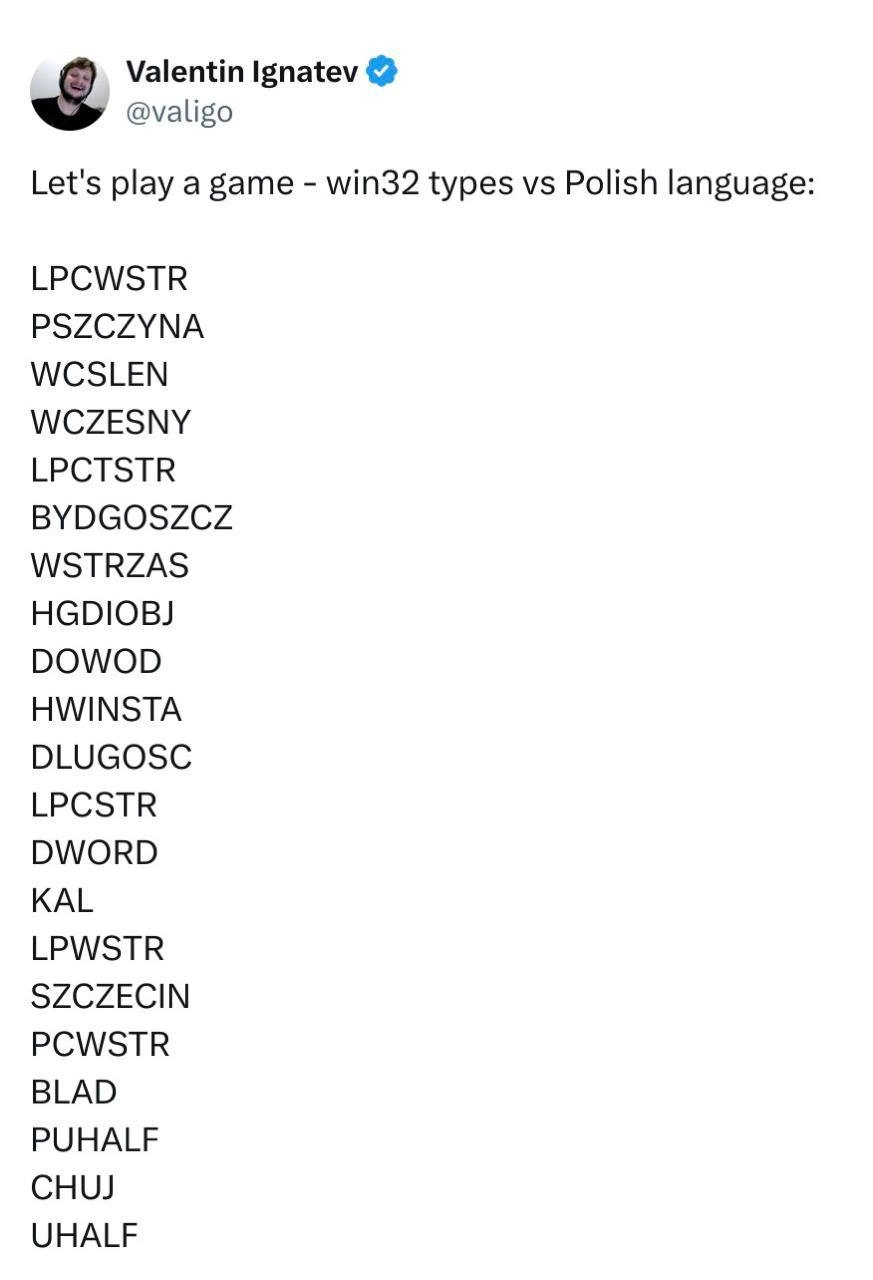
Valentin Ignatev (@valigo) poses a deceptively simple challenge:

Let's play a game - win32 types vs Polish language:

What follows is a single uppercase column where LPCWSTR, WCSLEN, LPCTSTR, HGDIOBJ, HWINSTA, LPWSTR, PCWSTR, DWORD, and PUHALF sit shoulder-to-shoulder with PSZCZYNA, BYDGOSZCZ, WSTRZAS, DOWOD, DLUGOSC, SZCZECIN, BLAD, KAL, and — included for shock value — CHUJ. The reason the game is genuinely hard is the heart of the joke, and it's a real linguistic-meets-historical collision.

The Win32 identifiers are the fossilized record of Hungarian notation, the naming discipline invented at Microsoft (named for its originator, Charles Simonyi, who was Hungarian) where a variable or type's nature is encoded as a terse prefix. Decode the soup and it's perfectly logical: LPCWSTR = Long Pointer to Const Wide STRing; LPCSTR drops the wide for a narrow string; LPCTSTR swaps in T for the generic text type that compiles to either depending on the UNICODE macro; HGDIOBJ = Handle to a GDI OBJect (the Graphics Device Interface); HWINSTA = Handle to a WINdow STAtion; DWORD = Double WORD, the 32-bit unsigned integer that is arguably the load-bearing pillar of the entire Windows API. Every one of these is a real typedef you'll find in windows.h. The prefixes were a 1980s response to a real problem — C's weak type system gave you almost no compile-time help, so the name itself became the documentation of what a thing was and how you were allowed to use it.

The collision is phonological. Polish orthography is famously consonant-dense, fond of clusters like szcz, rz, , and wstrz that look, to an eye trained on no diacritics and all-caps, exactly like a hand-mashed handle typedef. SZCZECIN and BYDGOSZCZ are major Polish cities; PSZCZYNA a town; BŁĄD means error, DŁUGOŚĆ means length, DOWÓD means proof, and the meme slips in KAL, CHUJ, and the half-words PUHALF/UHALF (the latter genuinely being NT kernel typedefs for unsigned half-words) to maximize the confusion. Strip the Polish diacritics, uppercase everything, and the visual entropy of the two categories converges to nearly the same distribution. That is why a fluent Windows programmer and a fluent Polish speaker would each get some answers confidently wrong.

The senior-level reflection is what this says about naming conventions as accumulated technical debt. Hungarian notation made sense for its era and its tooling, but it calcified into a system where readability was sacrificed to a prefix grammar that modern type-aware IDEs and strong type systems made obsolete. The Win32 header is a museum of decisions that were reasonable in 1985 and merely load-bearing by 2025 — you cannot rename DWORD without shattering thirty years of binary compatibility, so the consonant soup is immortal. The meme is funny precisely because it exposes that these sacred, ubiquitous identifiers carry no more human-pronounceable meaning than a random Polish toponym. The API achieved a kind of accidental linguistic minimalism: maximum information density, zero pronounceability.

Description

A light-mode tweet by Valentin Ignatev (@valigo, verified): "Let's play a game - win32 types vs Polish language:" followed by a single-column uppercase list interleaving real Win32 API typedefs with Polish words and city names: LPCWSTR, PSZCZYNA, WCSLEN, WCZESNY, LPCTSTR, BYDGOSZCZ, WSTRZAS, HGDIOBJ, DOWOD, HWINSTA, DLUGOSC, LPCSTR, DWORD, KAL, LPWSTR, SZCZECIN, PCWSTR, BLAD, PUHALF, CHUJ, UHALF. The joke is that the Windows API's consonant-heavy Hungarian-notation typedefs (LPCWSTR = long pointer to const wide string, HGDIOBJ = GDI object handle, HWINSTA = window station handle) are visually indistinguishable from Polish vocabulary and toponyms like Pszczyna, Bydgoszcz, and Szczecin (plus 'błąd' = error, 'długość' = length, 'dowód' = proof, and one profanity)
Comments

9
Anonymous ★ Top Pick Hungarian notation, Polish vocabulary - Win32 was multilingual from day one, just never in anything a human could pronounce
  1. Anonymous ★ Top Pick

    Hungarian notation, Polish vocabulary - Win32 was multilingual from day one, just never in anything a human could pronounce

  2. @moosschan 2mo

    Trick question - all of them are polish words, some just happen to be win32 types

    1. @Sympathy198 2mo

      wow

  3. @RiedleroD 2mo

    …blad is even a word in austro-bavarian

  4. @RiedleroD 2mo

    also I think it's meant to say bład (note the difference: ł vs. l)

    1. @RiedleroD 2mo

      correction: błąd

    2. dev_meme 2mo

      yes, that means mistake in Polish

      1. @RiedleroD 2mo

        yes I know

  5. @blue_bonsai 2mo

    Blyat

Use J and K for navigation