Grandpa Tells Kids About Stack Overflow Humiliation Rituals
Why is this DevCommunities meme funny?
Level 1: The Mean Librarian
Imagine the only place to get answers to your homework was a library with one very grumpy librarian. Before helping you, she'd announce to everyone that your question was silly, that another kid asked it years ago, and that you should have looked it up yourself. Kids went anyway, because there was nowhere else. Now imagine a magical talking book appears that answers any question instantly and never makes fun of anyone. Of course the kids stop going to the library — and the grown-ups end up sitting on a hill, telling wide-eyed children about the strange old days when getting help required getting embarrassed first.
Level 2: Closed as Duplicate
For those who arrived after the regime change: Stack Overflow was (is) a public Q&A site where programmers posted questions and earned reputation points for good answers. Its moderation vocabulary became developer folklore. Closed as duplicate meant your question was shut down with a link to an allegedly identical one — frequently old, subtly different, or unanswered. RTFM ("read the manual") culture meant being told the answer was findable if you'd only searched harder. The XY problem is when you ask about your attempted solution (X) instead of your real goal (Y), and respondents interrogate your life choices instead of answering.
The rite of passage went like this: you hit a wall, spent an hour crafting a question with code samples and formatting, posted it nervously — and woke up to two downvotes, a duplicate flag, and one comment asking why you weren't using a different framework entirely. It taught real skills, honestly: searching first, writing minimal reproducible examples, anticipating objections. It just taught them the way a drill sergeant teaches swimming. Today the same wall gets pasted into a chat window and an LLM answers in seconds without judging you, which is why the meme files the whole experience under grandpa stories.
Level 3: The Fall of the Reputation Economy
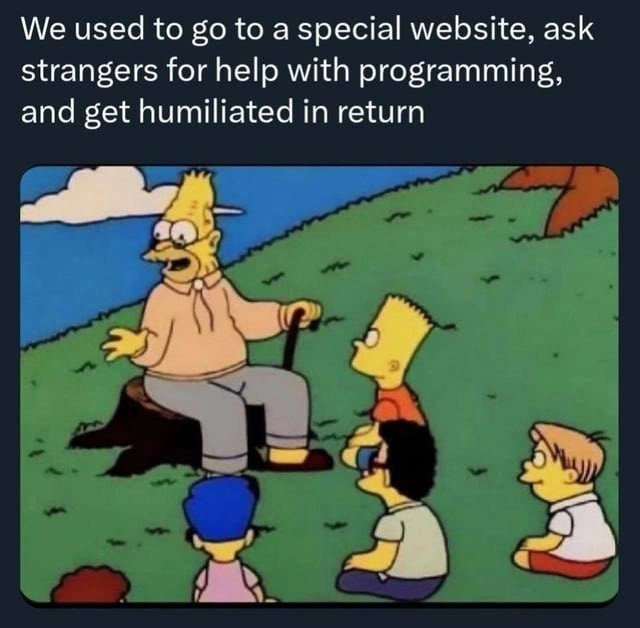
The framing device is everything here. Grandpa Abe Simpson, perched on a tree stump and gesturing mid-yarn to a semicircle of cross-legged children — Bart, Milhouse, Ralph among them — is the canonical visual for "stories from a vanished world." And the vanished world in question:
We used to go to a special website, ask strangers for help with programming, and get humiliated in return
Note what's not named. The meme never says Stack Overflow — it doesn't have to. "Special website," "strangers," and "humiliated" form a fingerprint precise enough that every developer over a certain experience threshold completes the identification in milliseconds. That deniable specificity is the format's craft: the humiliation wasn't a bug of one site, it was the ambient texture of an entire era of learning to code.
The deeper history is genuinely interesting, because Stack Overflow's harshness wasn't sadism — it was architecture. The site was explicitly designed as a Q&A wiki, not a help desk: questions were supposed to be durable, canonical artifacts useful to future searchers, not conversations serving one confused person. Every mechanism that traumatized beginners — closed as duplicate, "what have you tried?", downvotes on questions, the reflexive "why would you even want to do that?" (the XY problem rebuttal) — existed to defend the archive's signal-to-noise ratio. The tragedy is that the incentive system worked too well: a reputation economy optimized for curation inevitably produces curators, and curators at scale read as gatekeepers. Ask a slightly-imperfect question and you weren't joining a community; you were submitting a defective artifact for inspection.
Then LLMs arrived and unbundled the transaction. The machine answers instantly, privately, infinitely patiently, and never closes you as a duplicate of a 2011 question whose accepted answer recommends a library deprecated in 2014. Whether the answer is correct is a separate matter — but the meme isn't about correctness, it's about dignity. Developers didn't leave the old watering hole because the water was bad; they left because drinking required passing a hazing ritual. The bitter irony, which gives this meme its half-life: the corpus those strangers built through all that ruthless curation is a load-bearing chunk of what the models were trained on. The kids listening on the hill are, in a real sense, drinking from the well the humiliators dug.
Description
A meme captioned 'We used to go to a special website, ask strangers for help with programming, and get humiliated in return' above a still from The Simpsons: Grandpa Abe Simpson sits on a tree stump on a grassy hill, animatedly telling a story to Bart, Milhouse, Ralph, and other children gathered around him. The joke frames Stack Overflow - with its notorious 'closed as duplicate', 'why would you even want to do that?' culture - as a bygone era now that developers ask LLMs instead, recasting public humiliation by strangers as quaint oral history told to the next generation
Comments
7Comment deleted
Kids today will never know the character-building experience of having your question closed as a duplicate of one from 2011 that doesn't answer it
to be fair most documentation is terrible, especially man pages Comment deleted
Did you read the answers on StackOverflow? Comment deleted
Imagine trying to read C++ docs/books just to have all the code given not work and barely being able to get past basic concepts if you read headers individually, which takes forever Comment deleted
I want this similar meme before internet. I am curious Comment deleted
"saar pls give code now saar make sure it work thanks in advanced" Comment deleted
Back then stackoverflow would be able to detect irf user is doing something stupid or suboptimal. LLMs will happily allow you to make the square wheel. Comment deleted