Skip to content
DevMeme
1601 of 7435
GitHub: Our Social Coding Platform
OpenSource Post #1789, on Jul 18, 2020 in TG

GitHub: Our Social Coding Platform

Why is this OpenSource meme funny?

Level 1: Sharing is Caring

Imagine you and all your friends decide to build a huge LEGO city together. Everyone brings their own LEGO bricks, and you all start connecting pieces to make one big creation that all of you can play with. Nobody is saying “These are my bricks, you can’t use them” – instead, everyone’s dumping their pieces in a big pile for the project. You’ve also got one friend who’s super excited, waving everyone over to join in, saying “Come on, let’s build this together! It’ll be amazing!” That’s basically what this picture is showing, but with coding. It’s drawn like an old-fashioned poster that might have said “Let’s all work together for the greater good!” Instead of building a city or raising a barn, it’s about writing software as a team. The reason it’s funny is that it treats a coding website (GitHub) as if it’s a big important team mission from history. The guy in the poster is smiling and reaching out like “Hey friend, join our coding team effort!” It’s a playful way to say that when developers share their code and help each other, they can create much better things than if they worked alone. In simple terms: sharing code is good, working together is fun, and this meme makes us laugh by comparing that friendly teamwork to a super serious “everybody unite!” style poster. Even if you’re not a programmer, it’s like seeing a teacher encourage the whole class to draw one giant mural together – a bit dramatic in style, but the spirit is just about teamwork. And hey, teamwork makes the dream work, whether you’re building with LEGO or coding on GitHub!

Level 2: Version Control Collective

Let’s break down what’s going on for someone newer to the coding scene. GitHub is an online platform where developers store and share code, enabling people all over the world to collaborate on software projects. It’s built around Git, which is a version control system – basically a tool that tracks changes in code and lets many people work on the same codebase without overwriting each other’s work. When the meme says “SOCIAL CODING,” that’s actually GitHub’s slogan emphasizing collaboration: coding becomes a social, team activity rather than a solo task. The idea is that by pooling our efforts we can build software better together. This meme humorously compares that principle to a kind of coding “communism” – not in a serious political way, but joking that everyone sharing code and working collectively is like a little coding commune.

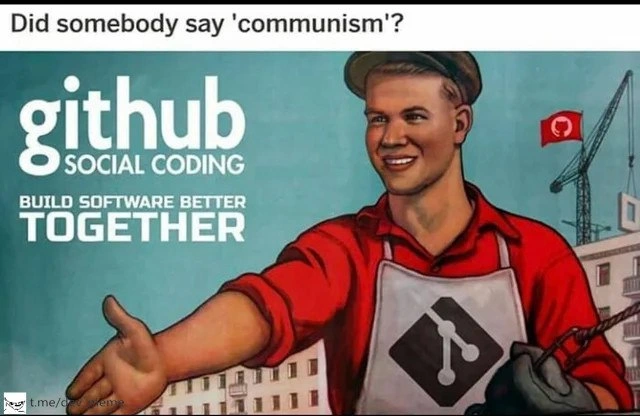
In the image, a smiling, robust worker in a red shirt and cap is extending his hand, as if inviting you to join the cause. This is drawn in the style of an old Soviet propaganda poster (the kind that would say things like “Workers, unite!”). Instead of a factory or farm tool, he’s proudly wearing an apron with the Git branch icon on it. That icon – showing lines splitting and merging – represents branching and merging in Git. Branching means taking the code and making your own copy to work on a feature, and merging means combining your changes back in. It’s a core concept of how multiple programmers can work on one project simultaneously. By slapping that icon on the worker’s apron like an emblem, the meme signifies “our noble work is coding together.”

In the background, there’s a construction crane and a red flag with the Octocat silhouette (the cat/octopus hybrid mascot of GitHub). These details reinforce the theme of building something big collectively. A crane suggests heavy construction (here, symbolizing large software projects under development), and the Octocat flag is like planting a banner for the open-source movement. The large white text “github SOCIAL CODING” and “BUILD SOFTWARE BETTER TOGETHER” are written in a bold, no-nonsense font reminiscent of 20th-century propaganda slogans. They’re essentially encouraging the viewer to join in communal software building. This mirrors how open-source projects invite developers: everyone can contribute code, fix bugs, or improve documentation for the common good of the project.

Now, why the joke about communism? Well, one of the core ideas in communism is collective ownership — the community owns things together instead of individuals owning things privately. Open-source software is a bit like that: the code isn’t owned by one single company; it’s shared openly. Anyone can use it, and anyone can help improve it. So the meme humorously exaggerates that similarity. It’s saying, “Haha, GitHub is like the Soviet Union of coding – everything’s shared!” Of course, this is just for laughs. In reality, open-source communities are voluntary and global, not run by a government. But developers often joke that working on a common codebase with people around the world, all contributing freely, feels a little like being part of a big cooperative. The top caption “Did somebody say ‘communism’?” is the meme’s cheeky way of acknowledging the comparison. If you imagine a group of devs talking about how great sharing code is, someone might jokingly chime in with that line, as if summoning the propaganda poster imagery we see here. It’s a nod-and-wink reference that this whole idea of collaborative coding is being metaphorically equated to a political ideology (in a lighthearted, irreverent way).

So, in summary, the meme takes the concept of collaborative coding on GitHub – where a bunch of developers team up to build software – and visually compares it to a unified social movement. Everything from the propaganda_poster_style art to the sloganeering text is one big metaphor. It’s highlighting the OpenSourceCulture of developers coming together (the DevCommunity as a whole) to create something awesome, and it finds humor in likening that positive cooperation to “communist” teamwork. For a newcomer: don’t worry, contributing to open source doesn’t require reading Marx 😅. But it does involve a lot of people across the globe pooling their knowledge to make code that anyone can use. That “togetherness” vibe is exactly what this meme is celebrating – with a big, goofy historical reference for comedic effect.

Level 3: Comrades of Code

For the seasoned developer, the humor jumps out immediately: we have GitHub, the home of open-source code, portrayed like a Soviet-era rallying cause. The phrase “Did somebody say ‘communism’?” in the caption winks at the viewer – it’s acknowledging the over-the-top comparison. Why is that funny? Because in the world of software, “Social Coding” (GitHub’s old tagline) really does encourage everyone to work collectively on code, a bit like a coding commune. The meme takes that open-source culture of sharing and dramatizes it with a propaganda poster aesthetic. Picture a cheery, muscular worker (our stand-in for the enthusiastic open-source dev) extending a hand and inviting you to join the project. On his apron is the Git branch/merge icon, practically elevated to a revolutionary symbol (who needs a hammer and sickle when you have a fork and merge?). In the background, a red flag emblazoned with the Octocat (GitHub’s mascot) flies proudly from a crane constructing... something presumably grand. This imagery screams “big collective project.” It’s parodying how open-source projects often feel: coders from around the world uniting to build something huge (an operating system, a framework, you name it) with almost missionary zeal. The slogan emblazoned below – “BUILD SOFTWARE BETTER TOGETHER” – sounds like an idealistic call to arms for developers: exactly the kind of upbeat, inclusive message you’d see on GitHub’s community pages or heard at a dev conference keynote. Now, the senior dev chuckles because there’s irony layered here. In decades past, old-guard companies (hi, Microsoft of the 90s 👀) treated free software like a threat to their business model – some critics even threw around words like “communism” to malign the idea of giving away code. Fast forward, and now Microsoft owns GitHub, proudly waving the flag of OpenSource. That turnaround makes the propaganda motif extra rich – the once “capitalist empire” is now literally running the biggest communal coding platform. It’s as if the corporate world said, “If you can’t beat the open-source rebels, join ’em (and maybe buy ’em out).” This meme cleverly satirizes that culture shift. It’s poking fun at how developers happily embrace collective code ownership: in open-source projects, no single person claims the code; it belongs to the community of contributors. That’s a point of pride – and also the joke. We’re proud of our collaborative coding so much that, sure, let’s compare ourselves to a heroic workers’ revolution! The DevCommunity finds it hilarious because it’s both self-aware and hyperbolic. Everyone who’s merged a pull request or reviewed someone else’s code on GitHub knows the warm, fuzzy feeling of teamwork. This poster takes that feeling to comic extremes: it’s like an alternate universe where writing unit tests and fixing bugs is akin to fulfilling a five-year plan for the Motherland of Code. It exaggerates volunteer collaboration into a full-blown ideological movement – and honestly, after a few caffeine-fueled hackathons, it does sometimes feel like one. We joke that we are “coding comrades” building a better world (or at least better software) hand in hand. By using the classic propaganda_poster_style — bold block text, idealized smiling worker, vibrant red accents — the meme taps into a visual language everyone recognizes, but repurposes it for TechHumor. It’s the contrast between the serious, old-fashioned imagery and the modern, playful context that makes devs smirk. In practice, contributing on GitHub isn’t actually political, but it does require cooperation, altruism, and trust in strangers on the internet – which is both remarkable and a little whimsical. So when we see “GitHub SOCIAL CODING” portrayed like state propaganda, we appreciate the tongue-in-cheek flattery: yes, we are part of a grand coding collective, and yes, it’s kinda funny to think of our pull requests as acts of proletarian solidarity. The next time you git push your code, you might just hear a little internal rallying cry: “For the Repository, for the Community!” 😄

Level 4: The People’s Repo

At the deepest level, this meme riffs on the ideology of open-source as if it were a grand socioeconomic movement. It playfully casts collaborative coding in the light of collectivist theory. In academic discussions, open-source development is sometimes framed as a new mode of production – a kind of digital commons where code is the shared property of the community rather than a product to hoard. The poster’s communist aesthetic isn’t just for shock value; it echoes real debates in tech history. Early software freedom advocates (think Stallman’s GNU Manifesto in 1985) spoke about software ownership in almost revolutionary terms. They argued that source code – the “means of production” in software – should belong to everyone. By the late 90s, the Open Source movement rebranded these ideas in more pragmatic terms, but the core notion remained: software improves faster when built together, not under one corporate banner. Economists have even coined terms like commons-based peer production to describe projects like Linux or Wikipedia, where volunteers worldwide collectively create value outside traditional market structures. In that sense, calling GitHub’s model “communism” is a tongue-in-cheek nod to how radically different collaborative coding is from old proprietary norms. After all, Git itself is a distributed system – every developer has a full copy of the repository, a literal sharing of code power that would make any socialist theorist grin. The meme exaggerates this parallel for comedic effect, but there’s truth underneath: by eliminating gatekeepers and encouraging shared ownership, open-source communities often achieve quality and innovation that a single entity couldn’t. It’s a bit of techno-utopian lore brought to life in Soviet poster form. And of course, any manifesto needs a slogan – here we have “BUILD SOFTWARE BETTER TOGETHER” – which sounds like it could be straight out of a 1950s industrial rally, but for code. It’s humor with depth: the foundations of collaborative software development genuinely align with the idea that collective effort leads to a greater good. In other words (to paraphrase a famous slogan): “Developers of the world, unite! You have nothing to lose but your bugs.”

Description

The image is a meme styled as a Soviet-era propaganda poster, with the caption 'Did somebody say 'communism'?'. The poster features a smiling, friendly worker in a red shirt and an apron bearing the Git logo, extending his hand for a handshake. In the background, a construction site with a crane is visible, flying a red flag with the GitHub Octocat logo. The left side of the poster contains the GitHub logo and the slogans 'SOCIAL CODING' and 'BUILD SOFTWARE BETTER TOGETHER'. The meme humorously draws a parallel between the collaborative, collective ethos of open-source development on platforms like GitHub and the ideology of communism. It ironically reframes slogans like 'social coding' and 'build together' within a collectivist, political aesthetic. For experienced developers, it's a witty commentary on the quasi-socialist principles that underpin the open-source community, which often exist within a larger capitalist industry
Comments

7
Anonymous ★ Top Pick Our CI/CD pipeline is the five-year plan, pull requests are reviewed by the committee, and the only thing we're forking is the means of production
  1. Anonymous ★ Top Pick

    Our CI/CD pipeline is the five-year plan, pull requests are reviewed by the committee, and the only thing we're forking is the means of production

  2. Anonymous

    Open source is the only revolution where everyone seizes the means of production, but three exhausted maintainers still play the politburo deciding if your one-line README fix merits entry into the collective

  3. Anonymous

    "From each according to their commits, to each according to their merge conflicts" - the manifesto nobody asked for but every enterprise monorepo eventually implements

  4. Anonymous

    GitHub's marketing team really nailed the 'from each according to their ability, to each according to their merge conflicts' philosophy. Nothing says 'workers of the world unite' quite like 47 contributors arguing in a PR thread about whether to use tabs or spaces, while the original maintainer hasn't been seen in 6 months and the CI pipeline is perpetually red

  5. Anonymous

    Git promised decentralization; we put it all on one SaaS, added CODEOWNERS and branch protection, and called it “social” - the five‑year plan is your PR approval queue

  6. Anonymous

    GitHub communism: from each contributor according to their commits, to each PR according to the maintainer's benevolence

  7. Anonymous

    GitHub “social coding”: take a distributed VCS, centralize it behind CODEOWNERS, and call the five‑year plan a roadmap

Use J and K for navigation