Skip to content
DevMeme
4013 of 7435
The Full-Stack Developer: A Master of All Trades, or a Master of None?
Career HR Post #4370, on May 9, 2022 in TG

The Full-Stack Developer: A Master of All Trades, or a Master of None?

Why is this Career HR meme funny?

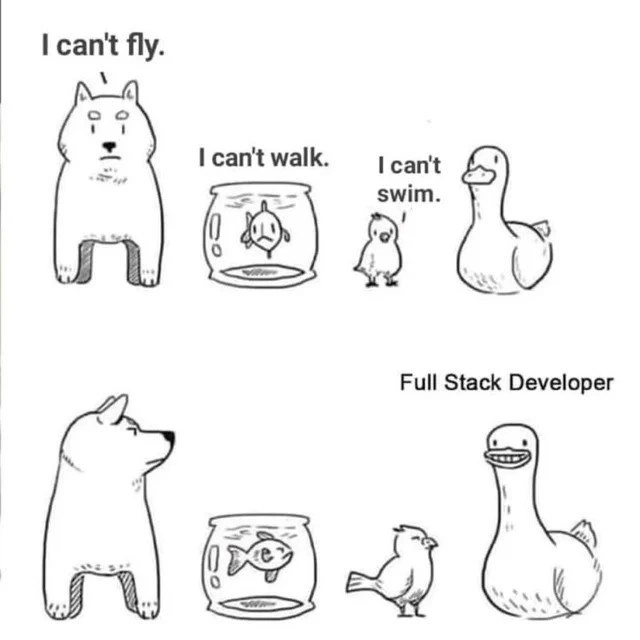
Level 1: Do-It-All Duck

Imagine you have three friends: one who’s really good at running but can’t swim, another who’s an amazing swimmer but can’t ride a bike, and a third who can fly a kite really high but is afraid to get in the pool. They’re like specialists who each excel at one thing and struggle with another. Now imagine a fourth friend who’s pretty good at running, can swim okay, and also knows how to fly a kite decently. This friend might not win a gold medal in any one activity, but they can join in on every activity without a problem.

The meme is joking that a full stack developer is like that all-rounder friend – or like a duck that can walk on land, swim in water, and fly in the air. A duck isn’t the best flyer compared to other birds, and it’s not the fastest swimmer compared to a fish, but it’s capable of doing all those things. In the world of coding, that’s funny and admirable because it means one person can handle whatever task comes up. If building a website were like an adventure, the full stack developer is the adventurer who can do a bit of everything: climb, swim, and fly over obstacles. That’s why in the picture the duck is labeled “Full Stack Developer” – it’s the one that doesn’t say “I can’t” do something. It’s both a little silly (imagine a duck proudly saying “I got this!” while other animals bow out) and a celebration of being versatile.

Even if you’re not a coder, you can recognize the humor in the idea: it’s like in a group project when one person ends up doing lots of different jobs because they have the skills for all of them. It feels good to be that duck who can help in every area, and it’s also a bit crazy to see one person doing so much. That mix of “wow, that’s impressive!” and “haha, that’s kind of funny” is exactly why this meme makes people smile.

Level 2: Jack of All Stacks

A Full Stack Developer is someone who works on both the frontend and the backend of a web application – essentially covering the entire “stack” of technologies that make a complete product. To understand that, let’s break down what frontend and backend mean in simpler terms:

  • The frontend of a website or app is everything the user sees and interacts with directly. This includes the layout, buttons, text, images – basically the content and design in the browser. Frontend developers use languages like HTML (for structure), CSS (for styling), and JavaScript (for interactivity) to create the user interface. If you open a web page and click a button or type into a form, those on-screen behaviors are all frontend work. It’s like the “face” of the application.
  • The backend is the behind-the-scenes part that users don’t directly see. This is the server-side logic, databases, and application code that power the features. Backend code handles things like storing and retrieving data, ensuring the right info is sent to the frontend, processing user input, and enforcing rules (for example, checking if a username is unique when someone signs up). Backend developers might use languages like Python, Java, JavaScript (Node.js), or Ruby, and work with databases using SQL or other data technologies. It’s like the “brain and heart” of the application, working in the shadows to keep everything running.

Now, a full stack developer is comfortable with both of these areas. They can build out the user interface and implement the server logic behind it. In the context of the meme, think of the dog as representing someone who’s mainly a backend dev (“I can handle the brains of the operation but don’t ask me to make it pretty”), the bird as a frontend dev (“I can make it look great and interactive but don’t involve me with database stuff”), and the fish as maybe a database or infrastructure specialist (“I keep things running under the waterline but I’m not coming up to build interfaces”). The duck is the full stack developer who can do a bit of everything those other three do – it walks on land (builds the frontend in the browser), swims in water (deals with databases and data), and flies in the air (handles the high-level application logic on the server, maybe even some cloud infrastructure).

For example, imagine you’re a junior web developer building a simple application, say a personal blog site. If you were working as a frontend specialist, you might only write the code for how the blog looks in the browser – the HTML structure of posts, CSS styles for fonts and colors, and maybe some JavaScript to add dynamic behavior like a popup menu. If you were strictly a backend specialist, you might only set up the database and the server code that sends blog posts to the frontend, without worrying about how the page looks. But as a full stack developer, you would do both. You’d create the webpage layout and write the server code that serves up the content.

Here’s a tiny illustration in code form. First, a snippet of frontend HTML with a bit of embedded JavaScript for a button on a page:

<!-- Frontend: an HTML button that when clicked calls a JS function -->
<button onclick="saveData()">Save</button>

<script>
  function saveData() {
    // This function sends a request to the server to save something
    fetch("/save", { method: "POST", body: "Hello!" })
      .then(response => response.text())
      .then(message => console.log("Server says:", message));
  }
</script>

This is something a frontend dev would handle – creating a button in the UI and making it do something (here, sending a message to the server).

Now, on the backend side, you’d write the code that actually handles that “save” request (for instance, using Node.js with an Express server):

// Backend: Node.js/Express code to handle the "/save" request
const express = require('express');
const app = express();
app.use(express.text()); // to parse plain text request bodies

app.post('/save', (req, res) => {
    // Imagine this saves data to a database or file
    console.log("Saving data:", req.body);
    res.send("Data successfully saved!");
});

app.listen(3000, () => console.log("Server running on port 3000"));

A backend developer focuses on this side: setting up the server, defining routes (like /save), manipulating data (here we just log it, but it could be a database operation), and sending back a response.

A full stack developer would be comfortable writing both the HTML/JavaScript for the button and the server code to handle the action. They understand the entire pathway: when the user clicks “Save”, the browser (frontend) calls the /save route, the server (backend) processes it (maybe storing some data), and then returns a result back to the browser. The full stack dev has to think about the whole flow, from the user interface through the network to the server and back.

Early in your career, you might start by focusing on one end. Maybe you love making things look and feel good, so you dive into frontend development – you get really good at making interactive, responsive web pages. Or perhaps you enjoy logic and data, so you focus on backend – building robust server functions and working with databases. Both paths are common, and many people eventually learn enough of the other side to call themselves full stack. In fact, your first time building a complete project (like a school assignment or a personal website) often turns you into a mini full stack developer without you even realizing it. You design how it looks and decide how it works behind the scenes.

The term “full stack” itself refers to the idea that software is built in layers (collectively called a technology stack). For a web app, a simple stack might be:

  • The browser/client layer (the code running on the user’s device that they directly see and use).
  • The server application layer (the code running on a server that you write, which decides what happens with the data and requests).
  • The database layer (where the application’s data is stored and managed).

A full stack developer is fluent in all these layers. It’s like being multilingual in programming – they can speak the language of the browser, the language of the server, and the language of the database. For instance, they might build a feature using React for the frontend, Express (Node.js) for the backend, and MongoDB for the database, handling every part of that trio.

In real developer life, it’s common to encounter scenarios such as:

  • When you built your first cool webpage but needed help connecting it to a real database or server – this was a case of frontend without backend.
  • When you wrote a server script that worked great, but you had no idea how to show that data to users in a nice web page – a case of backend without frontend.
  • Finally, when you learned enough of both sides to make a simple app work end-to-end all by yourself – that’s when you got a taste of full stack development for the first time.

Being a “jack of all stacks” means you have general skills across the board. Companies, especially startups or small teams, love having someone like that because one person can build features independently: design the web pages, write the logic, manage the data, and maybe even deploy it on a server. It’s like hiring one person who can do the work of what might otherwise require two or three specialists working together. For a junior developer, aspiring to be full stack means learning a bit of everything, which can be challenging but also really rewarding. Just like a duck may not be the absolute fastest or strongest in one single area, a full stack dev’s strength is in flexibility and the ability to connect all the pieces together.

Level 3: Duck of All Trades

In this meme’s comic-style analogy, each animal stands in for a different kind of developer with a missing skill, but the duck stands for the full stack developer who has no such obvious gap. The humor clicks with experienced devs because it pokes fun at the way specialists often have blind spots outside their domain, whereas the full stack dev is expected to handle anything thrown their way. Essentially, the duck is doing what three other animals can’t, just as a full stack engineer covers Frontend, Backend, and everything in between. It's a playful take on the generalist vs specialist debate that many dev teams know all too well.

Let’s break down the cast of characters and their tech stack counterparts:

  • Frontend Developer (Bird) – They soar in the client-side skies, mastering HTML/CSS and JavaScript to make UIs fly. But as the bird admits, "I can't swim." Similarly, a pure frontend specialist might feel out of depth when it comes to writing database queries or server-side logic.
  • Backend Developer (Dog) – Sturdy and grounded, they handle server code, APIs, and business logic on solid ground. Yet like the dog saying "I can't fly," many backend experts aren’t comfortable with fancy UI frameworks or pixel-perfect CSS – front-end work just isn’t their turf.
  • Database/DevOps Specialist (Fish) – Deep divers in data and infrastructure, they swim in oceans of SQL and cloud config. But "I can't walk," the fish complains: ask a strict data/DevOps specialist to build a user interface and they might flop around, since front-end application code isn’t their natural habitat.
  • Full Stack Developer (Duck) – The versatile one. A duck can waddle on land, swim, and fly. Analogously, a full stack dev can work on the UI, the server, and the database. There’s no "I can't ___" caption above the duck because this developer fills in wherever needed. One minute they’re debugging a UI glitch, the next they’re writing an API endpoint or tweaking a SQL query. The duck does it all, albeit maybe not with Olympic-level skill in each event.

Experienced developers find this funny because it’s relatable humor about team dynamics and skill sets. In a real project, each specialist might jokingly pass off a task: the front-end dev might say “SQL queries? Not my department,” the back-end dev might groan at the sight of a CSS file, and the DevOps engineer might prefer scripting infrastructure over touching any JavaScript. We’ve all been in that meeting where something needs fixing and everyone else suddenly looks at the lone full stack person – the unwritten rule is “the duck will do it.” 🦆

There’s also an underlying truth about specialization trade-offs. The duck (full stacker) isn’t necessarily the best at flying, swimming, or walking compared to the specialists (a duck won’t out-swim a fish or out-run a dog). Likewise, a full stack developer may not design as exquisitely as a UI/UX expert or write database procedures as masterfully as a veteran DBA. This is the classic “jack of all trades, master of none” scenario. But here’s the twist: the full saying continues, “…but oftentimes better than a master of one.” In many situations, having a broad skill set is extremely valuable. The full stack dev can navigate the entire web development spectrum, ensuring that all parts of a feature work together. They can build a feature end-to-end without hand-offs, which is a huge advantage in agile teams or startups where one developer might wear many hats.

Historically, most “webmasters” in the early days were ducks by necessity – the same person wrote the HTML, the server code (CGI scripts or PHP), managed the database, and maybe even ran the server hardware. As web technology grew more complex, roles split apart into front-end vs. back-end. Entire frameworks and job titles emerged around specializing (think Frontend Engineer focusing on React, Backend Engineer focusing on APIs and microservices, etc.). The term Full Stack Developer rose to popularity as a way to describe someone who could bridge that widening gap and do both sides. Seasoned devs smile at this meme because they remember times when being “full stack” wasn’t a fancy title, it was just called “getting the project done”. And they’ve seen how today job listings sometimes demand one person who knows everything: from pixel-perfect CSS to server scaling, essentially asking for a mythical unicorn (or our multi-talented duck).

Importantly, the meme also hints at the human side of being a duck. Full stack devs often context-switch a lot – fixing a front-end bug before lunch, reviewing database indexes after lunch, and by evening tackling an AWS deployment script. It’s as if they have to be three different specialists in one body. This can be both empowering and exhausting. There’s a camaraderie and a bit of commiseration when devs share this meme, like “Haha, yeah, I feel like that duck sometimes, juggling everything.” It’s funny because it’s true: being the duck means you can’t just shrug and say “not my problem” when something breaks in one layer of the stack. If the site’s CSS is broken and the server’s on fire, guess who’s looking in the mirror? The full stack developer.

Ultimately, FullStackDevelopment as symbolized by the duck is about adaptability. This meme humorously celebrates that multi-talented flexibility, while acknowledging the trade-off: no one can be the absolute best at all things at once. Yet, like a duck managing to get by in water, land, and air, a full stack dev gets the job done across the entire environment of a project. The senior engineers reading this may chuckle, recalling projects where they had to swoop in and “fly” through the front-end, then dive into the database, all while walking the project to completion. It’s a mix of pride (“I solved it all myself!”) and gentle irony (“...and next time, maybe we hire more specialized help?”).

Description

This is a two-panel, black-and-white comic that humorously critiques the 'Full Stack Developer' role through an animal analogy. In the top panel, a series of specialized animals state their limitations: a dog-like creature says, 'I can't fly,' a fish in a bowl says, 'I can't walk,' and a small chick says, 'I can't swim.' A duck is also shown, implicitly being the one who *can* do all these things to some degree. The bottom panel re-frames the scene. The specialized animals are now looking towards the duck, which has a wide, slightly pained, toothy grin. Above the duck is the label: 'Full Stack Developer'. The joke, well-understood by senior engineers, is that full-stack developers, like ducks, are generalists. A duck can walk, swim, and fly, but it doesn't do any of these activities as well as animals that specialize in them. This meme perfectly captures the industry debate about generalists vs. specialists and the often-true stereotype that a full-stack developer is proficient in many areas but a true expert in none, often stretched thin across the entire software development lifecycle
Comments

20
Anonymous ★ Top Pick A full-stack developer is someone who can write a React frontend, a Python backend, and the Terraform to deploy it, but needs Stack Overflow for all three
  1. Anonymous ★ Top Pick

    A full-stack developer is someone who can write a React frontend, a Python backend, and the Terraform to deploy it, but needs Stack Overflow for all three

  2. Anonymous

    Full-stack is just HR’s version of duck typing: if it walks like backend, swims through Kubernetes, and occasionally flies across a React PR, they cast it to “one engineer” and call capacity planning done

  3. Anonymous

    After 15 years of specialization, you realize the full stack developer isn't the duck who can do everything naturally - they're the venture-funded startup that hired one engineer and called them 'founding CTO' with equity instead of proper staffing budget

  4. Anonymous

    Full stack: equally confident in React and Postgres, equally dangerous in both

  5. Anonymous

    The full stack developer paradox: companies want someone who can architect microservices, optimize database queries, craft pixel-perfect UIs, configure Kubernetes clusters, and debug production incidents at 3 AM - all while being 'proficient' in 47 technologies listed in the job description. It's the tech industry's way of asking a bear to fly, a fish to walk, and a penguin to swim, then acting surprised when the resulting Frankenstein's monster of a role leads to burnout, shallow expertise across the board, and a duck that's just happy to be included in the conversation

  6. Anonymous

    Full stack is duck typing for org charts: if it walks like backend, swims like ops, and flies like frontend, we ship it - elegance optional, quacking mandatory

  7. Anonymous

    Full‑stack is just duck typing for org charts: if it ships like backend, renders like frontend, and wakes up like SRE, you’re one object implementing three slightly broken interfaces

  8. Anonymous

    Full stack devs love this meme: the one place being a generalist isn't code for 'spread too thin across monorepo hell'

  9. @s2504s 4y

    Lol

  10. @elonmasc_official 4y

    True

  11. @dsmagikswsa 4y

    Don’t get it…

    1. @RiedleroD 4y

      the goose can walk, swim and fly

      1. @dsmagikswsa 4y

        I get it. He can do everything but none of them is the best.

  12. @SamsonovAnton 4y

    I can't spawn I can't fork Only thing about me is the way I lock I can't trace I can't ping I'm just sitting here debugging everything

  13. @brbrmensch 4y

    that fish can fly

    1. @RiedleroD 4y

      that dog can swim

      1. @brbrmensch 4y

        it can

        1. @RiedleroD 4y

          aye

    2. @phpzapecanus 4y

      There is the few kind of that can

  14. @doodguy1991 4y

    The bird can't run (not very well anyways)

Use J and K for navigation