New grad flex triggers suspected AWS outage in drive-by reaction meme
Why is this AWS meme funny?
Level 1: Oops, I Broke It
Imagine you’re playing with a giant stack of building blocks at school. You excitedly add your little block to the very top for the first time, proud to be part of this big tower. At that exact moment, somewhere in the middle of the tower a block slips and the whole huge tower comes tumbling down. 😮 Everyone gasps and looks straight at you, the kid who just added a block. You freeze and think, “Did… did I do that?!” You feel a mix of pride (your block was up there!) and panic (did your block make it all fall?). Of course, the tower probably fell for a bunch of reasons – maybe it was already wobbly – but it’s funny and a bit scary to imagine that your one little action might have been the final straw. This meme is just like that. The new kid (new grad) proudly put in their piece (pushed code), and suddenly the big tower (AWS, which lots of people rely on) had a crash (outage). It’s a silly way to joke about feeling guilty or super powerful by accident. We laugh because we’ve all felt that jittery “uh-oh… was that me?” moment when something big goes wrong right after we touched it. It’s a playful reminder of how even a small newbie can feel like they caused a huge mess, and how everyone around can jokingly act surprised as if they did. In the end, it’s just a funny story – the tower will be built again, and the new kid will keep adding blocks (maybe a bit more carefully next time!).
Level 2: Production Outage 101
Let’s break down the scenario for those newer to these terms. AWS (Amazon Web Services) is a giant cloud platform that companies use to host their applications and services. When you ask Alexa a question or stream Disney+, behind the scenes those services are calling on servers in AWS data centers. An AWS outage means something went wrong in Amazon’s infrastructure, causing many apps and websites (in this case Alexa, Ring cameras, Disney’s streaming) to stop working properly. These outages are a big deal because so much of the internet relies on AWS’s “cloud.” Think of AWS as a utility provider for the internet — if it has a problem, it can be like a power grid failure taking out electricity for entire cities (or in tech terms, taking down huge chunks of the web).
Now, the meme shows two things: a news blurb about an AWS outage, and a Reddit post from someone in r/cscareerquestions with the flair “New Grad” saying “I just pushed my first commit to AWS!” A “new grad” is someone fresh out of college at their first job. They’re often excited and maybe a bit unfamiliar with big production systems. A “commit” means they made a change in code and saved it to the codebase; often companies use automated deployment pipelines so that committing code (and pushing it) can deploy that code to the production environment (the live system users see). So when this person says they pushed their first commit to AWS, they likely mean they contributed code that got deployed on AWS servers for the first time. It’s a proud moment for a newbie developer – their code is running in the real world! 🎉
However, deploying (releasing code to production) can sometimes cause unforeseen issues – these are Deployment Pain Points. If there’s a bug in the code or a mistake in the configuration, that new change might break something. A ProductionOutage or production issue is when the live service goes down or malfunctions. Companies have engineers “On Call,” meaning someone is always available (even at 3 AM) to respond if production breaks – this is often called Production Firefighting when you’re scrambling to fix things in an emergency. So in our meme, the joke is that the new grad’s first code push coincided with a huge AWS outage. It implies a cause-and-effect: “I deployed my code, and now AWS is down for half the internet – oops!” This is funny because it plays on the fear every developer has, especially early in their career: Did my change bring down something major? It’s almost never the case that a lone newbie’s code can take out AWS, but the timing and the newbie’s brag make it a perfect storm for humor.
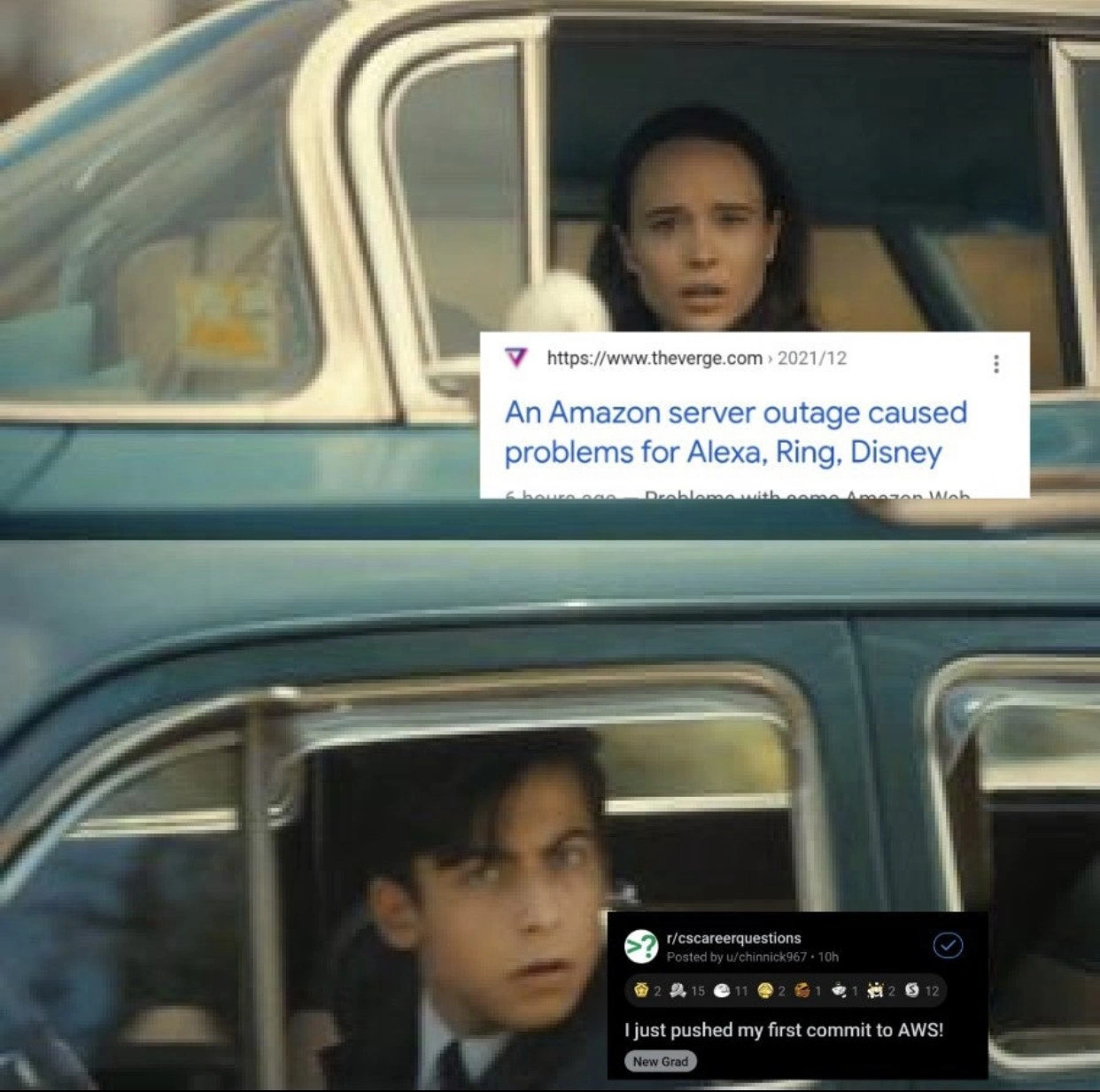
The format of the meme is a drive-by reaction image: basically, characters in a car reacting dramatically. In the top panel, a passenger (with a shocked face) is shown next to the news headline about the Amazon server outage. In the bottom panel, the other passenger (turning in alarm) is shown with the Reddit post text “I just pushed my first commit to AWS!” overlayed. The idea is that the people in the car (like the tech community or the on-call team) hear the news of the outage, then immediately look over at the eager new grad who proudly announces their deployment. The humor comes from that juxtaposition: the innocent enthusiasm of a newcomer against the backdrop of a serious outage. It’s the classic case of correlation being joked about as causation. In reality, AWS outages are usually due to internal issues at Amazon, not an external developer’s code. But it’s a very common joke in tech to immediately blame the latest change. In fact, one of the first troubleshooting steps for any outage is checking “what changed recently?” So if you were on a call and someone said “well, I did deploy something about 10 minutes ago…,” everyone’s gonna pounce on that as a lead. This meme exaggerates that dynamic to global proportions, which is why it’s both funny and a tiny bit stress-inducing for anyone who’s pressed that deploy button before.
In summary, it’s referencing AWS (big cloud provider), a production outage (system down), a deployment (releasing new code), and a new grad developer. It pokes fun at how, in tech culture, when something breaks, people half-jokingly ask “okay, whose code was it?!” – and the poor newbie is the comic foil this time. If you’re just starting out in software: don’t worry, your first commit probably won’t take down AWS! (And if by some cosmic fluke it does, well, you’ll have one legendary on-call humor story to share on Reddit... after the postmortem.)
Level 3: Who Deployed Last?
Every seasoned developer has lived this scenario: production is on fire and the first question muttered on the war-room call is “Alright, who deployed last?” The meme nails that instinct. It juxtaposes a real news headline about an AWS outage with a boastful Reddit post from a newly-minted engineer proudly announcing, “I just pushed my first commit to AWS!” This combination is comedy gold for anyone who’s been on OnCall duty. Why? Because it’s tapping into our shared deployment anxiety. The timing is hilariously perfect – the new grad’s triumphant moment coincides with Alexa and Disney+ going dark. The joke is that their first-ever code push caused the outage, as if a single rookie could send shockwaves through Amazon’s colossal infrastructure. Seasoned devs laugh because it’s an exaggeration of a very real fear. We’ve all felt that cold sweat after deploying: “Did my change just break something? Surely I didn’t take down an entire region… right?!” It’s a rite of passage in software engineering to wonder if you’re the one who “broke prod.”
This meme is essentially a blame game in action – a drive-by scapegoat. The image (characters in a teal vintage car looking shocked) perfectly captures that “Wait... YOU did what?!” moment. The passenger’s alarmed face in the top frame (with the outage news overlay) is every senior engineer reading about a major outage. The bottom frame’s wide-eyed front-seat guy, overlaid with the Reddit comment, represents the obliviously proud new grad. When seniors see a newbie brag “I deployed to production,” their immediate dark-humor reflex is “Oh, so you’re why everything’s on fire.” It’s tongue-in-cheek because nine times out of ten, the new person’s commit isn’t the real culprit — but culture often mythologizes these scenarios. The classic folklore is “the intern hit the big red button” or “the junior dev took down prod on day one.” This meme plays on that trope, with the “New Grad” flair making it clear we’re poking fun at how experienced folks sometimes (half-jokingly) point fingers at the greenhorn.
Yet beneath the humor lies a hint of trauma and truth. In real large-scale outages (like AWS us-east-1 incidents), root causes have included things like misconfigured capacity scaling, network overloads, or yes, even a developer’s mistake in a maintenance script (famously, a typo by an AWS engineer in 2017 knocked S3 out for hours). So the laugh comes with a wince — veteran engineers have seen single points of failure and human error topple giants. We joke about “production firefighting” and make memes to cope, but we also remember the sleepless nights, the Slack explosions, the scramble to rollback changes and restore services for millions of users. The meme’s scenario of a new grad causing a ProductionOutage is absurdly exaggerated yet relatable, because on day one with real access, every newcomer harbors that secret terror: “Please, please don’t let me be the one who breaks something big…” And every old-timer has at least one war story of a deployment gone wrong.
There’s also commentary here on DevOps culture and release practices. Ideally, no single commit (especially from a junior) should ever directly cause a massive outage — checks and balances like code review, automated tests, gradual rollouts, and blameless postmortems exist to prevent and learn from failures. But when push comes to shove, even Big Tech sometimes practices “deploy and pray.” 😅 The fact that a new grad even has the power to affect AWS production raises an eyebrow — implying either incredibly fast trust or a DevOps pipeline set to ludicrous speed. It’s part of why the meme resonates: the scenario is just barely plausible enough to tickle that part of your brain that’s seen outrageous failure chains. Seasoned devs see the r/cscareerquestions post (a subreddit where eager newbies often flex their early accomplishments) and can’t help but smirk: “Kid, maybe save the brag until we’re sure the site’s still up.” It’s a gentle roast of youthful exuberance and a nod to the cynical wisdom earned by pain: Never assume a deploy went well until some time (and monitoring) has passed. In other words, don’t be the one shouting “Ship it!” right before the whole thing sinks.
Level 4: Cascading Cloud Failure
At the most architectural level, this meme hints at the dark art of distributed systems and how a tiny change can trigger a cascading failure. Realize that AWS (Amazon Web Services) runs a constellation of services (compute, storage, databases, IoT, you name it) across multiple data centers. These are supposed to be redundant and fault-tolerant, but there are fundamental limits (think CAP theorem in action: balancing Consistency, Availability, and Partition tolerance). When a major AWS region has an outage (like the one referenced from December 2021 affecting Alexa and Ring), it’s often due to a chain reaction deep in the infrastructure. One misconfigured component (say a central network router or an overloaded cluster coordinator) can cause other services to timeout or fail in surprising ways. This is the nature of complex systems: lots of interdependent microservices mean a failure in one place can propagate globally. In theory, AWS has guardrails – canary deployments, automated rollback, circuit breakers – to catch bad changes. But in practice, even Amazon isn’t immune to Murphy’s Law. A small glitch (maybe as small as a single-line code commit or a routine config update) can spiral into full-blown downtime if it hits a critical choke point. There’s a whole field called Chaos Engineering devoted to studying this: intentionally introduce failures to ensure the whole system can survive. Yet, as any grizzled ops engineer will tell you, “chaos finds a way.” In academic terms, large-scale outages emerge from the unpredictable interactions of components (sometimes dubbed normal accident theory – in a system so complex, accidents are inevitable). In plain terms? The cloud is built on computers and code, and one benign-looking change can be the butterfly wing flap that causes a tornado. The meme jokingly posits that a new grad’s first commit was that butterfly. It’s an absurd proposition at face value – AWS is too massive for one newbie to single-handedly fell – yet it nods to the underlying truth of cloud reliability: even “small” changes can have outsized impact due to tight coupling and latent bugs. The humor gets a wry smile from veterans because it exaggerates a real paranoia: what if the innocuous code you just pushed wakes the sleeping dragon of a production outage? In a world where engineers worry about the one line of code that brings down millions of users, this meme hits on an almost philosophical note: did a butterfly flapping its wings (or a junior pushing code) set off a storm in the AWS ecosystem?
Description
The meme is split into two horizontal frames, both showing a teal vintage sedan viewed from the outside. Faces of the passengers are blurred. In the upper frame, a passenger in the rear seat is overlaid by a Google-style news snippet that reads: "https://www.theverge.com 2021/12 - An Amazon server outage caused problems for Alexa, Ring, Disney" with small grey text "6 hours ago" partially visible beneath. In the lower frame, the front-seat passenger is overlaid by a dark-mode Reddit post from r/cscareerquestions: "Posted by u/chinnick967 • 10h" followed by vote and comment icons, then the bold statement "I just pushed my first commit to AWS!" and a grey flair "New Grad". The juxtaposition jokes that the enthusiastic new graduate’s very first commit is responsible for the headline-worthy AWS outage, a familiar fear for engineers who deploy to production. This taps into deployment anxiety, on-call dread, and large-scale cloud reliability issues that senior devs regularly navigate
Comments
11Comment deleted
Congrats on your first AWS commit - turning all of us-east-1 into a single-fault domain is by far the quickest way to meet the CTO, the incident bridge, and six SREs you didn’t even know we had
The real AWS Well-Architected Framework principle nobody talks about: ensuring your deployment pipeline has a 'blame the intern' failover strategy for when us-east-1 inevitably catches fire again
Post-incident review conclusion: root cause was DNS; contributing factor was letting the new grad believe they have that kind of power
Ah yes, the classic 'git push origin main' on your first day that somehow takes down us-east-1 and half the internet with it. The real rite of passage isn't getting your AWS credentials - it's learning that your innocent terraform apply can cascade through three availability zones, sixteen microservices, and a Disney+ streaming event before anyone notices your variable was supposed to be a string, not a boolean. Welcome to the club, kid - we've all been there, except our outages only affected internal staging environments that nobody used anyway
Nothing says onboarding like discovering your first commit can exhaust the company’s error budget before the canary even flaps - this is why change freezes and rollbacks exist
Junior's terrified of their first AWS commit; seniors know it's the 'simple config tweak' on the 10,000th that blacks out half the internet
Nothing like a region-wide AWS incident to prove that “blast radius” isn’t just a Terraform variable
He's a hero Comment deleted
--> fuck fuck to produck Comment deleted
Please use English in this chat --- this rule also applies to stickers and other media Comment deleted
ok, mom ( Comment deleted